AQA · GCSE · Religious Studies
Course version: 8062 · Version from Sept 2018
Key Beliefs: The Dhamma (Dharma)
The Dhamma (or Dharma in Sanskrit) represents the universal truth about the nature of existence as realised and taught by the Buddha.
Checked against the AQA 8062 specification (opens in a new tab) on .
- Point 1 of 24
- 4 key terms
Study notes
From the checked teaching notes for this specification point.
The idea
The Dhamma (or Dharma in Sanskrit) represents the universal truth about the nature of existence as realised and taught by the Buddha. It is not merely a set of rules, but a practical path to enlightenment and the cessation of suffering. As the second of the Three Refuges, Buddhists 'take refuge' in the Dhamma to guide their daily lives. A concrete example of the Dhamma in practice is following the Noble Eightfold Path, which provides ethical and mental guidelines to overcome craving. Understanding the Dhamma allows Buddhists to see the world as it truly is, recognising concepts like impermanence (anicca) and the interconnectedness of all things, ultimately leading them towards Nibbana.
What earns the marks
- Defines Dhamma as the teachings of the Buddha and the universal truth of existence.
- Identifies Dhamma as the second of the Three Refuges (Three Jewels).
- Explains that the Dhamma provides a practical path to overcome suffering and achieve enlightenment.
- Connects the Dhamma to core Buddhist teachings such as the Four Noble Truths and the Noble Eightfold Path.
Common mistakes and how to put them right
Confusing the Buddhist concept of Dhamma with the Hindu concept of Dharma.
Put it right: Ensure Dhamma is explained as the Buddha's teachings and the truth of existence, rather than caste-based duty.
Describing the Dhamma merely as a holy book.
Put it right: Explain that while recorded in scriptures like the Pali Canon, Dhamma is a lived practice and universal truth, not just a text.
Stating that only monks can follow the Dhamma.
Put it right: Clarify that the Dhamma is a guide for all Buddhists, both laypeople and the monastic community (Sangha).
Exam tips
- Use the analogy of the Buddha as a doctor and the Dhamma as the medicine to explain its practical purpose in curing suffering.
- Always link the concept of Dhamma to the Three Refuges when discussing its importance to a Buddhist's daily life.
- Support your evaluation of the Dhamma's significance by comparing its importance to the Buddha and the Sangha in 12-mark questions.
Try the lesson
The start of the Key Beliefs: The Dhamma (Dharma) lesson, made from checked teaching notes for this specification point.
Have a go first
What does the term 'Dhamma' primarily refer to in Buddhism?
Listen
The Dhamma (or Dharma in Sanskrit) represents the universal truth about the nature of existence as realised and taught by the Buddha. It is not merely a set of rules, but a practical path to enlightenment and the cessation of suffering. As the second of the Three Refuges, Buddhists 'take refuge' in the Dhamma to guide their daily lives. A concrete example of the Dhamma in practice is following the Noble Eightfold Path, which provides ethical and mental guidelines to overcome craving. Understanding the Dhamma allows Buddhists to see the world as it truly is, recognising concepts like impermanence (anicca) and the interconnectedness of all things, ultimately leading them towards Nibbana. A strong answer earns marks for these points. Defines Dhamma as the teachings of the Buddha and the universal truth of existence. Identifies Dhamma as the second of the Three Refuges (Three Jewels). Explains that the Dhamma provides a practical path to overcome suffering and achieve enlightenment. Connects the Dhamma to core Buddhist teachings such as the Four Noble Truths and the Noble Eightfold Path. A common slip: Confusing the Buddhist concept of Dhamma with the Hindu concept of Dharma. Instead, Ensure Dhamma is explained as the Buddha's teachings and the truth of existence, rather than caste-based duty. Exam tip: Use the analogy of the Buddha as a doctor and the Dhamma as the medicine to explain its practical purpose in curing suffering.
See it
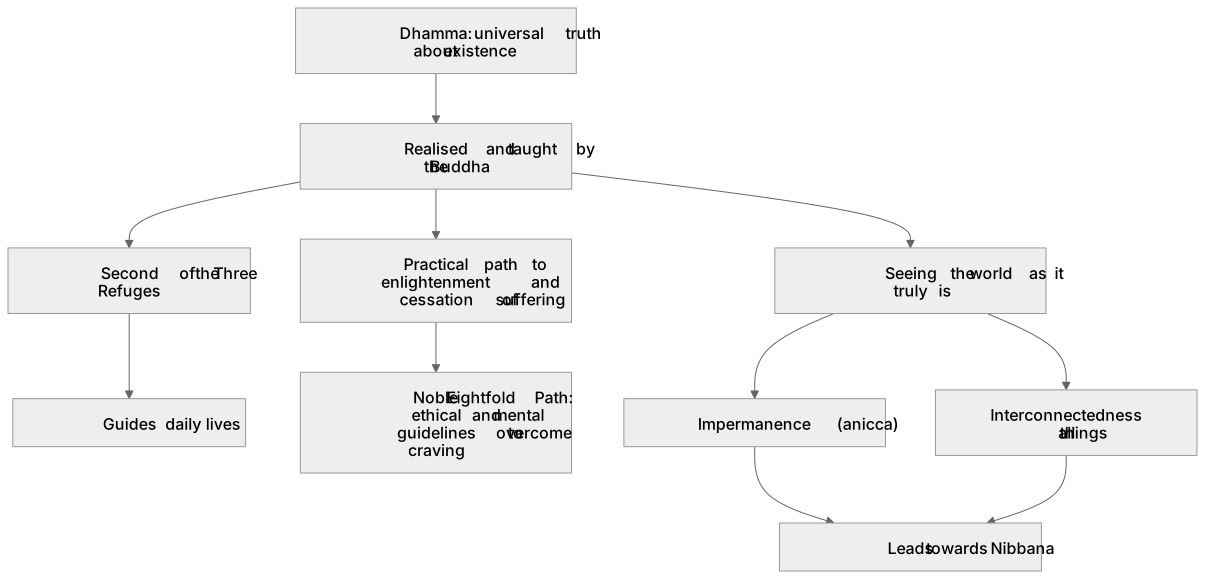
Key words
Say what each word means before you turn the card.
The Dhamma (Dharma)
Try answering aloud or in your head before turning the card.
The Three Refuges
Try answering aloud or in your head before turning the card.
Enlightenment and Nibbana
Try answering aloud or in your head before turning the card.
Buddhist Ethics and Practice
Try answering aloud or in your head before turning the card.
See every definition
- The Dhamma (Dharma)
- The universal truth about the nature of existence as realised and taught by the Buddha, and a practical path to enlightenment and the cessation of suffering.
- The Three Refuges
- Buddhists 'take refuge' in the Dhamma, the second of these, to guide their daily lives.
- Enlightenment and Nibbana
- The Dhamma is a practical path to enlightenment, and understanding it ultimately leads Buddhists towards Nibbana.
- Buddhist Ethics and Practice
- Following the Noble Eightfold Path is a concrete example of the Dhamma in practice, providing ethical and mental guidelines to overcome craving.
Label the diagram
Some boxes have lost their names. Pick the right name for each number.
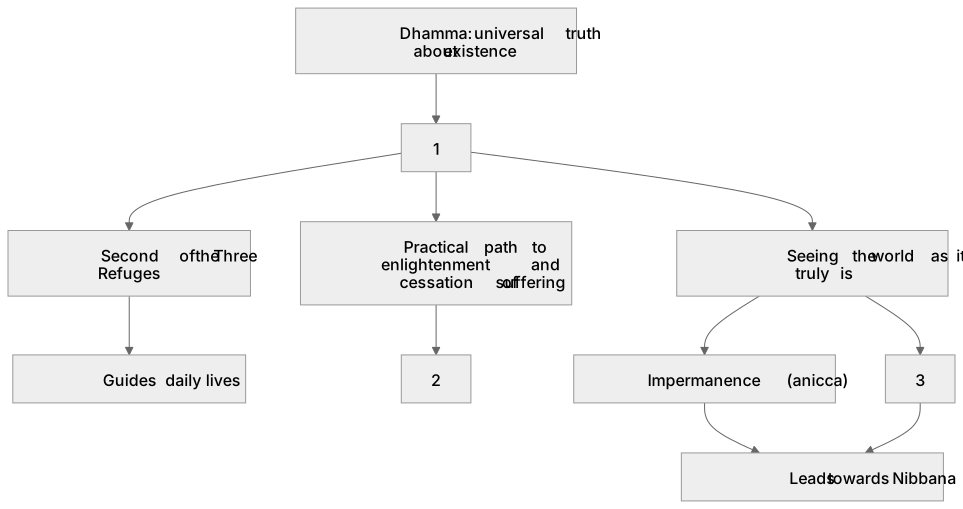
1Box 1
2Box 2
3Box 3
There is more to this lesson
The full lesson goes on to check your understanding and help you earn the marks. Create a free account to carry on, with your progress saved.
A week of Premium from your first lesson · Then the free plan continues · No card, no charge
Test your understanding of Key Beliefs: The Dhamma (Dharma)
Active recall beats re-reading. Take an instant quiz now to test what you’ve learned and lock it into long-term memory.
A week of Premium from your first lesson · Then the free plan continues · No card, no charge