AQA · GCSE · Religious Studies
Course version: 8062 · Version from Sept 2018
The end of craving (tanha), interpretations of nibbana (nirvana) and…
Full specification wording
Key Beliefs: the end of craving (tanha), interpretations of nibbana (nirvana) and Enlightenment
The Third Noble Truth teaches that suffering ceases when craving (tanha) is entirely uprooted.
Checked against the AQA 8062 specification (opens in a new tab) on .
- Point 23 of 24
Study notes
From the checked teaching notes for this specification point.
The idea
The Third Noble Truth teaches that suffering ceases when craving (tanha) is entirely uprooted. This cessation is known as nibbana (nirvana), which literally translates to 'blowing out' or 'extinguishing', referring to the extinguishing of the three poisons: greed, hatred, and ignorance. Interpretations of nibbana vary; some view it as a profound state of profound peace and liberation achieved during life, as the Buddha experienced under the peepal tree. Others interpret it as a reality beyond human comprehension, or the state entered after death (parinirvana) where the cycle of samsara is finally broken. Enlightenment is the deep spiritual awakening and profound understanding of the true nature of reality, which directly leads to the experience of nibbana.
What earns the marks
- Explain that ending tanha (craving) is the Third Noble Truth (Nirodha) and the direct cause of ending suffering (dukkha).
- Define nibbana as the 'blowing out' of the three poisons (greed, hatred, and ignorance).
- Contrast interpretations of nibbana: a state of profound peace achieved in this life versus the final escape from samsara after death (parinirvana).
- Describe Enlightenment as the awakening to the true nature of reality, enabling a Buddhist to achieve nibbana.
Common mistakes and how to put them right
Confusing nibbana with a physical place like a Christian heaven.
Put it right by explaining it is a state of being or liberation from samsara.
Using tanha to mean suffering.
Put it right by defining tanha as craving or desire, which is the root cause of suffering (dukkha).
Treating Enlightenment and nibbana as completely unrelated concepts.
Put it right by showing Enlightenment is the awakening that allows one to experience nibbana.
Exam tips
- Use the literal translation of nibbana ('blowing out') to explain the extinguishing of the three poisons.
- When evaluating interpretations of nibbana, contrast the experience of a living enlightened being with the final release after death.
- Always link the end of craving (tanha) directly to the cessation of suffering (dukkha) to demonstrate understanding of the Four Noble Truths.
Try the lesson
The start of the Key Beliefs: the end of craving (tanha), interpretations of nibbana (nirvana) and Enlightenment lesson, made from checked teaching notes for this specification point.
Have a go first
What is the Buddhist term for the craving that must end to achieve Enlightenment?
Listen
The Third Noble Truth teaches that suffering ceases when craving (tanha) is entirely uprooted. This cessation is known as nibbana (nirvana), which literally translates to 'blowing out' or 'extinguishing', referring to the extinguishing of the three poisons: greed, hatred, and ignorance. Interpretations of nibbana vary; some view it as a profound state of profound peace and liberation achieved during life, as the Buddha experienced under the peepal tree. Others interpret it as a reality beyond human comprehension, or the state entered after death (parinirvana) where the cycle of samsara is finally broken. Enlightenment is the deep spiritual awakening and profound understanding of the true nature of reality, which directly leads to the experience of nibbana. A strong answer earns marks for these points. Explain that ending tanha (craving) is the Third Noble Truth (Nirodha) and the direct cause of ending suffering (dukkha). Define nibbana as the 'blowing out' of the three poisons (greed, hatred, and ignorance). Contrast interpretations of nibbana: a state of profound peace achieved in this life versus the final escape from samsara after death (parinirvana). Describe Enlightenment as the awakening to the true nature of reality, enabling a Buddhist to achieve nibbana. A common slip: Confusing nibbana with a physical place like a Christian heaven. Instead, explaining it is a state of being or liberation from samsara. Exam tip: Use the literal translation of nibbana ('blowing out') to explain the extinguishing of the three poisons.
See it
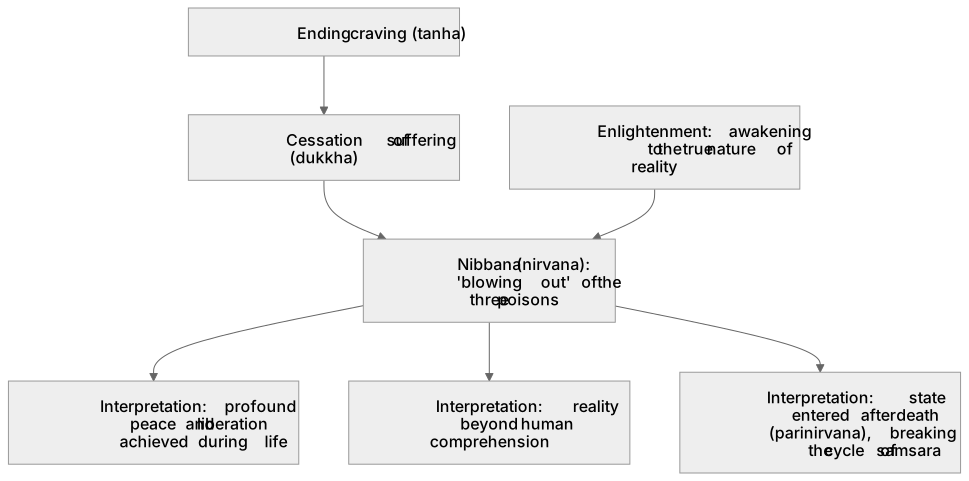
Label the diagram
Some boxes have lost their names. Pick the right name for each number.
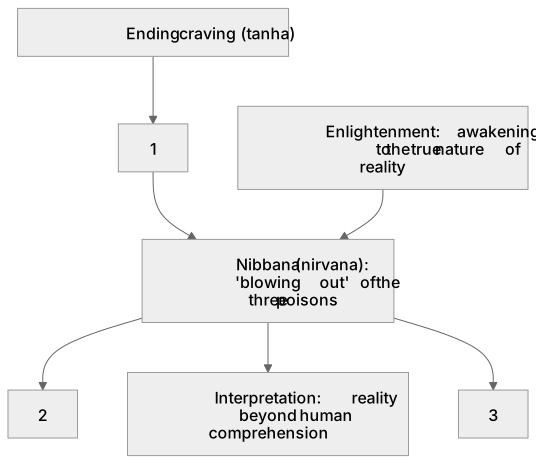
1Box 1
2Box 2
3Box 3
There is more to this lesson
The full lesson goes on to check your understanding and help you earn the marks. Create a free account to carry on, with your progress saved.
A week of Premium from your first lesson · Then the free plan continues · No card, no charge
Test your understanding of Key Beliefs: the end of craving (tanha), interpretations of nibbana (nirvana) and Enlightenment
Active recall beats re-reading. Take an instant quiz now to test what you’ve learned and lock it into long-term memory.
A week of Premium from your first lesson · Then the free plan continues · No card, no charge