AQA · GCSE · Religious Studies
Course version: 8062 · Version from Sept 2018
Students should consider different beliefs and attitudes to religious and…
Full specification wording
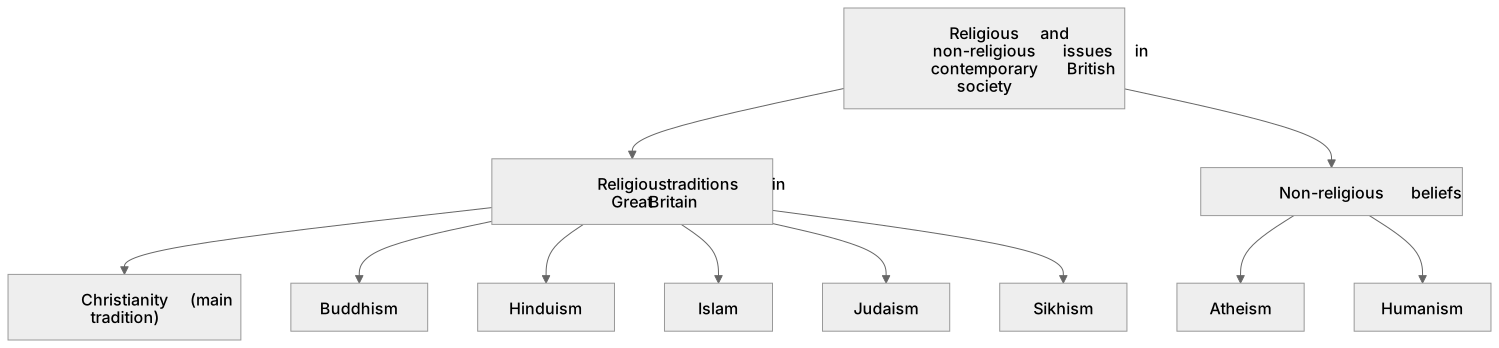
Subject content: Students should consider different beliefs and attitudes to religious and non-religious issues in contemporary British society. They should be aware that the religious traditions of Great Britain are, in the main, Christian, and that religious traditions in Great Britain are diverse. They include Christianity, Buddhism, Hinduism, Islam, Judaism and Sikhism, as well as other religious and non- religious beliefs such as atheism and humanism. This knowledge may be applied throughout the assessment of the subject content.
This diversity encompasses Christianity, Buddhism, Hinduism, Islam, Judaism, and Sikhism, alongside non-religious worldviews like atheism and humanism.
Checked against the AQA 8062 specification (opens in a new tab) on .
- 4 key terms
Study notes
From the checked teaching notes for this specification point.
The idea
This diversity encompasses Christianity, Buddhism, Hinduism, Islam, Judaism, and Sikhism, alongside non-religious worldviews like atheism and humanism. For instance, when discussing medical ethics, candidates should contrast a traditional Christian viewpoint with a secular humanist approach. This broad understanding of Britain's diverse landscape must be applied across all exam answers to demonstrate comprehensive religious literacy and meet assessment requirements.
What earns the marks
- Acknowledge Christianity as the main religious tradition in Great Britain.
- Identify and explain the diverse religious landscape, including Buddhism, Hinduism, Islam, Judaism, and Sikhism.
- Contrast religious views with non-religious beliefs, specifically atheism and humanism, on contemporary issues.
- Apply knowledge of this diverse British context to evaluate ethical and philosophical themes across the entire assessment.
Common mistakes and how to put them right
Stating that Britain is an entirely secular country without acknowledging its Christian heritage.
Put it right: Explicitly recognise that the main religious tradition of Great Britain is Christian, despite growing diversity.
Ignoring non-religious perspectives in thematic essays.
Put it right: Include views from atheism or humanism when evaluating contemporary issues to show a balanced understanding.
Confusing atheism with humanism.
Put it right: Define atheism as the lack of belief in God, and humanism as a specific ethical life stance based on reason and humanity without religion.
Exam tips
- When evaluating a statement in a 12-mark question, explicitly contrast a Christian perspective with a non-religious view like humanism.
- Use the phrase 'in contemporary British society' to contextualise your answers, showing awareness of modern diversity.
- Ensure you can name and briefly explain the stance of at least one minority religion in the UK to demonstrate breadth of knowledge.
Try the lesson
The start of the Subject content: Students should consider different beliefs and attitudes to religious and non-religious issues in contemporary British society. They should be aware that the religious traditions of Great Britain are, in the main, Christian, and that religious traditions in Great Britain are diverse. They include Christianity, Buddhism, Hinduism, Islam, Judaism and Sikhism, as well as other religious and non- religious beliefs such as atheism and humanism. This knowledge may be applied throughout the assessment of the subject content. lesson, made from checked teaching notes for this specification point.
Have a go first
Which religion is historically and currently recognised as the main religious tradition in Great Britain?
Listen
This diversity encompasses Christianity, Buddhism, Hinduism, Islam, Judaism, and Sikhism, alongside non-religious worldviews like atheism and humanism. For instance, when discussing medical ethics, candidates should contrast a traditional Christian viewpoint with a secular humanist approach. This broad understanding of Britain's diverse landscape must be applied across all exam answers to demonstrate comprehensive religious literacy and meet assessment requirements. A strong answer earns marks for these points. Acknowledge Christianity as the main religious tradition in Great Britain. Identify and explain the diverse religious landscape, including Buddhism, Hinduism, Islam, Judaism, and Sikhism. Contrast religious views with non-religious beliefs, specifically atheism and humanism, on contemporary issues. Apply knowledge of this diverse British context to evaluate ethical and philosophical themes across the entire assessment. A common slip: Stating that Britain is an entirely secular country without acknowledging its Christian heritage. Instead, Explicitly recognise that the main religious tradition of Great Britain is Christian, despite growing diversity. Exam tip: When evaluating a statement in a 12-mark question, explicitly contrast a Christian perspective with a non-religious view like humanism.
See it
Key words
Say what each word means before you turn the card.
Christian heritage
Try answering aloud or in your head before turning the card.
Atheism
Try answering aloud or in your head before turning the card.
Humanism
Try answering aloud or in your head before turning the card.
Contemporary British society
Try answering aloud or in your head before turning the card.
See every definition
- Christian heritage
- The religious tradition of Great Britain is, in the main, Christian, despite growing diversity.
- Atheism
- A non-religious belief, defined as the lack of belief in God.
- Humanism
- A non-religious belief, defined as a specific ethical life stance based on reason and humanity without religion.
- Contemporary British society
- The modern society in which students consider different beliefs and attitudes to religious and non-religious issues.
Label the diagram
Some boxes have lost their names. Pick the right name for each number.
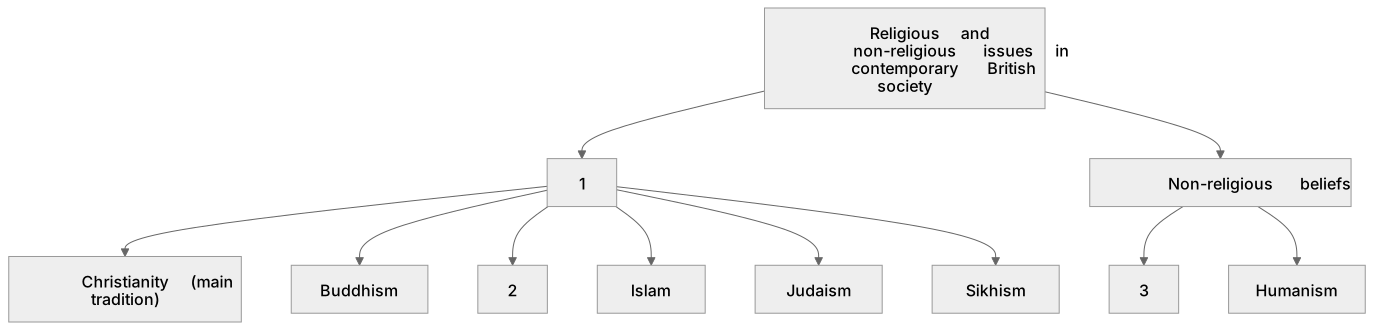
1Box 1
2Box 2
3Box 3
There is more to this lesson
The full lesson goes on to check your understanding and help you earn the marks. Create a free account to carry on, with your progress saved.
A week of Premium from your first lesson · Then the free plan continues · No card, no charge
Test your understanding of Subject content: Students should consider different beliefs and attitudes to religious and non-religious issues in contemporary British society. They should be aware that the religious traditions of Great Britain are, in the main, Christian, and that religious traditions in Great Britain are diverse. They include Christianity, Buddhism, Hinduism, Islam, Judaism and Sikhism, as well as other religious and non- religious beliefs such as atheism and humanism. This knowledge may be applied throughout the assessment of the subject content.
Active recall beats re-reading. Take an instant quiz now to test what you’ve learned and lock it into long-term memory.
A week of Premium from your first lesson · Then the free plan continues · No card, no charge