AQA · A-Level · Sociology
Course version: 7192 · Version from Sept 2015
Theory and Methods
Master the foundational theories and research methods of sociology. This guide covers the essential debates between positivism and interpretivism, the core theoretical perspectives, and how sociologists collect data, providing you with the analytical tools needed to excel in your GCSE exam.
- 4 min read
- 3 worked examples
- 1 practice question
- 6 key terms
Check what you remember
Read the wording for your board, then hide it and explain Positivism in your own words. Rough notes are fine. This is a self-check, with no mark or grade.
Reference: AQA
The view that sociology can and should use the methods of the natural sciences to discover objective laws of human behavior.
Study Notes
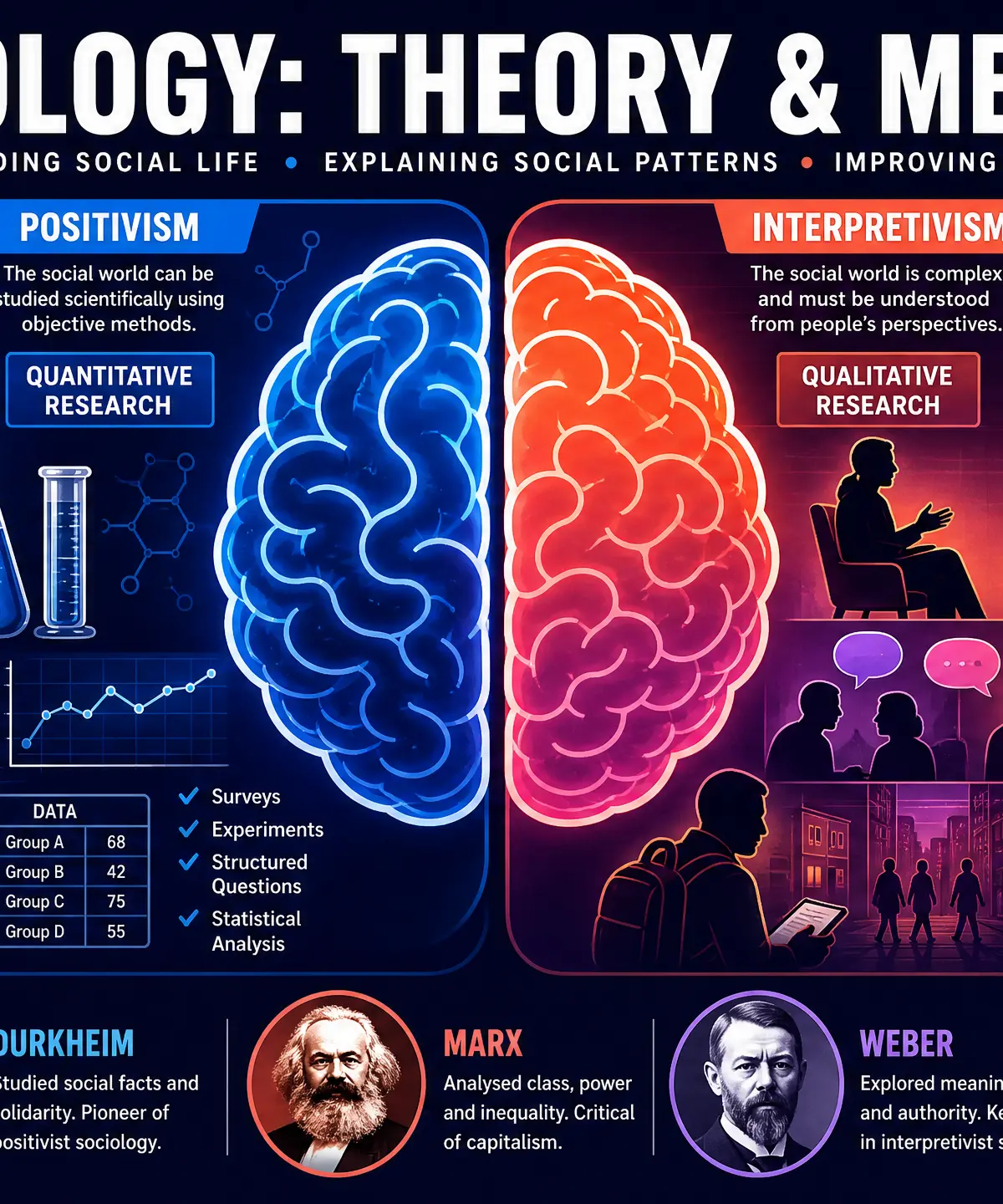
Overview
This topic is the backbone of GCSE Sociology. It covers the theoretical and methodological foundations of the discipline, exploring how sociologists investigate the social world and the different lenses through which they interpret it. Examiners expect candidates to not only describe various research methods and theories but to critically evaluate them. You must understand the debates surrounding the scientific status of sociology, the role of values in research, and how theoretical perspectives like Marxism and Functionalism view the relationship between sociology and social policy. Mastering this section is crucial, as theory and methods are often integrated into questions across all other sociological topics.
Key Theoretical Perspectives
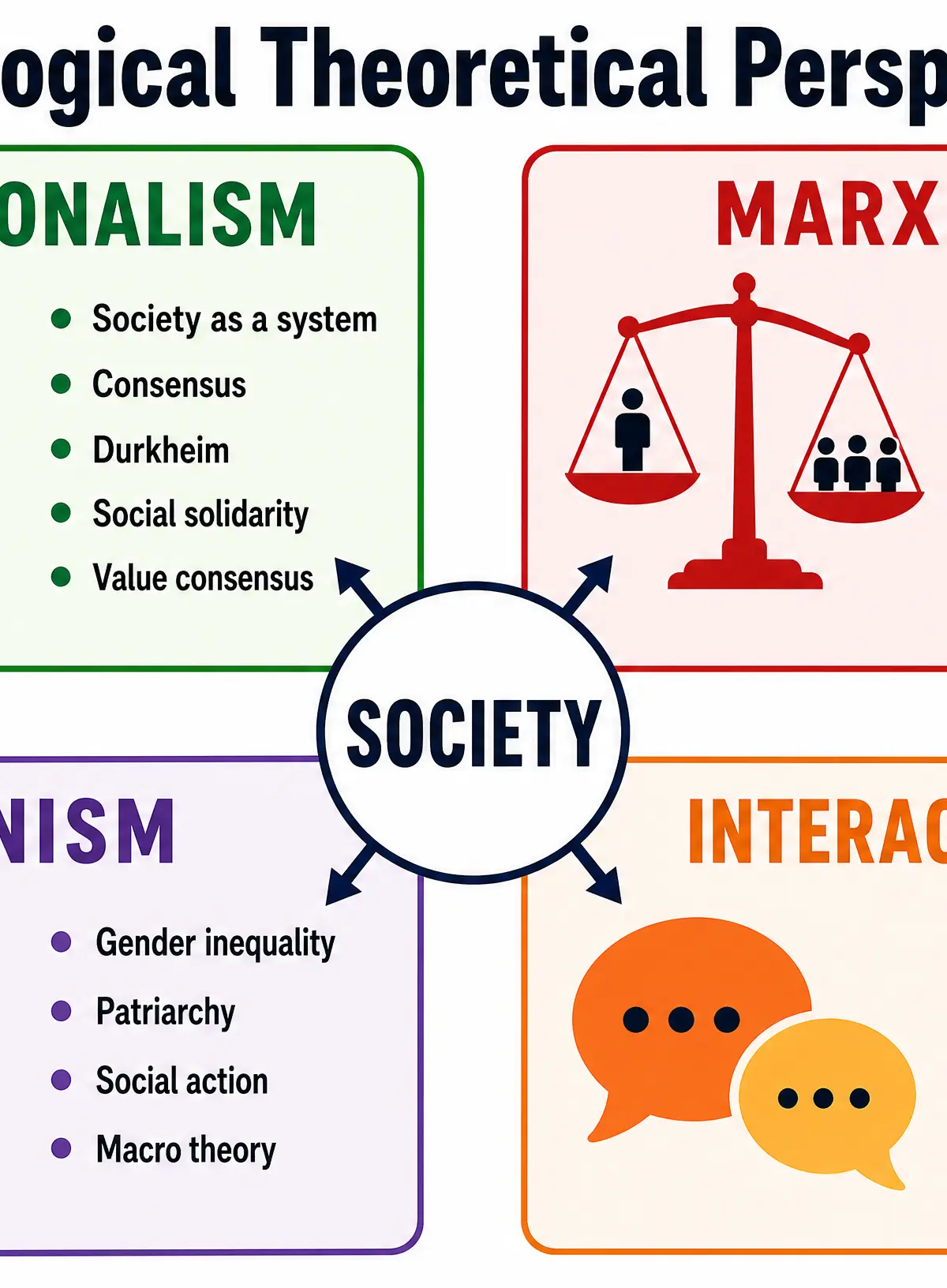
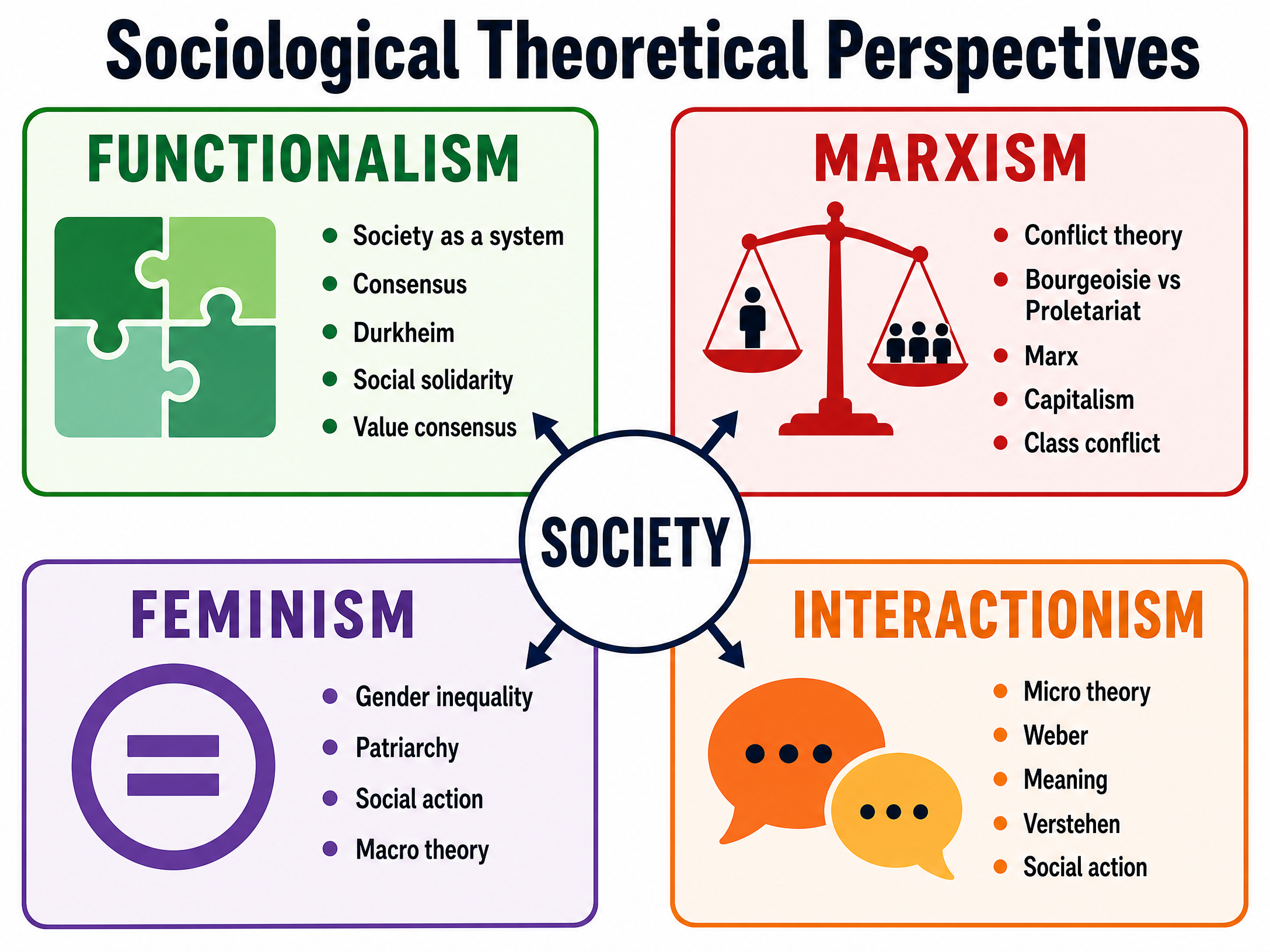
Functionalism
Key Thinker: Emile Durkheim
Core Ideas: Society is viewed as a complex system whose parts work together to promote solidarity and stability (organic analogy). It is a consensus theory that emphasizes shared norms and values (value consensus).
Exam Relevance: Use Functionalism to explain how institutions (like education or family) maintain social order. Contrast it with conflict theories.
Marxism
Key Thinker: Karl Marx
Core Ideas: A structural conflict theory arguing that society is divided into two main classes: the bourgeoisie (ruling class) and the proletariat (working class). It focuses on capitalism, exploitation, and class conflict.
Exam Relevance: Apply Marxism to evaluate how social policies or institutions often serve the interests of the powerful and maintain inequality.
Feminism
Core Ideas: A conflict theory focusing on gender inequality and patriarchy. It argues that society is structured to benefit men at the expense of women. Includes various strands (Liberal, Radical, Marxist).
Exam Relevance: Use to critique mainstream sociology for being 'malestream' and to analyze gender disparities in areas like family roles or crime.
Interactionism (Social Action Theory)
Key Thinker: Max Weber
Core Ideas: A micro-level approach focusing on small-scale interactions. It emphasizes Verstehen (empathetic understanding) and how individuals attach meaning to their actions.
Exam Relevance: Contrast with structural theories. Useful when discussing the importance of qualitative methods in uncovering subjective meanings.
Research Methods
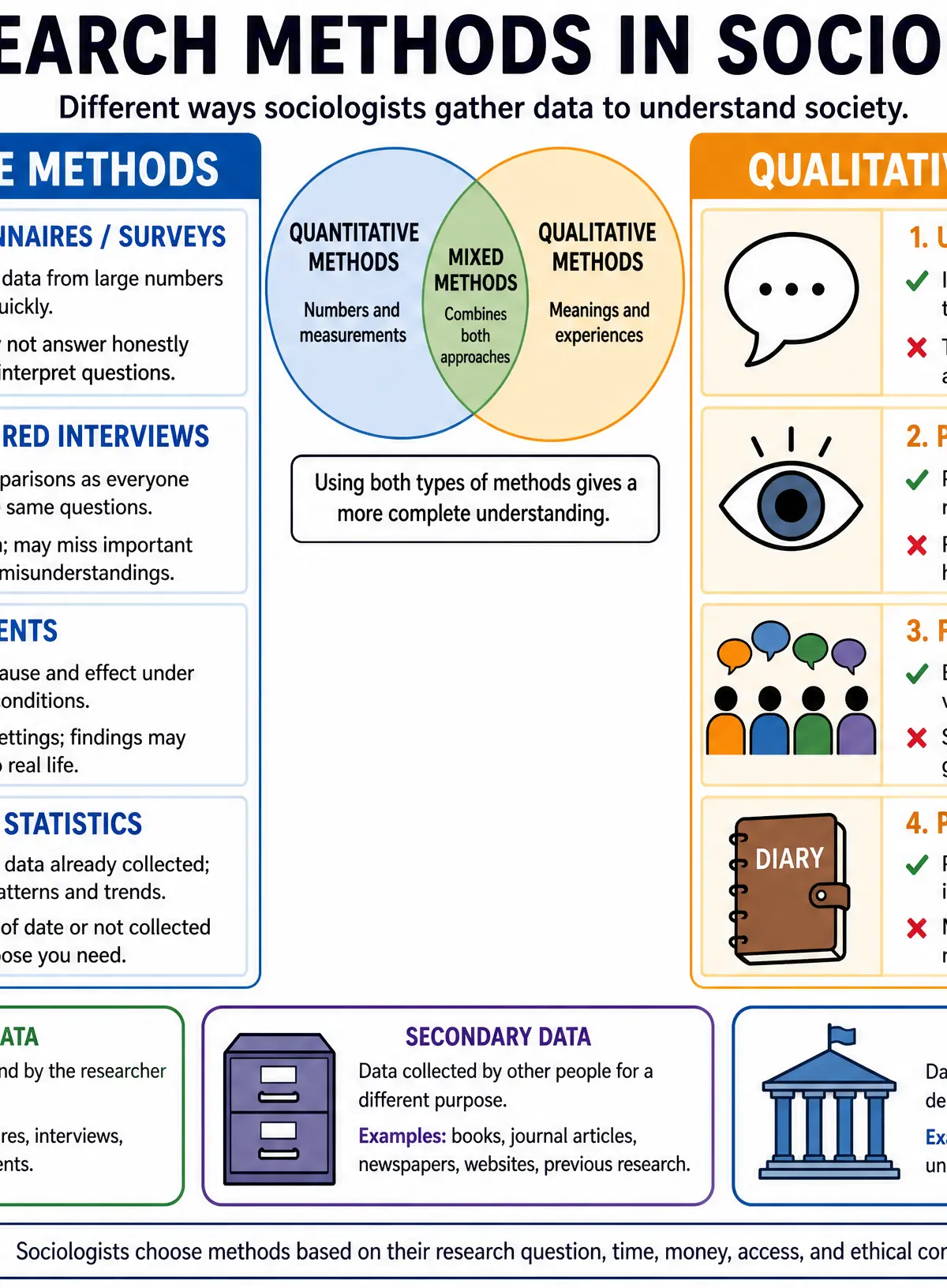
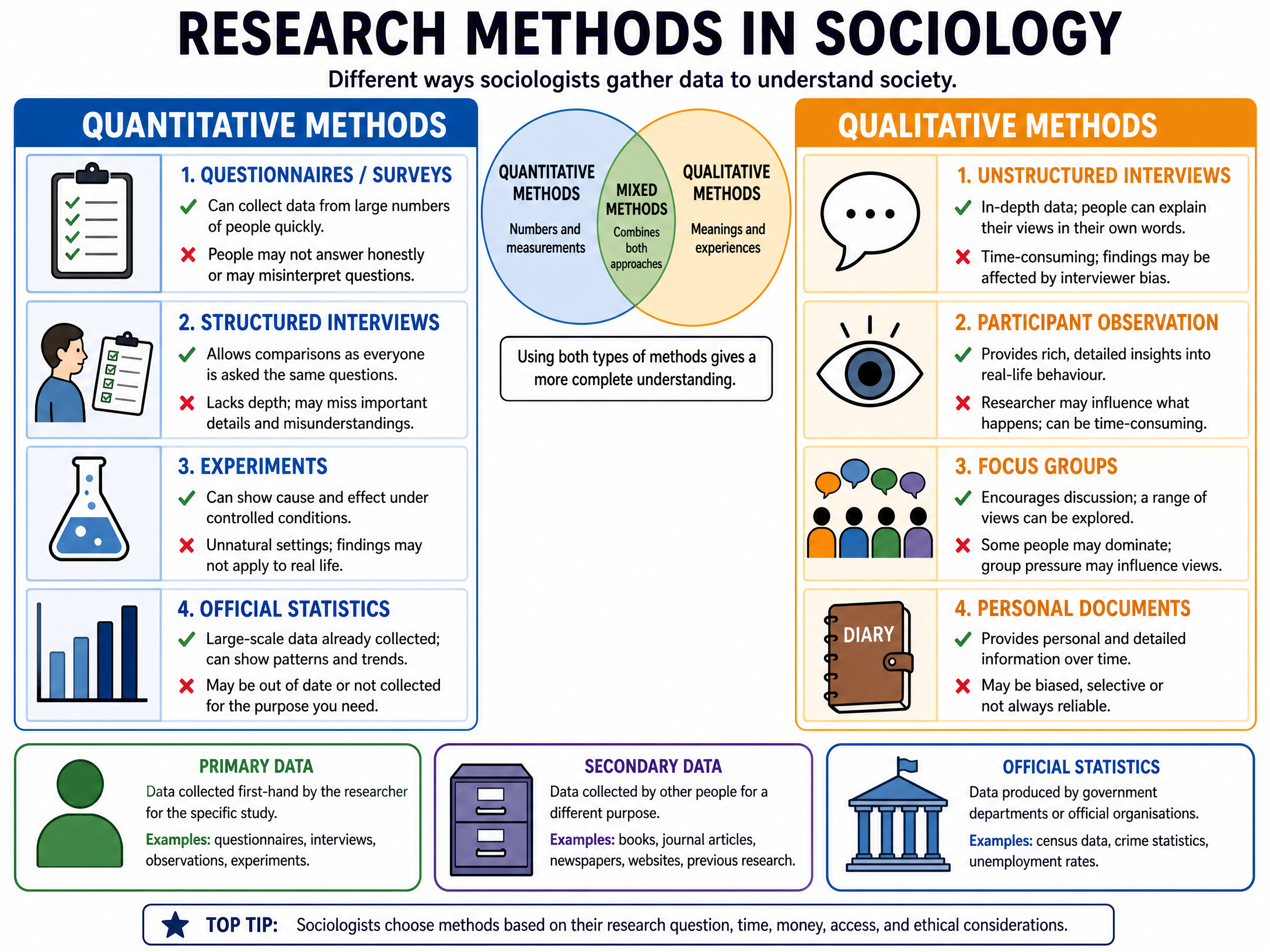
Quantitative vs. Qualitative Data
- Quantitative: Numerical data (e.g., statistics, percentages). Favored by positivists for identifying trends and patterns.
- Qualitative: Descriptive data focusing on meanings and experiences (e.g., interview transcripts). Favored by interpretivists for achieving depth and validity.
Primary vs. Secondary Sources
- Primary: Data collected first-hand by the researcher (e.g., questionnaires, observations).
- Secondary: Existing data collected by others (e.g., official statistics, historical documents).
The Science Debate
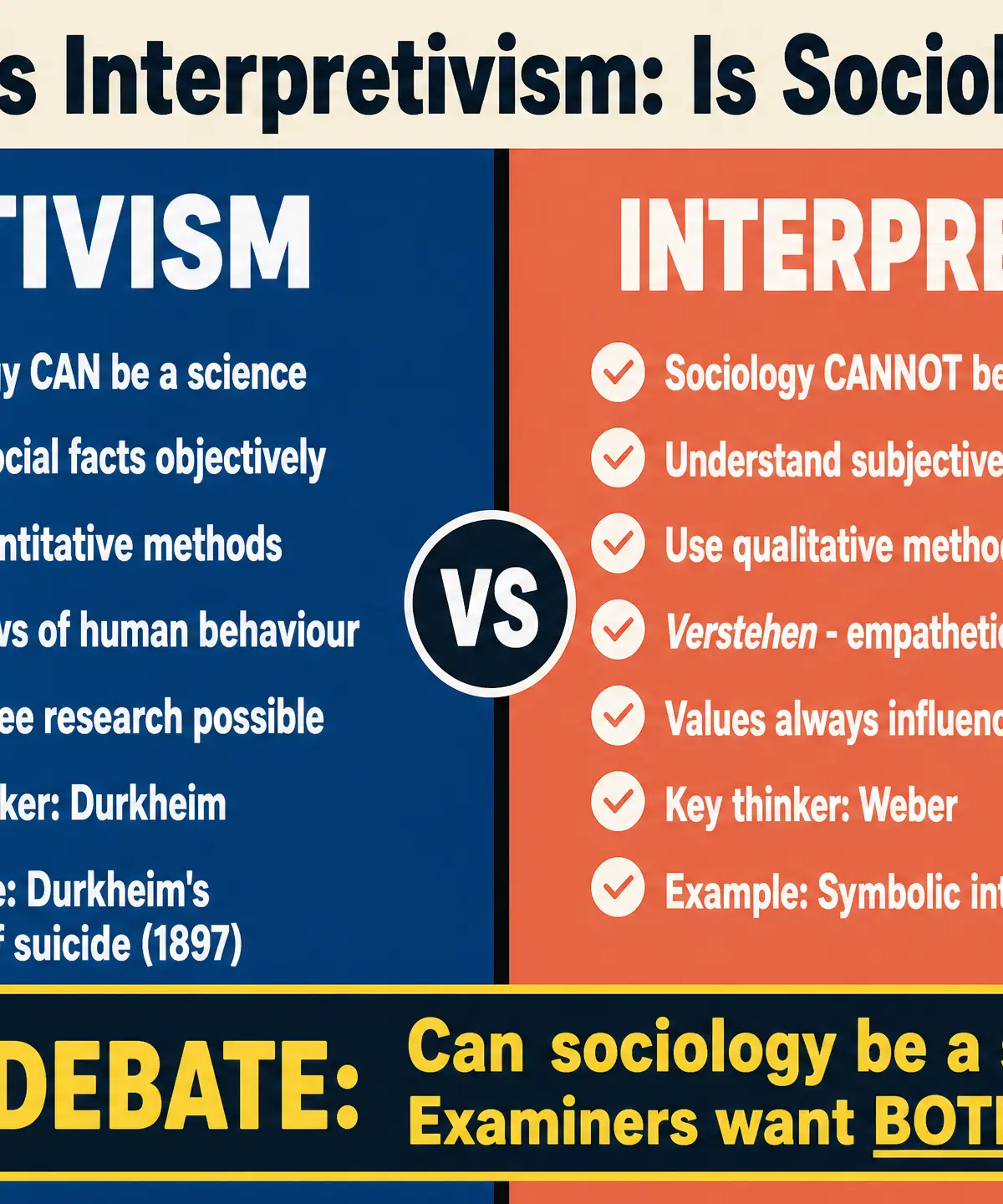
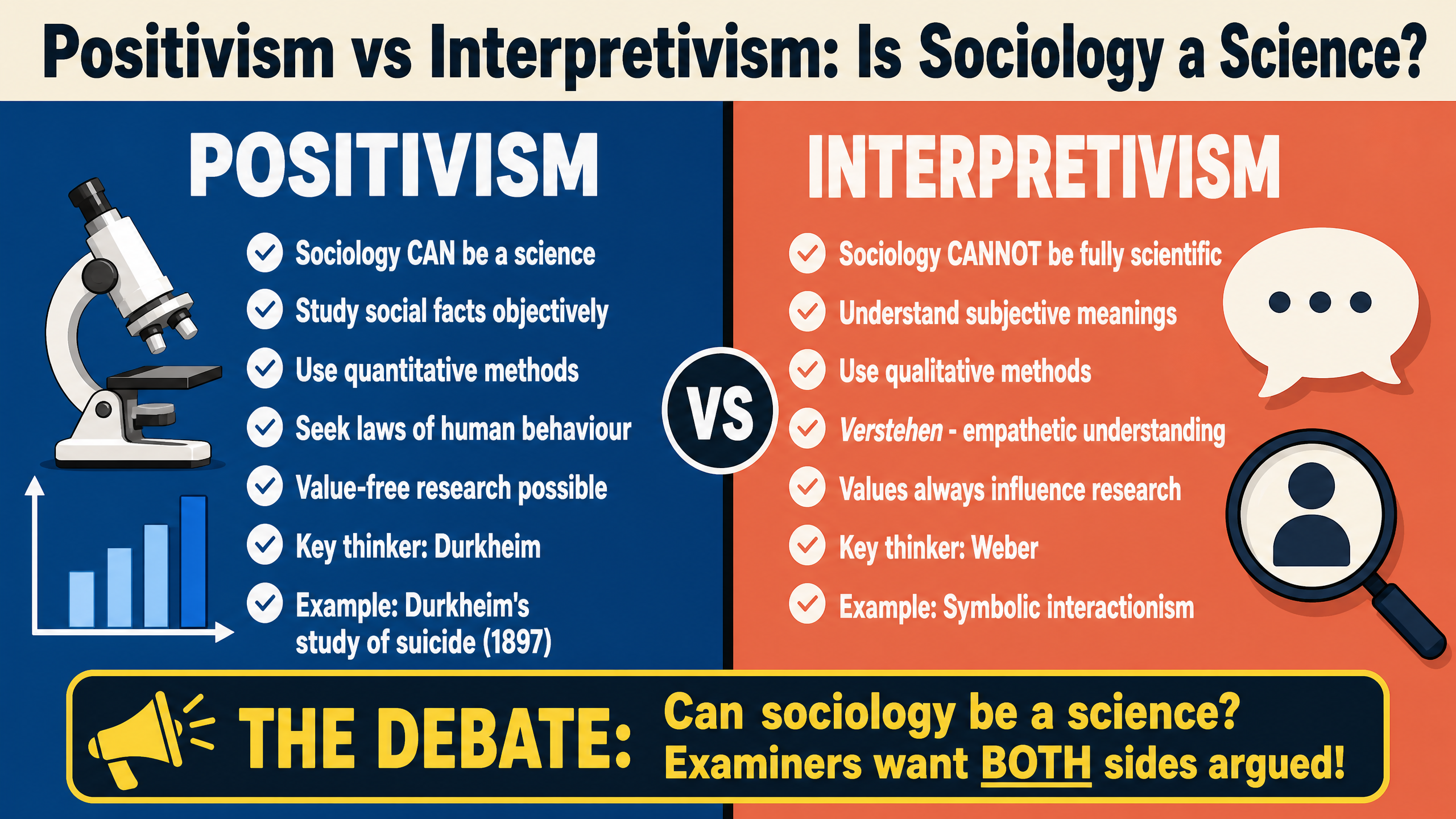
Positivism
Positivists argue that sociology can and should be a science. They believe society is governed by objective 'social facts' that can be measured using quantitative methods, similar to natural sciences. Durkheim's 1897 study of suicide is the classic example, using official statistics to find patterns.
Interpretivism
Interpretivists argue that sociology cannot be a science because humans, unlike matter, have consciousness and attach meaning to their actions. They advocate for qualitative methods to achieve Verstehen. They argue that research is inevitably influenced by the researcher's values.
Audio Revision
Listen to our comprehensive 10-minute podcast covering all these topics, complete with examiner tips and a quick-fire quiz!
Visual Resources
3 diagrams and illustrations
Interactive Diagrams
1 interactive diagram to visualise key concepts
Conceptual Flow Outline
Classification of Sociological Data
Worked Examples
3 worked examples — open one to explore the question and available guidance.
Practice Questions
Try the question, then reveal an answer plan or example response
Discuss how far sociologists agree that official statistics are a useful source of data. (12 marks)
Hint: Contrast the positivist view (practicality, reliability) with the interpretivist/Marxist view (lack of validity, political bias).
Exam technique
How to turn what you know into marks
How to approach the question
Always identify the command word first. If it says 'Evaluate' or 'Discuss how far', you MUST provide a balanced argument with a conclusion.
How to structure your answer
- Essay questions
- Intro defining key terms -> Argument FOR -> Argument AGAINST -> Evaluative Conclusion.
- Source questions
- Apply the source explicitly. Quote from it or reference the data, then explain it using your sociological knowledge.
- Explain questions
- Use PEEL: Point, Evidence (sociological study/concept), Explanation, Link back to the question.
Timing
Approximately 1 minute per mark. Spend 12-15 minutes on a 12-mark essay question.
Common pitfalls
- Confusing 'primary data' (who collected it) with 'qualitative data' (what type of data it is).
- Listing advantages/disadvantages without explaining *why* they matter.
- Forgetting to include a conclusion on 12-mark 'Discuss' questions.
What the command words want
- Explain
- State the point and develop it with reasons or examples.
- Evaluate
- Look at strengths and weaknesses, or arguments for and against, before reaching a judgement.
- Identify
- Simply state the point (1 mark).
Watch or listen (optional)
Test your understanding of Theory and Methods
Active recall beats re-reading. Take an instant quiz now to test what you’ve learned and lock it into long-term memory.
7 days Premium · Then the free plan continues · No card, no charge