AQA · A-Level · Sociology
Course version: 7192 · Version from Sept 2015
Work, Poverty and Welfare
This crucial GCSE Sociology topic examines the existence of poverty in contemporary society, the distribution of wealth, and how work is organised. It challenges you to look critically at everyday life and understand the structural forces that shape our life chances.
- 5 min read
- 3 worked examples
- 5 practice questions
- 6 key terms
Check what you remember
Read the wording for your board, then hide it and explain Absolute Poverty in your own words. Rough notes are fine. This is a self-check, with no mark or grade.
Reference: AQA
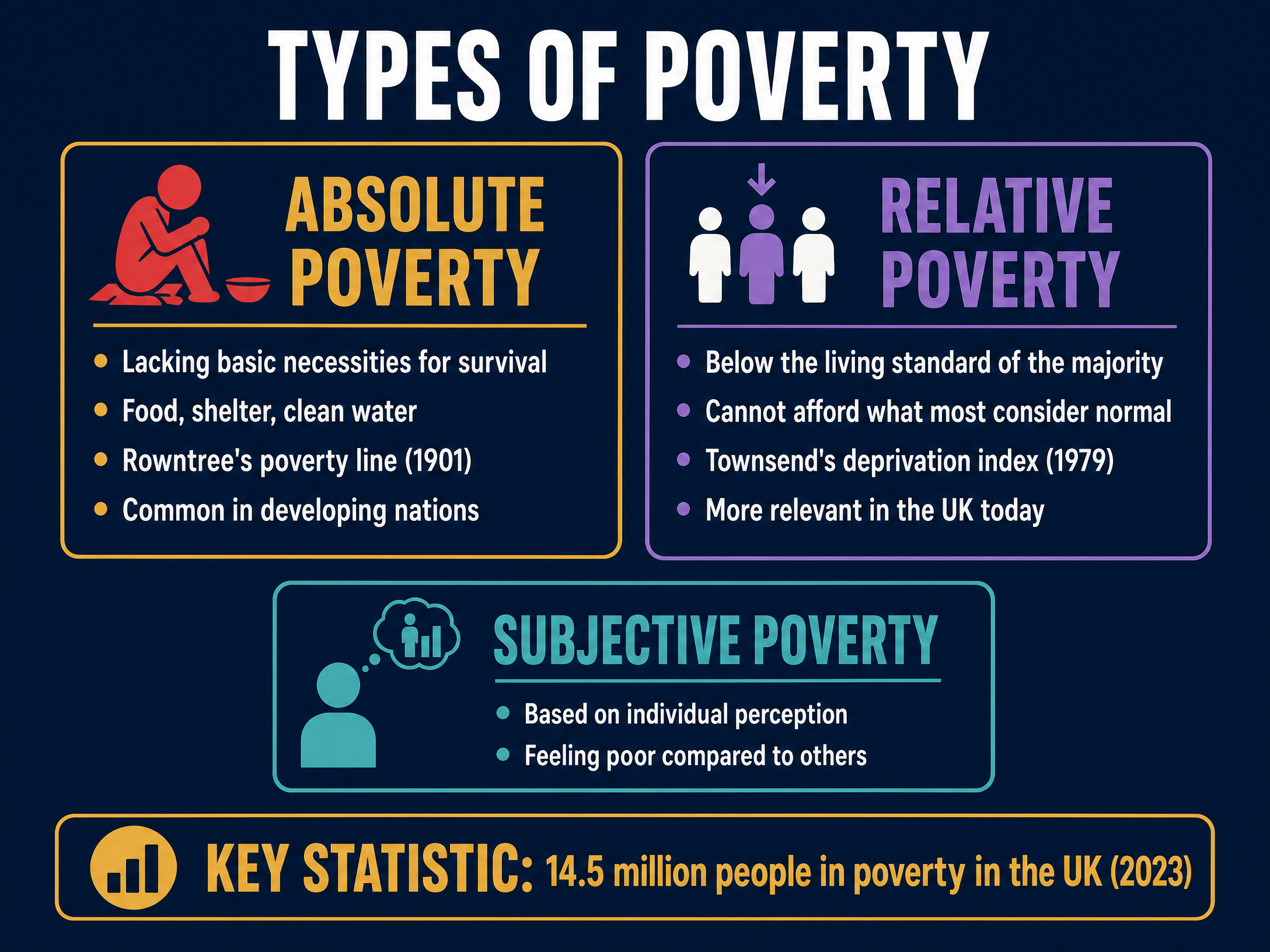
Lacking the basic physical necessities for survival, such as food, clean water, and shelter.
Study Notes
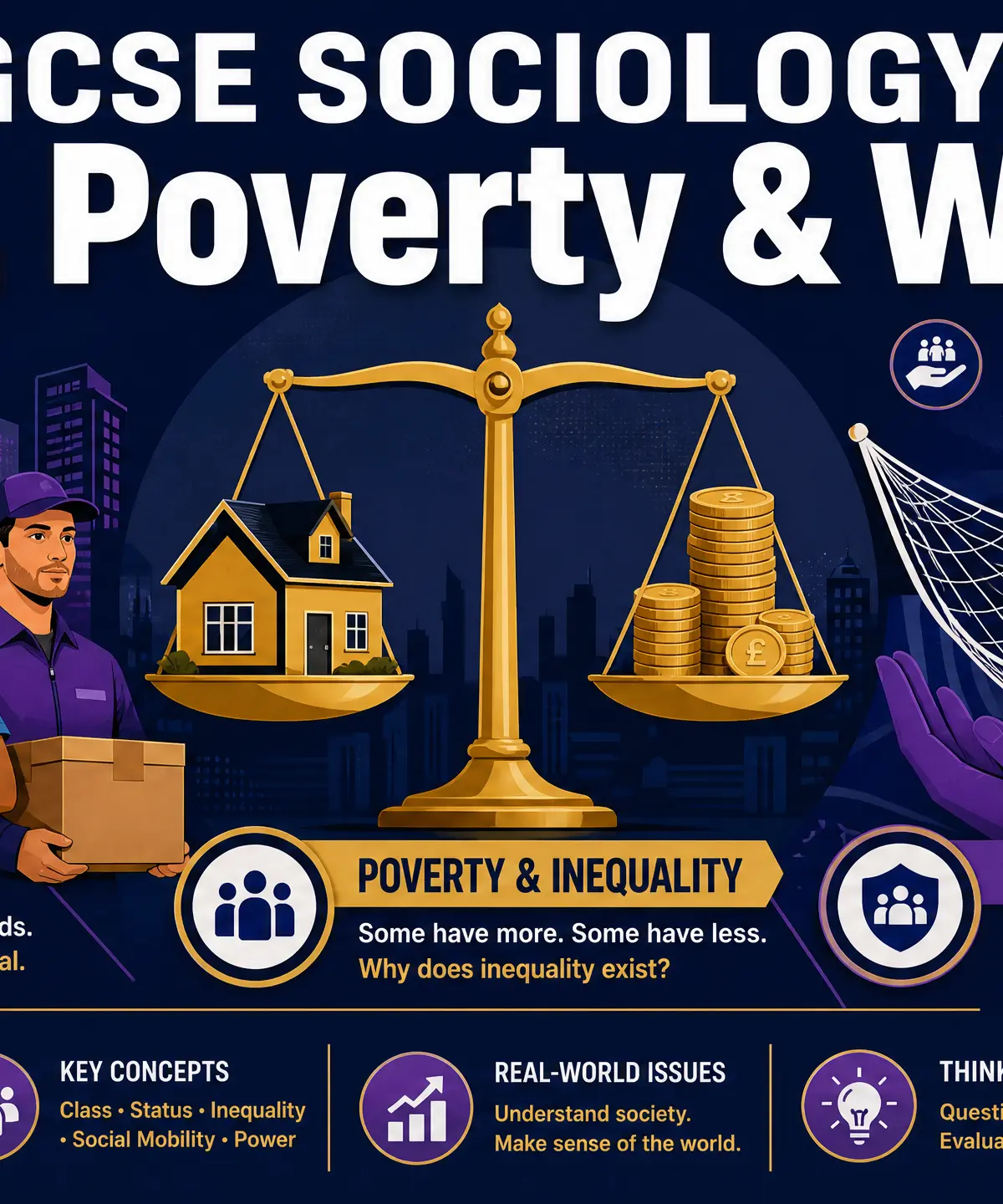
Overview
The study of Work, Poverty and Welfare is a cornerstone of GCSE Sociology. It asks fundamental questions about inequality in modern Britain: Why are some people rich while others struggle to survive? Is poverty the fault of the individual, or is it a structural feature of society? How does the work we do shape our identity and our life chances? Examiners expect candidates to move beyond common-sense assumptions and apply sociological perspectives (Functionalist, Marxist, Feminist, New Right) to these issues. You will need to understand how the labour process has changed over time, the impact of globalisation and technology on employment, and the ongoing debates about the purpose and effectiveness of the welfare state. Crucially, you must be able to link this topic to the core themes of social differentiation, power, and stratification.
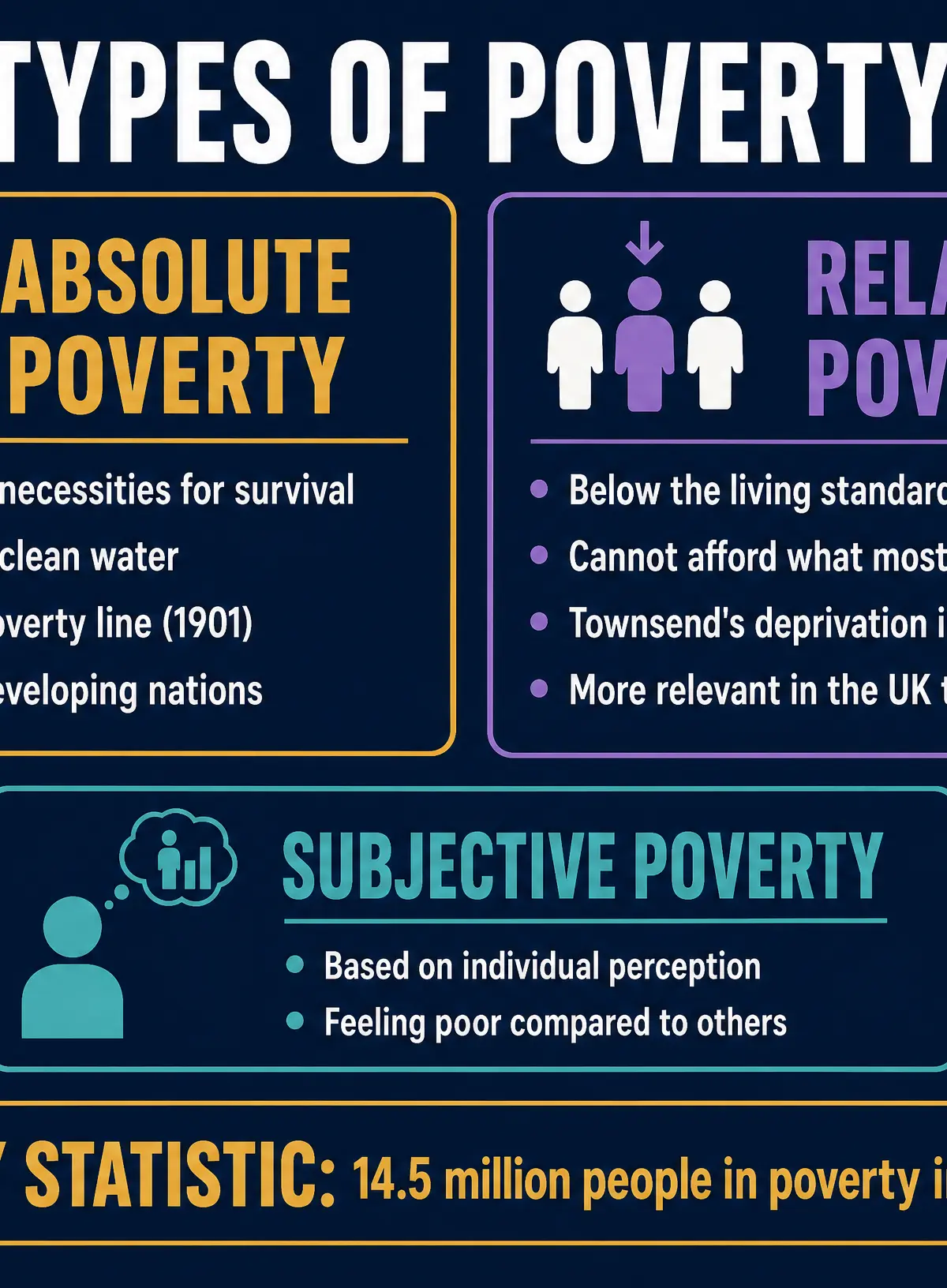
The Nature of Poverty
Absolute Poverty
Definition: Lacking the basic physical necessities for survival (food, shelter, clean water, clothing).
Key Sociologist: Seebohm Rowntree (1901 study of York).
Why it matters: It provides a fixed, objective measure of extreme deprivation. While less common in the UK today, it remains a critical global issue.
Relative Poverty
Definition: Having significantly less than the average standard of living in a given society; being unable to participate in normal social activities.
Key Sociologist: Peter Townsend (1979 deprivation index).
Why it matters: This is the most relevant measure for contemporary Britain. It acknowledges that poverty is socially constructed and changes over time. The UK government often uses 60% of median income as the poverty line.
Subjective Poverty
Definition: Whether individuals perceive themselves as poor compared to others.
Why it matters: It captures the lived experience of inequality and relative deprivation, though it is difficult to measure objectively.
Sociological Perspectives on Poverty & Welfare
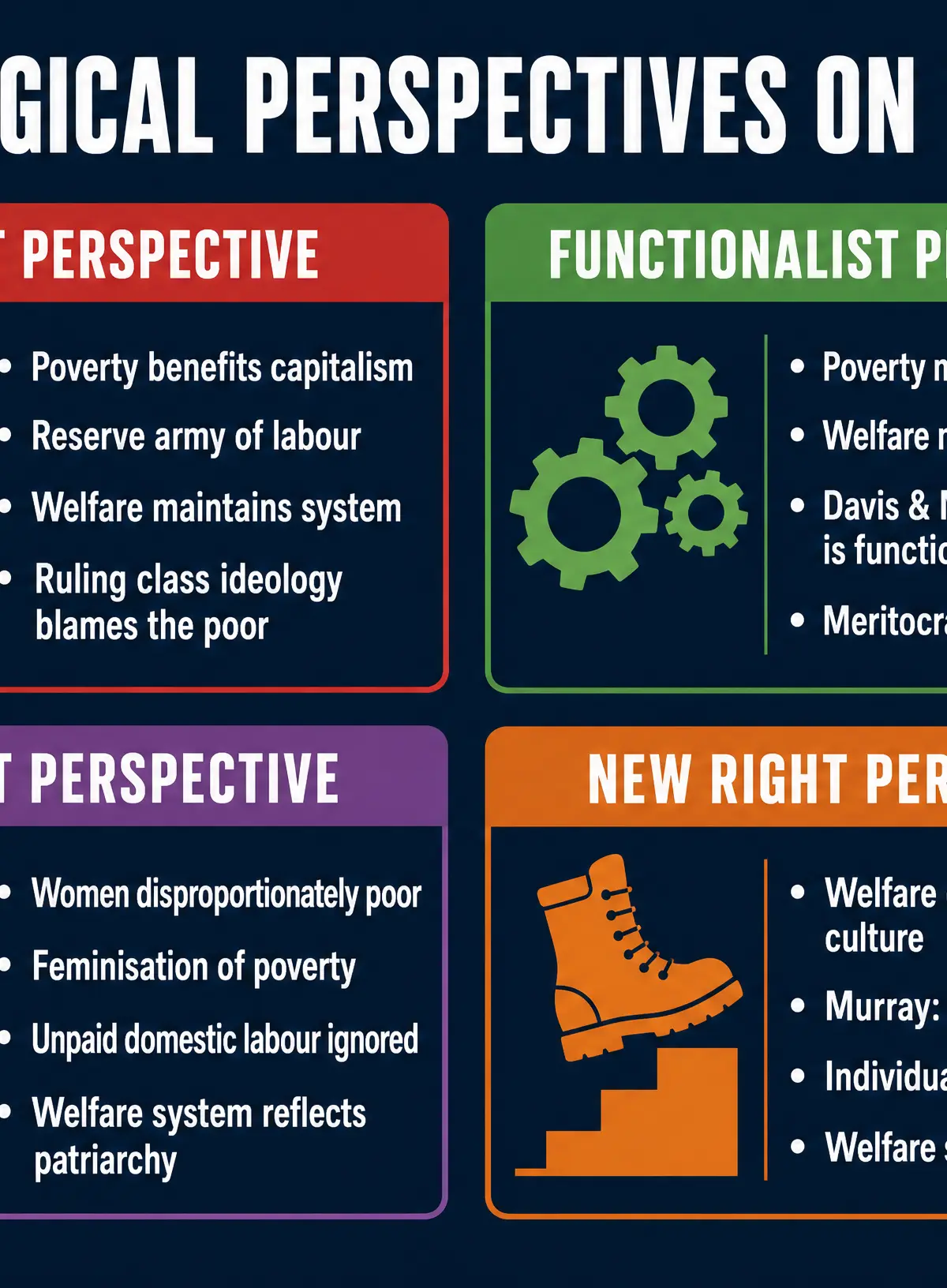
Functionalist Perspective
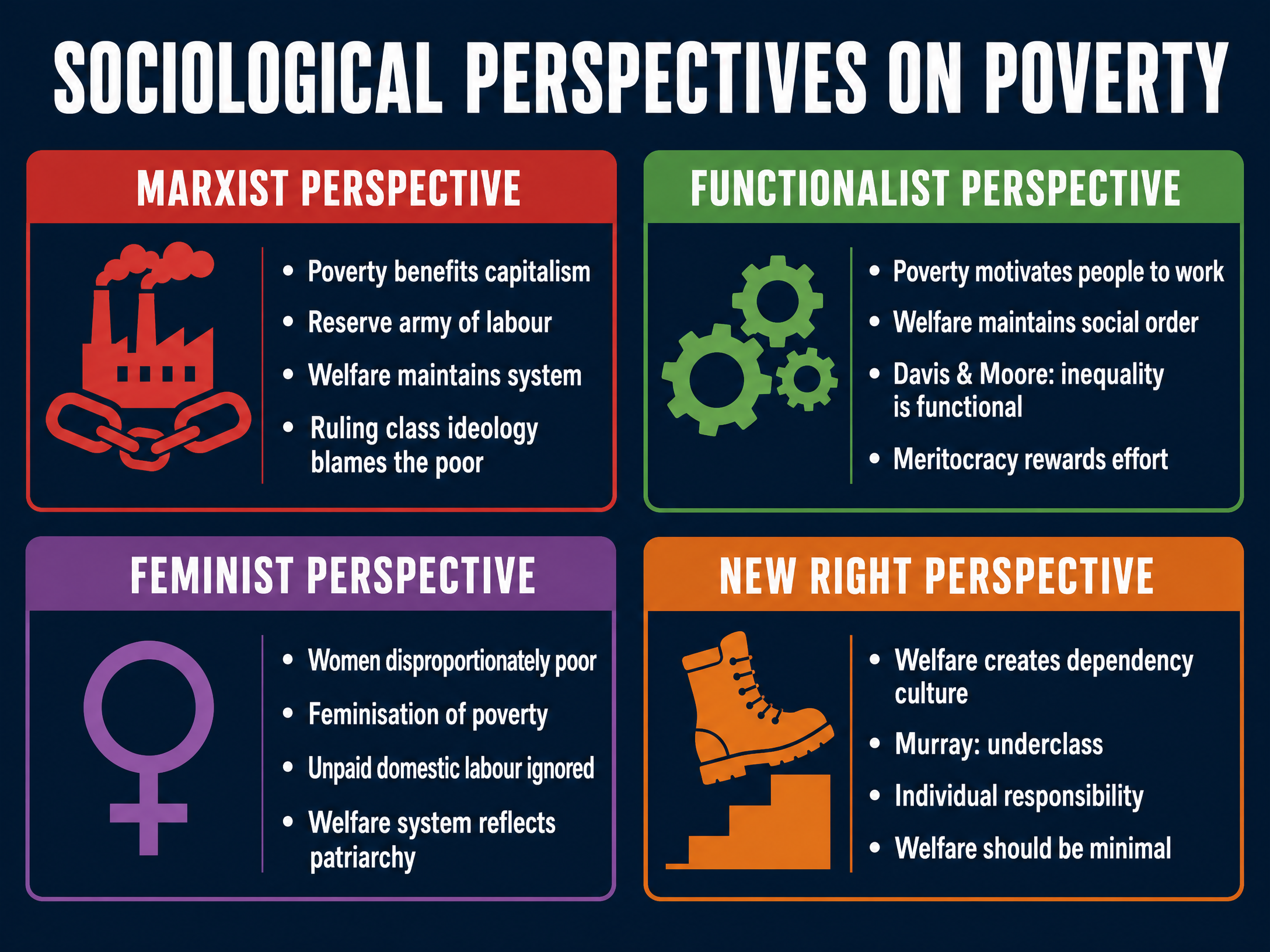
Key Idea: Inequality is necessary and functional for society.
Key Thinkers: Davis and Moore.
Argument: Poverty motivates people to work hard. The most important jobs require the most skill and should be rewarded highest (meritocracy). The welfare state provides a safety net to maintain social order.
Marxist Perspective
Key Idea: Poverty is a structural necessity of capitalism.
Key Thinkers: Karl Marx, Ralph Miliband.
Argument: The ruling class benefits from a 'reserve army of labour' (unemployed workers) which keeps wages low. The welfare state is a concession to prevent revolution, keeping workers just healthy enough to be exploited.
New Right Perspective
Key Idea: Generous welfare creates poverty.
Key Thinkers: Charles Murray.
Argument: The welfare state creates a 'dependency culture' and an 'underclass' who rely on benefits rather than work. This undermines individual responsibility and traditional family structures.
Feminist Perspective
Key Idea: Poverty and welfare are gendered issues.
Argument: The 'feminisation of poverty' highlights that women are more likely to be poor due to lower pay, part-time work, and unpaid caring responsibilities. The welfare state is built on a patriarchal 'male breadwinner' model.
The Organisation of the Labour Process
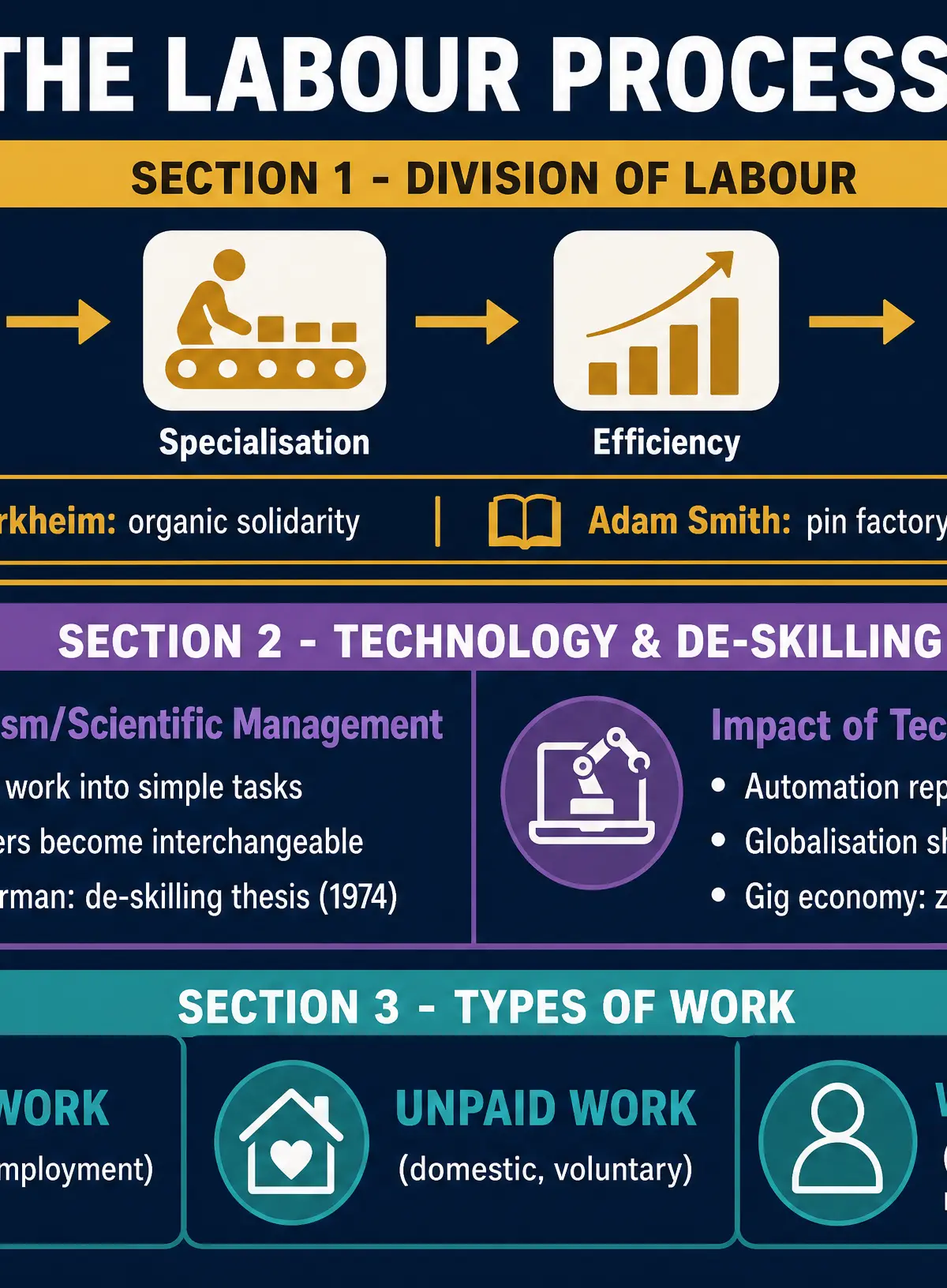
Division of Labour
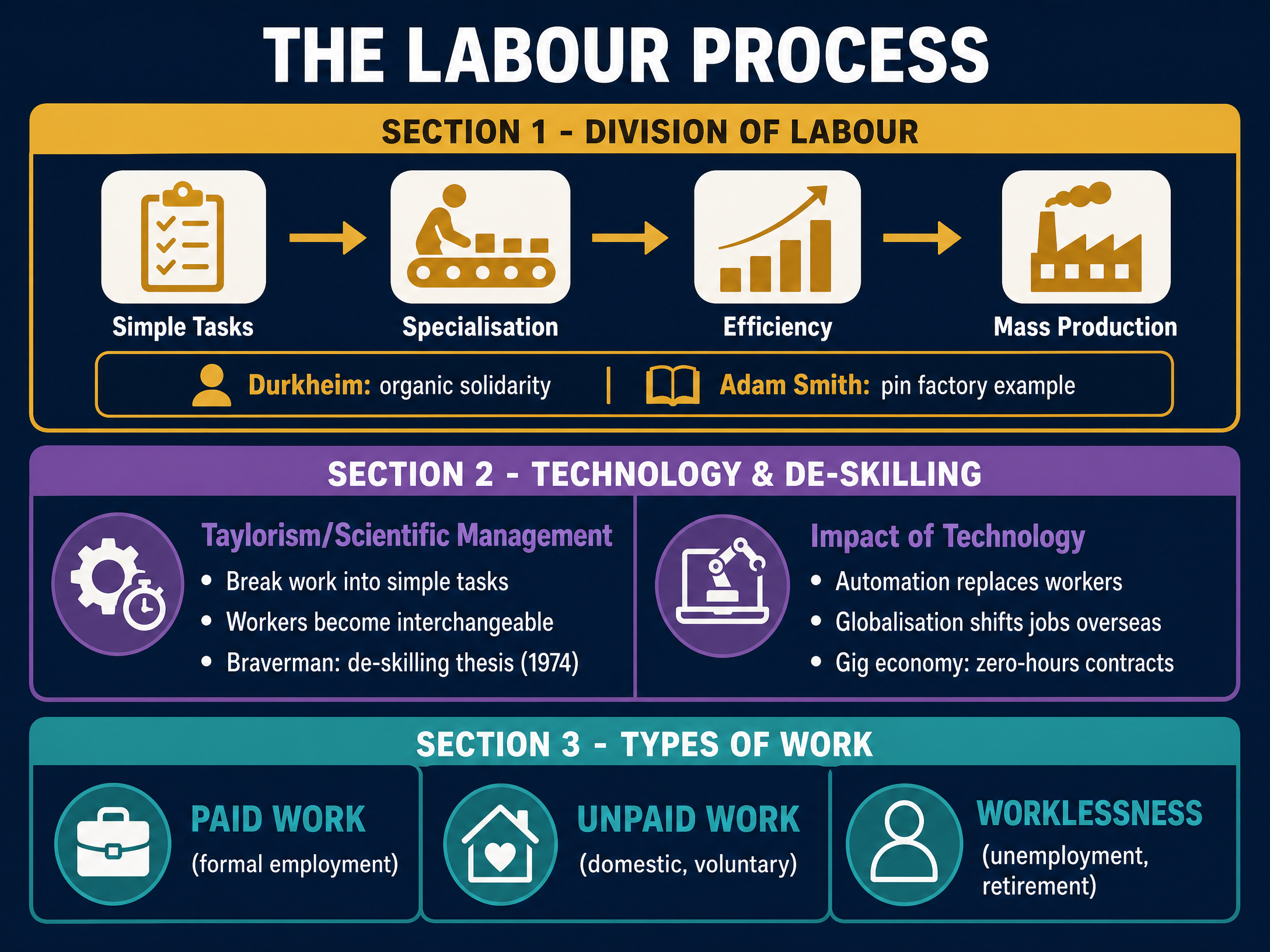
Concept: Breaking down complex production into simple, specialised tasks.
Key Thinkers: Adam Smith (pin factory), Emile Durkheim (organic solidarity).
Scientific Management & De-skilling
Concept: Taylorism (breaking work into timed, repetitive tasks) and Braverman's de-skilling thesis.
Impact: Workers lose autonomy and skill, becoming interchangeable parts in a machine, which reduces their bargaining power and wages.
Modern Changes to Work
Automation: Technology replacing human labour in both manual and cognitive tasks.
Globalisation: The shifting of manufacturing and service jobs to countries with lower labour costs.
The Gig Economy: The rise of insecure, zero-hours contract work (e.g., Uber, Deliveroo) offering flexibility but lacking employment rights or security.
Podcast Revision Resource
Listen to our comprehensive 10-minute audio guide covering all the key concepts, perspectives, and exam tips for this topic.
Visual Resources
3 diagrams and illustrations
Interactive Diagrams
1 interactive diagram to visualise key concepts
Conceptual Flow Outline
Forces shaping the modern labour process
Worked Examples
3 worked examples — open one to explore the question and available guidance.
Practice Questions
Try the question, then reveal an answer plan or example response
Identify two groups in society who are statistically more likely to experience poverty. (2 marks)
Hint: Think about the distribution of poverty across different demographics.
Explain one way in which the welfare state might create a 'dependency culture'. (4 marks)
Hint: Use the New Right perspective and Charles Murray's concept of the underclass.
Evaluate the Marxist view that poverty is a necessary feature of capitalist society. (12 marks)
Hint: Outline the Marxist view (reserve army of labour), then evaluate it using Functionalist and New Right perspectives.
Explain how the 'feminisation of poverty' affects women's life chances. (8 marks)
Hint: Explain the concept, then give two distinct reasons why women are disproportionately affected (e.g., labour market, caring responsibilities).
Describe one way in which globalisation has affected the labour process in the UK. (3 marks)
Hint: Think about where manufacturing jobs have gone and what kind of jobs have replaced them.
Exam technique
How to turn what you know into marks
How to approach the question
Always identify the command word, the key sociological concept, and whether a specific perspective is required.
How to structure your answer
- Explain questions
- Use the PEEL structure: Point, Evidence (sociological concept/study), Explanation (how it answers the question), Link.
- Evaluate questions
- Introduction → Perspective A (For) → Perspective B (Against) → Perspective C (Alternative view) → Reasoned Conclusion.
Timing
Approximately 1 minute per mark, plus planning time for 12-mark essay questions.
Common pitfalls
- Using common-sense arguments instead of sociological theories.
- Describing poverty without explaining its causes.
- Failing to reach a judgement in 'Evaluate' questions.
- Not using named sociologists or specific studies.
What the command words want
- Explain
- Give reasons how or why something happens, using connective language (4-8 marks).
- Describe
- Give the main features or characteristics with some detail (2-4 marks).
- Evaluate
- Look at arguments for and against, weigh up the evidence, and come to a conclusion (12 marks).
- Identify
- State the point clearly, no explanation needed (1 mark).
Watch or listen (optional)
Test your understanding of Work, Poverty and Welfare
Active recall beats re-reading. Take an instant quiz now to test what you’ve learned and lock it into long-term memory.
7 days Premium · Then the free plan continues · No card, no charge