AQA · GCSE · Sociology
Education
Master the sociological perspectives on education, from Durkheim's functionalism to Bowles and Gintis's Marxist critique. This comprehensive guide covers the internal and external factors driving educational achievement and the hidden processes within schools.
- 6 min read
- 3 worked examples
- 5 practice questions
- 6 key terms
Study Notes

Overview
This study guide covers the sociology of education, a core component of the GCSE Sociology specification. It explores the fundamental question: what is the purpose of education? You will examine how different sociological perspectives—Functionalism, Marxism, and Feminism—answer this question, providing contrasting views on whether schools promote meritocracy or reproduce inequality. The guide also delves into the complex factors affecting educational achievement, breaking them down into external factors (like social class, material deprivation, and cultural capital) and internal factors (such as teacher labelling, streaming, and the self-fulfilling prophecy). Examiners expect candidates to demonstrate a clear understanding of these concepts, apply relevant sociological studies (such as Willis, Ball, and Becker), and evaluate competing theories using specific terminology.

Sociological Perspectives on Education
Functionalism
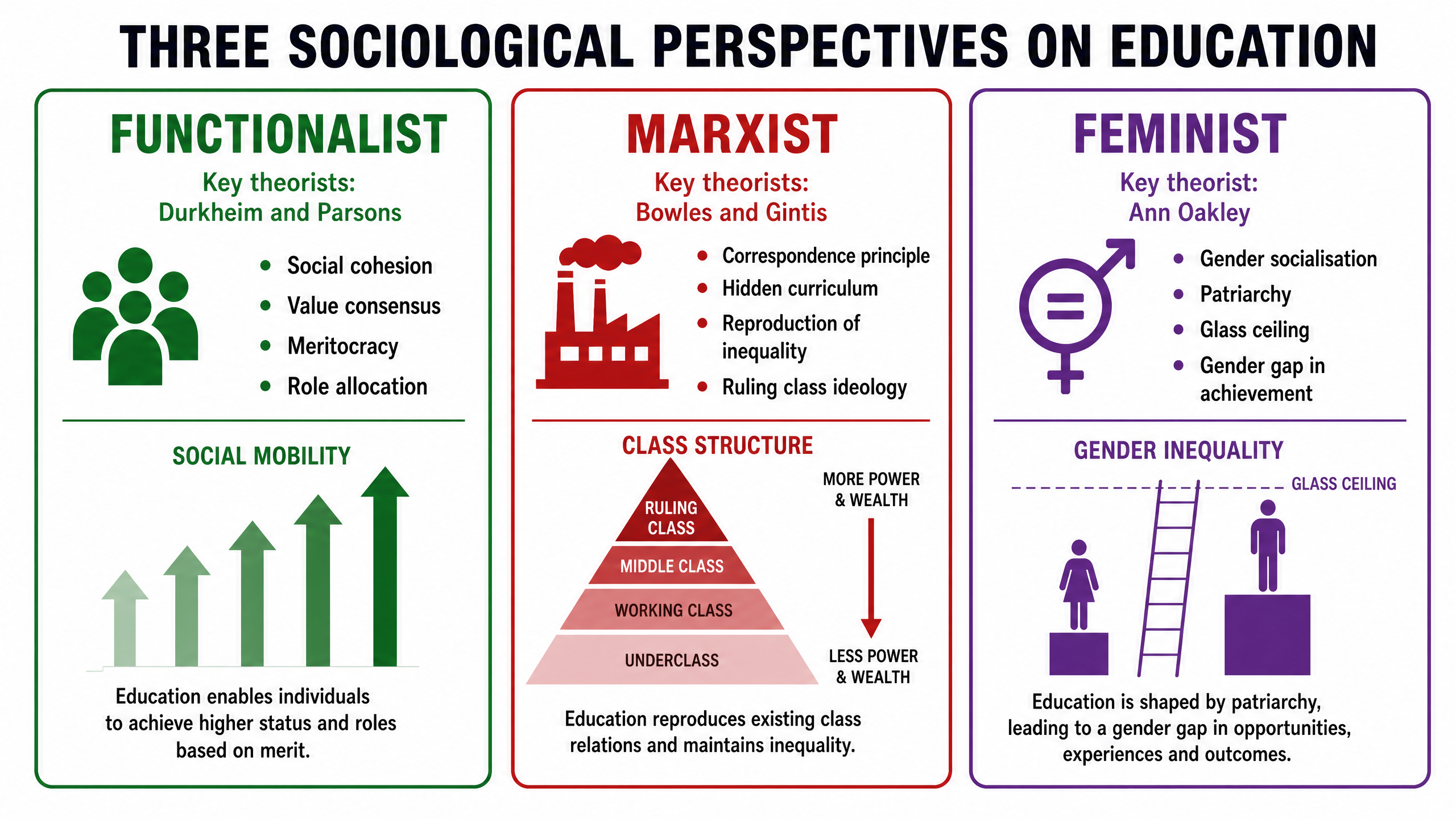
Key Theorists: Emile Durkheim, Talcott Parsons
Core Ideas: Functionalists view society as a system of interconnected parts working together to maintain stability (social cohesion). They see education as performing essential positive functions for society.
Key Functions:
- Social Solidarity: Durkheim argued that schools transmit shared values and norms, binding individuals into a cohesive society.
- Role Allocation: Parsons argued that schools are meritocratic. They act as a bridge between the particularistic values of the family and the universalistic values of wider society, sorting students into appropriate job roles based on their talent and effort.
Why it matters for exams: You must be able to define 'meritocracy' and explain how Functionalists believe education serves the needs of the economy.
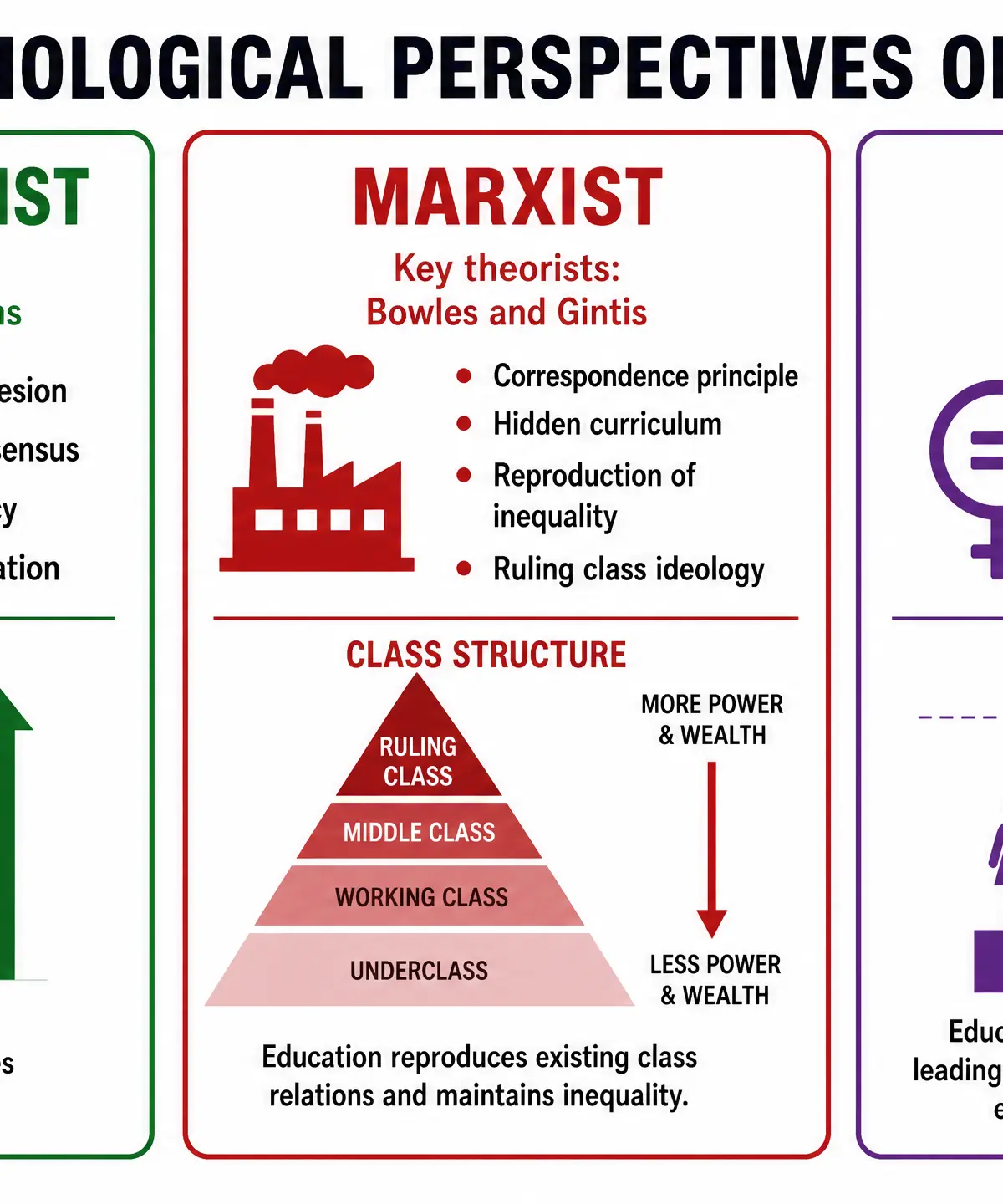
Marxism
Key Theorists: Samuel Bowles, Herbert Gintis, Paul Willis
Core Ideas: Marxists take a critical view, arguing that the education system serves the interests of the ruling class (bourgeoisie) and reproduces social inequality.
Key Concepts:
- The Correspondence Principle: Bowles and Gintis (1976) argued that the relationships in school mirror those in the capitalist workplace (e.g., obedience to authority, motivation by external rewards like grades/wages rather than the joy of learning/working).
- The Hidden Curriculum: The informal, unofficial lessons taught in school (punctuality, accepting hierarchy) that prepare working-class students for exploited labour.
- Reproduction of Inequality: Education legitimises class inequality by producing the 'myth of meritocracy'—making it seem like failure is the individual's fault, rather than the system's.
Why it matters for exams: Use Marxist concepts to evaluate and criticise Functionalist views. Willis's Learning to Labour (1977) is a crucial study showing how working-class boys' resistance to school culture ironically leads them into working-class jobs.
Feminism
Key Theorists: Ann Oakley, Sue Sharpe
Core Ideas: Feminists argue that the education system is patriarchal and has historically disadvantaged girls.
Key Concepts:
- Gender Socialisation: Schools reinforce traditional gender roles through subject choices (e.g., boys taking Physics, girls taking Health and Social Care) and teacher expectations.
- Changing Achievement: While girls historically underachieved, they now outperform boys at GCSE and A-Level. Feminists point to changes in the job market and feminist movements raising girls' aspirations (e.g., Sharpe's 1994 study).
Why it matters for exams: You must be able to explain both why girls' achievement has improved and why gender segregation in subject choices persists.
Factors Affecting Educational Achievement

External Factors (Outside School)
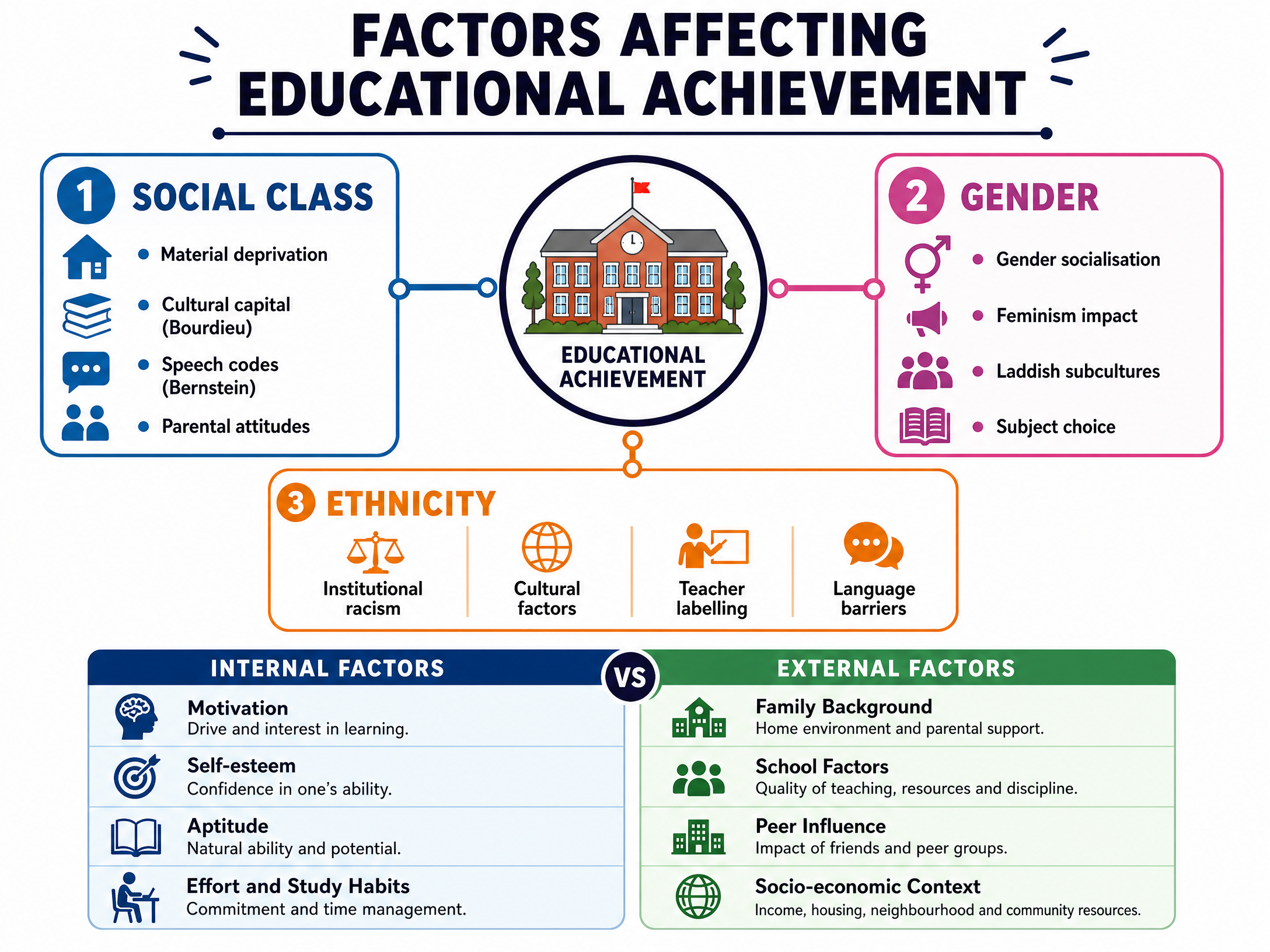
Material Deprivation: Working-class students may lack the physical resources needed for success (e.g., a quiet place to study, computers, good diet, ability to afford tutors or trips).
Cultural Capital: Pierre Bourdieu argued that middle-class families possess 'cultural capital'—the knowledge, attitudes, values, and language abilities that the education system rewards. Working-class students are disadvantaged because their culture is not valued by schools.
Speech Codes: Basil Bernstein identified that middle-class children use an 'elaborated code' (complex, abstract vocabulary) which matches the language of textbooks and teachers. Working-class children often use a 'restricted code' (context-bound, simpler vocabulary), putting them at a disadvantage.
Internal Factors (Inside School)
Labelling and the Self-Fulfilling Prophecy: Howard Becker found that teachers evaluate students based on an 'ideal pupil' stereotype (usually middle-class). If a teacher labels a student as 'low ability', the student may internalise this label and act accordingly, making the prediction come true (the self-fulfilling prophecy, demonstrated by Rosenthal and Jacobson).
Streaming and Setting: Grouping students by perceived ability. Stephen Ball's study of Beachside Comprehensive showed that streaming reinforced class inequalities, with working-class students disproportionately placed in lower streams, leading to anti-school subcultures.
Institutional Racism: Policies and practices within schools that unintentionally disadvantage ethnic minority students, affecting their achievement levels.
Specification Reference
Check your specific exam board (AQA, OCR, Eduqas) for the exact topic code, usually listed under 'Education' or 'Sociology of Education'.
Visual Resources
2 diagrams and illustrations
Interactive Diagrams
1 interactive diagram to visualise key concepts
Conceptual Flow Outline
The process of the Self-Fulfilling Prophecy in schools
Worked Examples
3 worked examples — open one to explore the question and available guidance.
Practice Questions
Test your understanding — click to reveal model answers
Identify and explain one internal factor that may lead to working-class underachievement. (4 marks)
Hint: Focus on what happens INSIDE the school (e.g., labelling, streaming).
Discuss how far sociologists agree that the education system is meritocratic. (12 marks)
Hint: Contrast the Functionalist view (Parsons) with the Marxist view (Bowles and Gintis/Bourdieu).
Explain what is meant by the 'hidden curriculum'. (2 marks)
Hint: Think about the unofficial lessons taught in school.
Identify and explain one way in which schools may reinforce gender roles. (4 marks)
Hint: Think about subject choices or teacher expectations.
Explain the difference between elaborated and restricted speech codes. (4 marks)
Hint: Reference Basil Bernstein and link to social class.