AQA · GCSE · Sociology
The sociological approach
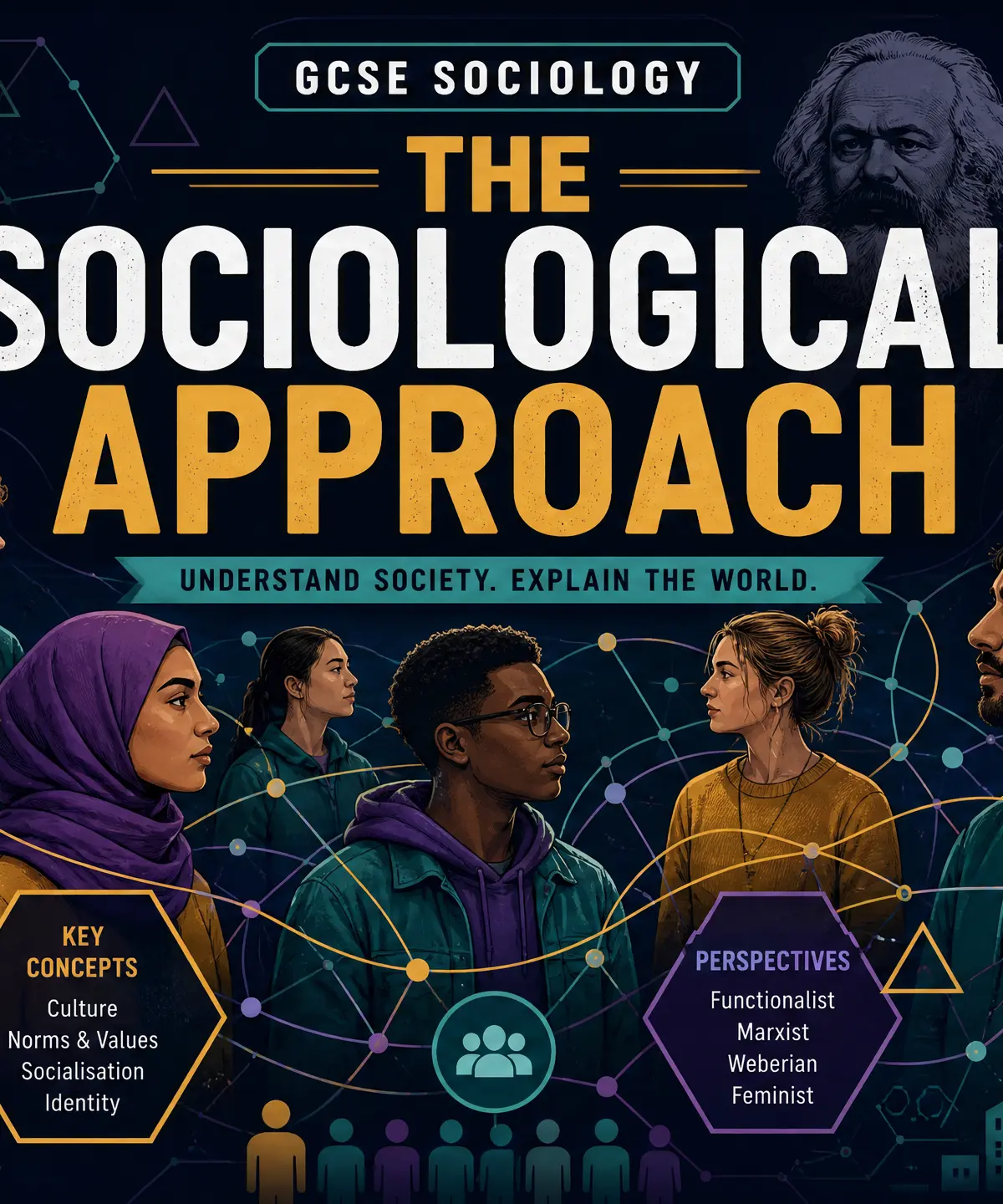
The Sociological Approach introduces the core concepts and perspectives used to understand society. It is the foundation of sociology, exploring how social structures shape our lives and why conflict and consensus exist.
- 5 min read
- 3 worked examples
- 5 practice questions
- 6 key terms
Study Notes
Overview
The Sociological Approach is the foundation of your GCSE Sociology course. It introduces you to the 'sociological imagination' — the ability to see the connection between individual experiences and wider social forces. Examiners expect you to understand the fundamental difference between consensus theories (which see society as cooperative) and conflict theories (which see society as unequal). You must also master the core concepts of socialisation, norms, and values, and be able to apply the four main sociological perspectives (Functionalism, Marxism, Feminism, and Interactionism) to contemporary UK society. This topic is not just examined on its own; these perspectives and concepts must be applied across every other topic in your exams, from education to crime.

Core Concepts
Socialisation
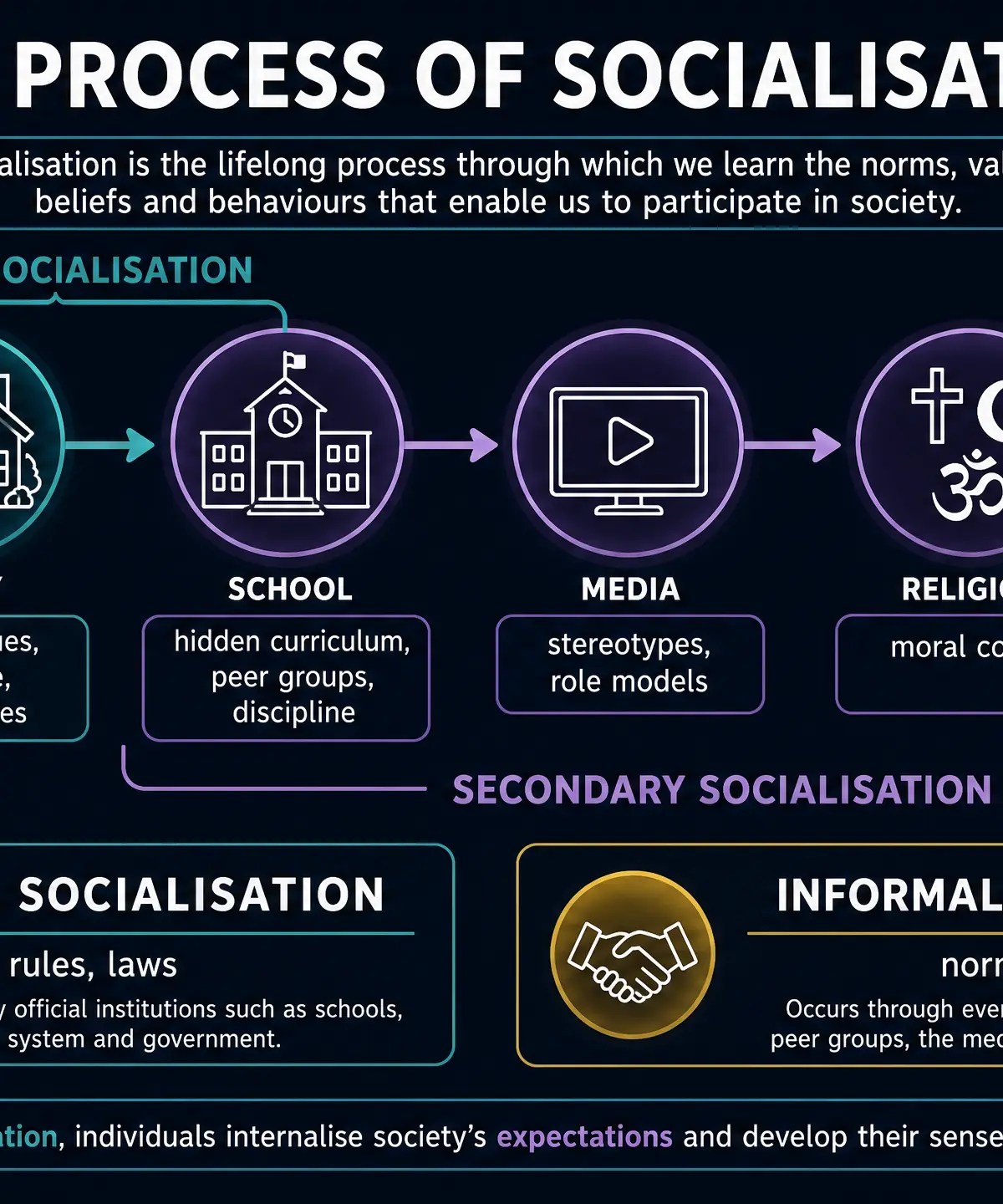
Definition: The lifelong process through which individuals learn the culture, norms, and values of their society.
Primary Socialisation: Occurs in early childhood, primarily within the family. This is where we learn language, basic rules of behaviour, and fundamental values.
Secondary Socialisation: Occurs later in life through other agents such as education, peer groups, the media, religion, and the workplace. It teaches us how to behave in wider society.
Norms and Values
Values: General beliefs and principles that a society considers important, worthwhile, and desirable (e.g., equality, respect for life, democracy).
Norms: Specific rules or guidelines that govern behaviour in particular situations. They put values into practice (e.g., queuing, saying 'please' and 'thank you', wearing a uniform to school).
Examiner Tip: Never confuse norms and values. Values are the broad ideas; norms are the specific actions.
Status and Role
Status: The social position a person holds in society. This can be ascribed (fixed at birth, like age or sex) or achieved (earned through effort, like becoming a doctor).
Role: The pattern of behaviour expected of someone who holds a particular status (e.g., the role of a teacher is to educate and maintain discipline).
The Four Sociological Perspectives
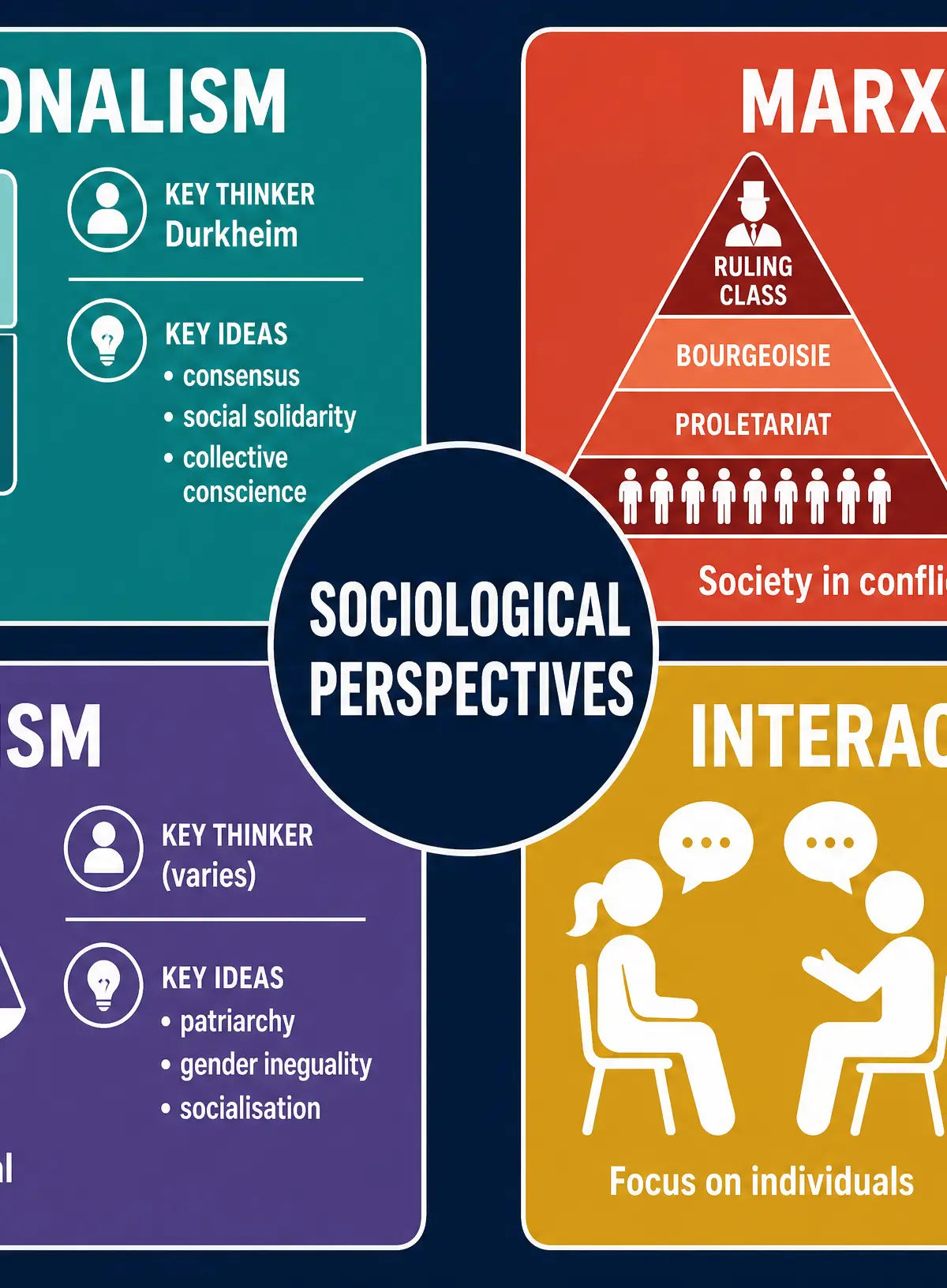
Functionalism (Consensus Theory)
Key Thinker: Émile Durkheim
Core Idea: Society is a complex system whose parts work together to promote solidarity and stability. It is often compared to a biological organism (the organic analogy).
Key Terms:
- Value Consensus: Agreement around shared values.
- Social Solidarity: The integration of people into society, making them feel they belong.
- Anomie: A state of normlessness where social rules break down.
Marxism (Conflict Theory)
Key Thinker: Karl Marx
Core Idea: Capitalist society is divided by class conflict between those who own the means of production and those who sell their labour.
Key Terms:
- Bourgeoisie: The ruling class who own wealth and property.
- Proletariat: The working class who are exploited for their labour.
- Exploitation: Treating someone unfairly in order to benefit from their work.
- False Class Consciousness: When the working class are unaware of their exploitation because ruling-class ideology dominates society.
Feminism (Conflict Theory)
Key Thinkers: Sylvia Walby, Ann Oakley
Core Idea: Society is fundamentally divided by gender, with men holding power and women being disadvantaged.
Key Terms:
- Patriarchy: A society dominated by men.
- Gender Socialisation: The way boys and girls are taught to behave differently (e.g., canalisation and manipulation).
- Glass Ceiling: An invisible barrier preventing women from reaching top jobs.
Interactionism (Action Theory)
Key Thinker: Max Weber, Howard Becker
Core Idea: Unlike the structural theories above, interactionism focuses on small-scale (micro) interactions between individuals and how they create meaning.
Key Terms:
- Labelling: Attaching a definition or meaning to an individual or group.
- Self-Fulfilling Prophecy: When a person internalises a label and acts accordingly, making the label come true.
- Master Status: A label that overrides all other statuses a person holds.
Visual Resources
2 diagrams and illustrations
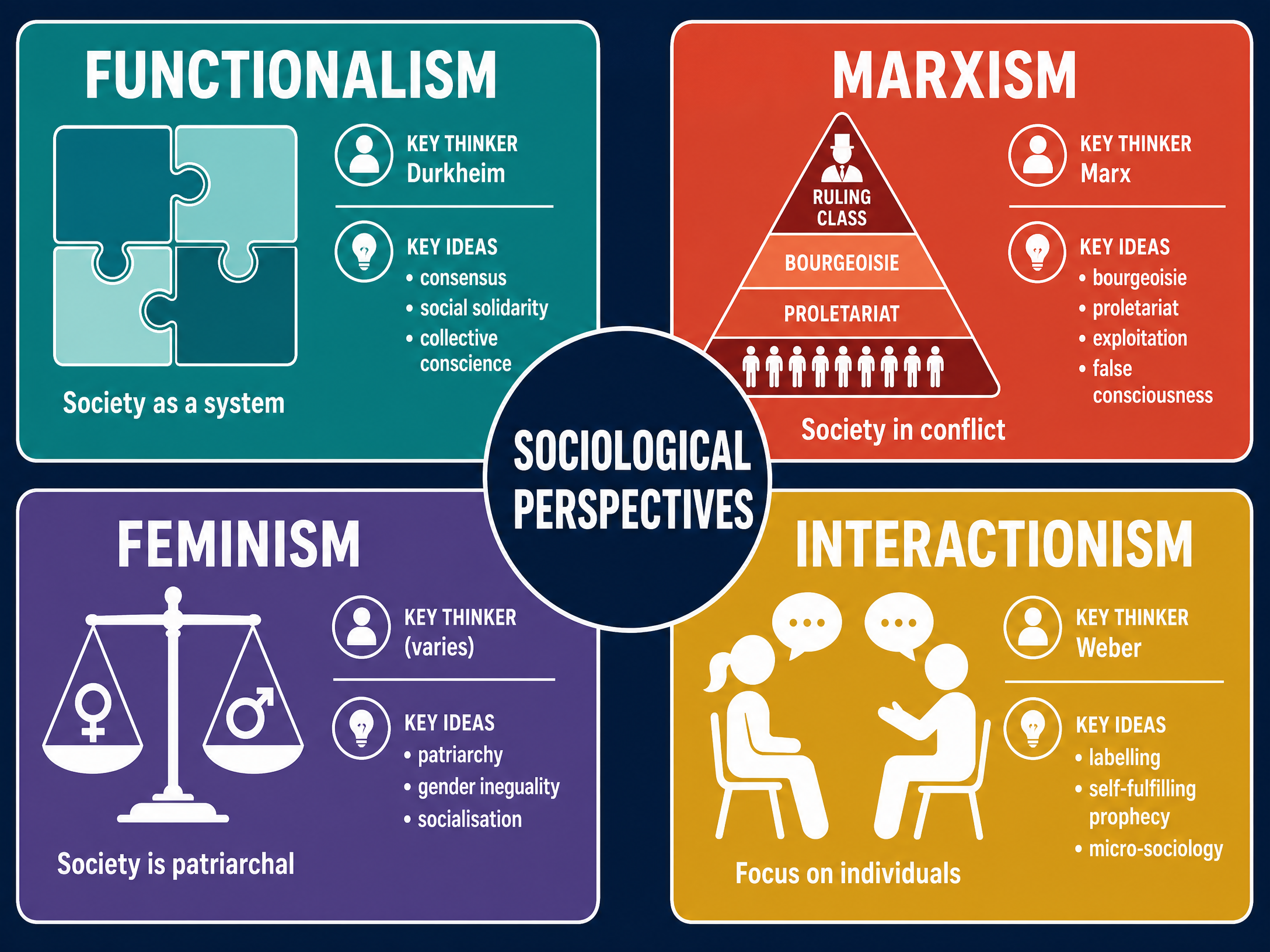
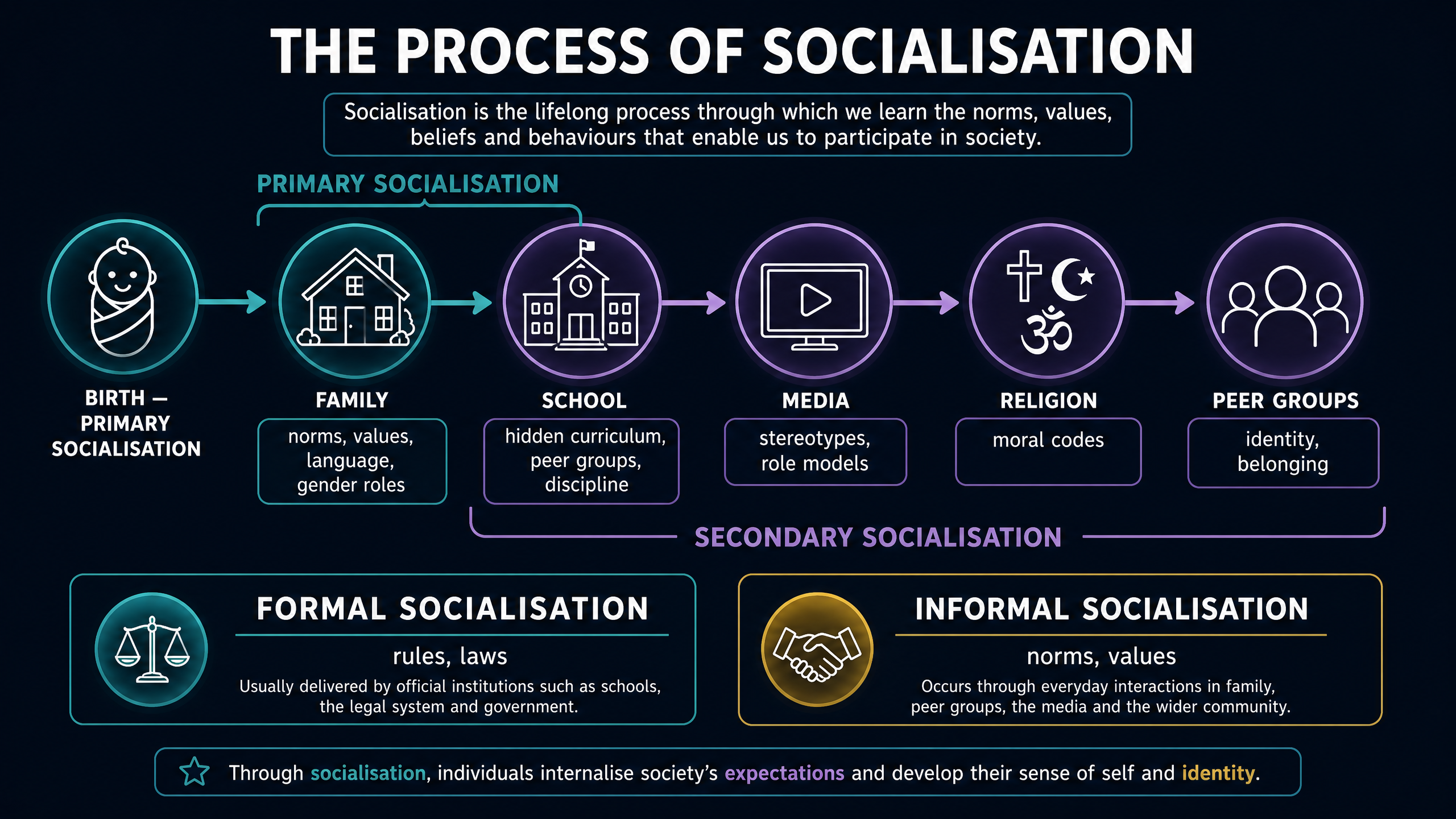
Interactive Diagrams
1 interactive diagram to visualise key concepts
Conceptual Flow Outline
Map of Sociological Perspectives
Worked Examples
3 worked examples — open one to explore the question and available guidance.
Practice Questions
Test your understanding — click to reveal model answers
Identify two agents of secondary socialisation. (2 marks)
Hint: Think about where you learn rules after you leave the family home.
Explain what sociologists mean by the term 'patriarchy'. (3 marks)
Hint: Define the term and link it to a specific sociological perspective.
Describe one way that the family socialises children into gender roles. (3 marks)
Hint: Use terms like canalisation or manipulation.
Explain one difference between ascribed status and achieved status. (4 marks)
Hint: Define both terms and give an example for each to highlight the contrast.
Discuss how far sociologists would agree that society is based on conflict. (12 marks)
Hint: Contrast Marxism and Feminism (conflict) with Functionalism (consensus).