OCR · GCSE · Sociology
Family Structures
This study guide critically examines the diverse family structures in contemporary UK society, moving beyond the traditional 'cereal packet' ideal. It is designed to equip OCR GCSE Sociology candidates with the theoretical knowledge and analytical skills needed to deconstruct concepts of family, kinship, and household, and to evaluate the social forces shaping them.
- 5 min read
- 3 worked examples
- 5 practice questions
- 6 key terms
Check what you remember
Read the wording for your board, then hide it and explain Kinship in your own words. Rough notes are fine. This is a self-check, with no mark or grade.
Reference: OCR
Relations based on blood, marriage, or adoption.
Study Notes
Overview
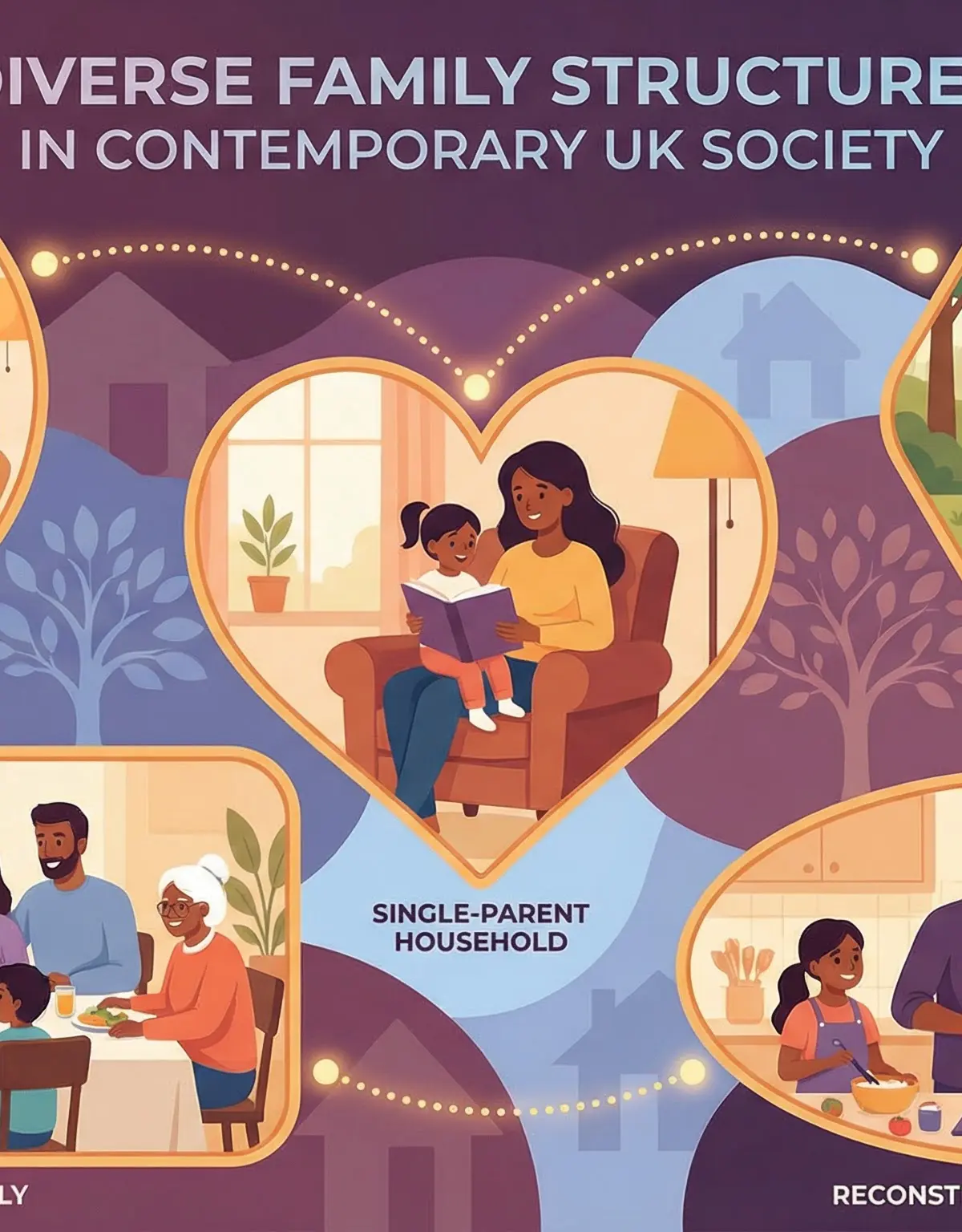
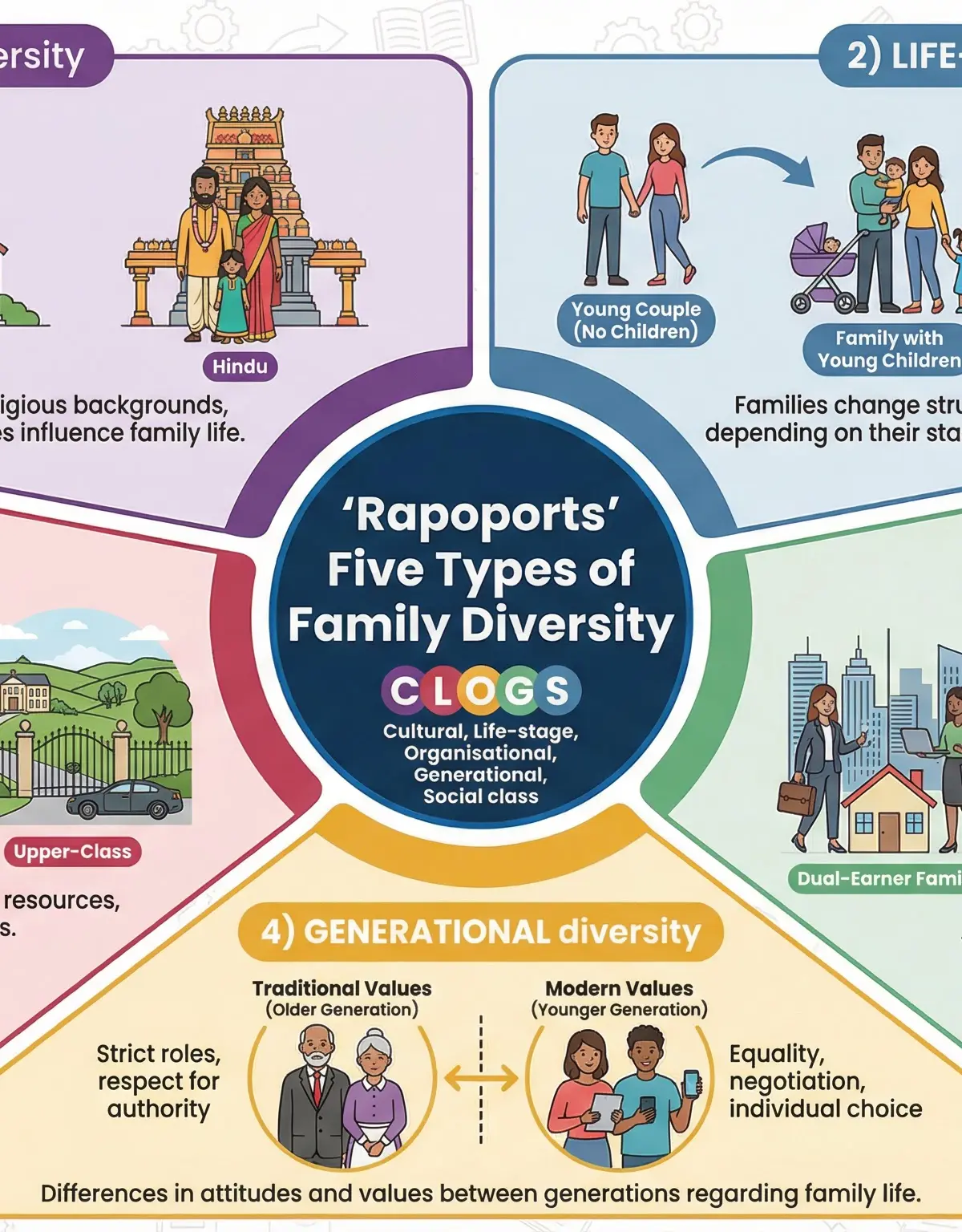
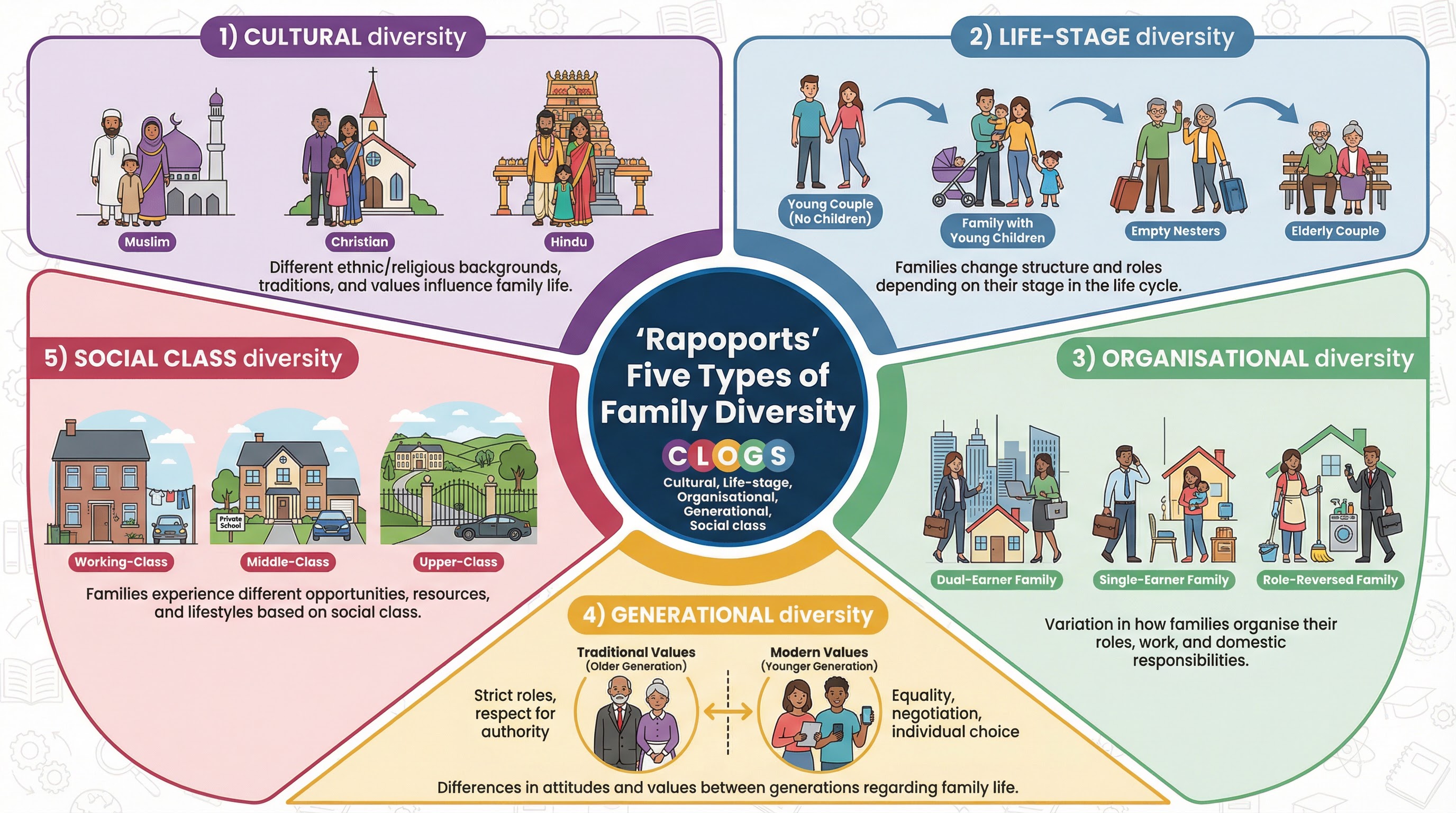
This topic explores the rich tapestry of family life in modern Britain. For the OCR J204 specification, candidates are expected to demonstrate a critical understanding of various family forms, including the nuclear, extended, reconstituted, lone-parent, and same-sex family. A key requirement is the ability to apply the major sociological perspectives – Functionalism, Marxism, and Feminism – to evaluate these structures. Examiners will award significant credit for the application of specific sociological evidence, such as the Rapoports' typology of family diversity (Cultural, Life-stage, Organisational, Generational, Social Class), and for debating the relevance of the traditional nuclear family in a pluralistic society. This guide will provide the detailed knowledge, theoretical application, and exam technique required to achieve top marks.
Key Family Structures & Concepts
The Nuclear Family
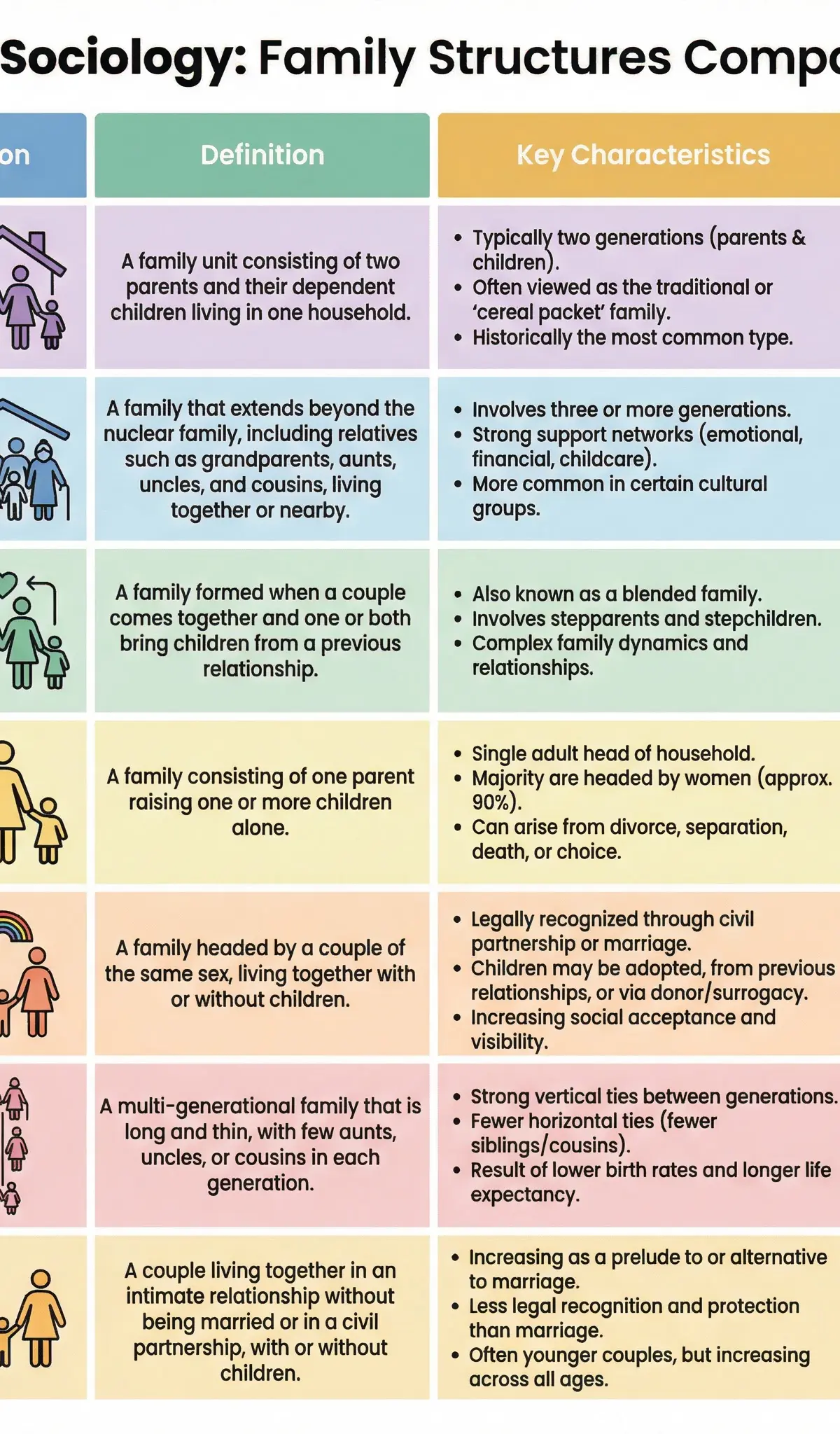
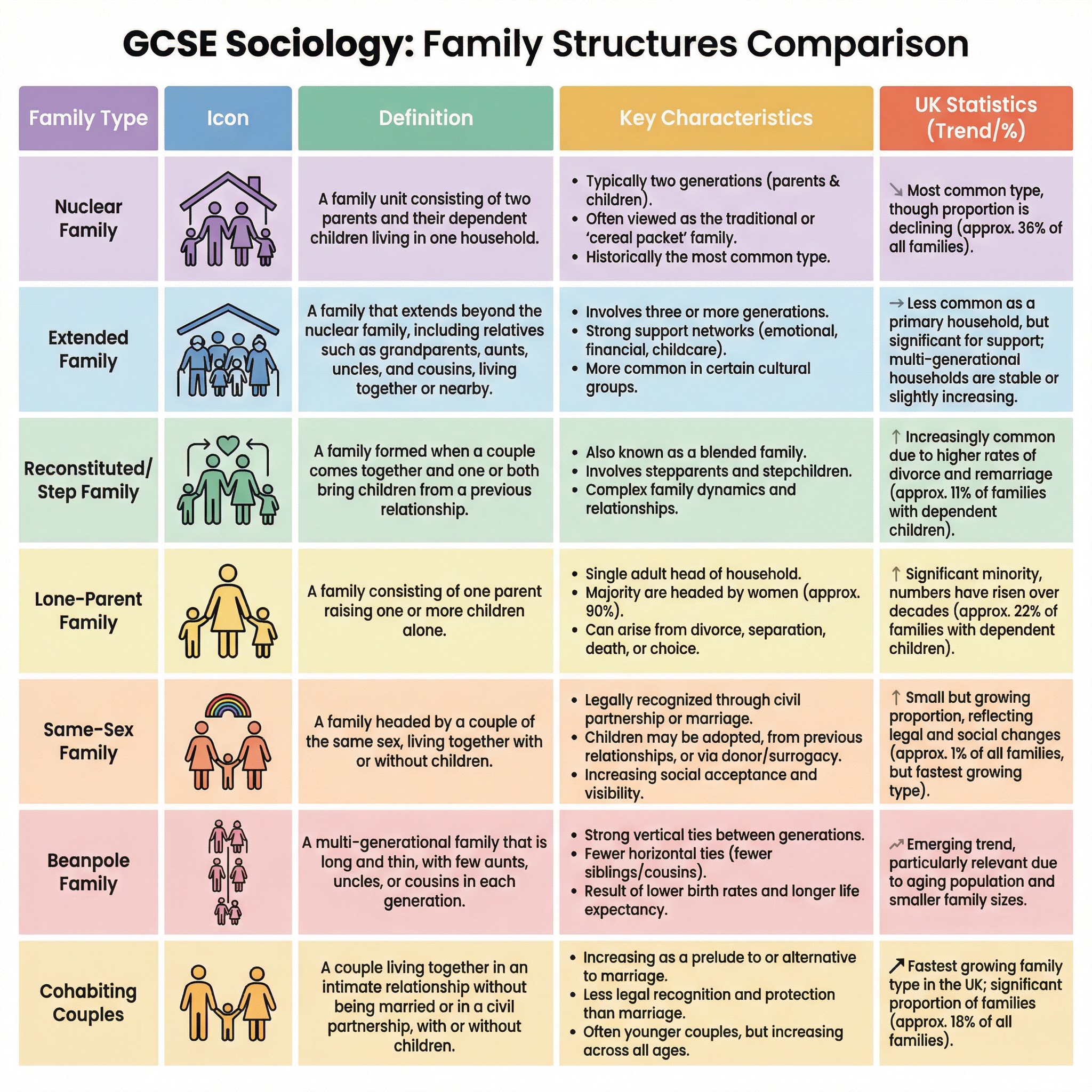
What it is: A family unit consisting of two parents and their dependent children living in one household. Often termed the 'cereal packet family' as it was traditionally portrayed in advertising as the ideal.
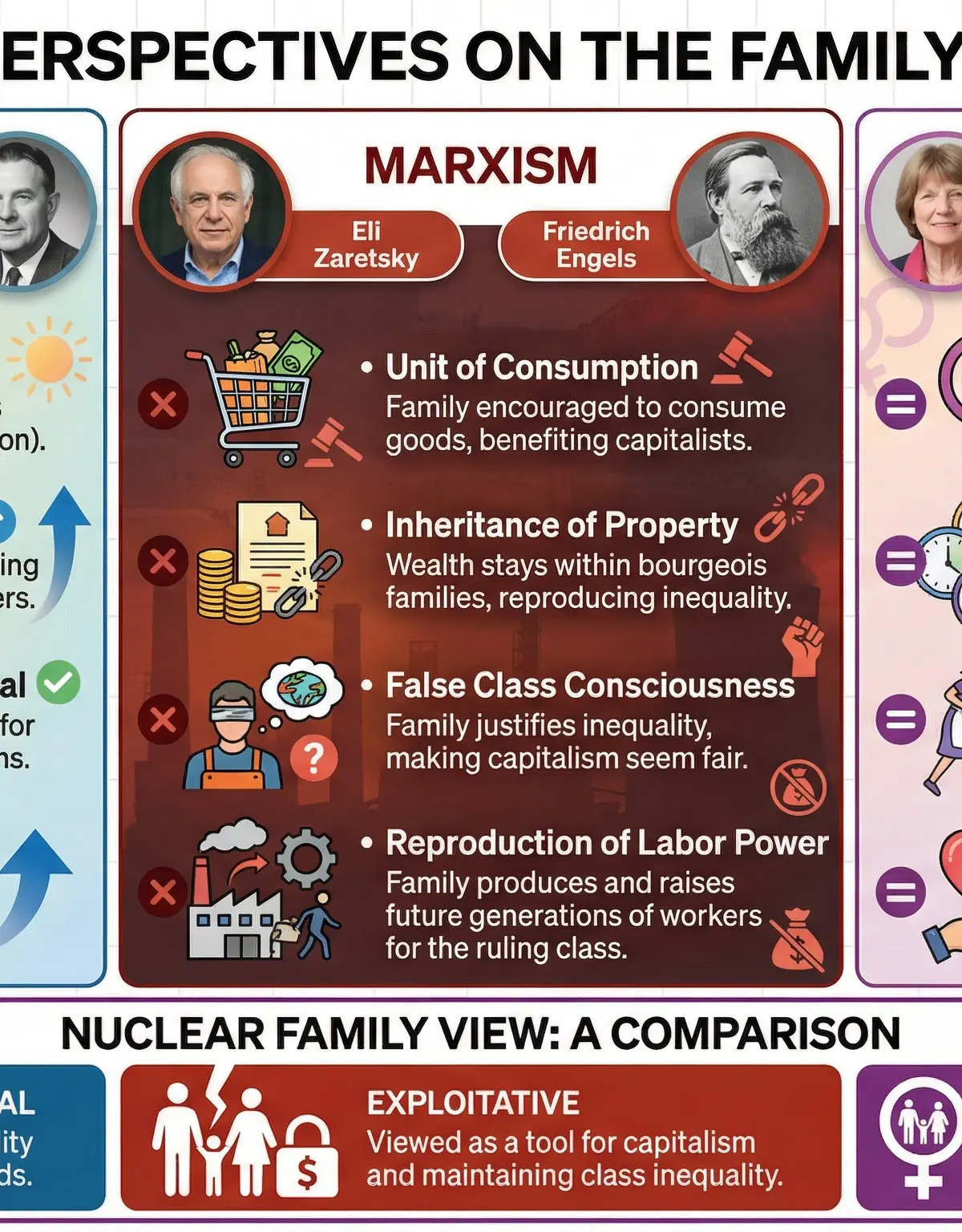
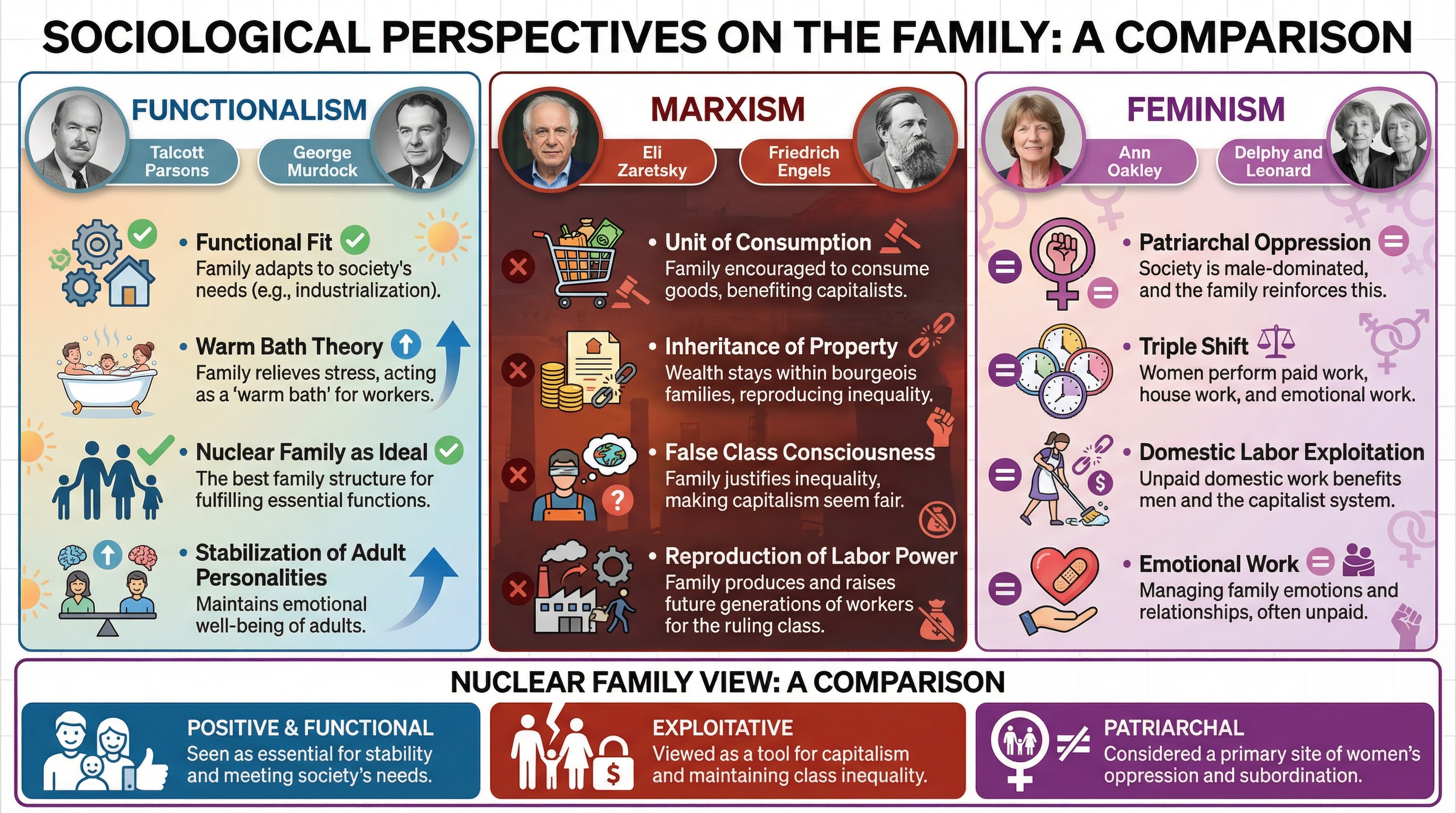
Why it matters: Historically the dominant family type, but its prevalence is declining. Candidates must analyze its supposed benefits (Functionalism) versus its criticisms (Marxism, Feminism). For example, Parsons saw it as a perfect 'functional fit' for industrial society, providing primary socialisation and the stabilisation of adult personalities. In contrast, Zaretsky argued it serves capitalism as a 'unit of consumption'.
Specific Knowledge: Young and Willmott's concept of the 'symmetrical family' (a privatised, home-centred nuclear family with more equal roles) is a key development to discuss.
Diversity in Family Structures
What happened: Sociologists have observed a significant shift away from the dominance of one family type towards a variety of forms. This is known as family pluralism.
Why it matters: This is a central debate. Candidates must argue to what extent the nuclear family is no longer the norm. Evidence of increasing numbers of lone-parent families (around 22% of families with children), reconstituted families (approx. 11%), and cohabiting couples (the fastest-growing family type) is crucial here.
Specific Knowledge: The Rapoports' work is essential. Use their five types of diversity (CLOGS) to structure your analysis.
Theoretical Perspectives on the Family
Functionalism
Key Thinkers: George Peter Murdock, Talcott Parsons.
Key Ideas: Sees the family as a vital social institution performing essential functions for society, such as the sexual, reproductive, economic, and educational functions (Murdock). Parsons' 'warm bath theory' suggests the family provides emotional relief from the stresses of modern life.
Impact: Provides a positive view of the nuclear family as the ideal structure for social stability.
Marxism
Key Thinkers: Friedrich Engels, Eli Zaretsky.
Key Ideas: Argues the family serves the interests of capitalism. Engels linked the nuclear family to the inheritance of private property. Zaretsky claimed it creates a 'false consciousness' by providing a haven from exploitation, thereby preventing revolution, and also acts as a key 'unit of consumption'.
Impact: Offers a critical perspective, viewing the family as a source of inequality and oppression.
Feminism
Key Thinkers: Ann Oakley, Christine Delphy and Diana Leonard.
Key Ideas: Focuses on how the family subordinates women. Oakley distinguished between sex and gender, arguing that gender roles are socially constructed within the family. Delphy and Leonard highlighted the exploitation of women's unpaid domestic labour. The concept of the 'triple shift' (paid work, domestic work, and emotional work) is also critical.
Impact: Challenges the harmonious view of the family, exposing it as a site of patriarchal power and conflict.
Visual Resources
3 diagrams and illustrations
Interactive Diagrams
1 interactive diagram to visualise key concepts
Conceptual Flow Outline
Flowchart showing the causes of increasing family diversity.
Worked Examples
3 worked examples — open one to explore the question and available guidance.
Practice Questions
Try the question, then reveal an answer plan or example response
Outline and explain two ways in which family life may be culturally diverse. (6 marks)
Hint: Think about different ethnic or religious groups and how their family structures or values might differ from the UK average.
Explain the 'dual burden' in the context of the family. (4 marks)
Hint: Think about the roles women are often expected to perform.
Evaluate the Functionalist view of the family. (12 marks)
Hint: Start by explaining the Functionalist view (Parsons, Murdock), then critique it from Marxist and Feminist perspectives.
Describe what sociologists mean by a 'beanpole family'. (3 marks)
Hint: Think 'long and thin'.
Explain the difference between a family and a household. (4 marks)
Hint: One is about relationships, the other is about residence.
Exam technique
How to turn what you know into marks
How to approach the question
1. **BUG** the question: Box the command word, Underline the key terms, Glance back at it. 2. Plan your paragraphs (3 points for a 12-marker). 3. Write using PEEL structure.
How to structure your answer
- Essay questions
- A balanced argument is key. Introduction setting out the debate -> Paragraphs for the argument -> Paragraphs against the argument -> A justified conclusion that answers the 'to what extent' part of the question.
- Source questions
- Analyse Content (what it says), Provenance (who made it, when, why), and apply Own Knowledge to evaluate its Usefulness and Limitations.
- Explain questions
- PEEL: Point (make a clear statement), Evidence (use specific sociological knowledge, names, dates, stats), Explanation (explain how the evidence supports your point), Link (link back to the question).
Timing
Approximately 1.25 minutes per mark. For a 12-mark question, this means 15 minutes.
Common pitfalls
- Confusing reconstituted and extended families.
- Describing family change without explaining the sociological reasons (AO1 dump).
- Asserting the nuclear family is 'gone' rather than one of many forms.
- Not using named sociologists to support points.
What the command words want
- Describe
- State two distinct points and provide a detailed sentence or two of information for each.
- Explain why
- Provide at least three clear reasons/causes. Use connective language like 'This led to...', 'As a consequence...'.
- How far do you agree / To what extent
- You MUST present both sides of the argument. Use phrases like 'On the one hand...', 'However, on the other hand...' and end with a firm judgement: 'In conclusion, I largely agree because...'.
Watch or listen (optional)
Test your understanding of Family Structures
Active recall beats re-reading. Take an instant quiz now to test what you’ve learned and lock it into long-term memory.
7 days Premium · Then the free plan continues · No card, no charge