OCR · GCSE · Sociology
Feminism
This study guide provides a comprehensive overview of Feminism for OCR GCSE Sociology. It explores feminism as a structural conflict theory, unpacking the core concepts of patriarchy, the sex-gender distinction, and the main feminist perspectives. It is designed to equip candidates with the theoretical knowledge and application skills needed to achieve top marks.
- 5 min read
- 3 worked examples
- 5 practice questions
- 7 key terms
Check what you remember
Read the wording for your board, then hide it and explain Patriarchy in your own words. Rough notes are fine. This is a self-check, with no mark or grade.
Reference: OCR
A social system in which men hold primary power and predominate in roles of political leadership, moral authority, and social privilege.
Study Notes
Overview
Feminism is a crucial conflict theory in sociology that examines society from the perspective of women. For your OCR GCSE exam, you must understand it as a structural theory arguing that society is fundamentally patriarchal – structured by men, for men, leading to the systematic oppression of women. Examiners expect candidates to move beyond a simplistic understanding of feminism as just being about 'equality'. Instead, you must analyse how institutions like the family, education, and the workplace create and perpetuate gender inequality. This guide will break down the core theories, key studies, and evaluation points you need. A key area to master is the distinction between different feminist strands – Liberal, Marxist, and Radical – as this allows for nuanced analysis that is highly credited by examiners.
Key Concepts & Theories
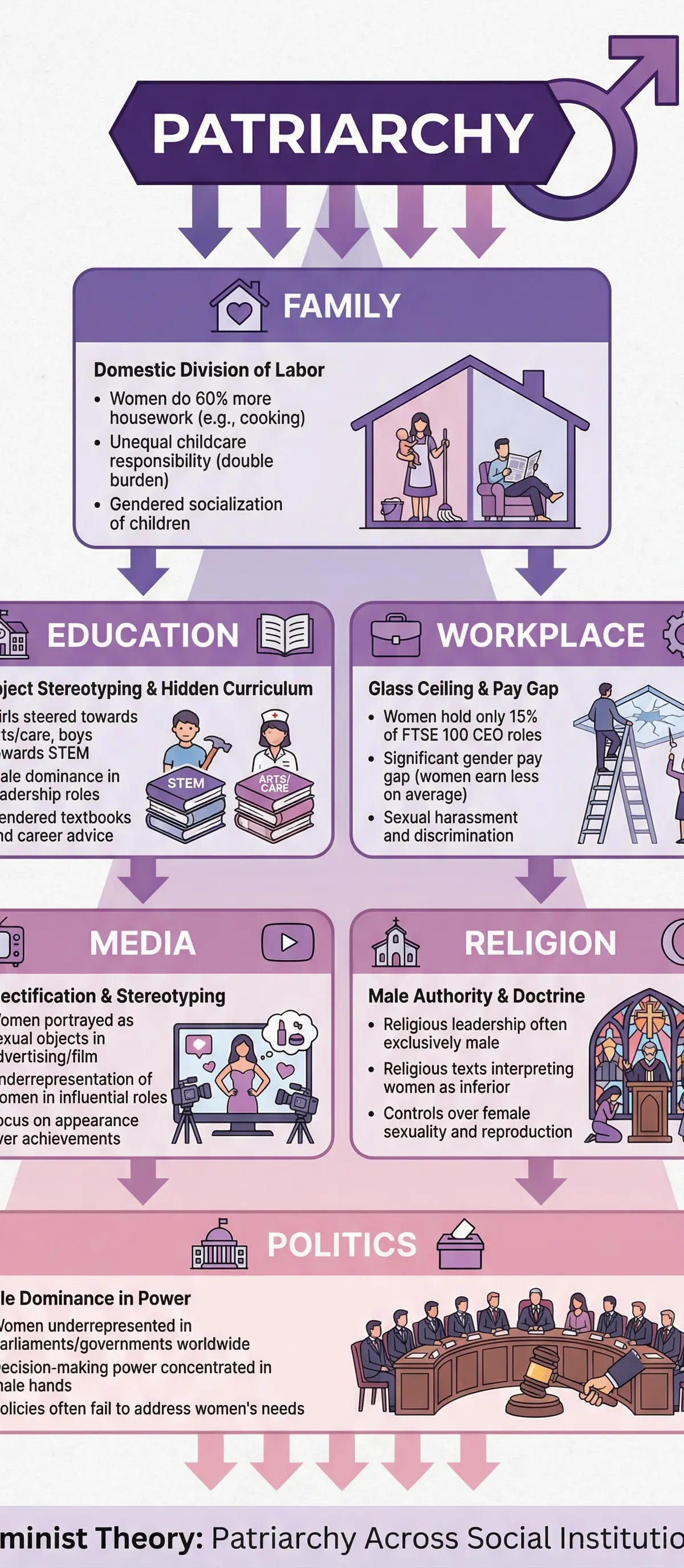
Patriarchy
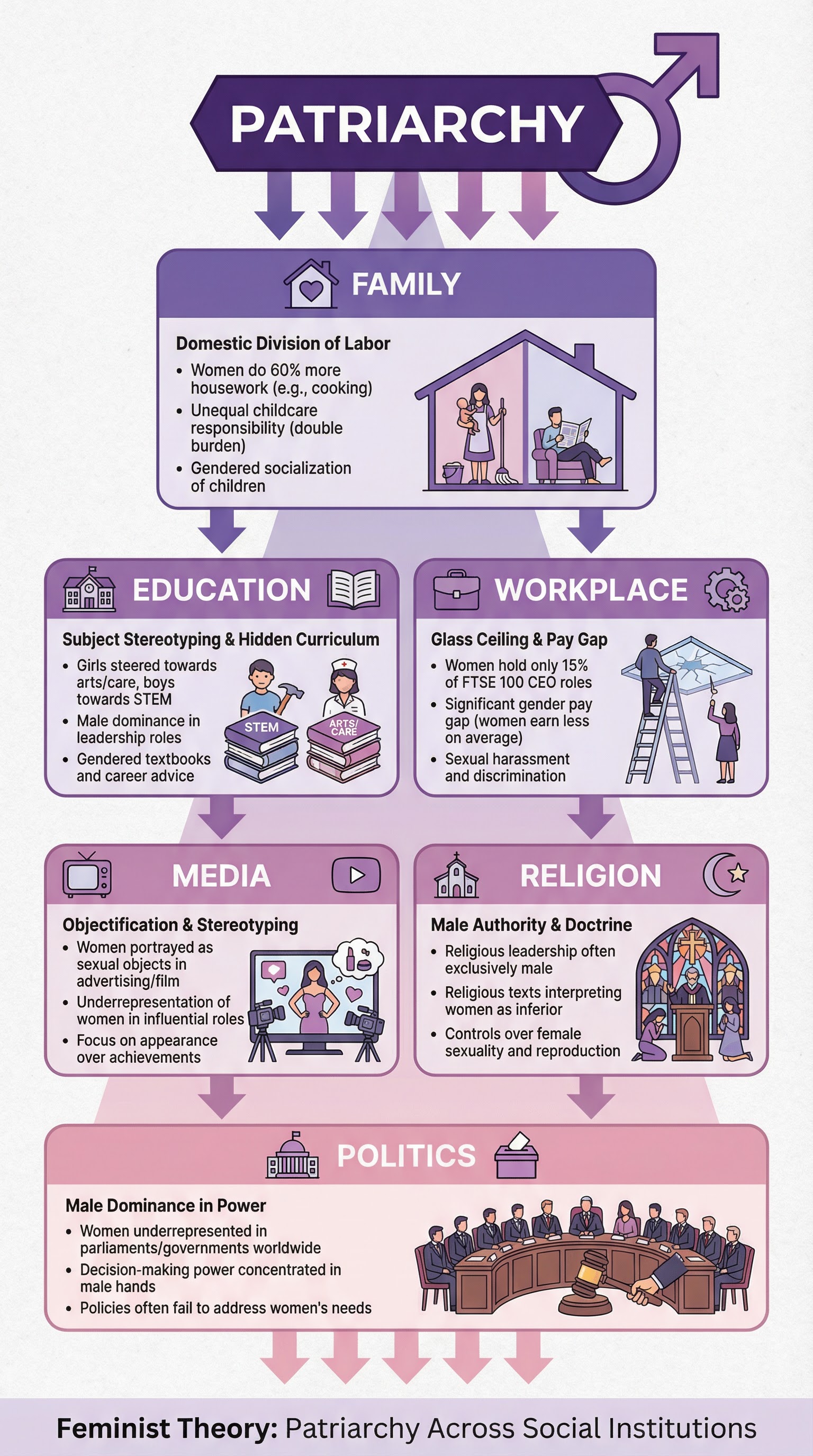
What it is: Literally means 'rule by the father'. In sociology, it refers to a social system where men hold primary power and predominate in roles of political leadership, moral authority, social privilege, and control of property. It is the central concept used by most feminists to explain female oppression.
Why it matters: Examiners award marks for showing how patriarchy is a structural force. It is not just about individual men's attitudes; it is embedded in the institutions of society. You must provide examples of how these institutions uphold male dominance.
The Sex-Gender Distinction
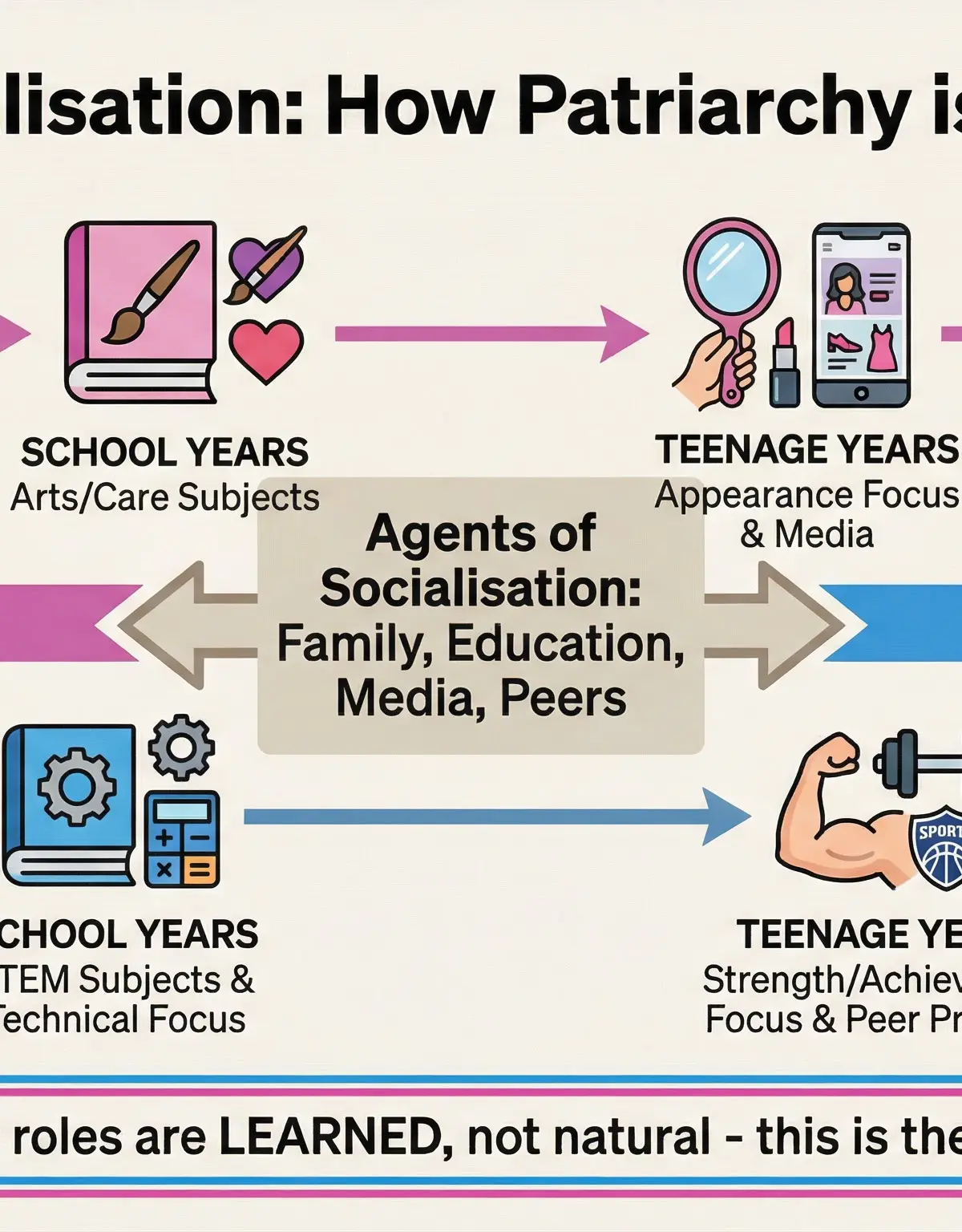
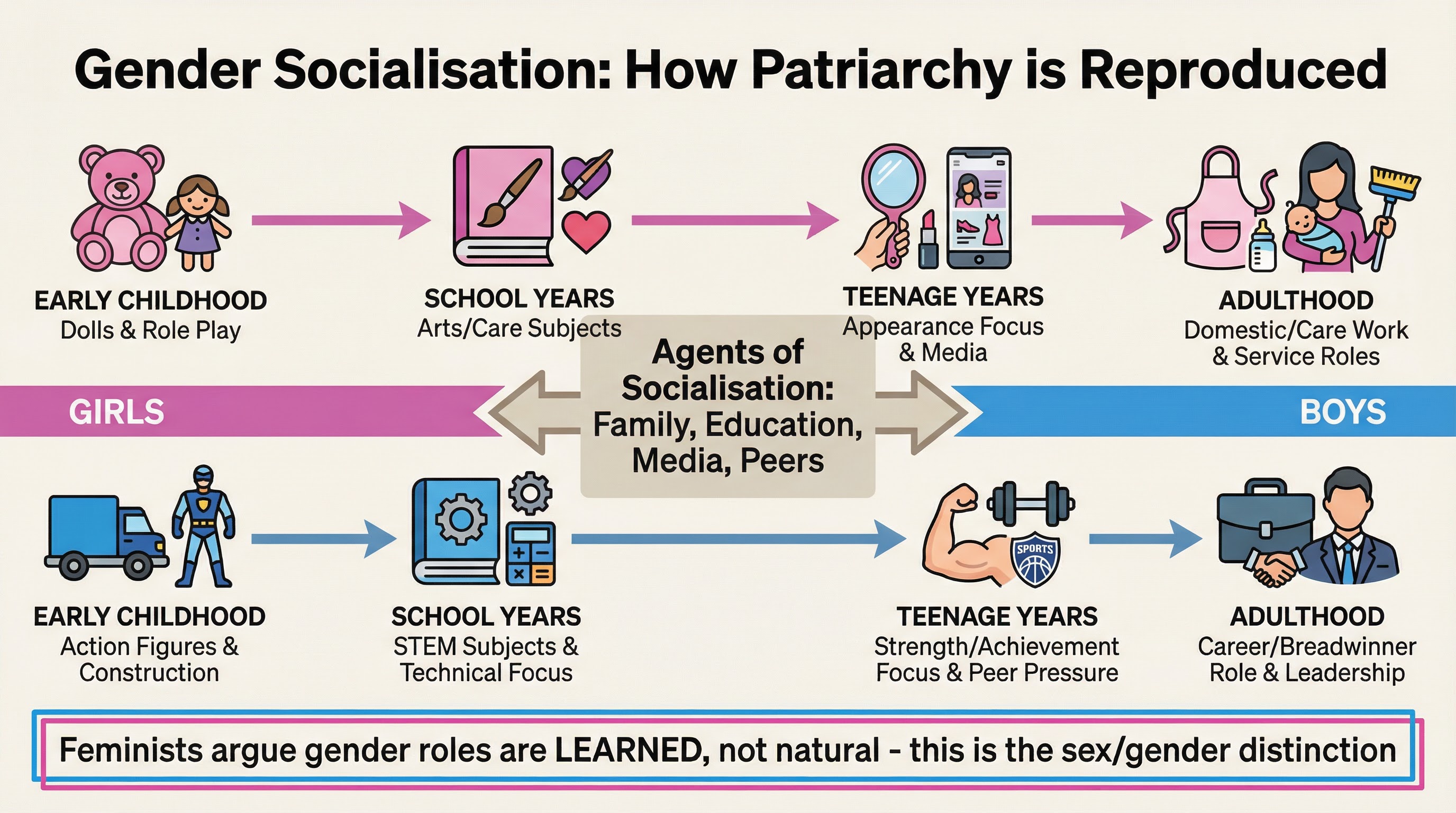
What it is: A crucial concept that separates biological identity from social identity.
- Sex refers to the biological differences between males and females (e.g., chromosomes, hormones).
- Gender refers to the culturally created roles, expectations, and identities associated with being a man or a woman. These are learned through socialisation.
Why it matters: Feminists, particularly Ann Oakley, argue that much of what is seen as 'natural' female behaviour (e.g., being caring or emotional) is actually a product of social construction. This challenges the functionalist view that gender roles are biological and fixed. Credit is given for explaining how gender is 'socially constructed'.
The Main Feminist Perspectives
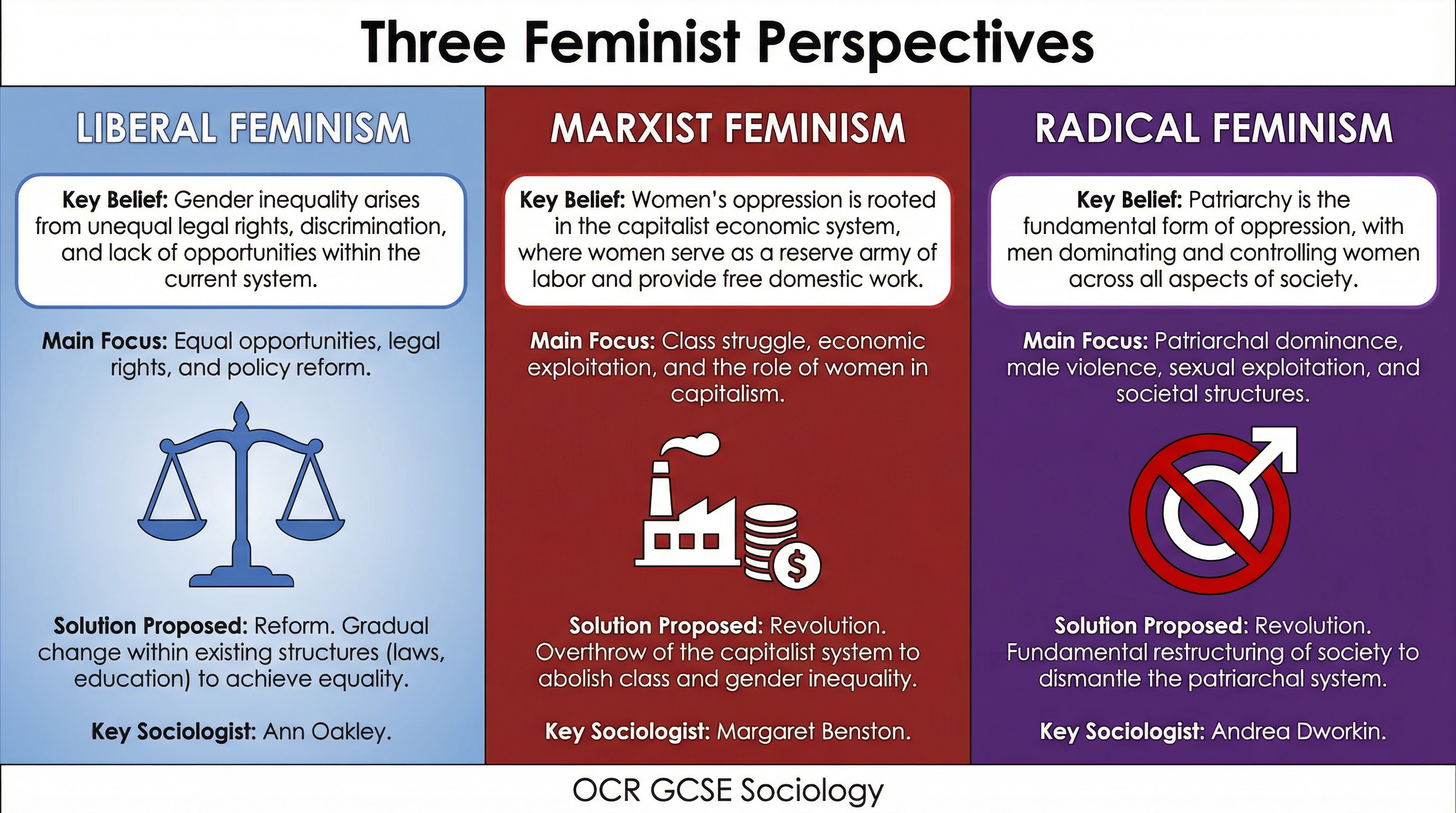
It is vital to distinguish between the different strands of feminism. This shows high-level understanding (AO3).
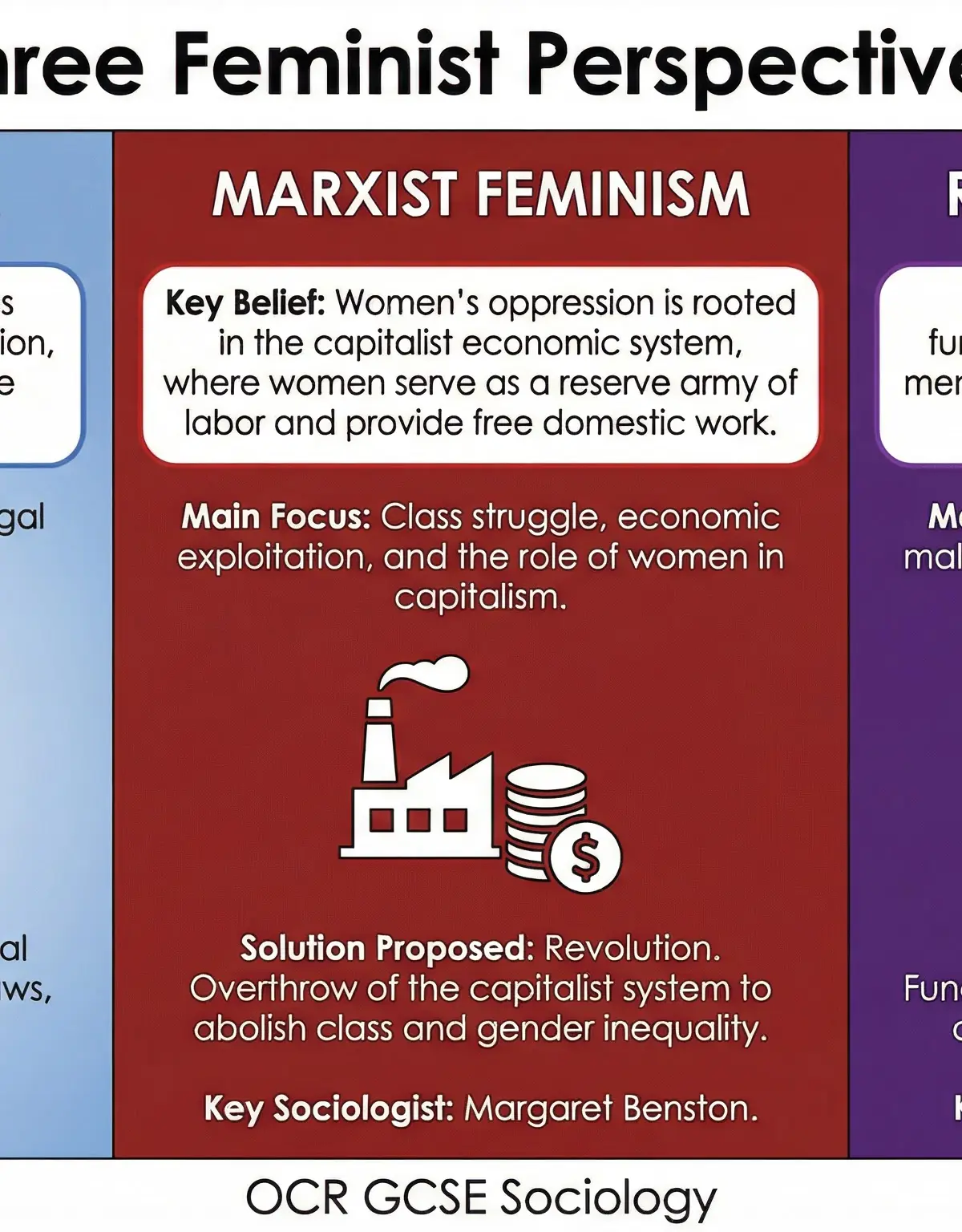
Specific Knowledge: You must be able to name key sociologists and their ideas:
- Liberal Feminism: Ann Oakley ('The Sociology of Housework'), Sue Sharpe ('Just Like a Girl'). Focus on legal and social reform.
- Marxist Feminism: Margaret Benston ('The Political Economy of Women's Liberation'), Fran Ansley ('women are takers of shit'). Focus on capitalism as the source of oppression.
- Radical Feminism: Andrea Dworkin, Kate Millett. Focus on patriarchy as the primary and most fundamental form of inequality.
Second-Order Concepts
Causation
Feminists argue the primary cause of social problems like domestic violence, the gender pay gap, and mental health disparities among women is structural inequality (patriarchy), not individual failings. Liberal feminists trace the cause to discriminatory laws and social attitudes. Marxist feminists identify capitalism as the root cause. Radical feminists point to the universal and historic nature of male power.
Consequence
The consequences of patriarchy are far-reaching: women experience lower pay (the gender pay gap is currently around 14.9% in the UK), the 'double burden' of paid work and unpaid domestic labour, higher rates of domestic and sexual abuse, and under-representation in positions of power (e.g., only 34% of MPs are women).
Change & Continuity
Change: Liberal feminists would point to significant progress (the 'march of progress') through legal changes like the Sex Discrimination Act (1975) and the Equality Act (2010). Women's educational achievement has surpassed men's at every level.
Continuity: Despite these changes, feminists argue that deep-rooted patriarchal structures remain. The glass ceiling still prevents women from reaching top jobs, and traditional gender roles persist in the family, as highlighted by studies on the domestic division of labour.
Significance
Feminism is highly significant as it has not only transformed the discipline of sociology by forcing it to consider gender, but it has also inspired a global political movement that has challenged and changed laws and social attitudes, improving the lives of millions of women.
Visual Resources
3 diagrams and illustrations
Interactive Diagrams
1 interactive diagram to visualise key concepts
Diagram could not be rendered
Timeline of key legal changes influenced by the feminist movement in the UK.
Worked Examples
3 worked examples — open one to explore the question and available guidance.
Practice Questions
Try the question, then reveal an answer plan or example response
Identify and explain two feminist criticisms of the functionalist view of the family. (8 marks)
Hint: Think about harmony vs. conflict. What does the functionalist view ignore?
Discuss how far sociologists would agree that gender inequality is no longer a significant problem in modern Britain. (12 marks)
Hint: This is an evaluation question. You need arguments for (the 'march of progress' view) and arguments against (feminist views).
Explain what sociologists mean by the social construction of gender. (4 marks)
Hint: Distinguish between sex and gender. Use an example.
Identify and explain one way in which the education system may reinforce patriarchal ideology. (4 marks)
Hint: Think about subject choice or the hidden curriculum.
Explain the difference between liberal and radical feminism. (4 marks)
Hint: Focus on their proposed solutions: reform vs. revolution.
Exam technique
How to turn what you know into marks
How to approach the question
1. **BUG** the question: Box the command word (e.g., Explain, Evaluate), Underline the key sociological terms, Glance back at the question regularly. 2. Plan your answer before writing.
How to structure your answer
- Essay questions
- Introduction setting out your argument. 2-3 PEEL paragraphs supporting the view in the question. 1-2 PEEL paragraphs offering evaluation/criticism. A conclusion that makes a clear judgement.
- 4-mark questions
- Two clear, separate points. Identify the concept, then explain it with an example. (Point-Explain-Example).
- Source questions
- Make a point based on the source, quote directly from the source to support it, then explain the sociological meaning of that evidence.
- Explain questions
- PEEL Structure: Make a Point, provide Evidence (sociological theory/study/statistic), Explain how the evidence supports the point, Link back to the question.
Timing
Approximately 1.5 minutes per mark. For a 12-mark question, this means spending around 18 minutes.
Common pitfalls
- Confusing sex and gender.
- Describing feminist ideas without using sociological terminology.
- Forgetting to evaluate in 12-mark questions.
- Not using the source provided in source-based questions.
What the command words want
- Explain
- Set out purposes or reasons. Use PEEL.
- Identify
- State a brief point or reason.
- Discuss / Evaluate
- Present a balanced argument with evidence for and against a view, leading to a justified conclusion.
- Using Source A, explain...
- Your answer MUST be based on the information provided in the source.
Watch or listen (optional)
Test your understanding of Feminism
Active recall beats re-reading. Take an instant quiz now to test what you’ve learned and lock it into long-term memory.
7 days Premium · Then the free plan continues · No card, no charge