OCR · GCSE · Sociology
School organisation and culture
This guide dissects the inner workings of school organisation and culture, revealing how processes like the hidden curriculum, teacher labelling, and streaming directly shape student identities and life chances. For OCR GCSE Sociology candidates, mastering these concepts is crucial for explaining the persistent patterns of differential achievement between social groups.
- 9 min read
- 3 worked examples
- 5 practice questions
- 6 key terms
Check what you remember
Read the wording for your board, then hide it and explain Hidden Curriculum in your own words. Rough notes are fine. This is a self-check, with no mark or grade.
Reference: OCR
The informal and unofficial aspects of culture that are taught in schools, such as norms, values, and beliefs.
Study Notes
Overview
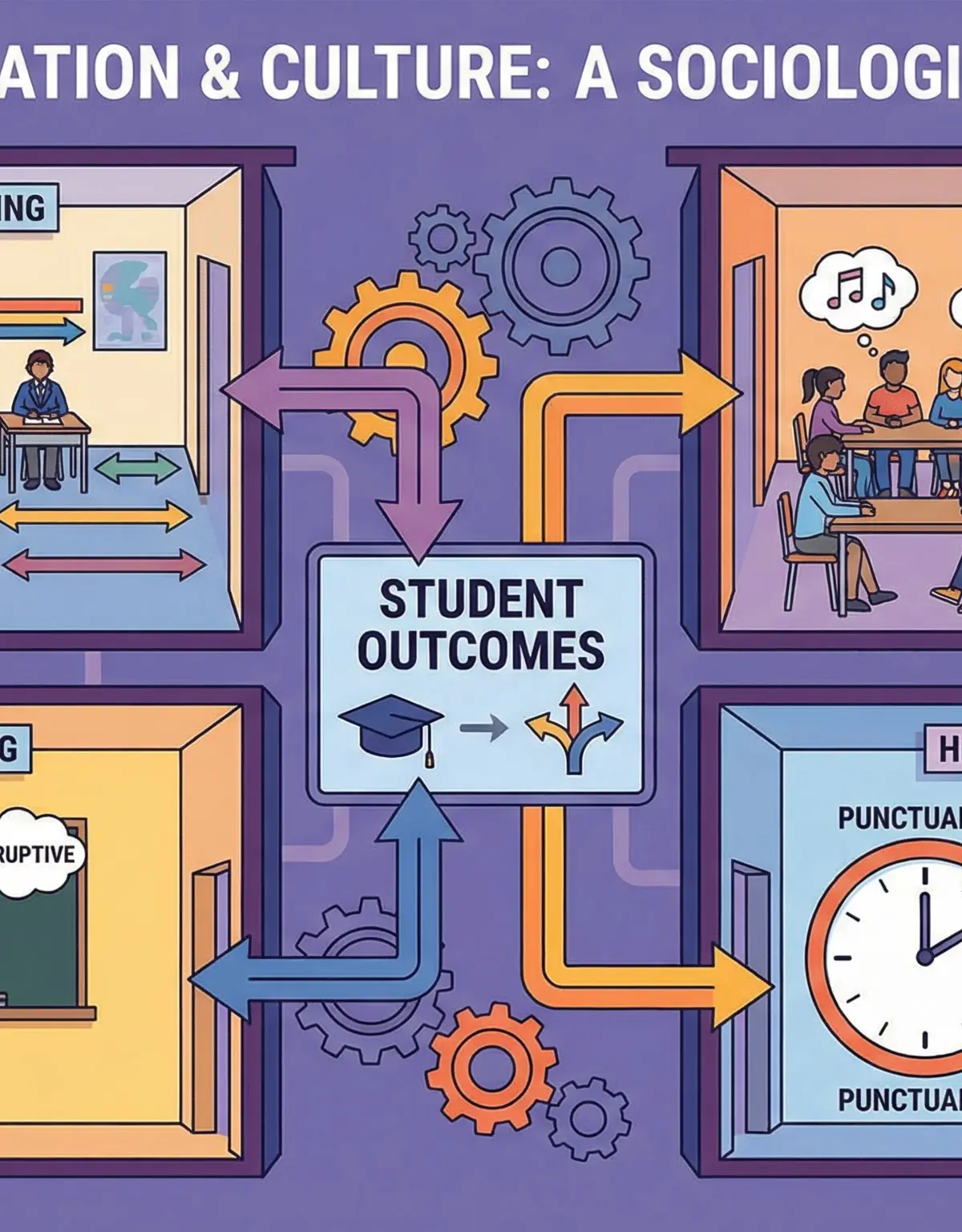
Welcome to your deep dive into School Organisation and Culture for OCR GCSE Sociology (J204). This topic moves beyond looking at factors outside the school (like home life) and focuses on the internal processes within the school gates that have a profound impact on educational achievement. Examiners expect candidates to understand and evaluate how the school's very structure and culture can create and reinforce social inequalities. We will explore the subtle but powerful influence of the Hidden Curriculum, the impact of Teacher Labelling and the self-fulfilling prophecy, the organisational tools of Banding, Streaming, and Setting, and the formation of Pupil Subcultures. This is a cornerstone of the sociology of education, blending micro-level Interactionist perspectives with macro-level Structuralist theories from Functionalism and Marxism. Marks are awarded for showing the connections between these processes and using specific sociological studies to support your analysis.
Key Concepts & Sociological Perspectives
The Hidden Curriculum
What it is: The Hidden Curriculum consists of the unwritten, unofficial, and often unintended lessons, values, and norms that students learn in school. It's distinct from the formal National Curriculum. It's taught through the everyday functioning of the school, such as the hierarchy of authority, the importance of punctuality, and the expectation of obedience.
Why it matters: Functionalists like Talcott Parsons see the hidden curriculum as a positive force, acting as a 'bridge' between the family and wider society, teaching universalistic values and preparing students for their roles in a meritocratic society. However, Marxists like Bowles and Gintis offer a critical perspective. They argue the hidden curriculum reproduces class inequality by creating a subservient, docile, and fragmented workforce. For example, by teaching working-class students to accept hierarchy and obey rules without question, it prepares them for low-status, alienating jobs in a capitalist system. This is what they call the 'correspondence principle'.
Specific Knowledge: Candidates must be able to distinguish the hidden curriculum from the formal curriculum and cite either the Functionalist or Marxist view with named sociologists.
Teacher Labelling and the Self-Fulfilling Prophecy
What happened: Interactionist sociologists focus on the power of face-to-face interactions in shaping social reality. Howard Becker's (1971) study of Chicago high school teachers is a classic example. He found that teachers often hold a stereotype of the 'Ideal Pupil' – typically a student who is middle-class, well-dressed, and speaks in elaborate code. Students who conform to this ideal are positively labelled, while those who do not (often working-class or minority ethnic students) are negatively labelled.
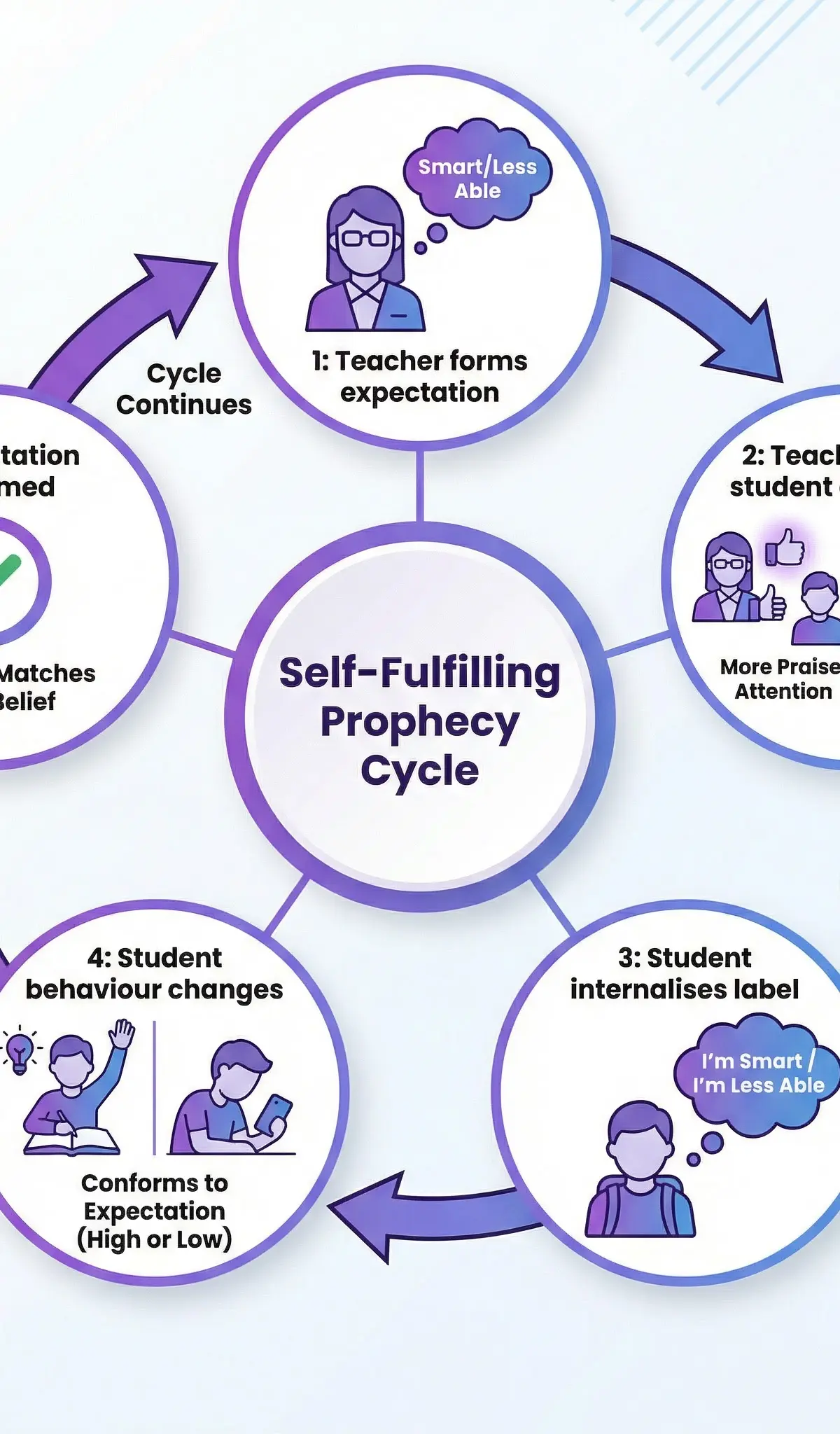
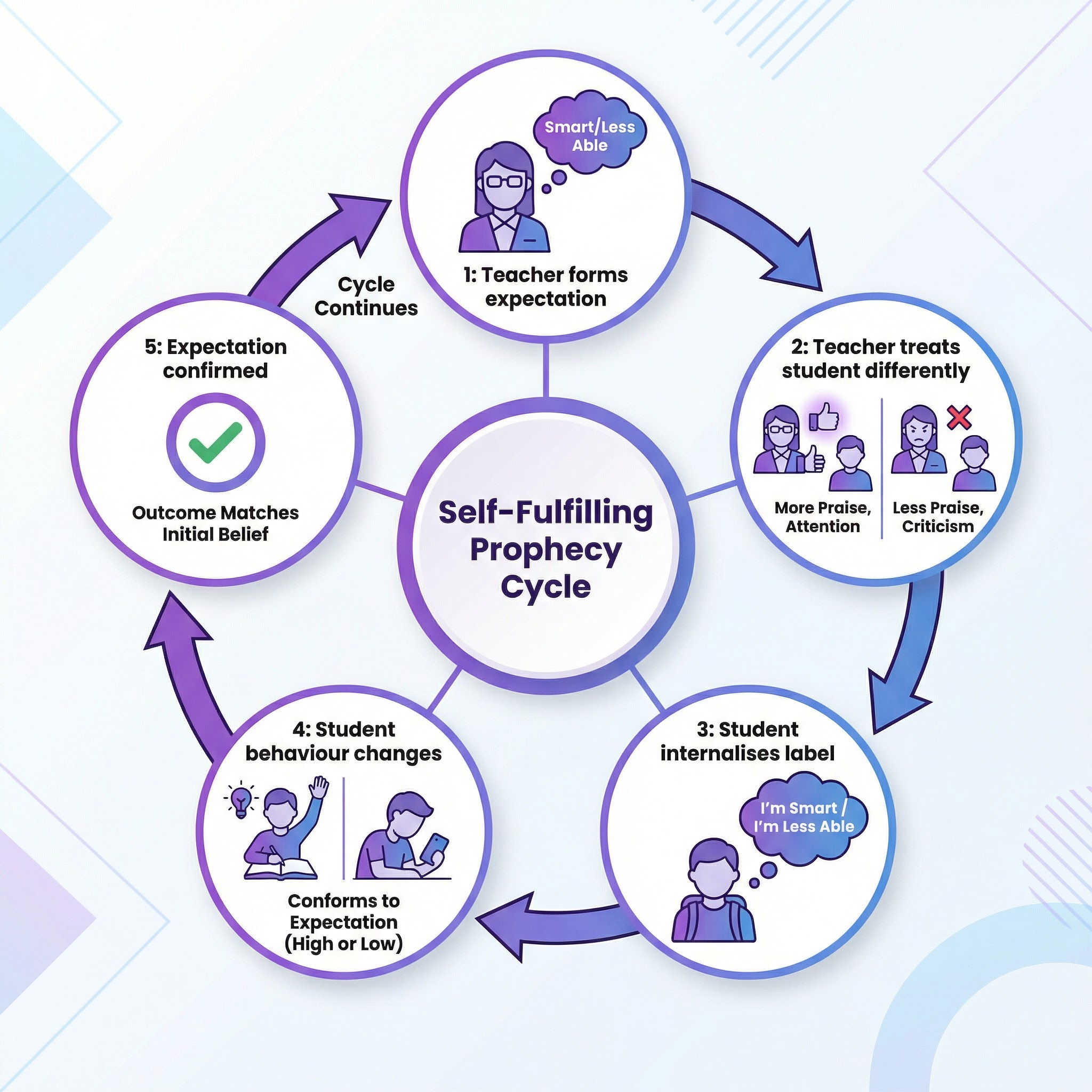
Why it matters: This initial label can trigger a Self-Fulfilling Prophecy (SFP), a concept developed by Robert Merton. The SFP is a three-stage process where a false belief or prediction comes true simply because it has been made. In schools, this works as follows:
- The teacher applies a label (e.g., 'bright', 'troublemaker').
- The teacher acts differently towards the student based on the label (e.g., giving more challenging work to the 'bright' student, or punishing the 'troublemaker' more harshly).
- The student internalises the label and their self-concept changes, leading them to behave in the way the teacher expected.
Rosenthal and Jacobson's (1968) famous field experiment, Pygmalion in the Classroom, demonstrated this powerfully. They told teachers that a random 20% of students were 'spurters' who would make rapid academic progress. A year later, this randomly selected group had indeed made significant gains in IQ, purely because of the higher expectations and positive interactions from their teachers.
Banding, Streaming, and Setting
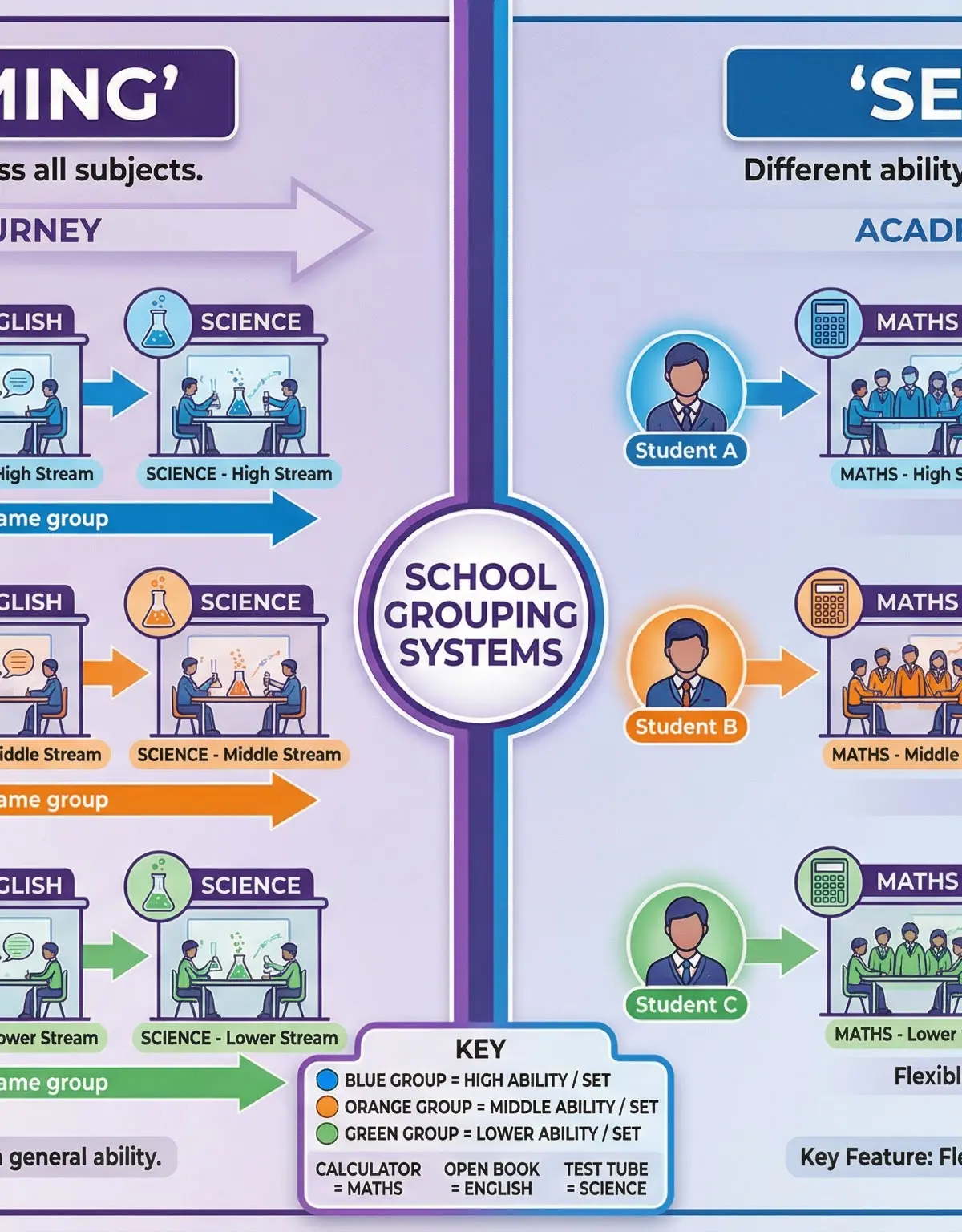
What it is: These are methods schools use to group students by ability. It's crucial to distinguish between them:
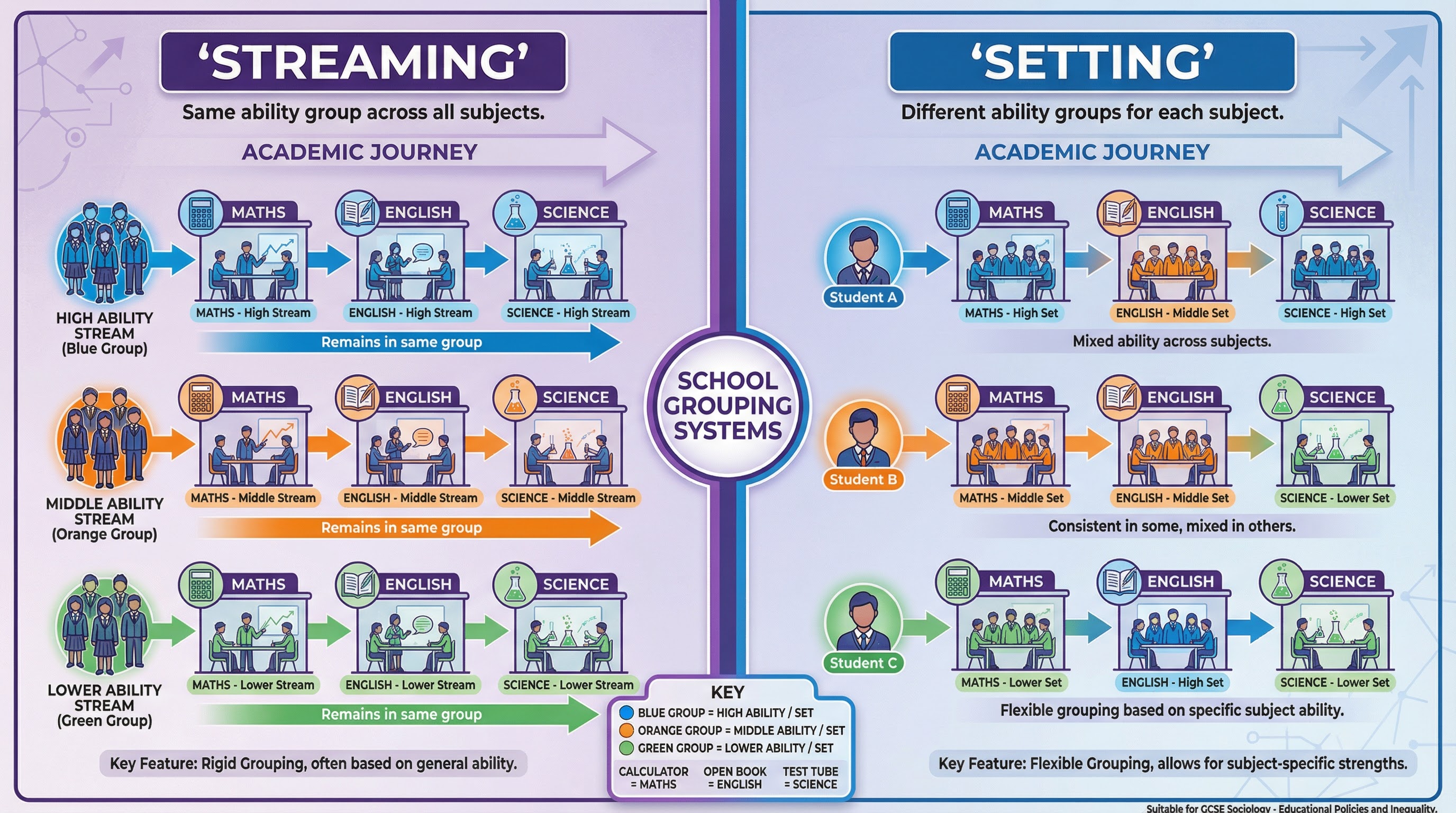
- Streaming: Students are sorted into ability groups (streams) and stay in that group for all subjects.
- Setting: Students are placed in ability groups (sets) for specific subjects. A student could be in the top set for Maths but a lower set for English.
- Banding: A broader form of streaming where schools ensure a balanced intake of different ability levels.
Why it matters: Sociologists argue that these grouping methods have a significant impact on achievement. Stephen Ball's (1981) research at 'Beachside Comprehensive' found that students in top streams were 'warmed up' for academic success, while those in lower streams were 'cooled down' and directed towards vocational courses. This process, known as differentiation, often leads to polarisation, where students divide into two opposing groups: pro-school and anti-school subcultures.
Pupil Subcultures
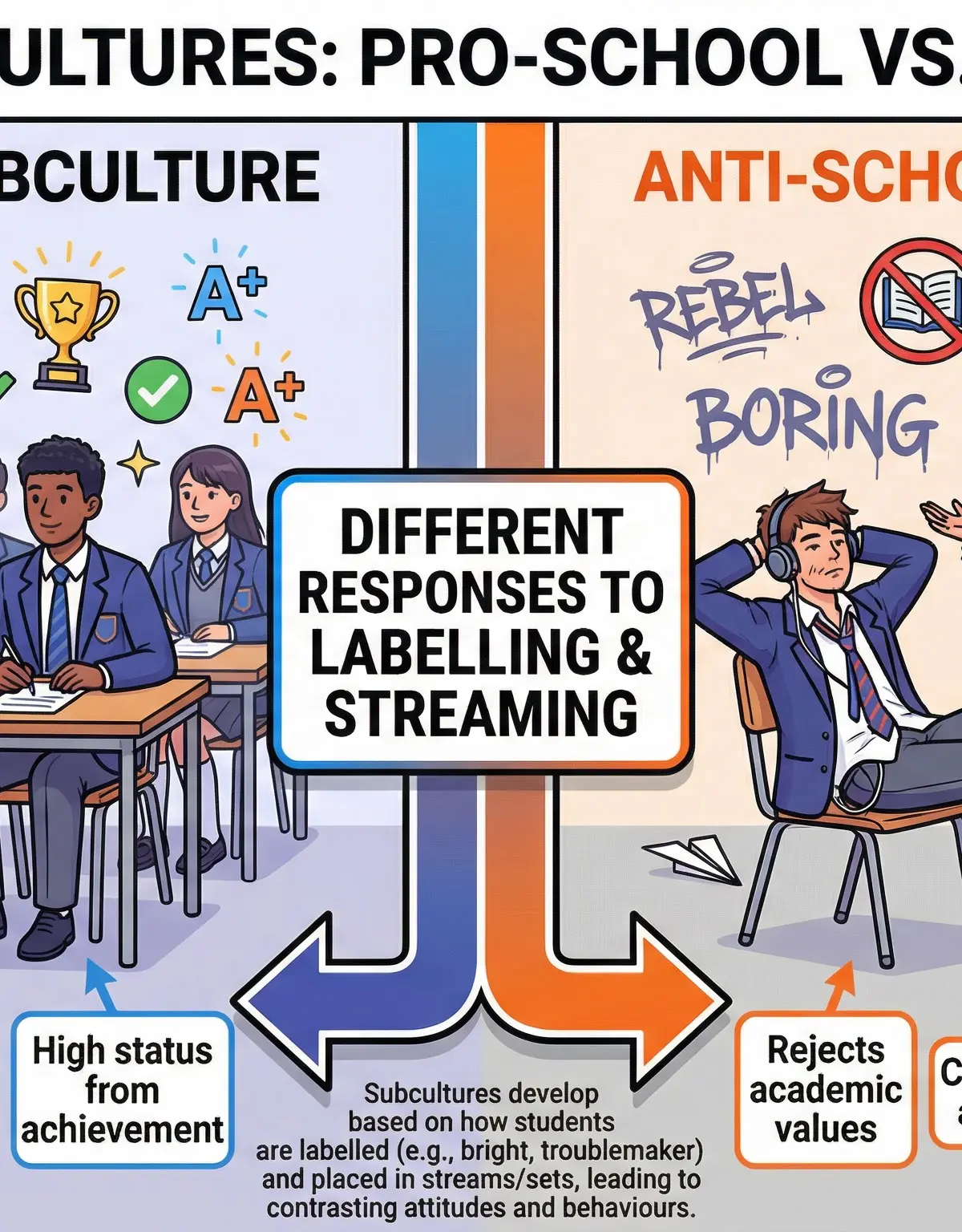
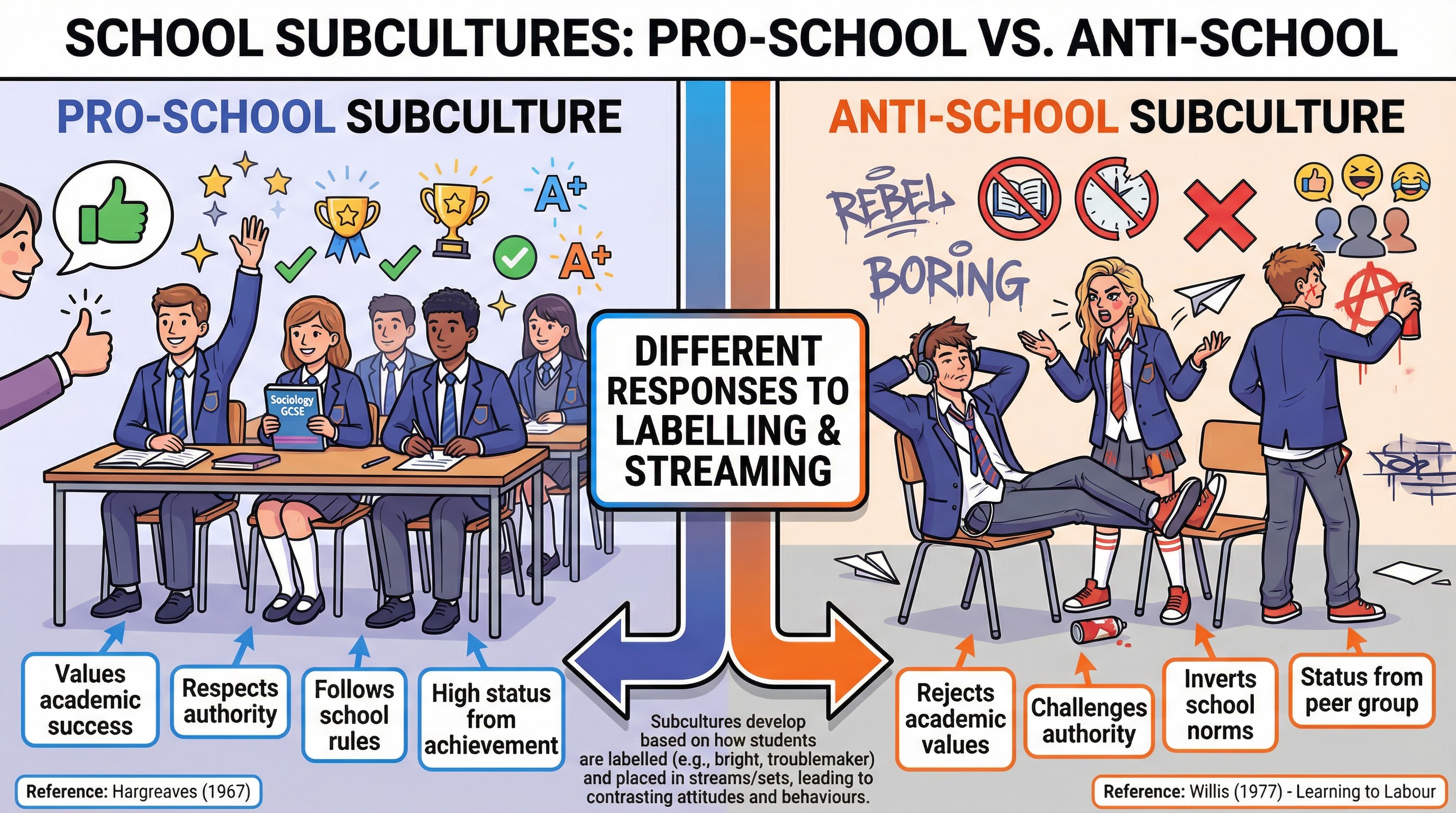
What they are: Pupil subcultures are groups of students who share similar values and behaviour patterns, which often emerge in response to labelling and streaming. They can be pro-school or anti-school.
- Pro-School Subcultures: Typically formed by students in higher streams. They accept the school's ethos, value academic achievement, and conform to the rules. They gain status through academic success.
- Anti-School Subcultures: Often formed by students in lower streams who have been negatively labelled. They reject the school's values, gain status by challenging authority and inverting school norms (e.g., being disruptive is seen as 'cool').
Why it matters: David Hargreaves (1967) found that boys in the lower streams of a secondary modern school were 'triple failures': they had failed their 11+, been placed in low streams, and were labelled as 'worthless louts'. They formed an anti-school subculture as a way of gaining status and self-worth that was denied to them by the school system. Paul Willis's (1977) neo-Marxist study, Learning to Labour, showed how a group of working-class 'lads' developed a 'counter-school culture' that directly opposed the values of the school. This prepared them for the boredom and monotony of the factory floor, ensuring they followed in their fathers' footsteps into manual labour, thus reproducing class inequality.
Second-Order Concepts
Causation
- Long-term causes: The structure of the education system and its relationship with the economy (Marxism) and social solidarity (Functionalism).
- Mid-term causes: School policies on grouping (streaming/setting), school ethos, and the prevalence of class-based stereotypes among teaching staff.
- Triggers: Specific teacher-pupil interactions, the application of a label, and the student's reaction to it.
Consequence
- Immediate effects: Students being placed in different ability groups, receiving different levels of teacher attention and encouragement.
- Long-term effects: The formation of subcultures, internalisation of labels leading to the self-fulfilling prophecy, and ultimately, differential educational achievement that reinforces the existing class structure.
Change & Continuity
- Change: The move from the tripartite system to comprehensive schools was intended to reduce inequality, and some schools have moved away from streaming (like in Ball's study). There is more awareness today of the effects of labelling.
- Continuity: Despite these changes, the hidden curriculum persists, labelling still occurs, and a strong correlation between social class and educational achievement remains. Marketisation policies may even increase the pressure on schools to stream and select 'ideal' pupils.
Significance
- This topic is highly significant because it demonstrates that schools are not neutral institutions. They are active agents in the process of social reproduction. The internal organisation and culture of a school can have as much, if not more, of an impact on a student's life chances as their background.
Source Skills
When presented with a source on this topic (e.g., a quote from a teacher, an observation of a classroom), candidates should analyse it by considering:
- Content: What does the source explicitly say about school processes? Does it show evidence of labelling, the hidden curriculum, or subcultural responses?
- Provenance: Who created the source? A teacher? A student? A sociologist? What is their perspective and potential bias?
- Application: How can you link the source to sociological concepts (e.g., 'ideal pupil', 'self-fulfilling prophecy') and studies (e.g., Becker, Ball)?
- Evaluation: How useful is the source? What are its limitations? A single teacher's view is not necessarily representative of all teachers.
Visual Resources
3 diagrams and illustrations
Interactive Diagrams
1 interactive diagram to visualise key concepts
Conceptual Flow Outline
Flowchart showing the interaction between external and internal factors leading to differential achievement.
Worked Examples
3 worked examples — open one to explore the question and available guidance.
Practice Questions
Try the question, then reveal an answer plan or example response
Outline two ways in which schools may group pupils by ability. (4 marks)
Hint: Think about the key terms for ability grouping and define them clearly.
Explain what sociologists mean by an anti-school subculture. (4 marks)
Hint: Define the term and give examples of behaviours. Mention a key study if you can.
Using material from Item A, analyse two ways that teacher labelling can affect pupil achievement. (10 marks) [Item A not provided, but question is generic]
Hint: This is an 'analyse with item' question. You must use the hooks in the (hypothetical) item and link them to your own sociological knowledge. Structure as two PEE paragraphs.
Outline and explain two criticisms of labelling theory. (8 marks)
Hint: Think about determinism and the focus of the theory.
Evaluate the view that the main function of the education system is to reproduce and legitimise social inequality. (20 marks) [Synoptic Question]
Hint: This is a top-tariff essay question. You need to contrast Marxist views with Functionalist and New Right views.
Exam technique
How to turn what you know into marks
How to approach the question
1. **Identify the command word**: 'Explain', 'Outline', 'Discuss how far'. This tells you the required skill. 2. **Identify the topic**: What part of the specification is it asking about? (e.g., labelling, subcultures). 3. **Identify the focus**: What is the specific angle? (e.g., 'between social classes', 'on educational achievement').
How to structure your answer
- Explain questions
- PEE: Point, Evidence (sociologist or concept), Explanation.
- Outline questions
- Provide the requested number of points with a brief development for each. No need for a conclusion.
- Discuss how far questions
- Introduction setting up the debate. 2-3 paragraphs for the argument (e.g., for internal factors). 1-2 paragraphs against the argument (e.g., for external factors). A conclusion that makes a clear judgement.
Timing
Approximately 1.25 minutes per mark. For a 12-mark question, this means 15 minutes.
Common pitfalls
- Conflating 'setting' and 'streaming'.
- Describing studies without explaining their significance or linking them to the question.
- Providing a one-sided argument for 'discuss' questions.
- Forgetting to evaluate - always consider the limitations of a study or theory, or bring in alternative explanations.
What the command words want
- Outline
- Give the main points in brief. No deep explanation needed.
- Describe
- Say what it is. Give the key features.
- Explain how/why
- Give reasons. Show the process. Use phrases like 'this leads to...' or 'this is because...'.
- Discuss how far/To what extent
- This requires evaluation. You must look at both sides of the argument and make a judgement in your conclusion.
Watch or listen (optional)
Test your understanding of School organisation and culture
Active recall beats re-reading. Take an instant quiz now to test what you’ve learned and lock it into long-term memory.
7 days Premium · Then the free plan continues · No card, no charge