Wealth Revision Notes
Subject: Sociology | Level: GCSE | Exam Board: OCR
This study guide delves into the critical sociological topic of wealth and inequality in the UK, providing a comprehensive resource for OCR GCSE students. It explores the crucial distinction between wealth and income, analyses theoretical debates, and connects wealth to tangible life chances, equipping candidates with the knowledge to excel in their exams.
Revision Notes & Key Concepts
Revision Podcast Transcript
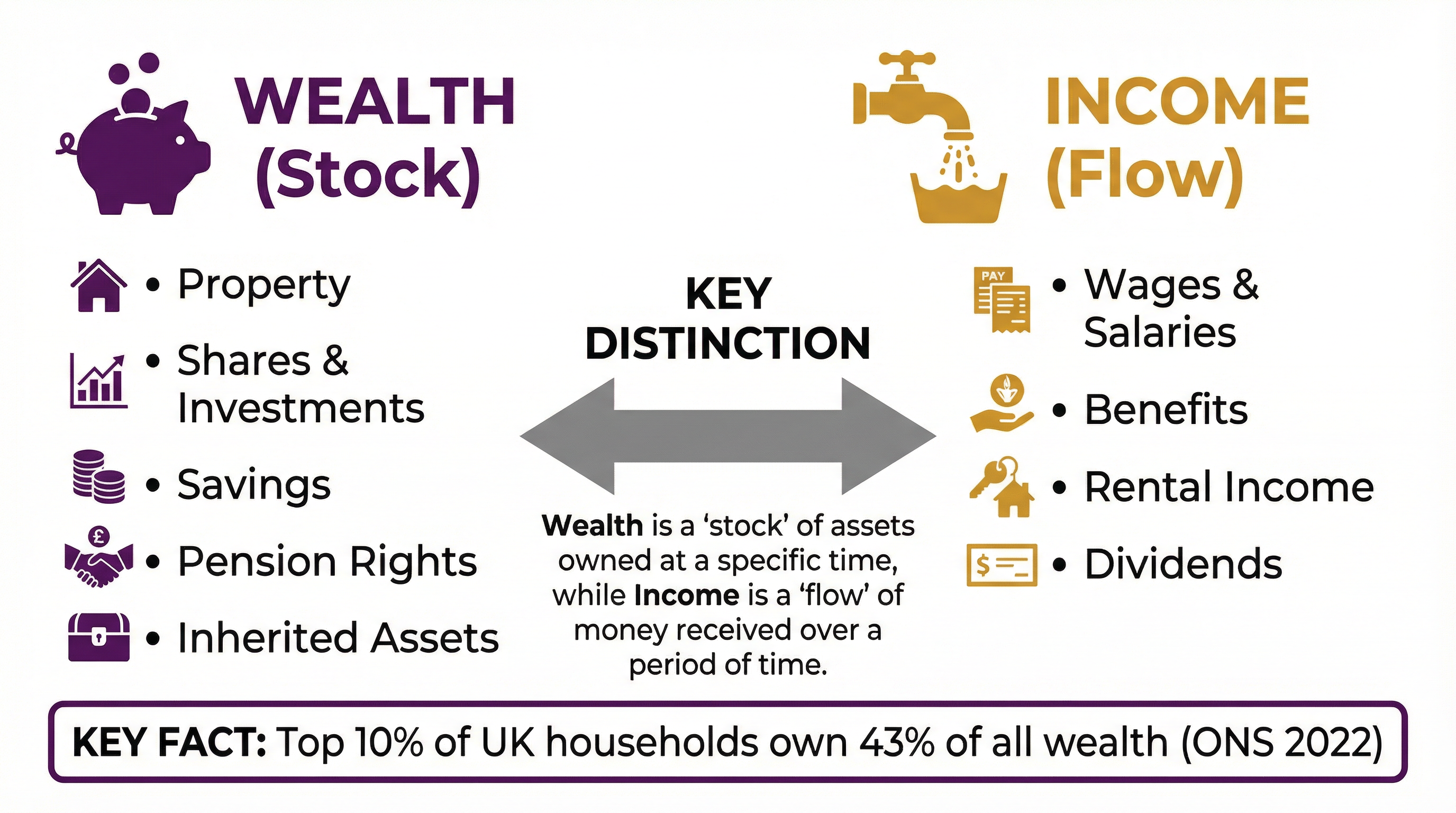
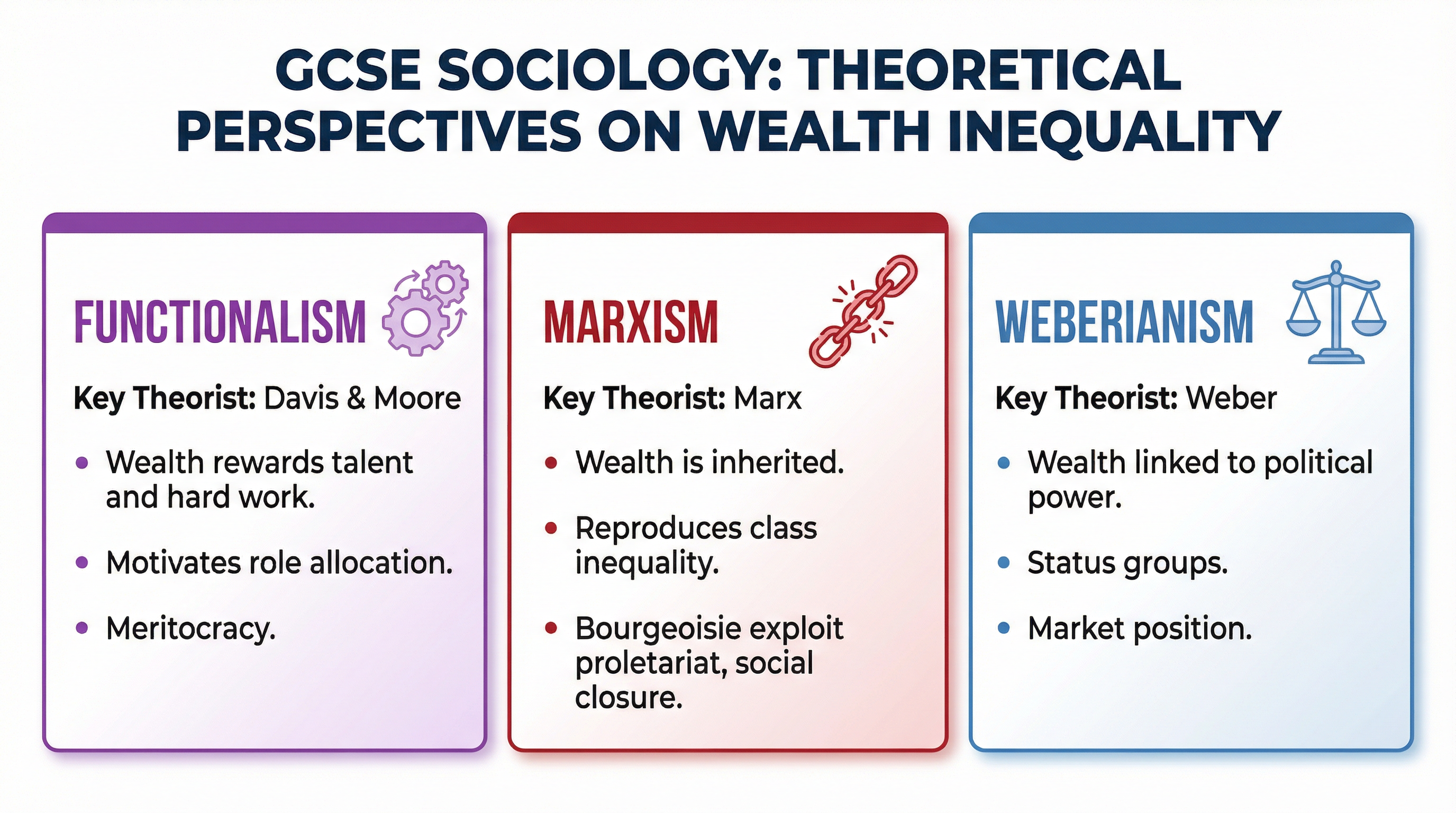
Welcome to Sociology Sorted — your go-to revision podcast for OCR GCSE Sociology. I'm your host, and today we're diving into one of the most important and fascinating topics on the specification: Wealth. Whether you're revising for your mock or the real thing, this episode is going to give you everything you need to walk into that exam hall feeling confident. So grab a pen, get comfortable, and let's get started. Now, before we dive into the content, let me tell you why this topic matters. Wealth is not just about money. It's about power. It's about opportunity. It's about who gets ahead in society and — crucially — why. The OCR mark scheme rewards candidates who can link wealth to life chances, apply sociological theory, and use real data. By the end of this episode, you'll be able to do all three. Let's begin with the single most important distinction in this entire topic, and it's one that trips up so many candidates in the exam. The difference between wealth and income. Wealth is a stock. Think of it like a lake — it's the total amount of water sitting there at any given moment. Wealth is the total value of all the assets a person owns: their property, their shares, their savings, their pension rights, any inherited assets. It's what you have accumulated over time. Income, on the other hand, is a flow. Think of it like a river — it's money coming in over a period of time. Wages, salaries, benefits, rental income — these are all forms of income. They flow in and flow out. Here's the critical exam point: a person can have a very high income but very little wealth. A young professional earning sixty thousand pounds a year but renting a flat and with no savings has high income but low wealth. Conversely, a retired person might have low income but enormous wealth in the form of a paid-off house and a large pension pot. Examiners specifically credit candidates who make this distinction clearly and explicitly. If you write "wealthy people earn a lot of money," you will lose marks. Always say: wealth is accumulated assets, income is a flow of earnings. Now, within wealth itself, there's another distinction worth knowing. Marketable wealth versus non-marketable wealth. Marketable wealth is assets you can sell — property, shares, savings. Non-marketable wealth includes things like occupational pension rights — you can't sell your pension, but it still represents significant financial security. This is a more sophisticated point that can push you into the higher mark bands. Right, so now we know what wealth is. Let's look at how it's distributed in the UK, because the data here is genuinely striking. According to the Office for National Statistics — the ONS — the wealthiest ten percent of households in the UK own approximately forty-three percent of all household wealth. Let that sink in. Ten percent of people own nearly half of everything. The bottom fifty percent of households, by contrast, own just nine percent of total wealth. The ONS Wealth and Assets Survey is the key source here. Always name it in your exam answers. Examiners love to see you reference real, named data sources. Now, what drives this inequality? This is where the theoretical perspectives come in, and this is where you can really show off your sociological thinking. Let's start with Functionalism. The key theorists here are Kingsley Davis and Wilbert Moore, who published their theory of stratification in 1945. Davis and Moore argued that inequality — including wealth inequality — is not only inevitable but actually necessary for society to function. Their argument goes like this: some roles in society are more important than others, and they require rare talents or long periods of training. To motivate the most talented people to fill these roles, society must offer greater financial rewards. So a brain surgeon earns more than a checkout worker not because of exploitation, but because society needs to incentivise people to undertake the difficult training required. From a Functionalist perspective, then, wealth is a just reward for talent, effort, and contribution. Society is essentially a meritocracy — a system where you get what you deserve based on your abilities and hard work. But here's where you need to show critical thinking. The Functionalist view has serious weaknesses. It assumes that the current distribution of wealth reflects genuine merit. But what about inherited wealth? If someone is born into a wealthy family, receives a private education, and inherits property worth millions of pounds, is that a reward for their talent? Critics would say no. And this is exactly where the Marxist perspective becomes powerful. Karl Marx argued that wealth inequality is not the result of merit — it is the result of exploitation and the reproduction of class inequality. For Marx, society is divided into two fundamental classes: the bourgeoisie, who own the means of production — the factories, the land, the capital — and the proletariat, who own nothing but their own labour power and must sell it to survive. Wealth, in the Marxist view, is not earned through hard work. It is accumulated through the exploitation of workers, who produce more value than they are paid for. The surplus value goes to the capitalist class as profit, which is then reinvested to generate more wealth. This is how wealth reproduces itself across generations. A key Marxist concept here is social closure — the idea that the wealthy use their power to restrict access to wealth and opportunity, keeping others out. This happens through inheritance, through elite private schooling, through social networks. The system is rigged to reproduce inequality, not to reward merit. Now let's bring in a third perspective: Weberianism. Max Weber agreed with Marx that class — defined by your economic position — matters enormously. But he added two further dimensions: status and party. Status refers to social prestige and honour — not just how much money you have, but how you are regarded in society. Party refers to political power and organisation. The Weberian insight for wealth is crucial: wealth is not just an economic phenomenon, it is a political one. Wealthy individuals and corporations use their economic power to influence political decisions — through lobbying, through funding political parties, through owning media outlets. This gives them disproportionate power to shape the rules of the game in their favour. This is sometimes called the power elite — a concept developed by C. Wright Mills, who argued that a small group of wealthy individuals effectively control political, military, and economic institutions in capitalist societies. So to summarise the theoretical debate: Functionalists say wealth inequality is justified and necessary because it motivates talent. Marxists say it is the product of exploitation and reproduces class inequality across generations. Weberians say wealth is linked to political power and status, not just economic position. Now let's talk about why wealth matters — and this is where you connect to life chances, which is absolutely essential for AO2 marks. The concept of life chances was developed by Max Weber. It refers to the opportunities an individual has to improve their quality of life — their chances of good health, good education, good housing, and a long life. And the evidence is overwhelming that wealth dramatically shapes life chances. In terms of health: wealthier individuals live longer. According to Public Health England data, the gap in life expectancy between the richest and poorest areas of the UK is approximately ten years for men. Wealth enables access to private healthcare, better nutrition, less stressful living conditions, and safer housing. In terms of education: wealth enables access to private schooling — where fees can exceed forty thousand pounds per year — and to private tutoring. Research by the Sutton Trust found that privately educated students are significantly over-represented at elite universities like Oxford and Cambridge, which in turn leads to higher-earning careers. This is what sociologists call the cycle of privilege. In terms of housing: wealth enables home ownership, which itself generates further wealth through rising property values. Those who cannot afford to buy are trapped in the private rental sector, paying high rents that prevent them from saving and accumulating assets of their own. And in the context of the current cost of living crisis — which is a brilliant contemporary example to use in your exam — the impact of wealth inequality is starker than ever. Those with savings and assets have a financial buffer. Those without wealth have been hit hardest by rising food prices, energy bills, and rents. This illustrates the difference between absolute poverty — lacking the basic necessities of life — and relative poverty — being unable to afford the standard of living considered normal in your society. Right, let's move into exam tips and common mistakes, because this is where marks are won and lost. Common mistake number one: conflating income and wealth. I cannot stress this enough. If a question asks about wealth, do not write about wages or salaries unless you are explicitly contrasting them. Always define wealth as accumulated assets at the start of your answer. Common mistake number two: making normative assertions without theoretical backing. Saying "it's unfair that some people are so much wealthier than others" will not earn you marks. You need to say: "From a Marxist perspective, this inequality is the result of exploitation and the reproduction of class advantage through inheritance." Theory first, always. Common mistake number three: failing to critique meritocracy. If you present the Functionalist view, you must also challenge it. Ask: does inherited wealth reflect merit? Does private education give some children an unfair advantage? The mark scheme rewards candidates who evaluate, not just describe. For 24-mark extended writing questions, your conclusion must provide a definitive judgement. Don't sit on the fence. Say something like: "Overall, the evidence suggests that wealth inequality in the UK is better explained by the Marxist emphasis on inheritance and social closure than by the Functionalist concept of meritocracy, given that a significant proportion of the wealthiest individuals in the UK have inherited rather than earned their wealth." For command words: "Describe" means give two developed features with supporting detail. "Explain" means give reasons with sociological evidence. "Evaluate" or "How far do you agree" means balanced argument, counter-argument, and a clear judgement. Now let's do a quick-fire recall quiz. I'll ask the question, give you five seconds to think, then give the answer. Ready? Question one: What is the difference between wealth and income? Wealth is a stock of accumulated assets; income is a flow of money received over time. Question two: According to the ONS, what percentage of UK household wealth is owned by the top ten percent? Approximately forty-three percent. Question three: Which two sociologists developed the Functionalist theory of stratification in 1945? Kingsley Davis and Wilbert Moore. Question four: What is social closure? The process by which the wealthy restrict access to wealth and opportunity to maintain their privileged position. Question five: What concept did Weber use to describe the opportunities individuals have to improve their quality of life? Life chances. Question six: What is the difference between marketable and non-marketable wealth? Marketable wealth can be sold, such as property and shares. Non-marketable wealth cannot be sold, such as pension rights. How did you do? If you got all six, you're in great shape. If you missed some, go back and review those sections. Let's wrap up with a quick summary of everything we've covered today. Wealth is a stock of accumulated assets — property, shares, savings, pension rights. Income is a flow. Never confuse them. The top ten percent of UK households own forty-three percent of all wealth, according to the ONS Wealth and Assets Survey. Functionalists — Davis and Moore — argue wealth inequality is necessary to motivate talent in a meritocratic society. Marxists argue it is the product of exploitation and inheritance. Weberians link wealth to political power and status. Wealth shapes life chances in health, education, and housing. Always make these links explicit in your exam answers. Critique meritocracy. Reference inheritance. Use the cost of living crisis as a contemporary example. And always end extended answers with a clear, definitive judgement. That's it for today's episode of Sociology Sorted. You've got this. Good luck with your revision, and I'll see you in the next episode.
Key Terms & Definitions
- Wealth
- A stock of assets held by a person or household at a single point in time, including financial assets (e.g., shares), property, and pension rights.
- Income
- Money received by an individual or household over a period of time, including wages, salaries, and benefits.
- Life Chances
- A concept, associated with Max Weber, for the opportunities each individual has to improve their quality of life, particularly in relation to health, education, and housing.
- Meritocracy
- A social system in which advancement is based on individual ability or achievement. A core concept in Functionalism.
- Social Closure
- The process whereby a dominant group restricts access to rewards, such as wealth and status, to a limited circle of people.
- Bourgeoisie
- The Marxist term for the ruling class in a capitalist society who own the means of production (e.g., factories, land, capital).
Worked Examples
Worked Example
Question: Explain, using two examples, how wealth can affect an individual’s life chances. (12 marks)
Solution: **Introduction**: Wealth, defined as a stock of accumulated assets, has a profound impact on an individual's life chances — their opportunities to achieve a good quality of life. This answer will explain how wealth affects the life chances of education and health. **Paragraph 1 - Education**: One major way wealth affects life chances is through education. Wealthier families can afford to send their children to private schools, which often have smaller class sizes, better facilities, and extensive networks. For example, according to The Sutton Trust, pupils from independent schools are seven times more likely to attend a top university like Oxford or Cambridge compared to those from state schools. This access to elite education provides a significant advantage in securing high-status, high-income careers, thus allowing wealth to be passed down through generations. This creates a cycle of privilege where wealth, not just merit, determines educational success. **Paragraph 2 - Health**: A second example is the impact of wealth on health outcomes. Individuals with significant wealth can afford private healthcare, avoiding long NHS waiting lists and accessing specialist treatments. Furthermore, wealth allows for a healthier lifestyle; for instance, being able to afford organic food, gym memberships, and housing in less polluted areas. ONS data shows a clear social gradient in health, with life expectancy for men in the most deprived areas of England being 9.7 years shorter than in the least deprived areas. This demonstrates that wealth is a critical determinant of both how long and how well a person lives. **Conclusion**: In conclusion, wealth is a powerful factor shaping an individual's opportunities in life. Through providing access to elite education and better healthcare, wealth creates and reinforces social inequality, challenging the Functionalist idea that society is a pure meritocracy.
Worked Example
Question: Outline and evaluate the Functionalist view of wealth inequality. (24 marks)
Solution: **Introduction**: The Functionalist perspective, most famously articulated by Davis and Moore, argues that wealth inequality is not only inevitable but also a positive and necessary feature of a healthy society. They contend that it serves the function of motivating the most talented individuals to fill the most important societal roles. However, this view has been heavily criticised by other perspectives, particularly Marxism, for ignoring the role of inheritance and exploitation in creating and sustaining wealth disparities. **Paragraph 1 - The Functionalist Argument (Role Allocation)**: Functionalists argue that society is a complex system of interconnected parts, and to function effectively, it must have a system of role allocation. Some roles are more functionally important than others and require greater skill or longer training. To incentivise the best candidates to pursue these roles (e.g., doctors, scientists), society must offer greater rewards, including higher income and the opportunity to accumulate wealth. In this view, wealth inequality is a fair and just outcome of a meritocratic system where talent and effort are rewarded. **Paragraph 2 - The Functionalist Argument (Meritocracy)**: Central to the Functionalist view is the concept of meritocracy. They believe that in a modern industrial society, your social position is achieved, not ascribed at birth. Therefore, those with the most wealth are, in theory, the most talented and hardworking individuals who have made the greatest contribution to society. This inequality is seen as legitimate and beneficial for all, as it ensures the most capable people are in charge. **Paragraph 3 - Marxist Critique (Inheritance and Social Closure)**: A major criticism of the Functionalist view comes from Marxism. Marxists argue that the idea of a meritocracy is a myth that serves to justify ruling class ideology. They point to the significance of inheritance. A vast amount of wealth is not earned but passed down through generations. This means that an individual's starting point in life is determined by their family's wealth, not their own talent. This is a process of social closure, where the wealthy maintain their advantage and prevent social mobility. **Paragraph 4 - Weberian Critique (Power and Status)**: Weberians would also critique the purely functionalist view. While not dismissing merit entirely, Weber argued that wealth is intrinsically linked to political power (Party) and social status. The wealthy can use their resources to influence laws and policies in their favour, further cementing their advantage. This is not about functional importance but about the exercise of power. For example, lobbying for lower inheritance tax rates directly benefits the wealthy and has little to do with motivating talent. **Conclusion**: In conclusion, while the Functionalist view of wealth inequality provides a simple model for why some are richer than others, it is a limited and ideological explanation. Its failure to adequately account for the role of inheritance, power, and exploitation means it presents a flawed picture of society. The evidence of inherited wealth and the clear link between wealth and political influence strongly suggest that the UK is not the pure meritocracy Functionalists describe. Therefore, the Marxist and Weberian perspectives offer a more critical and sociologically robust explanation for the persistence of vast wealth inequality.
Practice Questions
Question: Describe two ways in which wealth is distributed unequally in the UK. (8 marks)
Answer:
Question: Explain the Marxist view of the role of inheritance in society. (12 marks)
Answer: