AQA · GCSE · Spanish
Theme 2: Local, national, international and global areas of interest
Master Theme 2 of GCSE Spanish, covering essential vocabulary for your town, the environment, social issues, and travel. You'll learn to confidently use three tenses, express justified opinions, and tackle all four exam skills to secure top marks.
- 13 min read
- 4 worked examples
- 6 practice questions
- 8 key terms
Study Notes
Overview
Welcome to Theme 2: Local, national, international and global areas of interest. This is a crucial area of the GCSE Spanish specification, appearing across Listening, Speaking, Reading, and Writing papers. It covers topics relevant to the real world: your town, the environment, social issues like poverty and volunteering, and travel. Examiners love this theme because it naturally invites complex opinions and the use of multiple tenses.
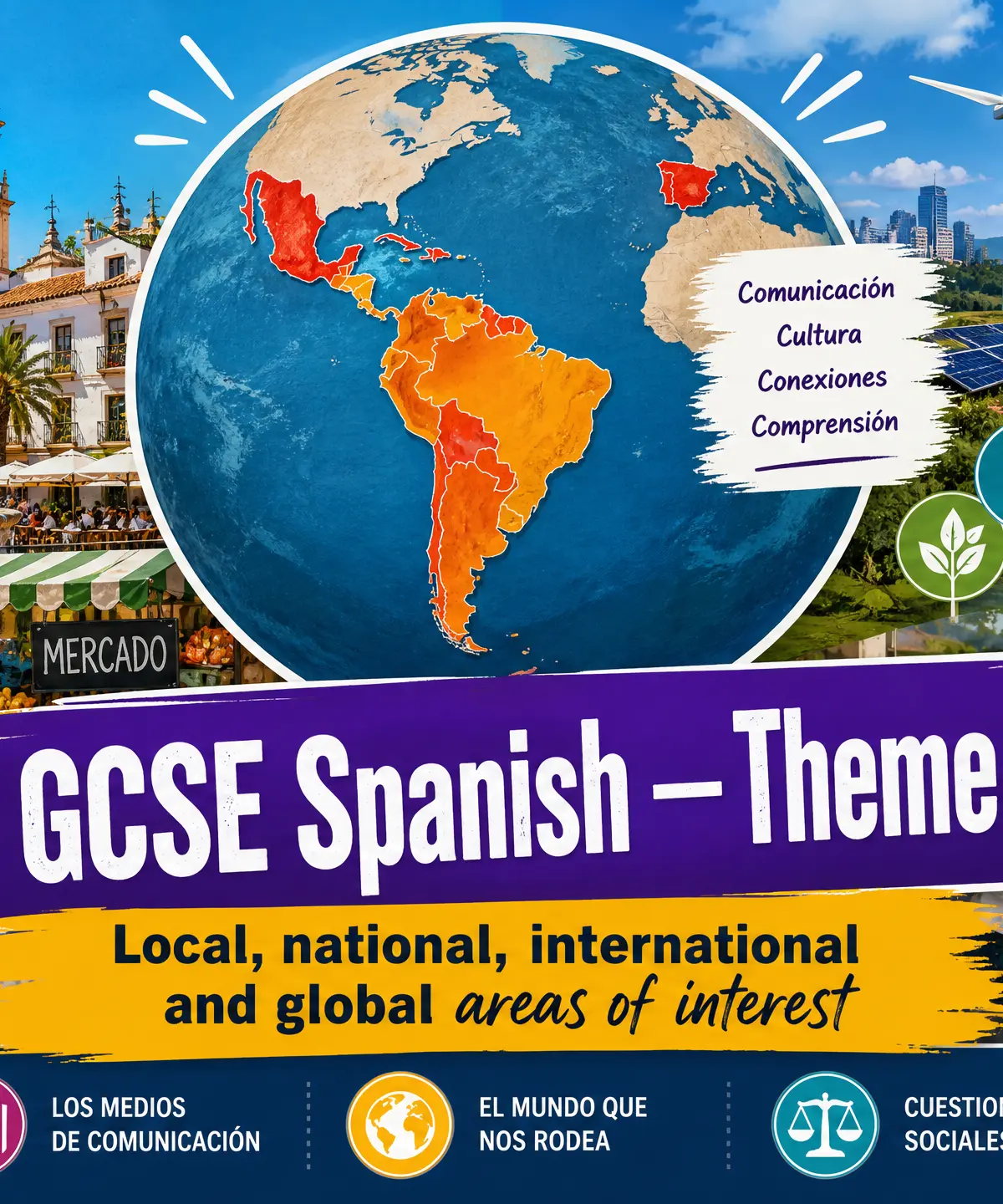
📖 Essential Vocabulary
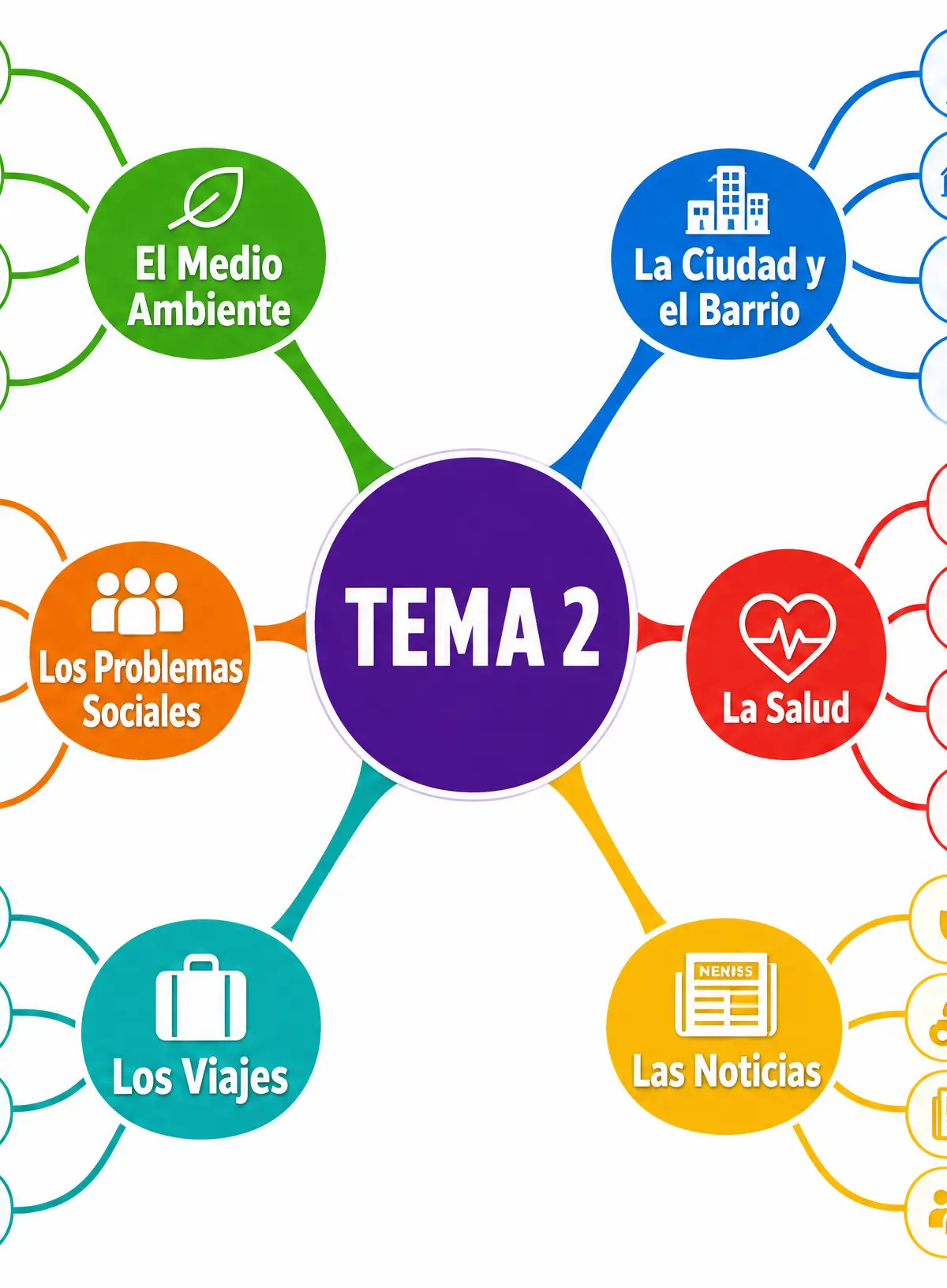
Tier 1 — Foundation Core
| Spanish | English | Gender | Example Sentence |
|---|---|---|---|
| el barrio | neighbourhood | m | Vivo en un barrio tranquilo. |
| la ciudad | city/town | f | Mi ciudad es muy grande. |
| el centro comercial | shopping centre | m | Voy al centro comercial los sábados. |
| el tráfico | traffic | m | Hay mucho tráfico por la mañana. |
| el medio ambiente | environment | m | Es importante proteger el medio ambiente. |
| reciclar | to recycle | verb | Siempre reciclo el plástico. |
| la basura | rubbish | f | Pon la basura en el cubo. |
| el problema | problem | m | La pobreza es un problema grande. |
| ayudar | to help | verb | Me gusta ayudar a los demás. |
| sano/a | healthy | adj | Llevo una vida muy sana. |
| el ejercicio | exercise | m | Hago ejercicio todos los días. |
| viajar | to travel | verb | Me encanta viajar en verano. |
| el hotel | hotel | m | Nos alojamos en un hotel bonito. |
| el avión | flight/plane | m | Prefiero viajar en avión. |
| las vacaciones | holidays | f | Mis vacaciones fueron geniales. |
Tier 2 — Higher Tier
| Spanish | English | Gender | Example Sentence |
|---|---|---|---|
| el ayuntamiento | town hall | m | El ayuntamiento ha construido un nuevo polideportivo. |
| la red de transporte | transport network | f | La red de transporte público es muy eficiente. |
| el calentamiento global | global warming | m | El calentamiento global es la mayor amenaza actual. |
| los combustibles fósiles | fossil fuels | m | Debemos reducir el uso de combustibles fósiles. |
| los sin techo | the homeless | m | Hay demasiados sin techo en las calles. |
| el voluntariado | voluntary work | m | Hice voluntariado en una residencia de ancianos. |
| la organización benéfica | charity | f | Recaudo fondos para una organización benéfica. |
| el alojamiento | accommodation | m | El alojamiento era de cinco estrellas. |
| el turismo de masas | mass tourism | m | El turismo de masas puede dañar el medio ambiente. |
| experimentar | to experience | verb | Me gusta experimentar nuevas culturas. |
High-Frequency Words & Phrases
| Phrase | English | Usage Context |
|---|---|---|
| a mi modo de ver | in my view | Introducing an opinion (Higher tier alternative to 'creo que') |
| por un lado... por otro lado | on one hand... on the other hand | Balancing an argument in writing or speaking |
| lo mejor es que | the best thing is that | Developing a description |
| lo peor es que | the worst thing is that | Providing a negative opinion |
| me preocupa que | it worries me that | Discussing global or social issues |
| hace falta | it is necessary to | Recommending action (e.g., for the environment) |
| sin embargo | however | Contrasting ideas |
| por lo tanto | therefore | Concluding a point |
| vale la pena | it is worth it | Recommending a place or action |
| si tuviera la oportunidad | if I had the opportunity | Using the conditional to express future desires |
📝 Grammar Focus
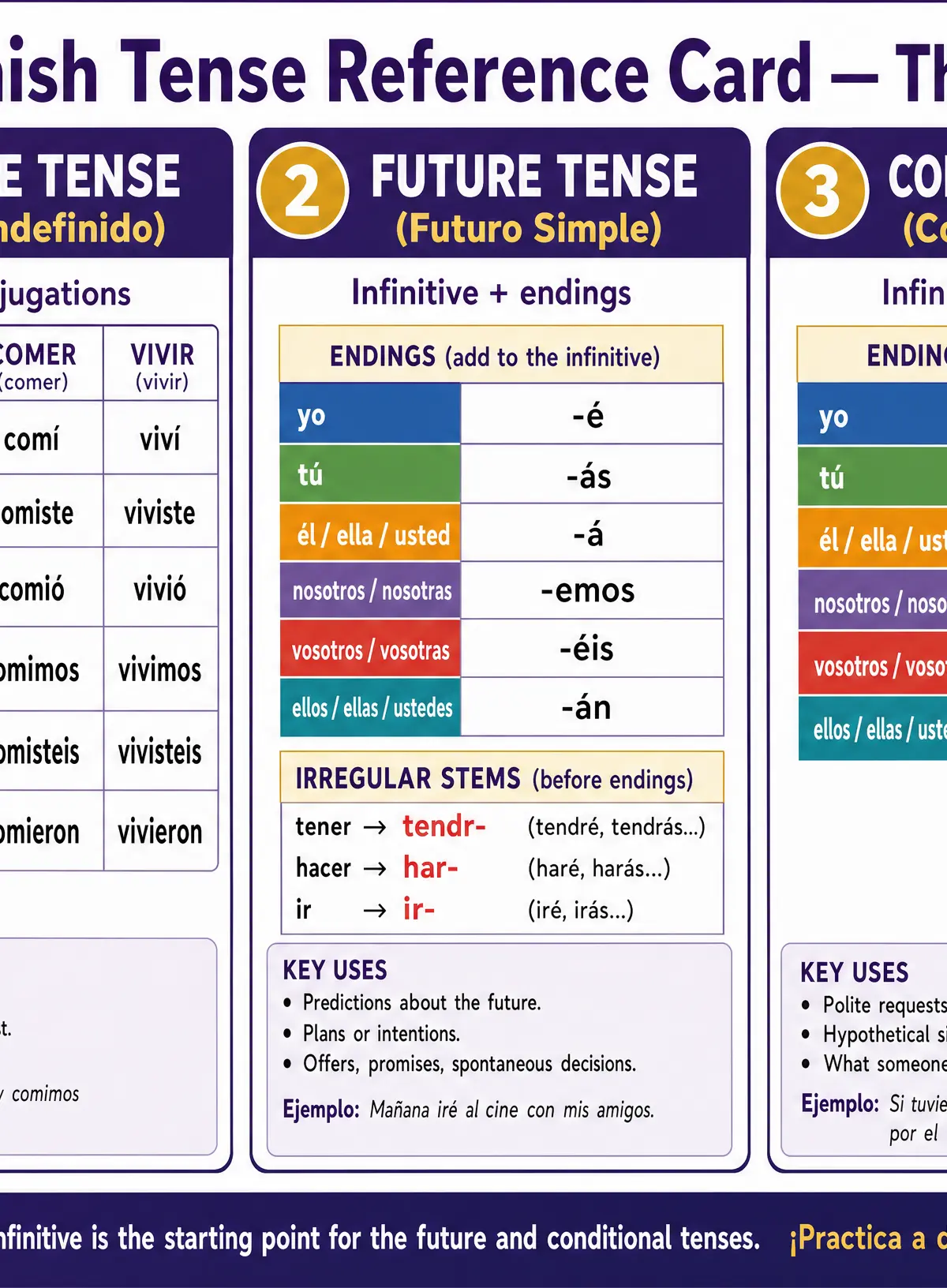
Key Structure 1: The Preterite Tense (Pretérito Indefinido)
When to use it: To describe completed actions in the past. Essential for recounting a past holiday or a past volunteering experience.
Conjugation Table
| Subject | -ar verbs (hablar) | -er verbs (comer) | -ir verbs (vivir) |
|---|---|---|---|
| yo | hablé | comí | viví |
| tú | hablaste | comiste | viviste |
| él/ella/usted | habló | comió | vivió |
| nosotros | hablamos | comimos | vivimos |
| vosotros | hablasteis | comisteis | vivisteis |
| ellos/ellas/ustedes | hablaron | comieron | vivieron |
Irregulars to learn: ir/ser (fui, fuiste, fue...), hacer (hice, hiciste, hizo...), tener (tuve, tuviste, tuvo...)
Key Structure 2: The Future Tense (Futuro Simple)
When to use it: To describe what will happen. Crucial for discussing future plans to help the environment or future holidays.
Conjugation Table
| Subject | All verbs (Infinitive + endings) | English Example (hablar) |
|---|---|---|
| yo | -é (hablaré) | I will speak |
| tú | -ás (hablarás) | You will speak |
| él/ella/usted | -á (hablará) | He/she will speak |
| nosotros | -emos (hablaremos) | We will speak |
| vosotros | -éis (hablaréis) | You (pl) will speak |
| ellos/ellas/ustedes | -án (hablarán) | They will speak |
Irregulars to learn: tener (tendr-), hacer (har-), poder (podr-), decir (dir-), saber (sabr-)
Key Structure 3: The Conditional Tense (Condicional Simple)
When to use it: To describe what would happen or what you would like to do. Perfect for hypothetical situations ("If I won the lottery, I would travel...").
Conjugation Table
| Subject | All verbs (Infinitive + endings) | English Example (viajar) |
|---|---|---|
| yo | -ía (viajaría) | I would travel |
| tú | -ías (viajarías) | You would travel |
| él/ella/usted | -ía (viajaría) | He/she would travel |
| nosotros | -íamos (viajaríamos) | We would travel |
| vosotros | -íais (viajaríais) | You (pl) would travel |
| ellos/ellas/ustedes | -ían (viajarían) | They would travel |
Irregulars to learn: Uses the exact same irregular stems as the future tense (tendría, haría, etc.).
🎧 Listening Skills
What to Expect
You will hear announcements, interviews, and conversations about town facilities, environmental campaigns, charity work, and holidays. The recordings get progressively faster and more complex.
Listening Strategies
- Read the questions carefully before the audio starts: Highlight key words in English. This primes your brain for what to listen out for.
- Listen for time markers: Words like 'ayer' (yesterday), 'actualmente' (currently), and 'el año próximo' (next year) change the meaning of the whole sentence.
- Watch for opinion qualifiers: Words like 'un poco' (a bit), 'bastante' (quite), or 'demasiado' (too much) often differentiate between the correct answer and a distractor.
Common Listening Traps
- False friends: 'Largo' means long (not large). 'Éxito' means success (not exit). 'Actual' means current (not actual).
- Double negatives: 'No hay nada que hacer' means 'there is nothing to do'.
- Changing opinions: A speaker might say they used to hate their town but now they love it. Wait for the 'pero' (but) or 'ahora' (now) before deciding.
🗣️ Speaking Skills
Role Play Scenarios
Scenario: Buying a train ticket (Travel & Tourism)
- Attendant: ¿En qué le puedo ayudar?
- You: Quisiera un billete de ida y vuelta a Madrid, por favor. (I would like a return ticket to Madrid, please.)
- Attendant: ¿Para cuándo?
- You: Para mañana por la mañana. (For tomorrow morning.)
Scenario: Asking about volunteering (Social Issues)
- Manager: ¿Por qué quieres ser voluntario?
- You: Quiero ayudar a los sin techo porque es un problema grave en mi ciudad. (I want to help the homeless because it is a serious problem in my city.)
Photo Card Practice
Model Photo Card Response (Topic: The Environment)
- Qu 1 (Description): En la foto hay un grupo de jóvenes limpiando un parque. Llevan guantes y están recogiendo basura. Hace sol.
- Qu 2 (Opinion): Creo que es muy importante proteger el medio ambiente porque tenemos que cuidar nuestro planeta para el futuro.
- Qu 3 (Related topic): En mi casa, siempre reciclamos el papel y el plástico, y mis padres usan el transporte público.
- Qu 4 (Past/Future): El fin de semana pasado, fui a la playa y recogí botellas de plástico. Fue agotador pero útil.
- Qu 5 (Unpredictable): Para mejorar mi ciudad, el ayuntamiento debería plantar más árboles y construir más carriles bici.
General Conversation Questions
| Question (Spanish) | Model Answer | English Translation |
|---|---|---|
| ¿Qué hay para los jóvenes en tu barrio? | En mi barrio hay muchas instalaciones. Lo mejor es que tenemos un polideportivo nuevo y muchos parques. | What is there for young people in your neighbourhood? / In my neighbourhood there are many facilities. The best thing is that we have a new sports centre and lots of parks. |
| ¿Qué haces para proteger el medio ambiente? | Para proteger el medio ambiente, siempre reciclo y me ducho en vez de bañarme para ahorrar agua. | What do you do to protect the environment? / To protect the environment, I always recycle and I shower instead of bathing to save water. |
| ¿Crees que es importante hacer trabajo voluntario? | Sí, a mi modo de ver es esencial. Ayuda a la comunidad y te da experiencia útil. | Do you think it's important to do voluntary work? / Yes, in my view it is essential. It helps the community and gives you useful experience. |
| Háblame de tus últimas vacaciones. | El año pasado fui a España con mi familia. Viajamos en avión y nos alojamos en un hotel en la costa. Hizo mucho calor. | Tell me about your last holidays. / Last year I went to Spain with my family. We travelled by plane and stayed in a hotel on the coast. It was very hot. |
| ¿Adónde irás de vacaciones el año que viene? | Si tengo dinero, iré a Sudamérica porque me gustaría experimentar una cultura diferente y practicar mi español. | Where will you go on holiday next year? / If I have money, I will go to South America because I would like to experience a different culture and practice my Spanish. |
✍️ Writing Skills
Translation Practice
English → Spanish:
| English | Spanish | Key Grammar |
|---|---|---|
| My city is very historic but it is dirty. | Mi ciudad es muy histórica pero es sucia. | Adjective agreement (histórica, sucia) |
| Last year I worked in a charity shop. | El año pasado trabajé en una tienda solidaria. | Preterite tense (trabajé) |
| We must protect the environment. | Debemos proteger el medio ambiente. | Modal verb + infinitive |
| Next summer we will travel to Mexico. | El próximo verano viajaremos a México. | Future tense (viajaremos) |
| If I were rich, I would buy a big house. | Si fuera rico, compraría una casa grande. | Imperfect subjunctive + Conditional |
Extended Writing
**Model 90-word response (Foundation):**Vivo en un pueblo bastante pequeño en Inglaterra. Me gusta mi pueblo porque es tranquilo y hay muchos parques. Sin embargo, no hay un cine. El fin de semana pasado, fui al polideportivo con mis amigos y jugamos al fútbol. Fue muy divertido. En mi casa, siempre reciclamos el plástico y el vidrio para proteger el medio ambiente. El año que viene, voy a ir a España de vacaciones con mi familia. Viajaremos en avión y nadaré en el mar. ¡Qué guay!
**Model 150-word response (Higher):**Vivo en las afueras de una ciudad industrial. A mi modo de ver, mi barrio tiene ventajas y desventajas. Lo mejor es que hay una red de transporte público excelente, lo que facilita los desplazamientos. No obstante, el mayor problema es la contaminación del aire debido a las fábricas y el tráfico.
En cuanto al medio ambiente, me preocupa mucho el calentamiento global. En casa hacemos lo posible para ayudar; por ejemplo, separamos la basura y mis padres han comprado un coche eléctrico. El mes pasado, participé en un proyecto de voluntariado donde limpiamos el río local. Fue una experiencia agotadora pero muy gratificante porque pudimos ver la diferencia inmediatamente.
En el futuro, si tuviera la oportunidad, me gustaría viajar por el mundo como voluntario internacional. Trabajaría con una organización benéfica en Sudamérica para ayudar a los niños desfavorecidos. Creo que es vital que los jóvenes nos involucremos en cuestiones globales.
Writing Checklist
- ✅ Have I used at least three tenses (Past, Present, Future/Conditional)?
- ✅ Have I given opinions and justified them with reasons (porque, ya que, dado que)?
- ✅ Have I used connectives to link sentences (sin embargo, además)?
- ✅ Are my adjective agreements correct (masculine/feminine, singular/plural)?
- ✅ Have I addressed all the bullet points in the prompt?
📚 Reading Skills
Key Strategies
- Skim for gist: Read the whole text quickly first to understand the general topic before looking at the questions.
- Use the context: Look at titles, pictures, and the source of the text to give you clues about the meaning.
- Identify tenses: Look at verb endings to understand if the text is about the past, present, or future.
False Friends & Tricky Words
| Word | Looks Like | Actually Means |
|---|---|---|
| largo | large | long |
| sensible | sensible | sensitive |
| actual | actual | current/present |
| el éxito | exit | success |
| la carpeta | carpet | folder/file |
🌍 Cultural Knowledge
Understanding the culture of Spanish-speaking countries enriches your answers and shows examiners a deeper engagement with the language.
- El voluntariado: In Spain, organizations like Cáritas and Cruz Roja are highly active. Mentioning these in a speaking or writing exam shows excellent cultural awareness.
- El turismo: Spain is the second most visited country in the world. However, cities like Barcelona and Palma de Mallorca are currently experiencing issues with turismo de masas (mass tourism), leading to local protests about housing costs and environmental impact. Discussing the pros and cons of tourism using Spain as an example is a superb way to access top marks in writing tasks.
- Transport: Spain has an extensive high-speed rail network called the AVE (Alta Velocidad Española), which is an environmentally friendly alternative to flying between major cities.
🎧 Audio Lesson
Listen to this 10-minute podcast covering all the key concepts, vocabulary, and exam techniques for Theme 2.
Visual Resources
2 diagrams and illustrations
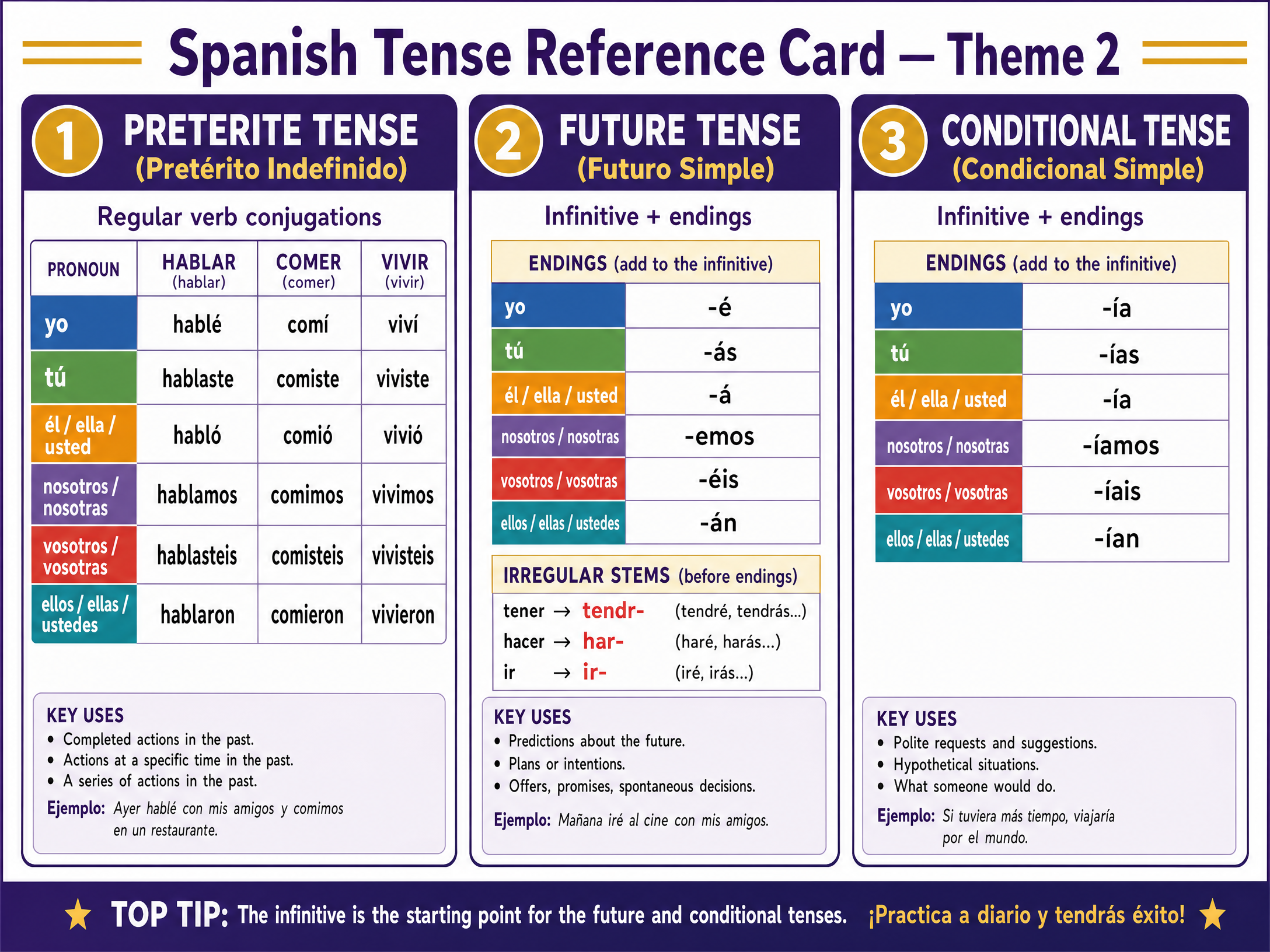
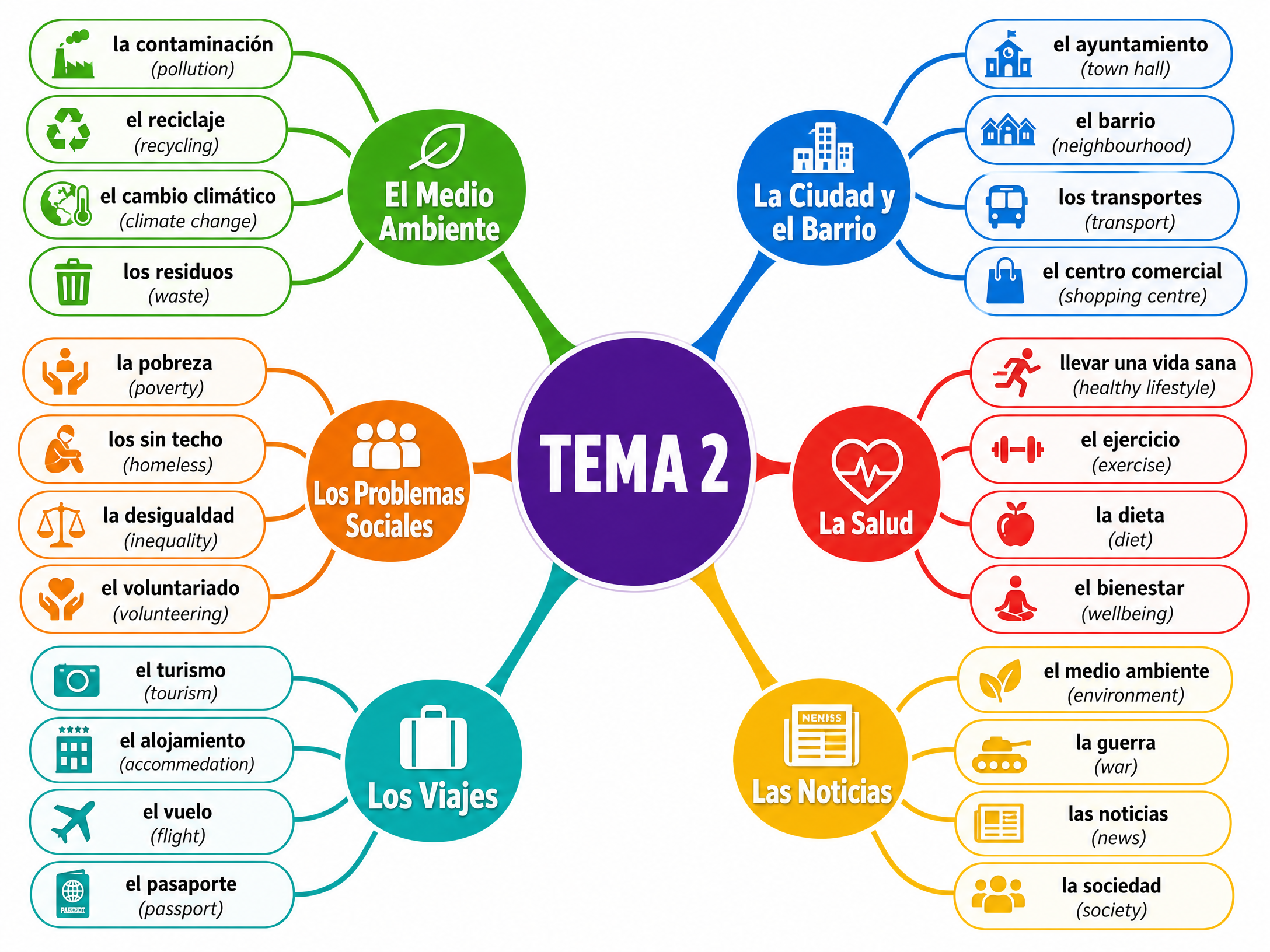
Interactive Diagrams
1 interactive diagram to visualise key concepts
Conceptual Flow Outline
MFL exam approach by skill
Worked Examples
4 worked examples — open one to explore the question and available guidance.
Practice Questions
Test your understanding — click to reveal model answers
Writing (Foundation): Escribe un email a tu amigo español sobre tu ciudad. (90 palabras). Menciona: 1) Dónde vives, 2) Qué hay en tu ciudad, 3) Qué hiciste el fin de semana pasado, 4) Tus planes para el futuro.
Hint: Use present tense for points 1 and 2, preterite for point 3, and 'voy a + infinitive' for point 4.
Speaking (Photo Card): Look at a photo of people recycling. Answer the question: ¿Qué están haciendo las personas en la foto?
Hint: Use the present continuous tense (están + gerund) to describe actions happening right now.
Translation (Higher): Translate into Spanish: 'Global warming is a serious problem. Yesterday, I recycled all the plastic. Next year, we will travel by train.'
Hint: Watch out for adjective agreement on 'serious problem' and ensure you use the preterite and future tenses correctly.
Reading (Higher): Read the text: 'El ayuntamiento ha decidido construir una nueva zona verde porque la contaminación del aire es insoportable. Aunque costará mucho dinero, vale la pena.' Question: Why is the town hall building a green space, and what is the drawback?
Hint: Look for the connective 'porque' for the reason, and 'Aunque' for the drawback.
Listening (Foundation): You hear: 'Me encanta mi barrio porque es muy tranquilo, pero no hay cine.' Question: What does the speaker like about their neighbourhood, and what is missing?
Hint: Listen for the positive opinion and the negative 'no hay'.
Writing (Higher): Escribe un ensayo sobre los problemas sociales. Menciona tu opinión sobre el voluntariado y una experiencia pasada.
Hint: Use complex structures like 'Lo más importante es que...' and ensure you use the preterite for your past experience.
Test your understanding of Theme 2: Local, national, international and global areas of interest
Active recall beats re-reading. Take an instant quiz now to test what you’ve learned and lock it into long-term memory.
7 days Premium · Then free forever · No card, no charge