AQA · GCSE · Spanish
Topic 2: Life at school/college
This topic covers essential vocabulary for digital devices, social media, and online actions. You'll master the Present, Preterite, and Future tenses to express and justify opinions on technology's impact on daily life, while practicing crucial exam skills across listening, speaking, reading, and writing.
- 12 min read
- 4 worked examples
- 6 practice questions
- 8 key terms
Study Notes
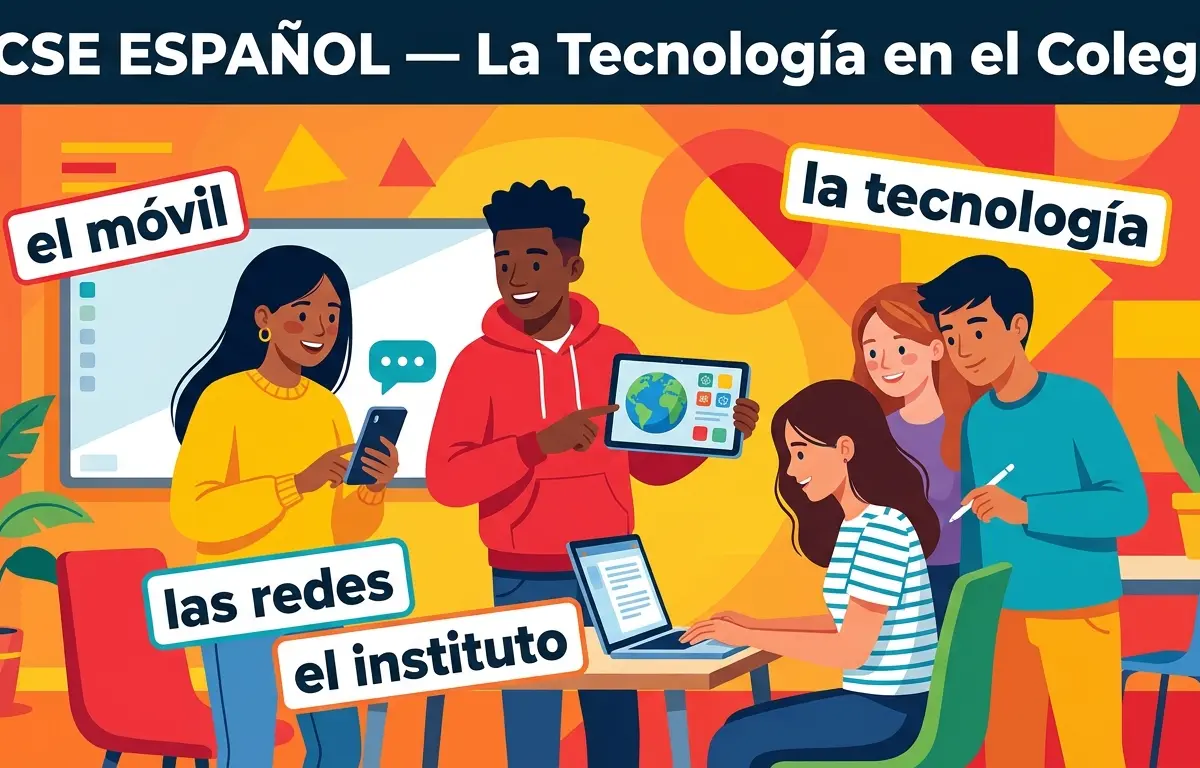
Overview
Welcome to Topic 2: Life at school/college, focusing on the ever-present role of technology. This theme is a goldmine for marks in your GCSE Spanish exam. Examiners love it because it allows you to easily demonstrate a range of tenses (what you used to do online, what you do now, and what you will do in the future) and express justified opinions (the pros and cons of social media). This topic appears across all four papers: Listening, Speaking, Reading, and Writing.
📖 Essential Vocabulary
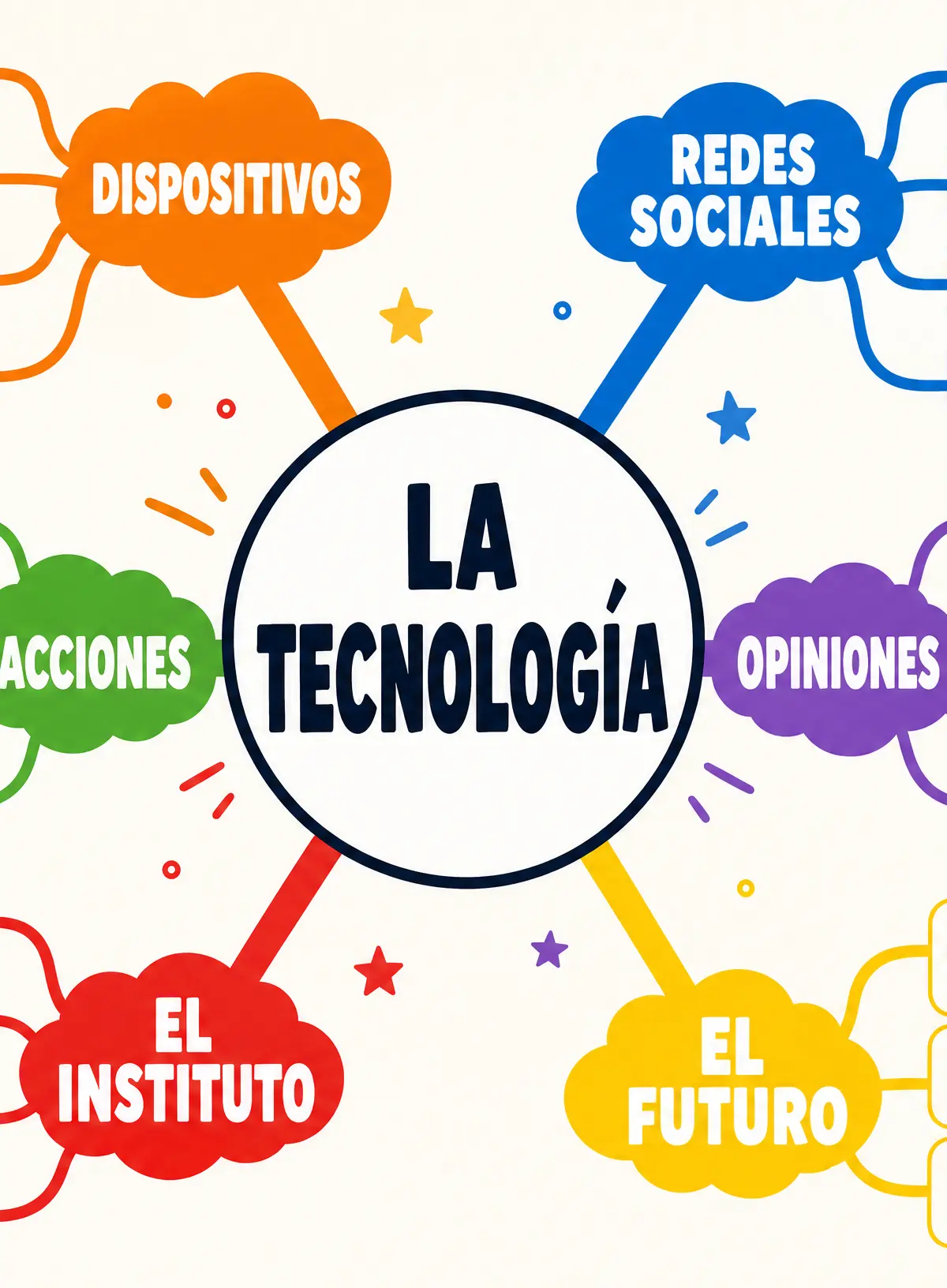
Tier 1 — Foundation Core
| Spanish | English | Gender | Example Sentence |
|---|---|---|---|
| el móvil | mobile phone | m | Uso mi móvil todos los días. |
| el ordenador | computer | m | Hago mis deberes en el ordenador. |
| la tableta | tablet | f | Mi hermana tiene una tableta nueva. |
| las redes sociales | social media | f (pl) | Me encantan las redes sociales. |
| el mensaje | message | m | Envío un mensaje a mi amigo. |
| la foto | photo | f | Comparto una foto en Instagram. |
| usar | to use | - | Uso internet para buscar información. |
| descargar | to download | - | Quiero descargar esta aplicación. |
| jugar | to play | - | Juego a los videojuegos después del colegio. |
| chatear | to chat | - | Chateo con mis amigos por la noche. |
| ver | to watch | - | Veo vídeos en YouTube. |
| útil | useful | - | Creo que la tecnología es muy útil. |
| divertido | fun | - | Jugar en línea es divertido. |
| aburrido | boring | - | Leer libros electrónicos es aburrido. |
| peligroso | dangerous | - | A veces, internet es peligroso. |
Tier 2 — Higher Tier
| Spanish | English | Gender | Example Sentence |
|---|---|---|---|
| la herramienta | tool | f | El ordenador es una herramienta educativa imprescindible. |
| el ciberacoso | cyberbullying | m | El ciberacoso es un problema grave hoy en día. |
| la privacidad | privacy | f | Es vital proteger tu privacidad en línea. |
| el perfil | profile | m | He actualizado mi perfil en las redes sociales. |
| la cuenta | account | f | Tengo una cuenta privada en Instagram. |
| la desventaja | disadvantage | f | Una desventaja de la red es la adicción. |
| subir / publicar | to upload / publish | - | Acabo de publicar un artículo en mi blog. |
| conectarse | to connect (oneself) | - | Me conecto a la red wifi del instituto. |
| imprescindible | essential / indispensable | - | Para mí, el móvil es totalmente imprescindible. |
| perjudicial | harmful | - | Pasar demasiado tiempo frente a la pantalla es perjudicial. |
High-Frequency Words & Phrases
| Phrase | English | Usage Context |
|---|---|---|
| todos los días | every day | Present tense routines |
| de vez en cuando | from time to time | Present tense frequency |
| ayer | yesterday | Preterite tense triggers |
| la semana pasada | last week | Preterite tense triggers |
| en el futuro | in the future | Future tense triggers |
| lo bueno es que | the good thing is that | Introducing advantages |
| lo malo es que | the bad thing is that | Introducing disadvantages |
| estoy de acuerdo | I agree | Responding to opinions |
| desde mi punto de vista | from my point of view | Introducing complex opinions |
| por un lado... por otro lado | on one hand... on the other hand | Balancing an argument |
📝 Grammar Focus
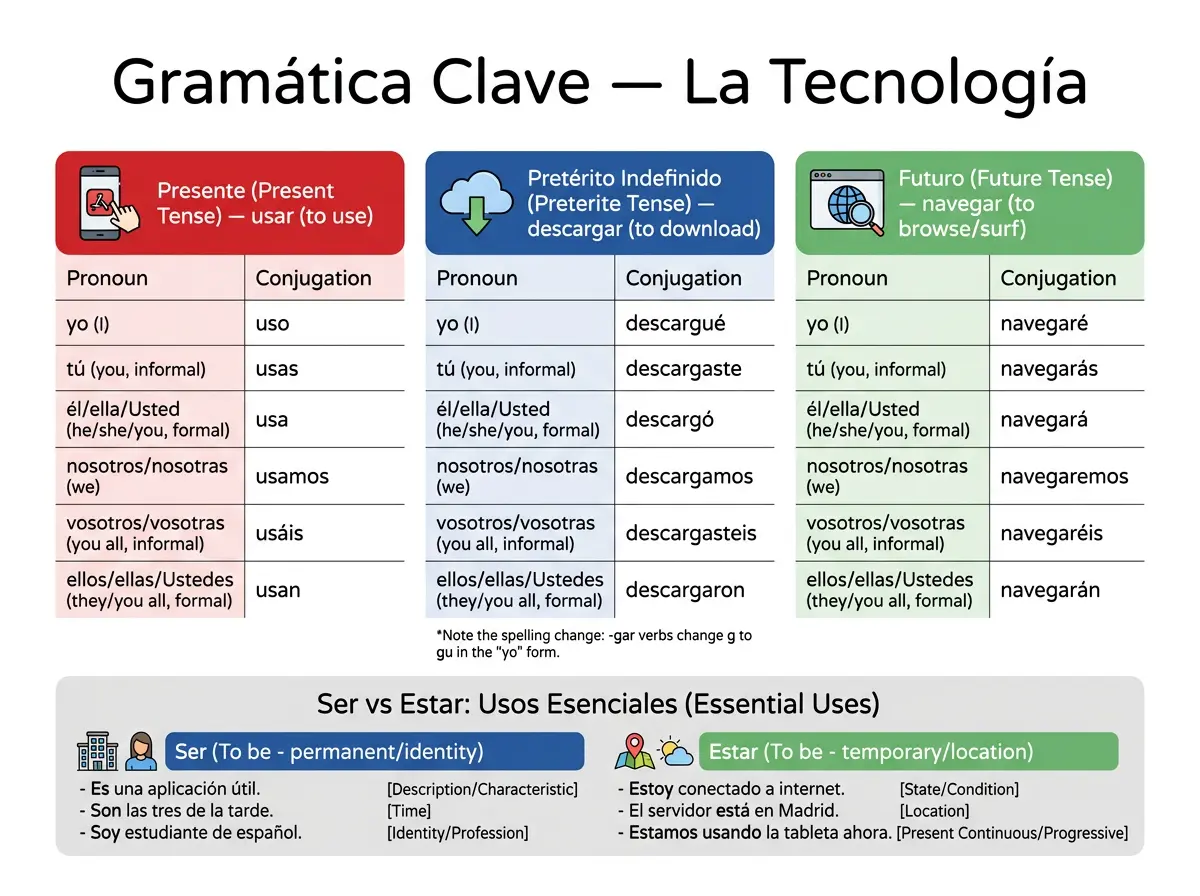
Key Structure 1: The Present Tense (El Presente)
When to use it: To describe your current daily routine with technology and state facts or current opinions.
Conjugation Table (Regular -ar verbs: usar)
| Subject | Verb Form | English |
|---|---|---|
| yo | uso | I use |
| tú | usas | you use (informal) |
| él/ella/usted | usa | he/she/you (formal) uses |
| nosotros/as | usamos | we use |
| vosotros/as | usáis | you all use (informal) |
| ellos/ellas/ustedes | usan | they/you all (formal) use |
Irregulars to learn: tener (to have - tengo, tienes...), hacer (to do/make - hago, haces...)
Key Structure 2: The Preterite Tense (El Pretérito Indefinido)
When to use it: To describe completed actions in the past, such as what you downloaded yesterday or how you used technology last weekend.
Conjugation Table (Regular -ar verbs: descargar)
| Subject | Verb Form | English |
|---|---|---|
| yo | descargué* | I downloaded |
| tú | descargaste | you downloaded |
| él/ella/usted | descargó | he/she/you (formal) downloaded |
| nosotros/as | descargamos | we downloaded |
| vosotros/as | descargasteis | you all downloaded |
| ellos/ellas/ustedes | descargaron | they/you all (formal) downloaded |
Irregulars to learn: *Note the spelling change in the 'yo' form for verbs ending in -gar (g becomes gu). Also learn ir/ser (fui, fuiste...), hacer (hice, hiciste...)
Key Structure 3: The Simple Future Tense (El Futuro Simple)
When to use it: To make predictions about technology or state what you will do online later.
Conjugation Table (Regular verbs: navegar)
| Subject | Verb Form | English |
|---|---|---|
| yo | navegaré | I will browse |
| tú | navegarás | you will browse |
| él/ella/usted | navegará | he/she/you (formal) will browse |
| nosotros/as | navegaremos | we will browse |
| vosotros/as | navegaréis | you all will browse |
| ellos/ellas/ustedes | navegarán | they/you all (formal) will browse |
Irregulars to learn: tener (tendré), hacer (haré), poder (podré)
🎧 Listening Skills
What to Expect
You will hear native speakers discussing their tech habits, arguing about social media, or talking about school rules regarding mobile phones. The recordings are played twice.
Listening Strategies
- Read the questions first: Before the audio starts, read the English questions to predict what Spanish vocabulary you might hear.
- Listen for time markers: Words like 'ayer' (yesterday) or 'mañana' (tomorrow) will help you identify the tense, which often holds the key to the answer.
- Note negatives and qualifiers: Listen carefully for 'no', 'nunca' (never), 'a veces' (sometimes), or 'demasiado' (too much). 'Uso el móvil a veces' is very different from 'nunca uso el móvil'.
Common Listening Traps
- False Friends: 'La red' means 'the net/internet', not the colour red. 'Actual' means 'current/present', not actual.
- Contradictions: A speaker might say they used to love Facebook, but now prefer TikTok. Wait for the 'pero' (but) or 'sin embargo' (however).
🗣️ Speaking Skills
Role Play Scenarios
Scenario 1: Buying a new phone in a shop in Spain.
- Assistant: ¿En qué puedo ayudarle? (How can I help you?)
- You: Quiero comprar un móvil nuevo porque el mío está roto. (I want to buy a new mobile because mine is broken.)
- Assistant: ¿Para qué usa el móvil normalmente? (What do you use the mobile for normally?)
- You: Lo uso para mandar mensajes y navegar por internet. (I use it to send messages and browse the internet.)
Photo Card Practice
Model Photo Card Response (A photo showing students looking at a tablet in class):
- Qu 1 (Description): En la foto hay tres estudiantes en un aula. Están mirando una tableta. Parecen contentos y concentrados. (In the photo there are three students in a classroom. They are looking at a tablet. They seem happy and focused.)
- Qu 2 (Opinion): En mi opinión, usar tabletas en clase es muy útil porque hace que el aprendizaje sea más interactivo y divertido. (In my opinion, using tablets in class is very useful because it makes learning more interactive and fun.)
- Qu 3 (Related topic): Sin embargo, creo que los móviles deberían estar prohibidos en el instituto porque son una distracción. (However, I think mobiles should be banned in school because they are a distraction.)
- Qu 4 (Past/Future): Ayer, usé mi ordenador para hacer los deberes de ciencias. Fue bastante difícil. (Yesterday, I used my computer to do my science homework. It was quite difficult.)
- Qu 5 (Unpredictable): En el futuro, creo que no habrá libros de texto de papel, solo usaremos tecnología. (In the future, I think there will be no paper textbooks, we will only use technology.)
General Conversation Questions
| Question (Spanish) | Model Answer | English Translation |
|---|---|---|
| ¿Para qué usas tu móvil? | Uso mi móvil para chatear con mis amigos y escuchar música. Lo uso todos los días. | What do you use your mobile for? / I use my mobile to chat with my friends and listen to music. I use it every day. |
| ¿Cuáles son las ventajas de las redes sociales? | Lo bueno de las redes sociales es que puedes mantenerte en contacto con la familia, pero pueden ser adictivas. | What are the advantages of social media? / The good thing about social media is that you can stay in touch with family, but they can be addictive. |
| ¿Qué hiciste en internet ayer? | Ayer por la tarde, descargué una película y luego hice mis deberes en línea. | What did you do on the internet yesterday? / Yesterday evening, I downloaded a film and then did my homework online. |
| ¿Crees que los jóvenes están obsesionados con la tecnología? | Sí, estoy de acuerdo. Muchos jóvenes pasan demasiado tiempo frente a la pantalla y no hacen deporte. | Do you think young people are obsessed with technology? / Yes, I agree. Many young people spend too much time in front of the screen and don't do sport. |
| ¿Cómo será la tecnología del futuro? | Creo que en el futuro los robots ayudarán en casa y los coches serán autónomos. | What will technology of the future be like? / I think in the future robots will help at home and cars will be autonomous. |
✍️ Writing Skills
Translation Practice
English → Spanish:
| English | Spanish | Key Grammar |
|---|---|---|
| I use my computer every day. | Uso mi ordenador todos los días. | Present tense, regular -ar verb |
| Social media is very useful. | Las redes sociales son muy útiles. | Ser vs Estar (Ser for description), adjective agreement |
| Yesterday, I downloaded a fun game. | Ayer, descargué un juego divertido. | Preterite tense, spelling change (g to gu) |
| In the future, I will buy a new mobile. | En el futuro, compraré un móvil nuevo. | Future tense |
| I like my tablet because it is fast. | Me gusta mi tableta porque es rápida. | Opinion phrase + justification + agreement |
Extended Writing
**Model 90-word response (Foundation):**Me encanta la tecnología. Todos los días, uso mi móvil para escuchar música y chatear con mis amigos. En mi opinión, mi móvil es muy útil y divertido. Sin embargo, a veces las redes sociales son un poco peligrosas. Ayer, usé mi ordenador para hacer mis deberes de español y luego vi un vídeo en YouTube. En el futuro, me gustaría comprar una tableta nueva porque la mía es muy antigua. Creo que la tecnología es importante para los jóvenes hoy en día.
**Model 150-word response (Higher):**Desde mi punto de vista, la tecnología juega un papel imprescindible en la vida de los jóvenes. Personalmente, uso mi teléfono inteligente constantemente para mantenerme en contacto con mis amigos a través de las redes sociales. Lo bueno de la tecnología es que facilita el aprendizaje; por ejemplo, ayer usé mi portátil para investigar para un proyecto de historia y descargué un artículo muy interesante.
Sin embargo, también hay desventajas graves. El ciberacoso es un problema creciente y muchos adolescentes sufren de adicción a las pantallas. Creo que es vital proteger nuestra privacidad en línea. El fin de semana pasado, decidí apagar mi móvil durante dos días para relajarme, y fue una experiencia muy positiva.
En cuanto al futuro, estoy convencido de que la inteligencia artificial transformará nuestra forma de estudiar. Probablemente, en diez años, los colegios no usarán libros de texto tradicionales, sino que todo será digital.
Writing Checklist
- ✅ Have I used at least three different tenses (Present, Past, Future)?
- ✅ Have I given opinions and justified them using 'porque' or 'ya que'?
- ✅ Have I used connectives (y, pero, sin embargo, además)?
- ✅ Are my adjective agreements correct (masculine/feminine, singular/plural)?
- ✅ Have I used specific, higher-tier vocabulary instead of just 'bueno' and 'malo'?
📚 Reading Skills
Key Strategies
- Skim for gist: Read the whole text quickly first to understand the general topic (e.g., is it a positive review of an app or a complaint about cyberbullying?).
- Context clues: If you don't know a word, look at the words around it. If the text says 'el ciberacoso es un problema muy grave', you can guess 'grave' means serious/bad.
False Friends & Tricky Words
| Word | Looks Like | Actually Means |
|---|---|---|
| la red | red | the net / internet |
| actual | actual | current / present |
| actualmente | actually | currently / nowadays |
| el éxito | exit | success |
| grabar | grab | to record / to save (data) |
🌍 Cultural Knowledge
Understanding the cultural context can enrich your answers. In Spain, mobile phone usage among teenagers is very high, similar to the UK. However, the use of 'WhatsApp' (often pronounced 'Guasap' in Spain) is almost universal for both social and official communication. Many Spanish schools have strict policies banning mobile phones in classrooms to combat distraction and cyberbullying. Mentioning these cultural nuances (e.g., "Como en muchos institutos españoles, en mi colegio los móviles están prohibidos...") shows a deep understanding that examiners reward highly.
Visual Resources
2 diagrams and illustrations
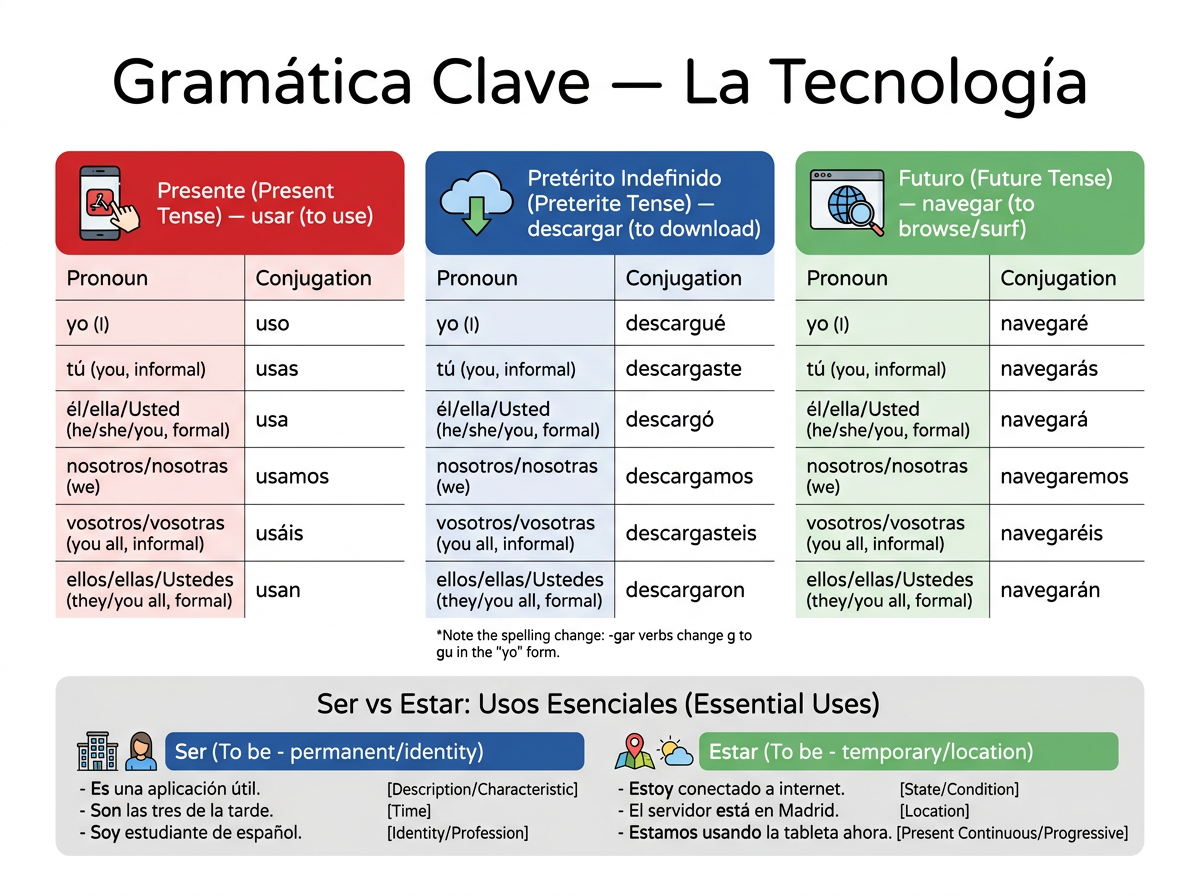
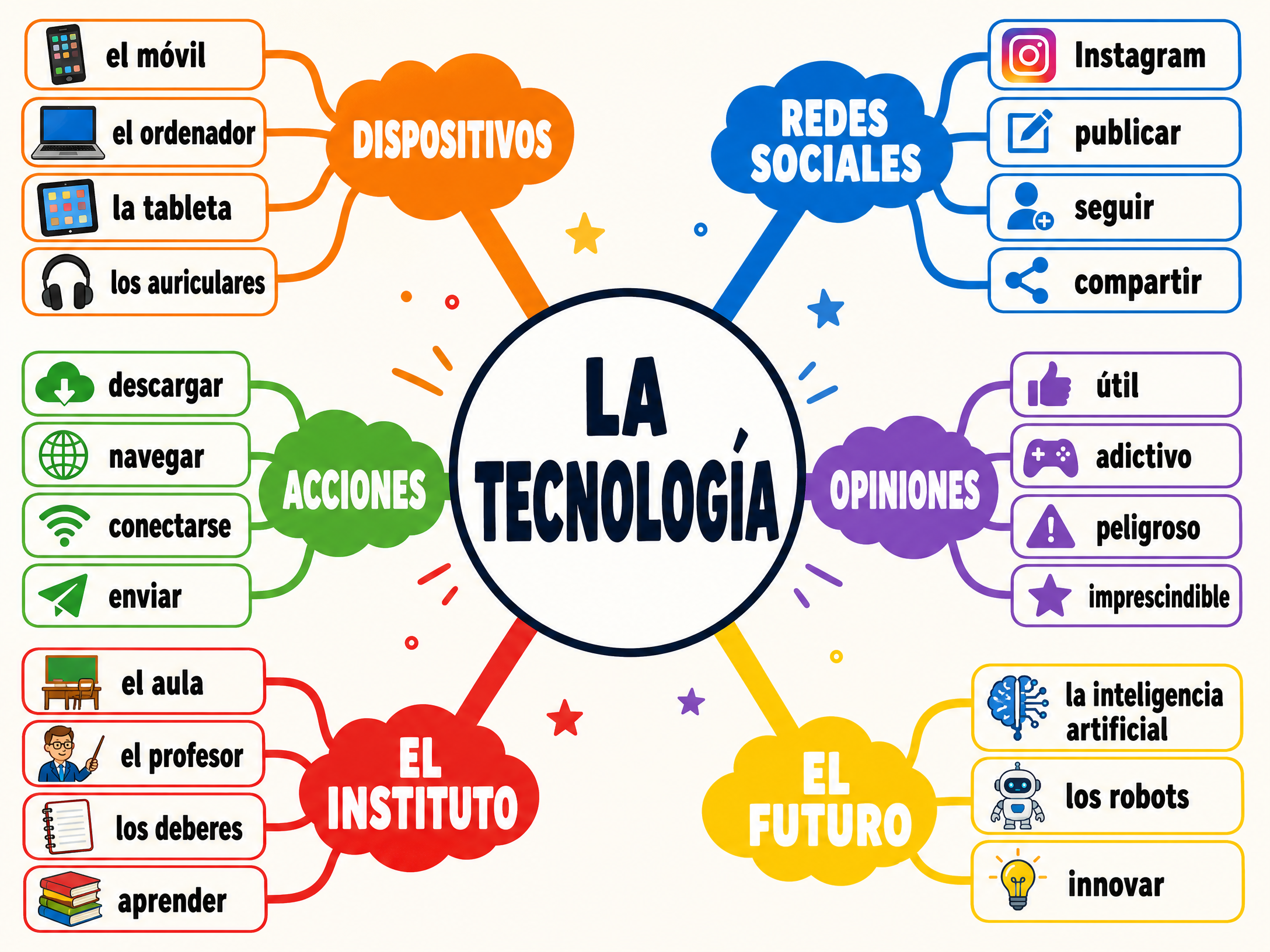
Interactive Diagrams
1 interactive diagram to visualise key concepts
Conceptual Flow Outline
MFL exam approach by skill
Worked Examples
4 worked examples — open one to explore the question and available guidance.
Practice Questions
Test your understanding — click to reveal model answers
Writing: Traduce las siguientes frases al español. 1. I use my mobile every day. 2. Yesterday, I downloaded a game. 3. In the future, I will buy a computer.
Hint: Check your verb tenses carefully: present, past (preterite), and future.
Speaking: Responde a la pregunta: ¿Cuáles son las ventajas y desventajas de los móviles?
Hint: Use 'por un lado' and 'por otro lado' to structure your answer. Remember to justify your opinions.
Reading: Lee el texto y responde en español: 'Mi hermano pasa cinco horas al día en su tableta. Mi madre dice que es demasiado tiempo de pantalla y es malo para sus ojos.' ¿Qué opina la madre?
Hint: Look for the sentence starting with 'Mi madre dice que...'
Listening: Escucha y elige la opción correcta. (Transcript: 'Antes, me encantaba Facebook, pero ahora prefiero usar Instagram porque es más divertido para compartir fotos.') ¿Qué red social prefiere ahora?
Hint: Listen for the time markers 'antes' (before) and 'ahora' (now).
Writing (90 words): Escribe sobre la tecnología. Incluye: qué tecnología usas, tu opinión sobre internet, qué hiciste ayer en línea, y un problema con la tecnología.
Hint: Ensure you cover all 4 bullet points. Use the present tense for the first two, preterite for the third, and present/general for the fourth.
Speaking (Photo Card): Mira la foto de unos jóvenes con sus móviles. ¿Qué están haciendo?
Hint: Use the present continuous tense (estar + gerund) or simple present to describe actions happening right now.
Test your understanding of Topic 2: Life at school/college
Active recall beats re-reading. Take an instant quiz now to test what you’ve learned and lock it into long-term memory.
7 days Premium · Then free forever · No card, no charge