AQA · GCSE · Spanish
Topic 3: Education post-16
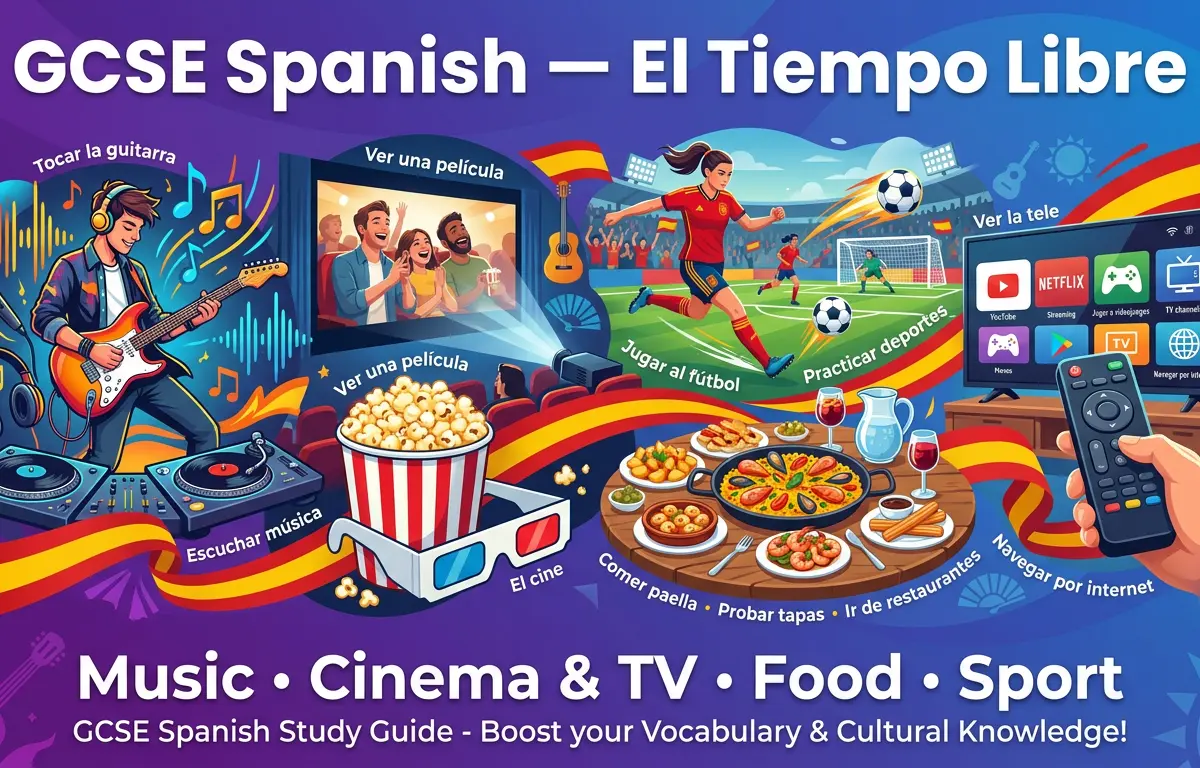
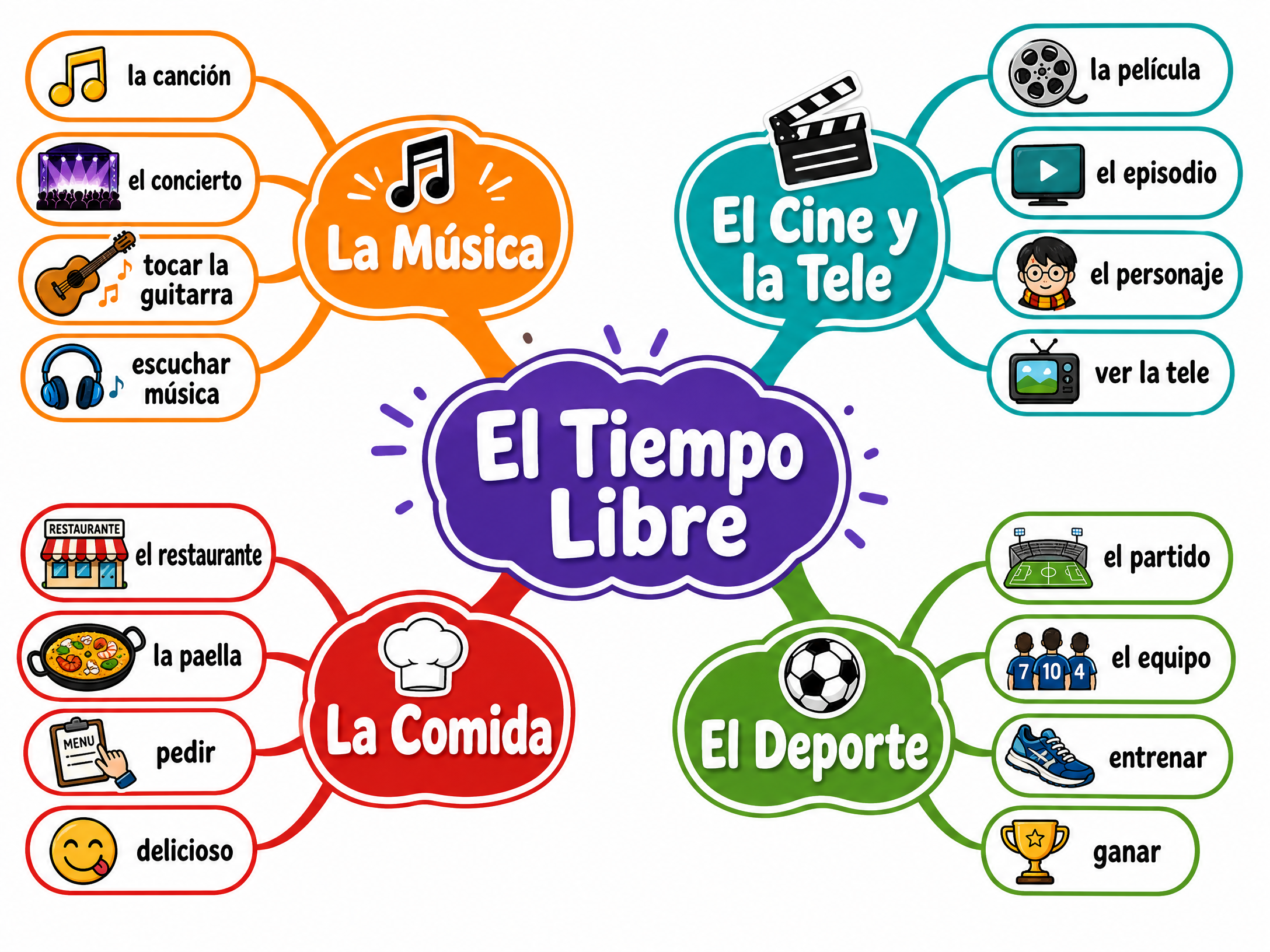
This topic covers essential vocabulary for music, cinema, TV, food, and sport. You will learn to express justified opinions using verbs beyond 'gustar' and narrate your free-time activities across past, present, and future tenses to secure top marks across all four skills.
- 12 min read
- 4 worked examples
- 6 practice questions
- 8 key terms
Study Notes
Overview
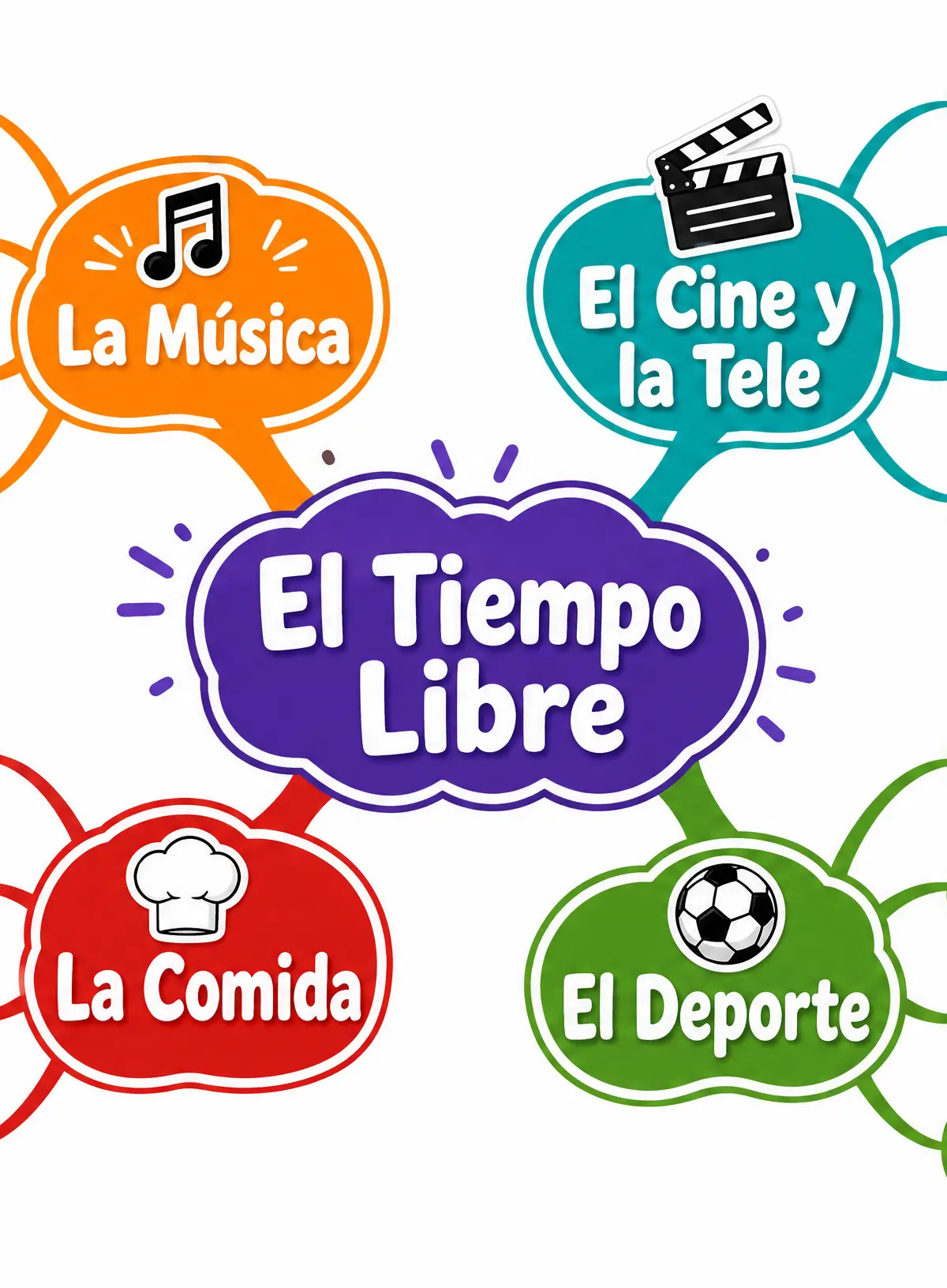
El tiempo libre (Free Time) is a core topic that appears in all four GCSE Spanish exam papers: Listening, Speaking, Reading, and Writing. It covers four main themes: Music, Cinema & TV, Food, and Sport. This topic is a fantastic opportunity to show off your personality and use a wide range of opinion verbs, justifications, and tenses. Mastering this topic guarantees you can tackle role plays, photo cards, and extended writing tasks with confidence.
📖 Essential Vocabulary
Tier 1 — Foundation Core
| Spanish | English | Gender | Example Sentence |
|---|---|---|---|
| la música | music | f | Me gusta escuchar la música pop. |
| la película | film / movie | f | Mi película favorita es de terror. |
| el cine | cinema | m | Voy al cine los sábados. |
| el programa | programme | m | Veo un programa de deportes. |
| la comida | food | f | La comida española es deliciosa. |
| el restaurante | restaurant | m | Comemos en el restaurante. |
| el deporte | sport | m | Practico mucho deporte. |
| el fútbol | football | m | Juego al fútbol con mis amigos. |
| la canción | song | f | Esta canción es muy buena. |
| el equipo | team | m | Mi equipo favorito siempre gana. |
| el partido | match / game | m | El partido empieza a las ocho. |
| escuchar | to listen | - | Me gusta escuchar la radio. |
| ver | to watch / see | - | Quiero ver la tele. |
| comer | to eat | - | Voy a comer una hamburguesa. |
| jugar | to play | - | Juego al tenis los fines de semana. |
Tier 2 — Higher Tier
| Spanish | English | Gender | Example Sentence |
|---|---|---|---|
| el concierto | concert | m | Fui a un concierto de rock anoche. |
| el personaje | character | m | El personaje principal es muy divertido. |
| los efectos especiales | special effects | m | Los efectos especiales fueron increíbles. |
| la paella | paella | f | Probé la paella y estaba riquísima. |
| el campeonato | championship | m | Mi equipo ganó el campeonato. |
| entrenar | to train | - | Tengo que entrenar tres veces a la semana. |
| descargar | to download | - | Suelo descargar música en mi móvil. |
| las palomitas | popcorn | f | Siempre compro palomitas en el cine. |
| los subtítulos | subtitles | m | Prefiero ver películas con subtítulos. |
| el torneo | tournament | m | El torneo de tenis es mañana. |
High-Frequency Words & Phrases
| Phrase | English | Usage Context |
|---|---|---|
| a menudo | often | Expressing frequency of activities. |
| de vez en cuando | from time to time | Showing variety in your routine. |
| dos veces a la semana | twice a week | Adding specific detail for higher marks. |
| sin embargo | however | Linking contrasting ideas. |
| por otro lado | on the other hand | Presenting an alternative viewpoint. |
| lo que más me gusta es | what I like most is | Introducing a strong preference. |
| vale la pena | it's worth it | Giving a sophisticated recommendation. |
| no aguanto / no soporto | I can't stand | Expressing strong dislike instead of 'no me gusta'. |
| es una pérdida de tiempo | it's a waste of time | Justifying a negative opinion. |
| me relaja | it relaxes me | Explaining why you enjoy an activity. |
📝 Grammar Focus
Key Structure 1: Gustar and Opinion Verbs
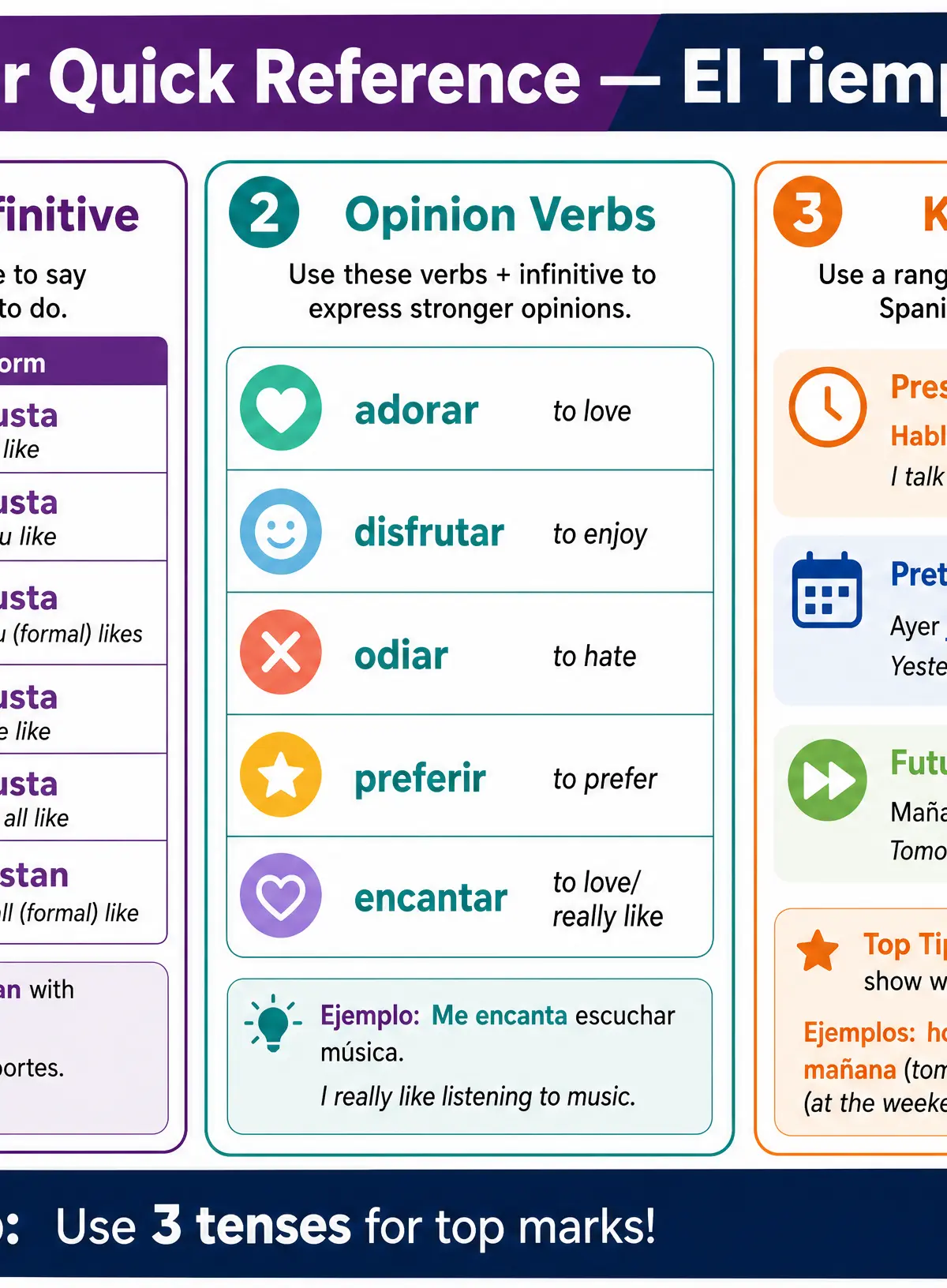
When to use it: To express what you like and don't like doing. Remember that gustar agrees with the thing being liked, not the person who likes it.
Conjugation Table: Gustar
| Subject | Verb Form (Singular/Infinitive) | Verb Form (Plural) | English |
|---|---|---|---|
| yo | me gusta | me gustan | I like |
| tú | te gusta | te gustan | you like |
| él/ella | le gusta | le gustan | he/she likes |
| nosotros | nos gusta | nos gustan | we like |
| vosotros | os gusta | os gustan | you (pl) like |
| ellos/ellas | les gusta | les gustan | they like |
Important Note: Use a variety of verbs! Instead of just gustar, try: encantar (to love), adorar (to adore), disfrutar de (to enjoy), odiar (to hate), preferir (to prefer).
Key Structure 2: The Preterite Tense (Past)
When to use it: To describe specific completed actions in the past, such as what you did last weekend.
Conjugation Table: Regular Verbs (e.g., jugar, comer, salir)
| Subject | -AR verbs (e.g., hablar) | -ER verbs (e.g., comer) | -IR verbs (e.g., salir) |
|---|---|---|---|
| yo | hablé | comí | salí |
| tú | hablaste | comiste | saliste |
| él/ella | habló | comió | salió |
| nosotros | hablamos | comimos | salimos |
| vosotros | hablasteis | comisteis | salisteis |
| ellos/ellas | hablaron | comieron | salieron |
Irregulars to learn: Fui (I went/was), hice (I did/made), vi (I saw), tuve (I had).
Note: Jugar has a spelling change in the 'yo' form: jugué.
Key Structure 3: The Near Future Tense
When to use it: To state what you are going to do next weekend or in the future. It is formed using the present tense of ir + a + infinitive.
Conjugation Table: Ir + a + Infinitive
| Subject | Verb Form | English |
|---|---|---|
| yo | voy a (jugar) | I am going to (play) |
| tú | vas a (comer) | you are going to (eat) |
| él/ella | va a (ver) | he/she is going to (watch) |
| nosotros | vamos a (escuchar) | we are going to (listen) |
| vosotros | vais a (salir) | you (pl) are going to (go out) |
| ellos/ellas | van a (entrenar) | they are going to (train) |
🎧 Listening Skills
What to Expect
In the listening exam, you will hear short conversations, announcements, or interviews about free-time activities. You might hear people discussing their favourite music genres, a film review, a restaurant booking, or a sports match.
Listening Strategies
- Read the questions first: Use the reading time to predict vocabulary. If the question is about cinema, expect words like película, actor, aburrido.
- Listen for negatives: Words like nunca (never), nada (nothing), and nadie (nobody) completely change the meaning of a sentence.
- Listen for time frames: Did they play football ayer (yesterday) or are they playing mañana (tomorrow)? Tenses are often tested in listening.
Common Listening Traps
- Distractors: The speaker might mention two sports (e.g., Me gustaba el tenis, pero ahora prefiero el fútbol). Make sure you answer based on what they prefer now.
- False Friends: Soportar means 'to tolerate' or 'stand', not 'to support' (which is apoyar).
🗣️ Speaking Skills
Role Play Scenarios
Scenario: Buying cinema tickets
- Examiner: ¿Qué película quieres ver?
- You: Quiero ver la nueva película de acción, por favor.
- Examiner: ¿Para qué sesión?
- You: Para la sesión de las siete.
Photo Card Practice
Model Photo Card Response (A photo of people eating in a restaurant):
- Qu 1 (Description): En la foto hay cuatro personas comiendo en un restaurante. Parece que están muy contentos.
- Qu 2 (Opinion): Me encanta comer en restaurantes porque la comida es deliciosa y no tengo que cocinar.
- Qu 3 (Related topic): Normalmente, prefiero la comida italiana, especialmente la pizza.
- Qu 4 (Past/Future): El fin de semana pasado, fui a un restaurante mexicano con mi familia para celebrar mi cumpleaños.
- Qu 5 (Unpredictable): Para mantenerme sano, intento comer mucha fruta y verdura, y evito la comida rápida.
General Conversation Questions
| Question (Spanish) | Model Answer | English Translation |
|---|---|---|
| ¿Qué haces en tu tiempo libre? | En mi tiempo libre, suelo escuchar música y jugar al fútbol con mi equipo porque es divertido. | In my free time, I usually listen to music and play football with my team because it's fun. |
| ¿Qué tipo de películas prefieres? | Prefiero las películas de comedia porque me hacen reír, pero odio las películas de terror. | I prefer comedy films because they make me laugh, but I hate horror films. |
| ¿Qué hiciste el fin de semana pasado? | El fin de semana pasado, fui al cine con mis amigos y luego comimos hamburguesas. ¡Fue genial! | Last weekend, I went to the cinema with my friends and then we ate burgers. It was great! |
| ¿Qué vas a hacer mañana? | Mañana, voy a entrenar con mi equipo de baloncesto por la tarde. | Tomorrow, I am going to train with my basketball team in the afternoon. |
| ¿Crees que tienes suficiente tiempo libre? | No, creo que no tengo suficiente tiempo libre porque tengo muchos deberes. | No, I don't think I have enough free time because I have a lot of homework. |
✍️ Writing Skills
Translation Practice
English → Spanish:
| English | Spanish | Key Grammar |
|---|---|---|
| I listen to music every day. | Escucho música todos los días. | Present tense, frequency phrase |
| I love sports because they are fun. | Me encantan los deportes porque son divertidos. | Gustar (plural form), justification |
| Yesterday, I watched a film. | Ayer, vi una película. | Preterite tense (irregular verb 'ver') |
| Tomorrow, I am going to play tennis. | Mañana, voy a jugar al tenis. | Near future tense (ir + a + infinitive) |
| Although I like reading, I prefer going to the cinema. | Aunque me gusta leer, prefiero ir al cine. | Connective (aunque), comparative opinion |
Extended Writing
**Model 90-word response (Foundation):**En mi tiempo libre, me encanta escuchar música pop porque es muy relajante. También, juego al fútbol dos veces a la semana con mis amigos. En mi opinión, el deporte es muy importante para la salud. El fin de semana pasado, fui al cine con mi familia y vimos una película de comedia. Fue muy divertida. Mañana, voy a comer en un restaurante italiano porque me gusta mucho la pizza. ¡Qué rico!
**Model 150-word response (Higher):**Para mí, el tiempo libre es esencial para relajarme después del instituto. Lo que más me gusta hacer es escuchar música, especialmente el rock, ya que me ayuda a olvidar el estrés. Además, soy un gran aficionado al deporte. Entreno con mi equipo de baloncesto tres veces a la semana.
El fin de semana pasado fue fenomenal. El sábado por la mañana jugué un partido muy importante y, afortunadamente, ganamos. Luego, por la noche, fui a un restaurante español con mis amigos para celebrar. Probé la paella por primera vez y estaba absolutamente deliciosa.
Sin embargo, no soporto ver la televisión porque creo que es una pérdida de tiempo. En el futuro, me gustaría ir a un festival de música en España, porque sería una experiencia inolvidable. Si tuviera más tiempo libre, aprendería a tocar la guitarra.
Writing Checklist
- ✅ Have I used at least three different tenses (Present, Past, Future/Conditional)?
- ✅ Have I used a variety of opinion verbs (not just me gusta)?
- ✅ Have I justified my opinions using porque, ya que, dado que?
- ✅ Have I included connectives (e.g., sin embargo, además, por lo tanto)?
- ✅ Are my adjective agreements correct (masculine/feminine, singular/plural)?
📚 Reading Skills
Key Strategies
- Skim first: Read the text quickly to get the overall context. Is it a review? An interview? A blog post?
- Use the questions: The questions usually follow the chronological order of the text.
- Look for synonyms: The text will rarely use the exact same words as the question. If the question asks about tiempo libre, the text might say ratos libres.
False Friends & Tricky Words
| Word | Looks Like | Actually Means |
|---|---|---|
| asistir | to assist | to attend (e.g., a concert) |
| el éxito | exit | success (e.g., a hit film) |
| la lectura | lecture | reading |
| la letra | letter (post) | lyrics (of a song) |
| soportar | to support | to tolerate / stand |
🌍 Cultural Knowledge
Understanding the culture of Spanish-speaking countries can enrich your writing and speaking responses:
- Food: Meals in Spain are eaten much later than in the UK. Lunch (la comida) is usually around 2:00 PM - 3:30 PM, and dinner (la cena) is often eaten between 9:00 PM and 10:30 PM. Tapas are small dishes shared among friends.
- Cinema: Spanish cinema is highly regarded globally. Directors like Pedro Almodóvar and actors like Antonio Banderas and Penélope Cruz are famous worldwide.
- Music: Latin music genres like Reggaeton, Salsa, and Flamenco are incredibly popular. Mentioning specific artists (e.g., Rosalía, Shakira) or genres in your speaking exam shows great cultural awareness.
- Sport: Football is a massive part of Spanish culture, with La Liga being one of the top leagues in the world. Real Madrid and FC Barcelona are huge cultural institutions.
🎧 Podcast Lesson
Listen to this 10-minute podcast episode for a full review of the vocabulary, grammar, and exam tips for this topic!
Visual Resources
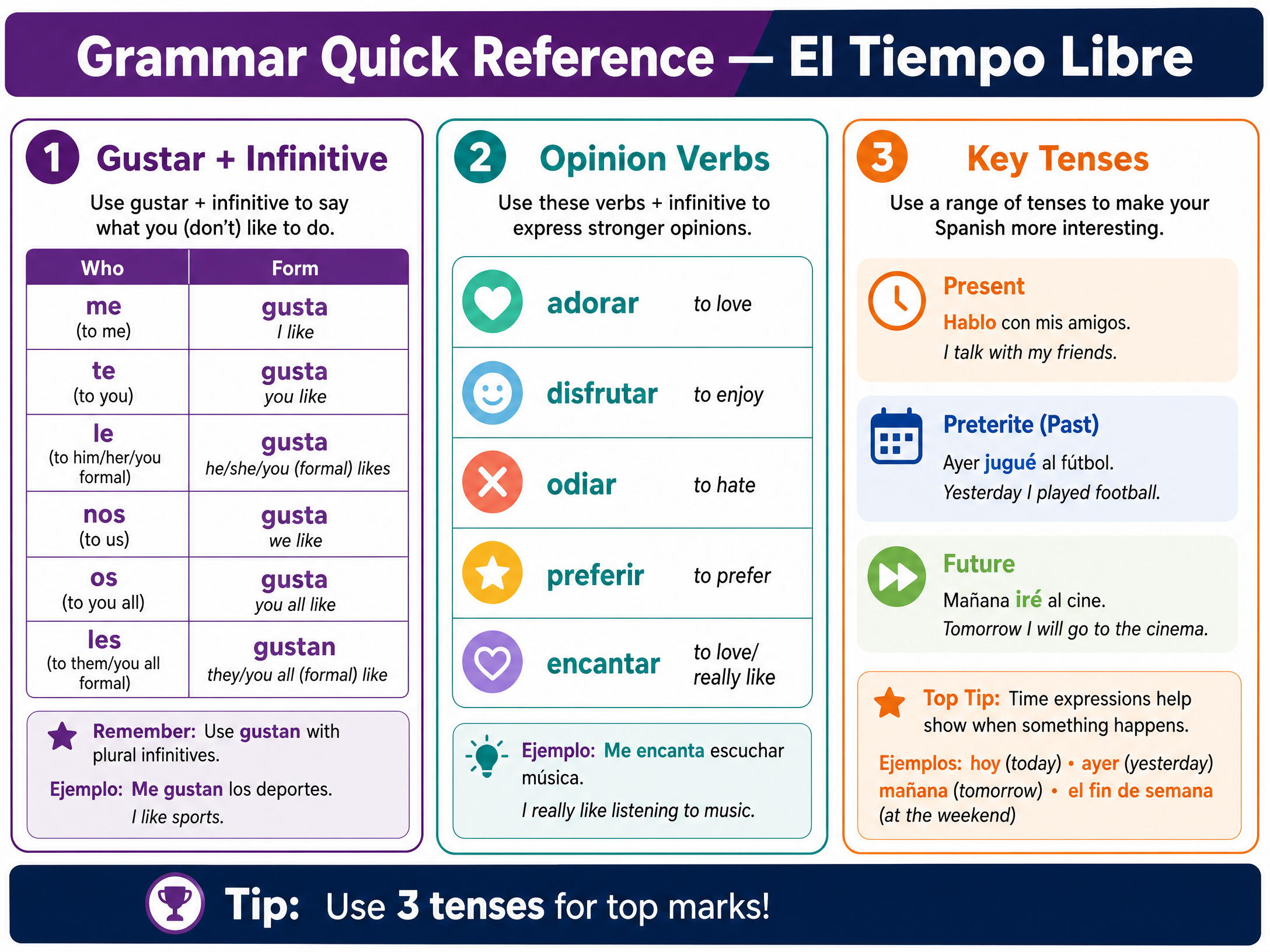
2 diagrams and illustrations
Interactive Diagrams
1 interactive diagram to visualise key concepts
Conceptual Flow Outline
MFL exam approach by skill
Worked Examples
4 worked examples — open one to explore the question and available guidance.
Practice Questions
Test your understanding — click to reveal model answers
Writing: Traduce las siguientes frases al español. 1. I love music. 2. Yesterday I played football. 3. Tomorrow I am going to the cinema.
Hint: Pay attention to the tenses and the verb 'gustar'.
Speaking: Responde a la pregunta: ¿Qué hiciste el fin de semana pasado?
Hint: Use the preterite tense and include an opinion about what you did.
Reading: Read the text and answer in English. 'Mi pasión es la música. Toco la guitarra desde hace cinco años y mi sueño es dar un concierto.' What is the person's dream?
Hint: Look for the word 'sueño' and the cognate 'concierto'.
Writing (Higher): Escribe sobre tu programa de televisión favorito. Menciona por qué te gusta y qué viste ayer.
Hint: Use present and past tenses, and justify your opinions.
Listening: Escucha el audio. ¿Por qué no le gusta a Juan ir al cine?
Hint: Listen for negative opinions and reasons.
Speaking (Role Play): Estás en un restaurante. Pide algo para comer y beber.
Hint: Use 'quisiera' or 'para mí' to order politely.
Test your understanding of Topic 3: Education post-16
Active recall beats re-reading. Take an instant quiz now to test what you’ve learned and lock it into long-term memory.
7 days Premium · Then free forever · No card, no charge