Series and parallel circuits — OCR GCSE Physics
Verified courseTeaching note checked against the official specification.
Series and parallel circuits explained
Circuit diagrams are a standardised language: each common element has its own symbol, and lines represent connecting wires.
Read the full explanation
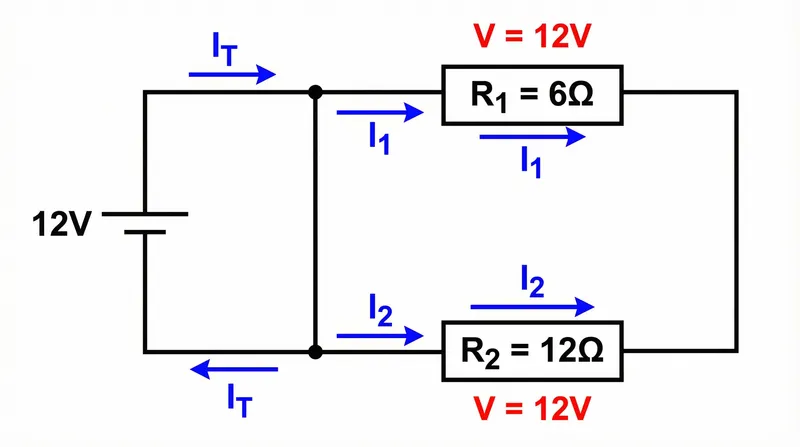
To construct a circuit you read the diagram and join components in the order shown, keeping the loop closed. To check it, you compare the built circuit with the diagram, confirming each component is the right type, in the right position and the right way round, and that the loop is continuous. In series, components sit on one path so the same current passes through each; in parallel, branches split the current. A cell, switch, lamp, resistor, ammeter (in series) and voltmeter (across a component) are common elements to recognise and place correctly.
Watch and listen
Listen: Series and parallel circuits audio lesson
Read the full guideVisual Resources
1 diagram and illustration
Interactive Diagrams
1 interactive diagram to visualise key concepts
Conceptual Flow Outline
Flowchart showing how current splits at a junction into different branches and then recombines. The rules for voltage and current are summarised.
Your focus
- Recognise and name common circuit symbols in a diagram
- Decide whether a given circuit is series or parallel
- Select the arrangement that correctly places an ammeter or voltmeter
Series and parallel circuits exam tips
Marking Points
- Identifies the correct circuit symbol for each named common element such as cell, switch, lamp, resistor, ammeter and voltmeter
- Distinguishes a series circuit, where components share one path, from a parallel circuit, where the current splits between branches
- Places an ammeter in series with the component whose current is measured and a voltmeter in parallel across it
- Checks a built circuit against its diagram by confirming each component's type, position and orientation and that the loop is continuous
Examiner Tips
- 💡Learn each common symbol so you can match a diagram to a description quickly
- 💡Trace the path from the cell to decide whether components are in series or parallel before answering
- 💡Check whether the question asks you to construct (build from a diagram) or check (compare a build with a diagram)
Common Mistakes
- Connects a voltmeter in series with a component; place the voltmeter in parallel across the component instead
- Draws a parallel circuit as a single loop with no branches; show separate branches that rejoin the main circuit
- Reverses the cell symbol or omits the switch; match each symbol's shape and position to the diagram