A Level Economics Revision: Top Strategies & Plans for 2026
You're probably staring at a pile of notes, a few flashcards, and a sense that you should be doing more, but you're not sure what “more” even means. That's the usual A Level Economics trap, not laziness, just a subject that can swallow your time if you revise it like one giant memory test instead of a set of papers with different demands. The good news is that a smarter plan beats a longer one, especially when you line your revision up with the exam board, the mark scheme, and the kind of questions that come up.
Why Most A Level Economics Revision Plans Fall Apart
A student often starts well, then the plan slips. They reread the same pages on inflation three times, make neat flashcards for definitions, and tell themselves evaluation can wait until “later”, which usually means the week before the mock. By then, microeconomics and macroeconomics have turned into one huge blur, and the revision timetable looks busy without being useful.
That is where many A Level Economics Revision plans break. They treat the subject like a list of facts, but the exam is really asking for knowledge, application, analysis, and evaluation under time pressure. Pearson's support materials remind students that the full A Level Economics A has a maximum mark of 335, with Papers 1 and 2 weighted at 35% each and Paper 3 weighted at 30% (Pearson assessment support). If you revise as though every topic matters equally in every paper, you spend too much time on the wrong things.
Practical rule: revise for the paper, not just for the topic.
The other common mistake is confusing recognition with recall. Definitions feel safe because you can nod along while reading them, but that does not mean you can write them out cleanly in an exam, apply them to a chart, and then use them to build a judgement. Pearson also reminds candidates that percentage figures in graphs show percentage-point changes between data points, and that numerical answers should be double-checked with a calculator, while board support materials also stress that assessment decisions affect how you should practise questions and interpret evidence (Pearson assessment support). That is the sort of detail that separates tidy revision from marks left on the table.
If you are building a rescue route, start with structure rather than panic. A simple board-specific system does far more for confidence than another evening of colour-coding notes. If you want a guided starting point for that sort of routine, Online Revision for A-Level is built around exam-aligned practice rather than generic note reading.
Mapping Your Exam Board Before You Touch a Flashcard
A lot of students start revision by opening a blank set of flashcards and hoping the subject will sort itself out. That feels active, but it is often the fastest way to waste time. Your first job is to map the board you sit, because the board decides what counts as good economics, what the papers ask for, and how much of the course is tested through defined content and wider application. The government's subject content says A level specifications must mix microeconomics and macroeconomics, use local, national and global contexts, and make the defined content account for 60% of the specification, so your board shapes both what you study and how you need to answer (A level economics subject content).
That is why two students can revise the same topic and still end up preparing for slightly different exams. AQA sets out its A level in two clear halves, Individuals, firms, markets and market failure and The national and international economy, and its published topic list includes the economic problem, price determination, monopoly, the labour market, AD/AS analysis, monetary and fiscal policy, and the international economy. Pearson Edexcel uses a different structure, with Theme 1 and Theme 2 built into the A Level and the core content making up 60% of the specification (Pearson getting started guide). That difference matters because it changes the balance between straightforward topic recall, synoptic links, and the kind of evaluation you are expected to build.
For AQA, the two-paper structure pushes you to separate micro and macro revision carefully. For Edexcel, the theme-based structure means students often need to connect classroom themes to the way the exam frames those themes, rather than treating every unit as an isolated block. OCR and WJEC also expect you to learn through the shape of the papers, not just the topic list, so the board specification should be the first document on your desk, not the last.
| Board | Paper 1 focus | Paper 2 focus | Paper 3 focus | Notes |
|---|---|---|---|---|
| AQA | Microeconomics, market failure, firm behaviour | Macroeconomics, national and international economy | Synoptic analysis and evaluation across the course | Split into the two big content areas listed in the specification |
| Pearson Edexcel | Theme 1 and related micro content | Theme 2 and related macro content | Synoptic paper across the full A Level | Full A Level Economics A has 335 marks, with 35%, 35%, and 30% weighting across the three papers |
| OCR | Specification-led micro and macro coverage | Specification-led macro and policy coverage | Extended response and synoptic thinking | Use the official board paper breakdown before planning, because the skills mix can shift by paper |
| WJEC | Board-specific micro and macro content | Board-specific macro and policy content | Board-specific higher-mark responses | Start from the specification, then match topic revision to the paper style |
The point of the table is not to memorise another version of the syllabus. It is to show you where your revision needs to become board-specific. A student on AQA needs to know how market failure, firm behaviour, and macro policy are distributed across the papers. A student on Edexcel needs to know how the theme structure affects what gets tested together. OCR and WJEC students need to pay even closer attention to the language of the paper, because the same topic can be framed differently depending on the exam board.
Once you have that map, use it to build your question practice as well as your notes. If you need a place to find Economics A Level questions, use it to match practice to the paper you are sitting. That is much better than revising topic by topic in a way that ignores the exam in front of you.
Ranking Topics So You Revise the Right Things First
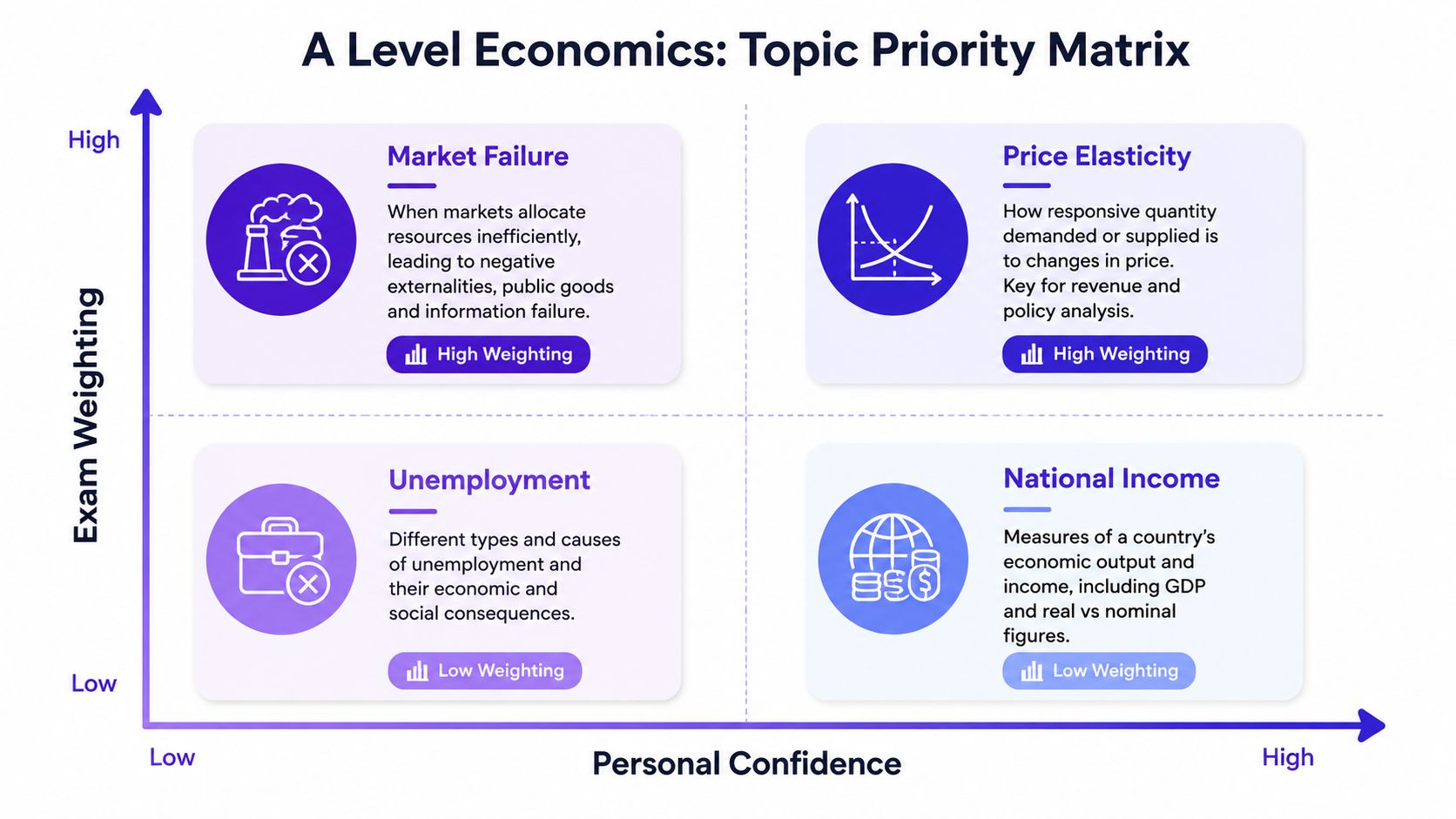
Stop revising in topic order. Chronology feels neat, but it usually means you spend too long on things you already half know and not enough on the bits that lose marks fastest. A better method is to rank topics by exam weighting and personal confidence, then revise the items that sit in the high-weight, low-confidence box first.
Build the grid in ten minutes
Draw a simple four-box grid. Put Personal Confidence on the horizontal axis, from low to high, and Exam Weighting on the vertical axis, from low to high. Then drop each topic into the box that feels most honest.
Start with the AQA list if you want a concrete reference point. Topics like market failure, monopoly, the labour market, AD/AS analysis, monetary policy, fiscal policy, and the international economy all sit inside the board's two main content areas (AQA specification at a glance). That gives you enough detail to sort by importance without pretending every chapter deserves the same time.
Some students rank by what feels hardest. That's useful, but not enough. A topic that feels hard and appears everywhere deserves far more time than a topic that feels hard but hardly ever earns marks in your board's question style.
Turn the grid into a ranked list
Your first priority box usually contains topics like market failure and AD/AS, because they're both big and often awkward under time pressure. Your second box holds topics you already know but still need to sharpen, such as price elasticity or national income. Low-weight, low-confidence items go later, not because they don't matter, but because they shouldn't steal time from the topics that are more likely to decide a grade boundary.
After each mock, update the grid. If a topic moved from “low confidence” to “middle confidence”, move it down the list. If a new gap appears in your data response answers, put that topic straight back into the first box and give it the next available session.
Building a Weekly Revision Timetable You Will Actually Stick To
A timetable works when it fits a real week, not an imaginary one with endless energy. If you've got school, homework, a job, or another subject with a looming test, your revision needs to be short enough to start and structured enough to finish.
Keep sessions focused, not heroic
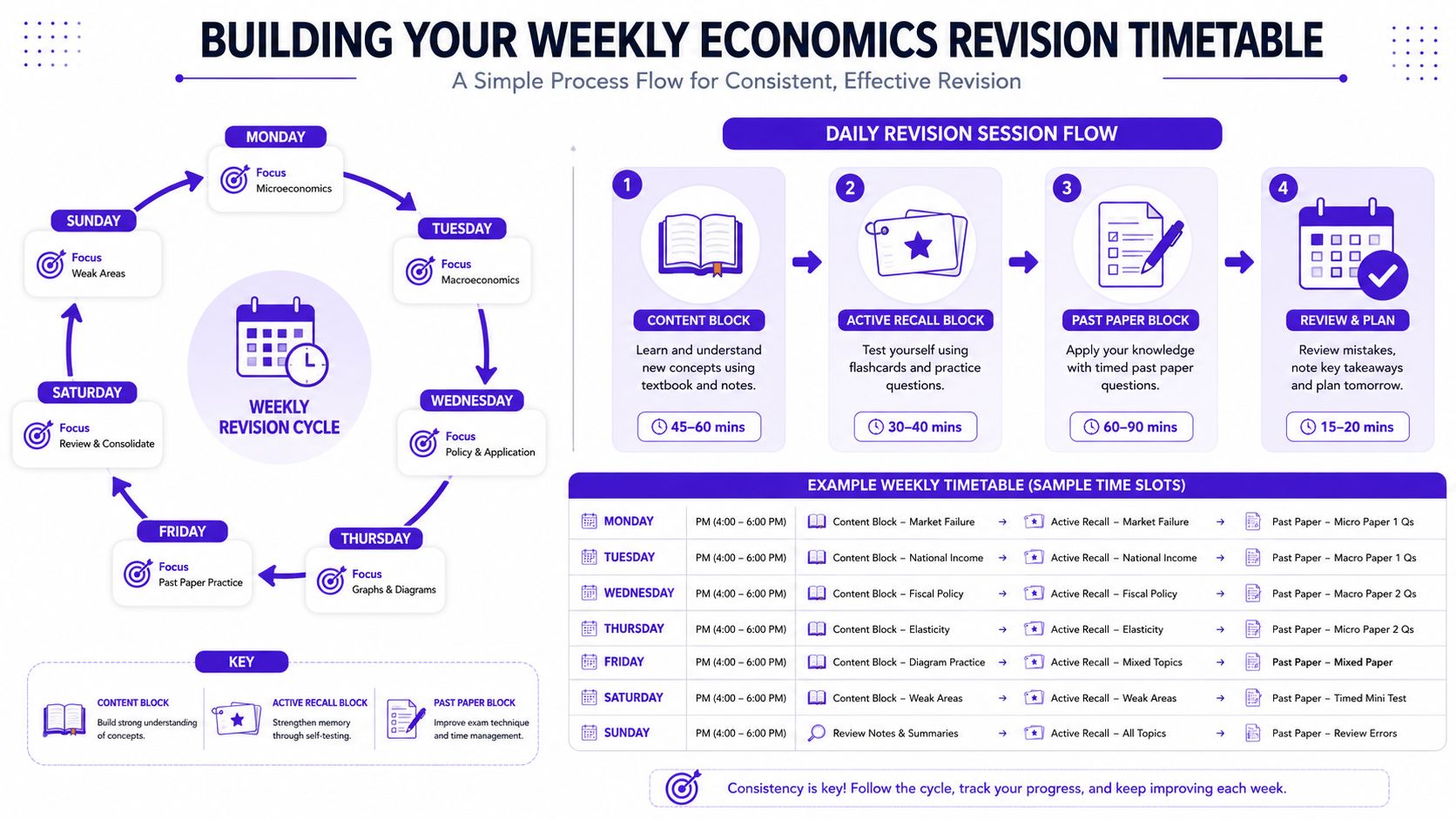
For most students, a 40 to 60 minute block is far more productive than a three-hour slog. You can still do serious work in that window, especially if you split it into a content block, an active recall block, and a timed question block. Long sessions often collapse because students drift, check their phone, or keep rereading without testing anything.
A useful weekly pattern for Year 13 looks like this:
- Monday PM, Micro content: revise one topic, such as market failure, then write a short set of definitions from memory.
- Tuesday PM, Macro content: work through one macro theme, then test diagrams and policy chains.
- Wednesday PM, Micro practice: do short questions and one longer paragraph response.
- Thursday PM, Macro practice: use data, graphs, and a timed explanation or evaluation task.
- Weekend, timed paper or section: sit a paper fragment under time, then mark it properly.
The point is repetition with purpose. A student who does this every week will meet the same ideas again and again in a controlled way, which makes exam day feel less hostile.
Use the week as a cycle
End each week by checking what slipped. If Thursday's macro session went badly, don't panic and rewrite the timetable from scratch. Move that topic into next Monday's content block, then test it again in a short recall slot. That keeps the plan stable enough to trust, while still responding to what your answers are telling you.
Active Recall and Spaced Repetition That Work for Economics
Reading your notes feels efficient because your eyes are moving and your brain recognises the material. The problem is that recognition isn't the same as recall, and exam scripts only reward recall that survives pressure. If you want the content to stick, you need to make your brain produce it, not just review it.

Turn each topic into prompts
Use flashcards for definitions, diagram labels, and chains of causation. A card that says “What happens if the Bank of England tightens monetary policy?” is better than a card that just says “monetary policy”, because the first forces you to build a response. The same goes for diagrams. Cover the labels, sketch the curve, and name the change without peeking.
A simple spaced pattern works well in plain English, revisit the topic after 1 day, then 3 days, then 7 days, then 14 days. That gives you enough separation to make recall effortful without leaving it so long that the content disappears. The same rhythm helps for a class test, a mock, or a topic you keep missing in essays.
Practical rule: if you can only answer a flashcard after seeing the first word, the card is too vague.
Make recall feel like the exam
The best revision sets copy the shape of the paper. Independent revision guides recommend sequencing practice by question type, from topic-based MCQs to short data-response items and then 24-mark essays, and checking every wrong answer against the mark scheme and examiner comments to see whether the error was knowledge, application, or evaluation (Save My Exams revision tips).
That approach lines up nicely with tools that use spaced review systems, including resources like overcoming the forgetting curve in online courses. For economics, the point is not just remembering a definition, but remembering it in the form you'll need when a graph, a policy choice, or a judgement appears in front of you.
If you revise monetary policy the night before a class test, don't just re-read. Make five prompts, one for the definition, one for a diagram shift, one for a transmission mechanism, one for an advantage, and one for a limitation. Then answer them without notes, mark the weak ones, and repeat only the misses.
An interactive tool such as MasteryMind can sit in that routine if your school uses AQA, Edexcel, OCR, or WJEC, because it aligns practice with specification content and gives examiner-style feedback. Used well, it's just another way of forcing recall under exam conditions.
Turning Theory Into Top-Band Evaluation
Most students lose marks because they treat evaluation as a final sentence. That's too late. Strong evaluation starts inside the paragraph, where you compare the size of the effect, the time lag, the assumptions behind the policy, and whether the evidence in the question supports the claim.
Choose the judgement that earns the mark
A weak answer to a question about higher interest rates usually says inflation will fall, then ends with “however, it depends on the situation.” That sounds cautious, but it doesn't show judgement. A stronger answer asks whether inflation is demand-led or cost-push, whether higher rates will hit spending quickly or slowly, and whether weaker growth makes the policy risky.
The mixed UK macro picture makes that kind of judgement easier to practise. An independent 2026 economics briefing reported the IMF cut the UK's GDP growth forecast from 1.4% to 0.8% for 2026, forecast inflation at 3.3%, and expected unemployment to rise to 5.6% (2026 economics briefing). Those figures are useful because they point in different directions at once, which is exactly what examiners like to see in evaluation paragraphs.
Compare two answers in your head
A mid-band paragraph might say that raising interest rates should reduce inflation because borrowing becomes more expensive and consumers spend less. That's correct, but it stays generic.
A top-band paragraph adds that the policy could worsen unemployment if firms cut hiring or if households already facing weaker growth pull back further. It then weighs whether inflation is the more urgent problem, given the current backdrop, and ends with a clear judgement on which side looks stronger in this context.
Good evaluation is not “both sides”. It's choosing which side is stronger and saying why.
If you want a place to drill that skill with timed responses, A-Level Past papers can help you practise the exam-style structure rather than just the content. The trick is to write evaluation every time you answer, not as a decorative final sentence but as part of the logic of the paragraph.
Tracking Progress and Adjusting the Plan as Exams Approach
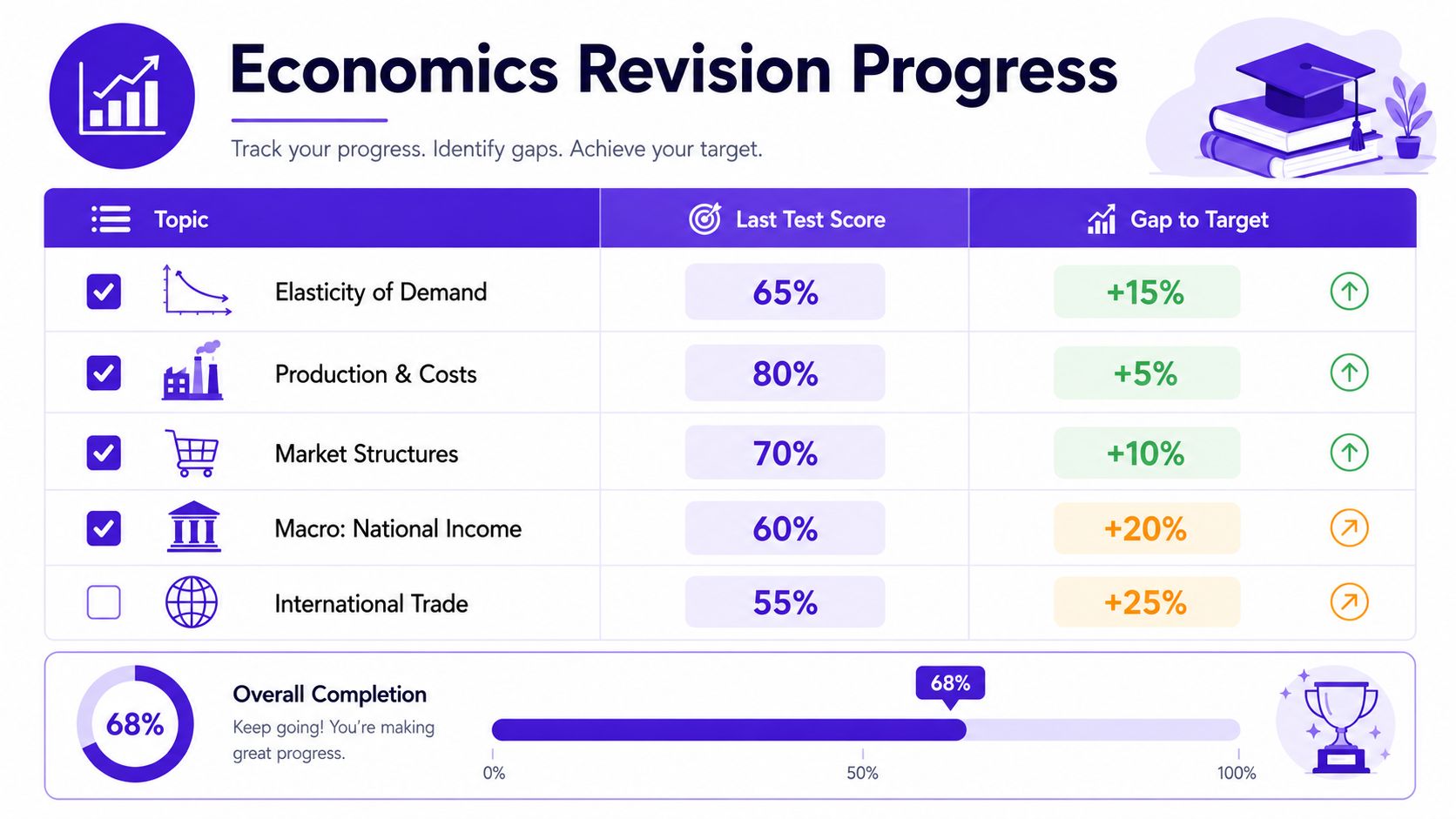
A revision plan only works if it changes when your evidence changes. The simplest tracker is three columns, topic, last test score, and gap to target, reviewed every fortnight. That gives you a live picture of where you're improving and where you're still guessing.
Use mock papers to diagnose, not just grade
After each mock, split the mistakes into two piles. One pile is knowledge gaps, the other is technique gaps. If a student knew the theory but lost marks on application, the fix is different from a student who couldn't explain the diagram at all. That distinction matters more than the overall score, because it tells you where to spend the next revision hour.
Shift time away from weak topics only after a second mock shows the same pattern. One bad paper can happen for all sorts of reasons, including nerves or a bad question choice. Two papers with the same weakness are a clearer signal that the timetable needs changing.
Final four-week checklist
Use full timed papers, mark-scheme review, and targeted recall. Keep the last 48 hours lighter, with a short recap and an early night so you arrive rested rather than drained. If you've been using an exam practice tool, Exam Practice for A-Level can be one part of that final stretch because it keeps questions close to the board style you'll face in the hall.
The best students don't revise more in the final week. They revise more precisely, then stop in time to think clearly on the day.
If you want a revision system that matches UK exam boards, marks your practice against examiner-style expectations, and helps you move from quick recall to proper essay judgement, visit MasteryMind. It's built for structured practice, mixed-topic review, and the kind of a level economics revision that changes how you answer questions. Try it alongside your specification, then use the feedback to sharpen the topics and essays that matter most.
Ready to master this topic?
Practise with quizzes, blurt exercises and exam questions on MasteryMind.
7 days Premium · Then free forever · No card, no charge