Factors Affecting Transpiration: A Study Guide

You know the feeling. You've got a biology test coming up, the topic looks simple at first glance, and then the questions start asking you to explain why a plant dries out faster on one day than another. Transpiration turns up in exactly that kind of paper, and examiners love it because it looks like a recall topic but quickly becomes a reasoning topic.
A plant on a hot, breezy afternoon can look fine in the morning and droop by lunch. That change is not random, it's the visible result of water leaving the leaves faster than the roots can replace it. If you want a quick stretch beyond the basics, you can also browse cactus care tips at The Cactus, which is a neat way to see how some plants handle water loss differently. For students doing broader revision, the structure in MasteryMind Biology AQA preparation can help you link this topic to the rest of plant transport.
What Transpiration Actually Is and Why Plants Do It
A plant that looks slightly wilted on a warm, breezy day is usually losing water faster than it can replace it. That water loss is called transpiration, and it happens from the plant's surfaces, especially the leaves. In GCSE biology, the key external factors affecting transpiration are temperature, humidity, air movement, and light intensity (BBC Bitesize).
A useful trade-off, not just water waste
Plants do not “want” to waste water, but transpiration gives them real benefits. It helps pull water and minerals up from the roots, it cools the leaf, and it helps keep cells firm so the plant stays upright and growing. That's why a plant can't shut the process down all the time.
The main water loss happens through the stomata, and educational summaries commonly describe stomatal transpiration as responsible for about 98% of plant water loss (Slideshare educational summary). That matters because anything that changes stomatal opening can have a big effect on overall water loss.
Practical rule: if a question asks for a definition, keep it short. “Transpiration is the evaporation of water from a plant, mainly through the stomata,” is the kind of line that scores fast.
A one-mark answer usually needs that definition plus one benefit if the wording asks for it. A sensible extra detail is that transpiration is linked to water uptake, not just losing water. If you can say that clearly in under 30 seconds, you're already in good shape for the easiest recall questions.
How the Transpiration Stream Actually Works
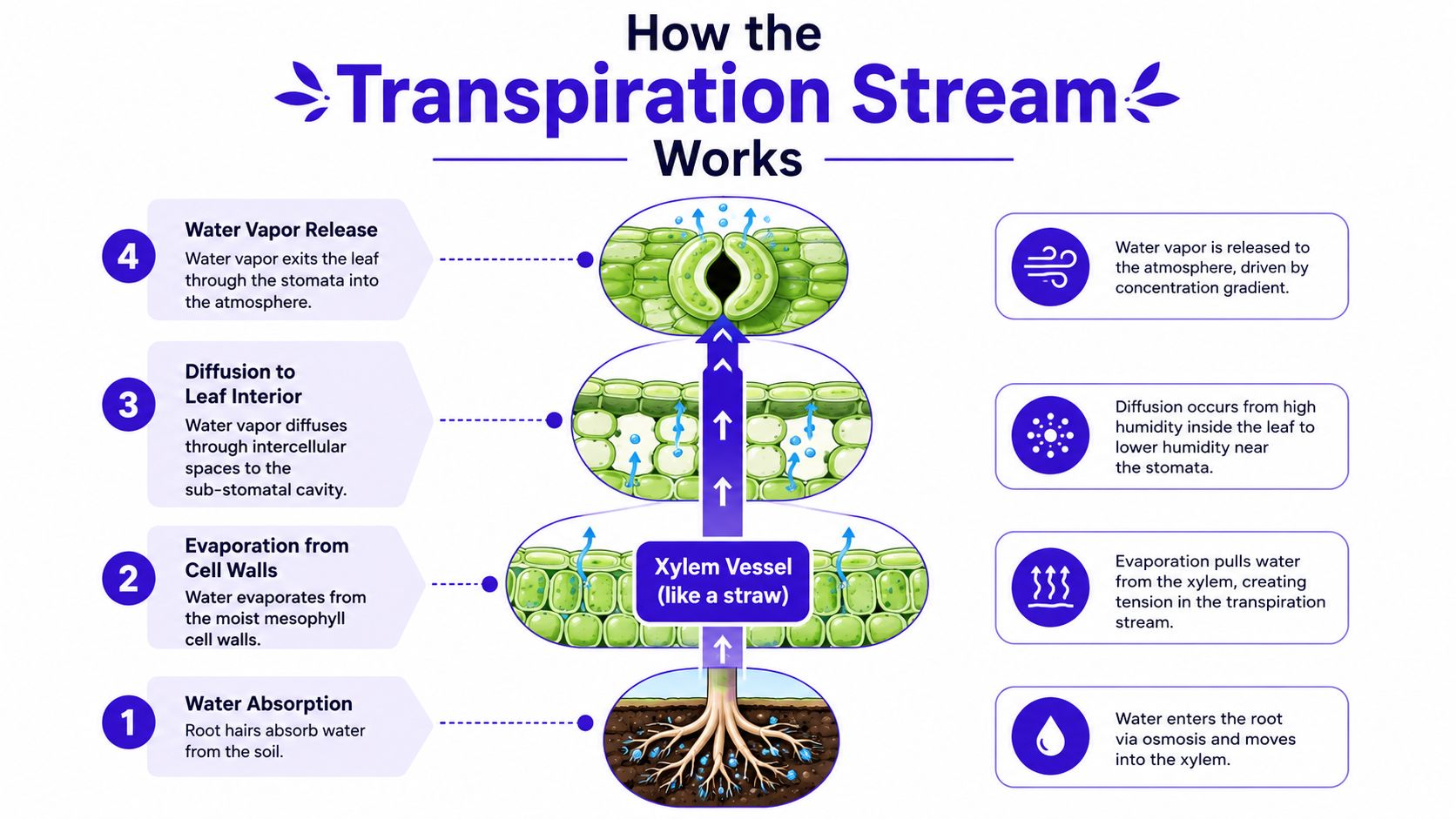
Water does not disappear from a leaf. It moves in a continuous pathway from the soil, through the plant, and out into the air. The xylem carries that water upward, and the pull begins when water evaporates from moist cell walls inside the leaf, diffuses into the leaf air spaces, then leaves through the stomata.
The pull from above
Water moves through the xylem in a connected column pulled upward by evaporation at the leaf surface. When water molecules evaporate from the top, cohesion holds the column together, so the lower water follows the same pull. That is the cohesion-tension theory.
Water leaves the leaf, pressure drops, and the xylem column gets pulled upwards from below.
Examiners like this sequence because it shows cause and effect clearly. A strong answer does more than say “water goes up the plant.” It names the steps in order, evaporation, diffusion, exit through stomata, then pull through xylem.
Why stomata matter so much
Stomata are the gates that control the whole system. When they open, water vapour leaves more easily, so the pull on the xylem increases. When they close, water loss slows, but gas exchange also falls, which is why the plant has to balance water conservation against photosynthesis.
A lot of confusion comes from mixing up water movement with gas exchange.
Keep them separate in your head. Water leaves the mesophyll cell walls, passes into air spaces, and exits through stomata. The xylem then supplies replacement water from the roots, which is why water uptake and water loss are linked. For a related exam point on managing water use in crops, see these irrigation scheduling tips.
The Four External Factors You Must Know for Exams
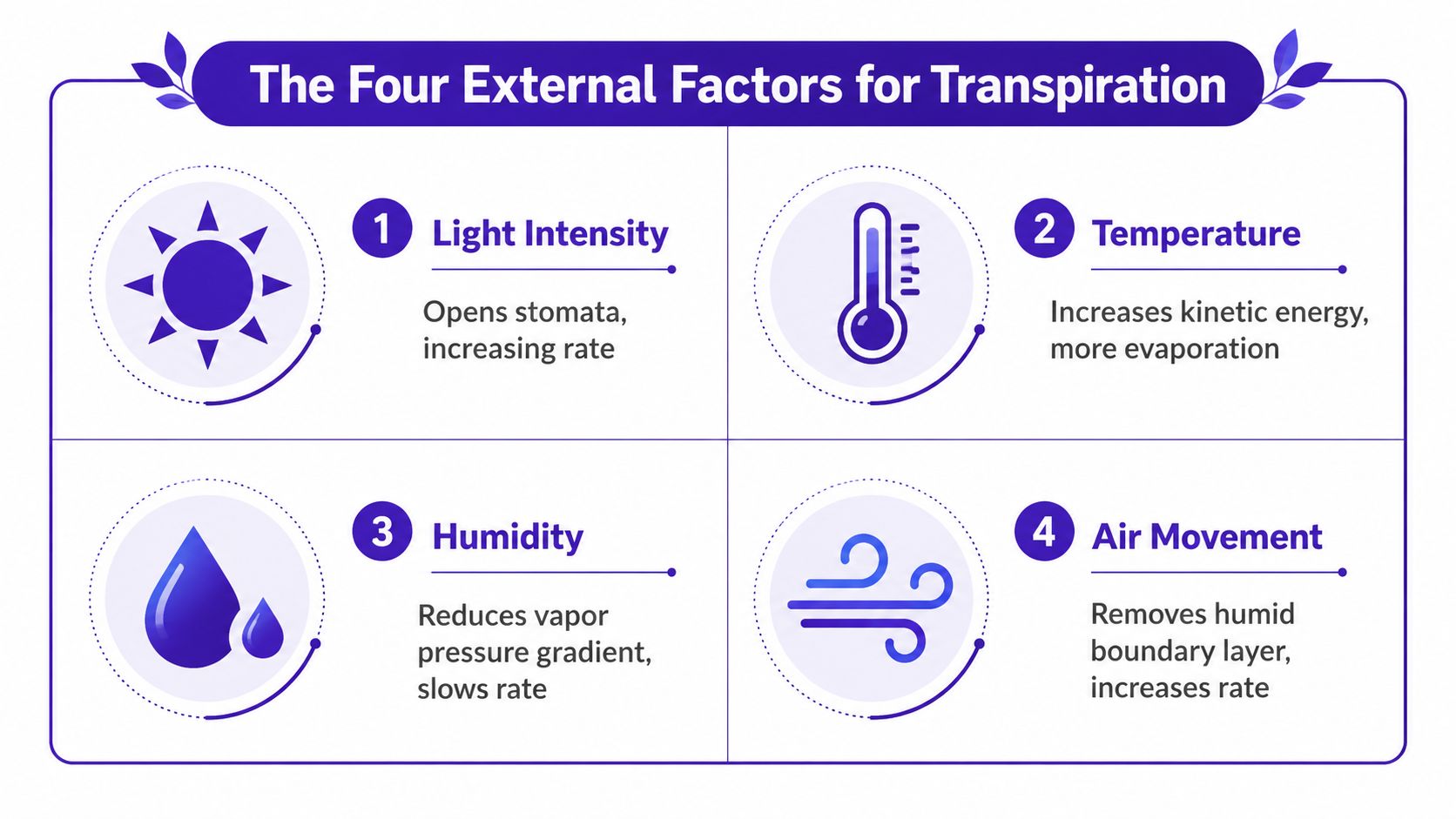
A windy, dry, sunny day gives you a perfect exam-style clue. The leaf is losing water quickly, and that rate changes because four external factors are acting at once, light intensity, temperature, humidity, and air movement. If you can explain each one clearly, you are already answering the question in the way examiners want, especially when comparing different conditions in a greenhouse or field. For a quick revision checkpoint, BBC Bitesize and A-Level and GCSE biology resources both keep the focus on the same core ideas.
Light intensity and temperature
Light intensity matters because stomata usually open in daylight. When the guard cells open the stomata, water vapour can leave more easily, so transpiration rises. A simple memory hook is, “light opens the door.”
Temperature matters because warmer conditions increase the rate of evaporation from mesophyll cell surfaces. A standard biology reference notes that at 30°C a leaf may transpire about three times as fast as it does at 20°C (LibreTexts/16:_The_Anatomy_and_Physiology_of_Plants/16.02:_Plant_Physiology/16.2C:_Transpiration)). That is the sort of detail that earns marks when a question asks you to explain why a hot, bright day speeds up water loss. The key idea is not just that warmth increases movement. It also increases evaporation, so the air inside the leaf becomes loaded with water vapour more quickly.
Humidity and air movement
Humidity affects the diffusion gradient. If the air around the leaf is already damp, less water vapour can move out, so transpiration slows. Memory hook, “wet air weakens the pull.”
Air movement removes the humid layer around the leaf. That keeps the air next to the stomata drier, so the gradient stays steeper and water leaves faster. If the air is still, a humid boundary layer builds up and slows the process. That boundary layer is the exam trap many students miss, because it explains why a still greenhouse and a breezy garden do not give the same transpiration rate even when the temperature looks similar.
The pattern can change at extremes. Very strong light or high temperature can increase transpiration at first, but if water loss becomes too great, the plant may close its stomata to reduce loss. That means the simple “more light, more transpiration” rule only works while the plant still has enough water and keeps its stomata open. This is the vapour pressure deficit trade-off in plain terms, and it is the kind of higher-level point that helps with AO2 and AO3 answers.
You will also see these factors tested in practical and data questions that ask you to apply the biology to a greenhouse, classroom, or windy garden setting. If you need a useful real-world angle, irrigation scheduling tips are a good reminder that water loss and water supply have to be balanced carefully in plants.
Measuring Transpiration Rate with a Potometer
The potometer is the classic school practical for this topic, and examiners expect you to know its limits as well as its method. It measures water uptake, not pure water loss, but it's still the standard way to compare transpiration under different conditions. In practice, you'll often use a leafy shoot, a capillary tube, and an air bubble to track how fast water is moving through the apparatus.
Setting it up properly
Start by cutting a leafy shoot underwater so air doesn't enter the xylem. Then assemble the potometer carefully and introduce a single air bubble into the capillary tube. If you accidentally trap extra air bubbles during assembly, the reading becomes unreliable straight away.
The usual school method is to measure the movement of the air bubble over a 15-minute interval and repeat the test three times under each condition before working out an average (WJEC-style revision guidance). That repetition matters because it makes the result more trustworthy.
How to calculate the rate
If the bubble moves 18 mm in 15 minutes, you use the tube's cross-sectional area to convert distance into volume. Then divide by leaf area and time to get a transpiration rate in mm³ per cm² per minute. That unit tells you how much water is being taken up per unit leaf area each minute.
A lot of students lose marks by forgetting that leaf area must be controlled or recorded. Bigger leaves naturally take up more water, so you can't compare two shoots fairly unless you account for that difference. Another common slip is saying the potometer measures transpiration directly, when it measures uptake.
Examiner's note: if a question asks for a limitation, mention that the shoot has been cut from the roots, so the setup is not identical to a living plant in soil.
For extra revision on how schools package GCSE and A-Level practice, the format in A-Level and GCSE biology resources gives a good sense of how method questions are usually framed.
The Vapour Pressure Deficit Trade-Off Most Guides Skip
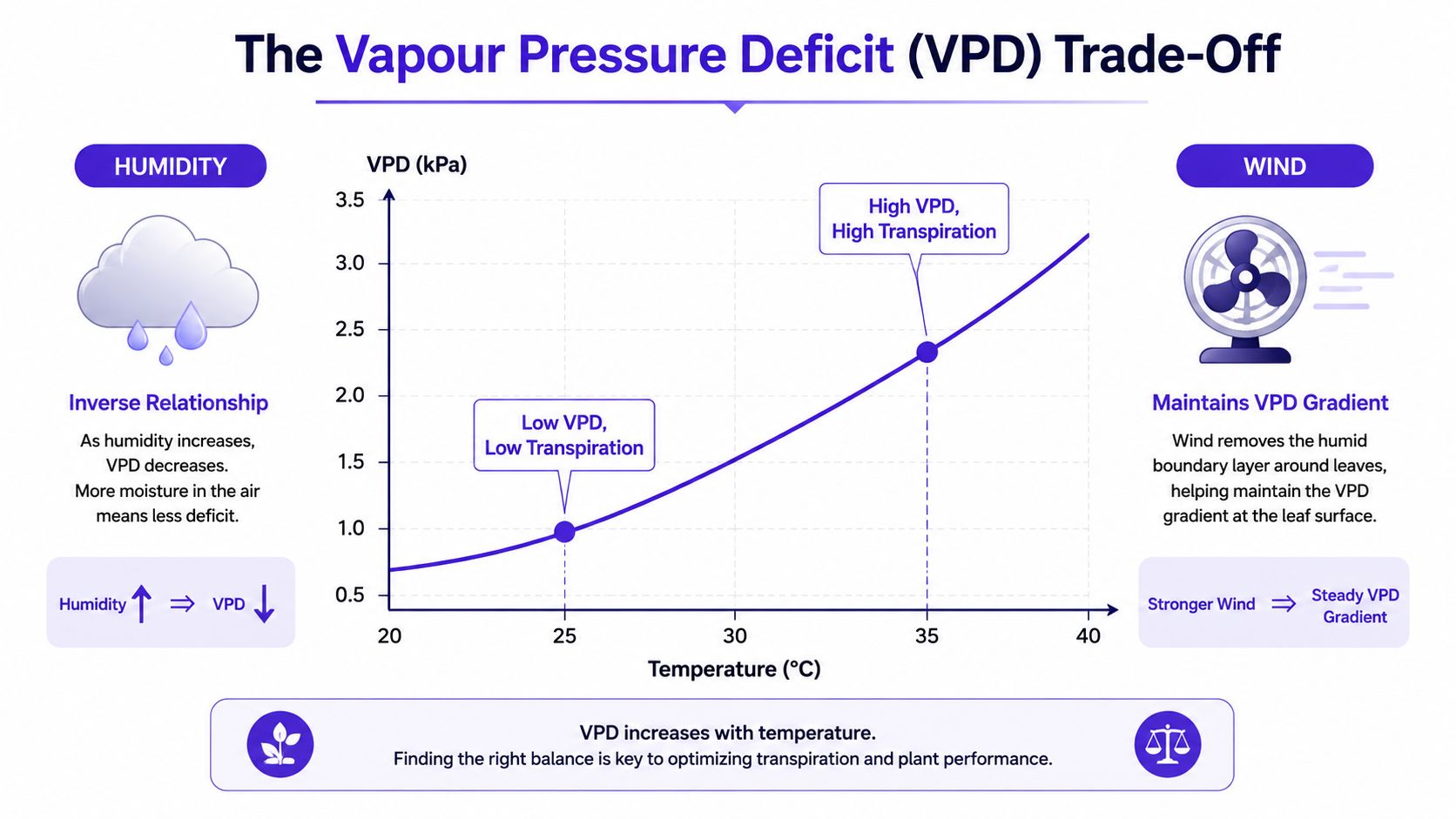
A lot of guides make transpiration sound simple. Hotter air, windier air, more transpiration. That's useful at first, but it's not the whole story. The better way to understand it is through vapour pressure deficit, or VPD, which combines temperature and humidity into the air's actual drying power.
Why the simple rule breaks down
Recent modelling work shows that transpiration does not just rise forever as conditions get hotter or windier, because very high temperature or strong wind can trigger stomatal closure and reduce water loss (ScienceDirect). That's the bit many students miss. Plants are not passive leaks, they regulate their stomata to protect water status.
Humidity is part of the same story. As relative humidity rises, transpiration falls because the gradient from leaf to air becomes weaker. Higher ambient temperature and air velocity increase the drying demand, but only up to the point where the plant starts closing stomata to protect itself.
The exam-friendly way to phrase it
A strong AO2 answer might say that a warm, windy day usually increases transpiration at first because evaporation is faster and the boundary layer is removed. But if the heat becomes extreme, the plant may close its stomata, so the rate can plateau or even fall. That is the trade-off.
A controlled-environment study also found that light, temperature, humidity, water availability, wind velocity, stomatal size, number and distribution, cutinization, species, and developmental stage all significantly affect transpiration rates (Ohio State University resource). That is why real plants don't all respond identically in the same weather.
Putting It All Together in a Real Garden
A UK garden plant on a summer day gives you the whole topic in one scene. At dawn, light begins to rise and stomata open, so transpiration starts climbing. By midday, temperature is higher, the air is drier, and a breeze strips away the humid layer around the leaf, so the rate rises again.
By the afternoon heatwave, the plant may start to struggle. If root uptake can't keep up with water loss, turgor drops and the stomata begin to close to protect the plant. That's why a day that looks “perfect for transpiration” on paper can still end with a wilted plant.
What examiners want you to see
The important point is interaction. Light opens stomata, temperature speeds evaporation, humidity weakens the gradient, and wind strengthens it by removing moist air near the leaf. In a real plant, all four act together, so the final rate depends on the balance between water loss and water conservation.
That's why a garden plant can look fine in the morning and limp by late afternoon even if the soil hasn't suddenly changed. The atmosphere can demand more water than the roots can supply, and the plant responds by closing stomata. Once you understand that, long-answer questions become much easier to handle.
Short answer to remember: transpiration is not a fixed process, it changes as the plant and the weather interact.
Exam-Style Questions and How to Score Full Marks
You don't need fancy language here. You need the right command word, the right mechanism, and the right level of detail. If a question says name, give the term. If it says explain, give the reason why. If it says evaluate, give one strength and one limitation.
Try these three questions
1 mark recall. Name two external factors that affect transpiration.
Model answer: light intensity and humidity.
3 mark explain. Explain how increasing temperature affects transpiration rate.
Model answer: higher temperature increases evaporation from mesophyll cell surfaces, so water vapour builds up faster in the leaf air spaces. That steepens the diffusion gradient from the leaf to the air, so transpiration increases. At very high temperatures, stomata may begin to close to reduce water loss.
6 mark extended response. Plan an investigation using a potometer to compare transpiration in still and windy conditions.
Model answer: use the same leafy shoot throughout, cut it underwater, and seal the apparatus to prevent leaks. Measure bubble movement over 15 minutes and repeat three times in still air, then repeat three times with a fan at a fixed distance. Control leaf area, light intensity, temperature, and humidity as much as possible, then calculate the mean rate of water uptake in each condition.
Common mistakes that lose marks
- Ignoring the mechanism: saying “wind increases transpiration” without explaining the boundary layer is incomplete.
- Mixing up describe and explain: describe gives what you can observe, explain gives why it happens.
- Forgetting controls: in practical questions, uncontrolled light or temperature can ruin the comparison.
If you want an example of a real context where water loss matters, save water with xeriscape is a useful reminder that plant choice and water use are tightly linked in dry conditions. For practice in exam-style wording, Exam Practice for GCSE is the kind of tool students use when they want answers that sound like mark schemes.
Quick Recap and Smart Next Steps

Five-point recap
- Light intensity opens stomata in daylight.
- Temperature speeds evaporation from leaf surfaces.
- Humidity lowers the diffusion gradient and slows water loss.
- Air movement removes the humid boundary layer and speeds loss.
- VPD explains why extreme heat or wind can eventually trigger stomatal closure.
Five quick self-check questions
- Can you define transpiration in one sentence?
- Can you name the four external factors without hesitation?
- Can you explain why higher temperature usually increases the rate?
- Can you explain why a humid day slows transpiration?
- Can you describe one limitation of a potometer?
If you can answer all five without looking, you're in good shape. If not, don't cram randomly, use spaced repetition and mixed-topic practice so the facts stick properly. For topic-by-topic revision and GCSE Past Papers, a structured revision platform can turn this into short quizzes, examiner-style feedback, and targeted practice that feels much closer to the actual thing than rereading notes.
If you want a cleaner way to revise factors affecting transpiration, use MasteryMind to practise the exact command words and mark-style responses that come up in UK biology papers. It's built to help you move from recall to explanation, so you can test this topic properly instead of hoping it appears in a friendly way. Visit MasteryMind and start turning this topic into marks.
Ready to master this topic?
Practise with quizzes, blurt exercises and exam questions on MasteryMind.
7 days Premium · Then free forever · No card, no charge