Gas Exchange Systems: The Ultimate GCSE and A-Level Guide

You're staring at a gas exchange question the night before an exam, trying to remember whether oxygen moves into or out of the blood, and wondering why the mark scheme seems to want a whole paragraph for a process that sounds simple. That confusion is common. Gas exchange systems become much easier once you stop treating them as lists of adaptations and start seeing the same problem being solved repeatedly: moving gases across a thin surface quickly enough to keep cells supplied and remove carbon dioxide.
The strongest answers connect structure, diffusion, ventilation, transport and environmental conditions. That approach works whether you're revising GCSE alveoli, A-Level comparisons between fish and insects, or an unfamiliar diagram designed to test whether you can apply principles rather than recall labels.
Core Principles of Gas Exchange and Diffusion
Diffusion is the starting point for almost every biological gas exchange system. It means the net movement of particles from a region of higher concentration to a region of lower concentration. This is similar to pupils leaving a crowded classroom and spreading into a quieter corridor. The particles move randomly, but the overall movement is away from the crowded area until the difference becomes smaller.
In living organisms, diffusion only works efficiently when the exchange surface is designed to support it. The important factors are the concentration gradient, surface area, diffusion distance and the properties of the membrane. A steep gradient provides a strong driving force. A large surface gives more space for particles to cross at the same time. A short diffusion distance means particles have less tissue to travel through.
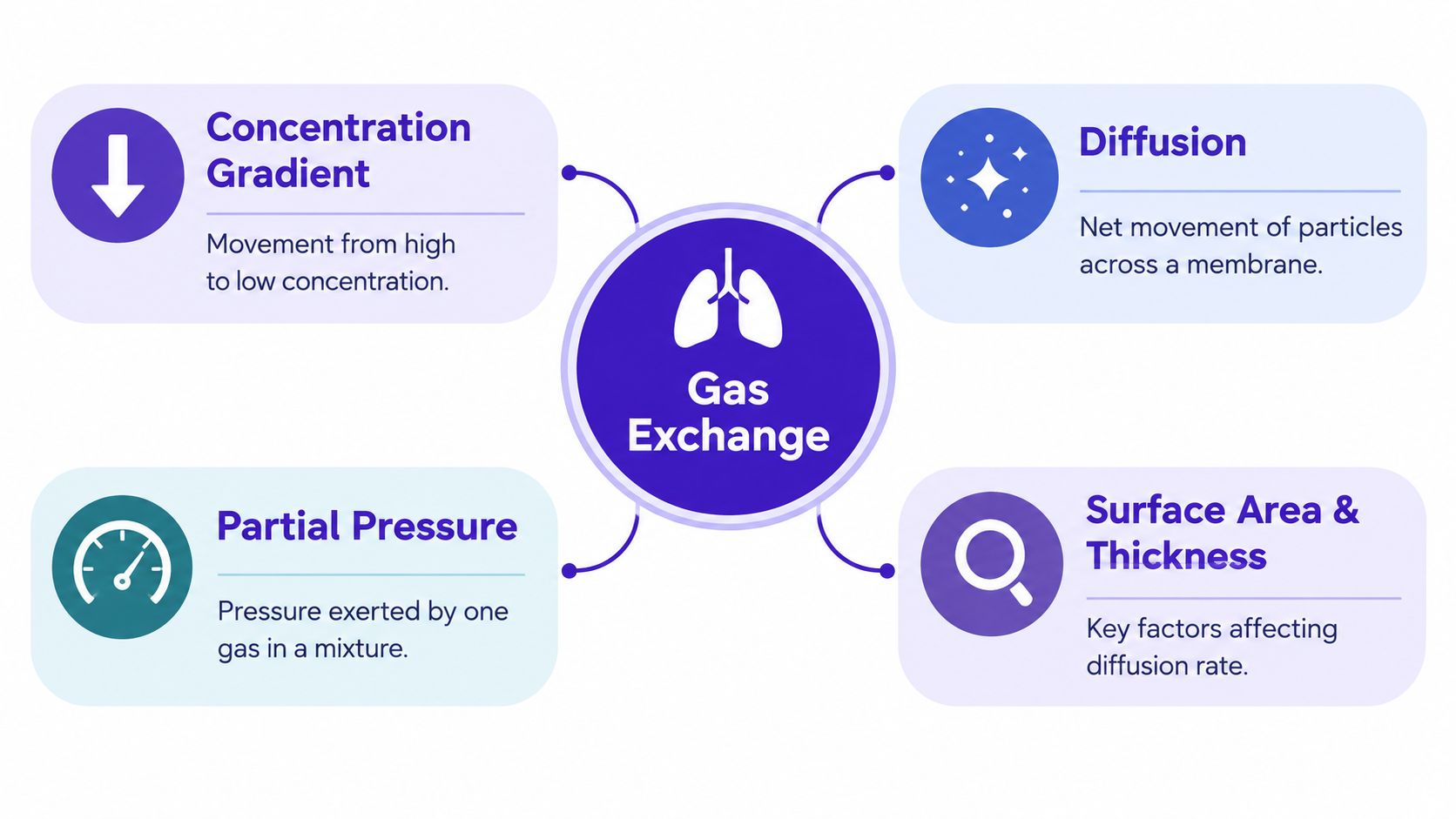
Making diffusion work faster
A useful plain-English version of Fick's law is:
Rate of diffusion increases when surface area and concentration difference increase, and decreases when diffusion distance increases.
That relationship helps you explain unfamiliar examples. If an organism has a folded exchange surface, the folds create more area. If the membrane is thin, the distance is reduced. If ventilation continually replaces air or water next to the surface, the organism maintains a difference in concentration rather than allowing equilibrium to develop.
The word gradient matters. Oxygen does not “move into the blood because the body needs it”. Oxygen moves because its concentration, or its partial pressure, is higher on one side of the exchange surface than the other. Carbon dioxide follows its own gradient in the opposite direction.
Partial pressure is the pressure exerted by one gas within a mixture. At A-Level, this term lets you describe gas movement more precisely, particularly when discussing lungs, blood and different gas mixtures. The essential reasoning remains the same: a difference in partial pressure creates a direction for net movement across the membrane.
Exam habit: Whenever you're asked why exchange is rapid, check that your answer includes both a structural factor and its effect on diffusion. “Thin wall” is incomplete. “A thin wall gives a short diffusion distance, so gases cross quickly” earns the biological reasoning.
Surface area to volume ratio also explains why small organisms may exchange gases directly across their body surface, while larger organisms need specialised structures. As body volume increases, the demand of internal cells rises, but the external surface available for diffusion doesn't increase at the same rate. Internal folds, branches, sacs and tubes solve this geometry problem by creating a larger exchange surface within the available body space.
For wider revision, MasteryMind biology revision tools can help you practise definitions alongside application questions. If respiration appears in the same question, it's also useful to understand how the gases produced and consumed relate to the respiratory quotient explained, rather than treating gas exchange and respiration as completely separate topics.
Human Alveoli and the Mechanics of Breathing
Human gas exchange depends on two linked but distinct processes. Ventilation is the movement of air into and out of the lungs. Gas exchange is the diffusion of oxygen and carbon dioxide across the alveolar-capillary membrane. Air can reach the alveoli without efficient exchange, and blood can flow past them without receiving much oxygen if the gradients or membrane conditions are poor.
The pathway begins when air enters through the nose or mouth and travels through the trachea, bronchi and bronchioles. The bronchioles end in clusters of alveoli. During inhalation, the diaphragm contracts and flattens, while the external intercostal muscles help expand the ribcage. The resulting pressure change draws air into the lungs. Exhalation reverses the pressure conditions and moves air out.
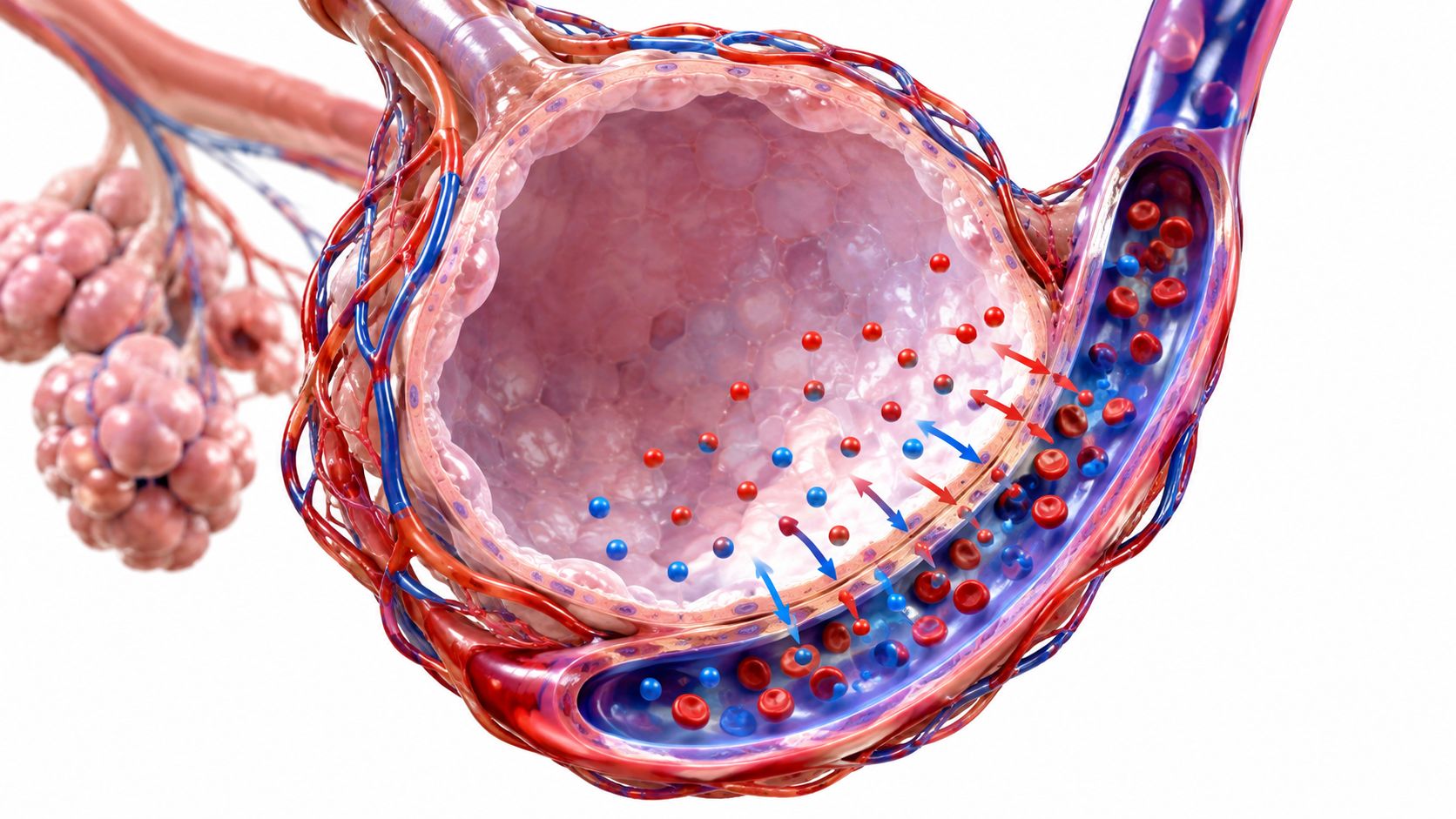
Why the alveoli are efficient
An adult has around 600 million alveoli, with a combined surface area about the size of a tennis court, according to BBC Bitesize's alveoli guidance. That extensive surface allows many oxygen and carbon dioxide molecules to cross at once.
Each alveolus has a wall one cell thick, which keeps the diffusion distance short. Its moist lining allows gases to dissolve before crossing the surface, as explained in BBC Bitesize's exchange-surface resource. A dense capillary network lies next to the alveoli, bringing deoxygenated blood close to the air and carrying oxygenated blood away.
These adaptations work together rather than independently:
- Large surface area: provides more space for simultaneous diffusion.
- Thin walls: reduce the distance oxygen and carbon dioxide must cross.
- Moist surface: allows gases to dissolve before diffusion.
- Dense capillary supply: maintains blood flow next to the exchange surface.
- Continuous ventilation: refreshes alveolar air and helps preserve concentration differences.
Oxygen moves from the alveolar air into the capillary blood, while carbon dioxide moves from the blood into the alveoli. The directions depend on concentration gradients, not on a gas “choosing” where to go. BBC Bitesize's diffusion explanation sets out this movement clearly for GCSE learners.
This short visual explanation can help you separate ventilation from diffusion before you attempt a labelled diagram.
At a more advanced level, gas exchange is driven by partial-pressure differences across the alveolar-capillary membrane, as described in Oxford's physiology teaching resource. Reduced ventilation means the air is not refreshed effectively. Reduced perfusion means blood flow is inadequate. Either problem weakens the gradient and lowers oxygen delivery.
Students often mix up the lungs' structure with the mechanics of breathing. For a related application, exercise physiology for GCSE students can help you connect breathing changes with oxygen demand without confusing ventilation with the actual exchange surface.
Comparative Anatomy Across Different Organisms
Every organism needs to obtain oxygen and remove carbon dioxide, but no single gas exchange system suits every environment. A small insect, a fish living in water, an amphibian and a flowering plant face different problems involving body size, surface area, water loss, oxygen availability and transport distance.
The best comparisons begin with the shared principle. Each system needs a large or well-positioned exchange surface, a short diffusion distance and a maintained gradient. The structures differ because the organism's body plan and habitat differ.
| Organism Group | Exchange Surface | Key Adaptation for Efficiency |
|---|---|---|
| Mammals | Alveoli in the lungs | Many air sacs provide a large surface, with thin moist walls and close capillaries |
| Bony fish | Gill filaments and lamellae | Extensive surface in water, with water flow and counter-current exchange maintaining gradients |
| Insects | Tracheae and tracheoles | Air tubes deliver oxygen directly towards tissues, reducing dependence on blood transport |
| Amphibians | Skin and lungs | Moist skin supports diffusion, while lungs provide an internal exchange route |
| Plants | Stomata and internal leaf air spaces | Stomata regulate carbon dioxide entry and water-vapour loss |
Fish and counter-current exchange
Fish gills must extract oxygen from water, where movement across the gill surface can quickly reduce the concentration difference. Water flows across the gill lamellae while blood flows in the opposite direction. This counter-current arrangement keeps the blood next to water with a higher oxygen concentration along much of the exchange surface, allowing diffusion to continue rather than reaching equilibrium early.
For an exam answer, don't write only “counter-current flow is efficient”. State the mechanism: blood and water move in opposite directions, maintaining a diffusion gradient across the gill surface, so oxygen continues to diffuse into the blood.
Insects and amphibians
Insects use spiracles, tracheae and narrower tracheoles to move air directly towards body tissues. Their blood isn't the main transport route for oxygen in the way mammalian blood is. This direct delivery suits their body design, because the tubes bring gases close to cells without requiring oxygen to travel through the circulatory system first.
Amphibians use both lungs and their skin. The skin must remain moist for gases to dissolve and diffuse across it, so this system depends strongly on the animal's environment. Lungs provide an internal surface, but the skin remains an important additional route.
Plants solve a different problem
Plants need carbon dioxide for photosynthesis, but open pores also allow water vapour to escape. Stomata regulate this trade-off. Internal air spaces bring gases closer to photosynthesising cells, while guard cells alter the opening of the stomata according to conditions.
Comparison rule: Don't compare structures without comparing outcomes. Say how the feature changes surface area, diffusion distance, gradient maintenance or water loss.
A high-mark comparison should also recognise limitations. Fish gills work well in water but are vulnerable to drying out. Amphibian skin supports exchange but needs moisture. Insect tracheae deliver gases directly but work within the constraints of their body design. Mammalian lungs protect a moist exchange surface inside the body, but they require ventilation and blood flow to maintain the conditions for rapid diffusion.
Real-World Impacts of Air Pollution on Lung Function
A textbook alveolus looks perfectly adapted, but real lungs don't operate in a clean, controlled diagram. Polluted air can affect the conditions needed for efficient gas exchange, particularly by irritating lung tissue and reducing lung function.
UK Biobank research linked higher exposure to particulate matter and nitrogen dioxide with lower lung function. A 5 µg/m³ increase in PM2.5 was associated with an 83.13 mL lower FEV1 and a 62.62 mL lower FVC, with effects stronger among people from lower-income households and people with other respiratory exposures, as reported in the UK government's gas statistics collection.
FEV1 refers to the amount of air exhaled during a forced breath in the relevant measurement period, while FVC refers to the total forced vital capacity. You don't need to turn these measures into a memorisation exercise for a GCSE question. The useful biological interpretation is that lower lung function can reduce effective ventilation and make it harder to maintain the conditions that support diffusion.
Linking pollution to the membrane
Pollutants can trigger inflammation in the respiratory system. Inflammation may interfere with the thin alveolar-capillary interface, increasing the effective diffusion distance or reducing how efficiently gases cross it. It can also affect airways, which changes the amount of air reaching the exchange surfaces.
That gives you a strong evaluation chain:
- Pollutant exposure irritates or inflames lung tissue.
- Airway or membrane function becomes less effective.
- Ventilation, diffusion distance or gradient maintenance is impaired.
- Less oxygen reaches the blood efficiently.
More alveoli alone wouldn't guarantee better gas exchange if the exchange membrane is inflamed or blood and air flow are poorly matched. This is the point students often miss when they focus only on surface area.
Short-term conditions matter too. UK public-health guidance states that exposure over hours or days can worsen lung function and contribute to coughing, wheezing, shortness of breath, asthma flare-ups and respiratory admissions, as described in UK air pollution health guidance. UK-based research also reported that one hour of exposure to everyday indoor or outdoor pollutants could affect lung function, with woodsmoke and limonene-derived aerosols showing the strongest immediate effects.
Indoor air matters because the alveoli don't operate separately from the airways. The lungs need a clean supply of air to preserve a useful gradient, and the exchange surface needs to remain thin, moist and functional. A classroom or home can therefore affect gas exchange before a person notices obvious illness.
Exam Techniques and Common Mark Scheme Pitfalls
Students often lose marks because they know the biology but answer a different question from the one set. Describe means report what you can see or identify. Explain means give the biological reasons. Compare means include similarities and differences, not two separate descriptions.
Command words that change your answer
For a description, write observations such as “oxygen concentration is higher in the alveolus than in the capillary”. Don't add a long explanation unless the question asks for one.
For an explanation, build a chain. “The alveolar wall is one cell thick, so the diffusion distance is short. Oxygen crosses quickly down its concentration gradient.” That is much stronger than “the alveoli are adapted for diffusion”.
For a comparison, use a clear paired structure:
- Mammalian alveoli have a dense capillary network, whereas insect tracheoles deliver air directly towards tissues.
- Fish use gills in water, whereas mammals use internal lungs in air.
- Both systems provide a large exchange surface and maintain concentration differences.
A diagram question rewards accurate labels and functional statements. If you label a capillary, don't call it an alveolus. If you label ventilation, don't describe it as diffusion. Blood flow carries oxygen away from the lungs, but blood movement isn't the same as gas movement across the membrane.
Mark-scheme language: Use “steep concentration gradient”, “short diffusion distance”, “large surface area”, “one-cell-thick wall” and “moist lining” when those features apply. Then state the consequence.
The six-mark and extended-response trap
A six-mark response needs connected reasoning, not a collection of isolated facts. Start with the exchange surface, explain how its structure affects diffusion, then include ventilation and blood flow if the question concerns the whole respiratory system.
A longer evaluation response needs balance. You might compare two systems, identify the advantage of each, then explain a limitation linked to its environment. Avoid claiming that one organism's system is simply “better”. It may be better for its own conditions, while being unsuitable elsewhere.
Use Exam Practice for GCSE to practise switching between command words and checking whether each sentence answers the question asked.
Before moving on, use this quick check:
- Define: Have you stated what diffusion or gas exchange means?
- Locate: Have you identified the alveoli, gills, tracheoles, skin or stomata?
- Explain: Have you linked each adaptation to diffusion?
- Compare: Have you written both a similarity and a difference?
- Apply: Have you used the information in the diagram or data rather than relying only on memory?
Active Revision Strategies for Long-Term Retention
Passive rereading makes gas exchange feel familiar without proving that you can reproduce it under pressure. Close the textbook and draw an alveolus from memory. Label the air space, thin wall, capillary and directions of oxygen and carbon dioxide movement. Then explain why each label matters.
Active recall works especially well with biological diagrams because it exposes missing links. If you remember “large surface area” but can't explain how it increases the rate of diffusion, you've found the gap before the exam does.
A practical revision cycle
Start with a blank page and answer one question aloud: “How is the alveolus adapted for rapid gas exchange?” Give yourself time to produce the full chain, not just the keywords. The MasteryMind active recall techniques resource can support this kind of retrieval practice.
Next, use spaced review. Return to the same diagram after a delay rather than repeating it several times in one sitting. On later attempts, change the question: explain diffusion, compare alveoli with gills, interpret a pollution result, or identify why a reduced gradient affects oxygen delivery.
Mix topics once the basics are secure. Follow a gas exchange question with respiration, transport in plants or exercise physiology. This forces you to choose the relevant principle instead of answering from a memorised pattern.
Say the explanation in your own words, then check it against the specification. A confident answer should include the direction of diffusion, the relevant adaptation and the reason that adaptation improves exchange.
MasteryMind provides UK GCSE and A-Level practice aligned with AQA, Edexcel, OCR and WJEC, including biology questions that move from quick recall to analysis and evaluation. Visit MasteryMind to practise gas exchange diagrams, command words and examiner-style feedback, then use spaced review to keep the topic secure before your next exam.
Ready to master this topic?
Practise with quizzes, blurt exercises and exam questions on MasteryMind.
7 days Premium · Then free forever · No card, no charge