OCR · GCSE · Physical Education
Respiratory System: Structure, Function, and Response to Exercise
This guide provides a comprehensive overview of the respiratory system for OCR GCSE PE students. It covers the structure and function of the respiratory pathway, the mechanics of breathing, gaseous exchange, and the immediate effects of exercise on the system, all tailored to meet exam board requirements."
- 8 min read
- 3 worked examples
- 4 practice questions
Study Notes
Overview
Understanding the respiratory system is fundamental for any physical education student. This topic explores how we get oxygen from the air into our bodies to fuel movement, and how we get rid of waste products like carbon dioxide. For your OCR GCSE PE exam, you will be expected to demonstrate a detailed understanding of the structures involved, the mechanics of how they work at rest and during exercise, and how to interpret data related to lung function. This knowledge is crucial for analysing athletic performance and understanding how the body responds to physical stress.

Key Knowledge & Theory
Core Concepts
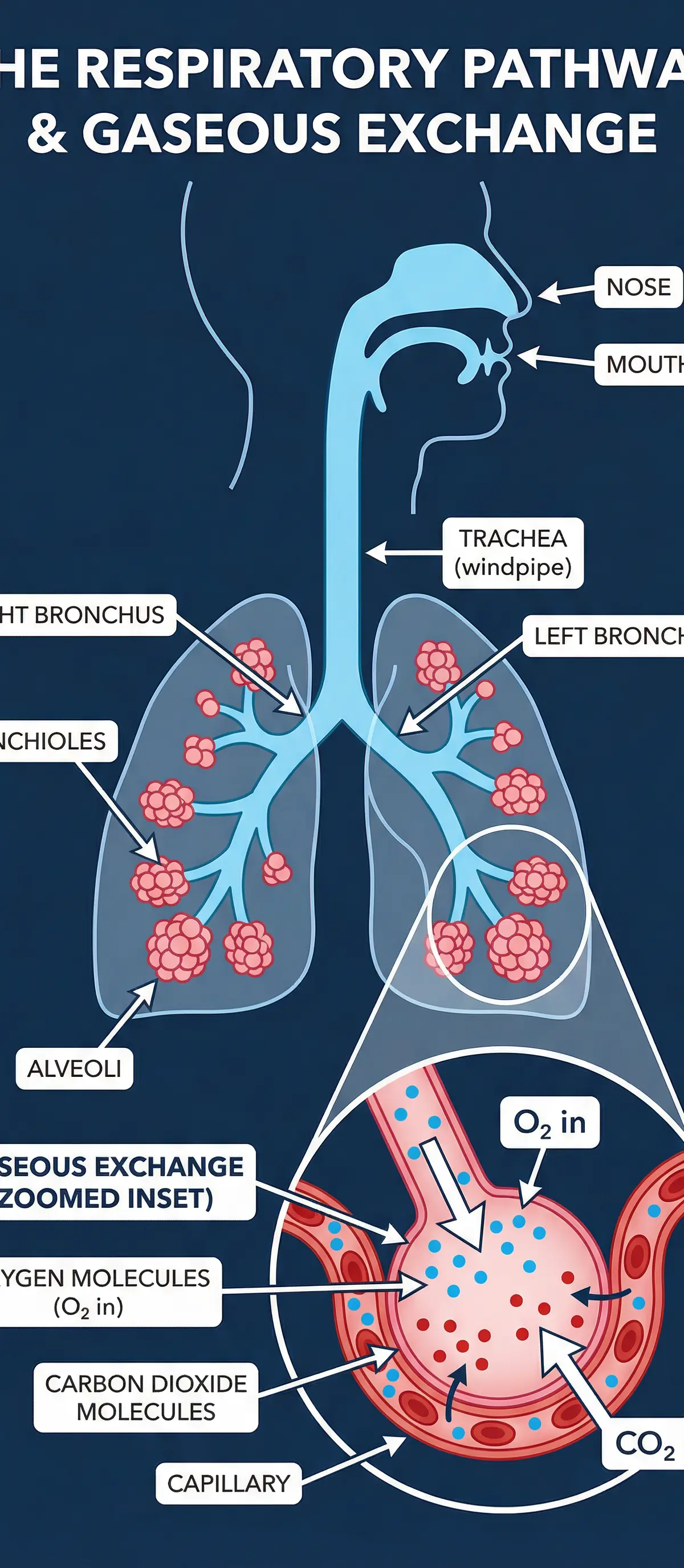
The Respiratory Pathway: Air travels through a specific sequence of structures to reach the lungs. Marks are awarded for listing these in the correct order.
- Nose / Mouth: Air enters the body. The nasal passages warm, filter, and moisten the incoming air.
- Trachea (Windpipe): A tube supported by C-shaped rings of cartilage that prevent it from collapsing.
- Bronchi: The trachea splits into two bronchi, one leading to each lung.
- Bronchioles: The bronchi branch into progressively smaller tubes called bronchioles.
- Alveoli: Tiny, clustered air sacs at the end of the bronchioles where gaseous exchange occurs.
Mechanics of Breathing (Ventilation): This is the process of moving air into and out of the lungs. It relies on changes in pressure within the thoracic cavity.
- Inspiration (Breathing In): An active process. The diaphragm contracts and flattens, while the external intercostal muscles contract, pulling the ribcage up and out. This increases the volume of the thoracic cavity, which decreases the pressure inside the lungs to below atmospheric pressure, causing air to rush in.
- Expiration (Breathing Out): A largely passive process at rest. The diaphragm and external intercostal muscles relax, the thoracic cavity volume decreases, and pressure inside the lungs increases above atmospheric pressure, forcing air out.
- Forced Expiration: During exercise, expiration becomes an active process. The internal intercostal muscles contract to pull the ribcage down and in, and abdominal muscles contract to push the diaphragm up, forcefully expelling air.
Gaseous Exchange: This occurs in the alveoli and is the process by which oxygen enters the blood and carbon dioxide leaves it. It happens via diffusion.
- Key Features of Alveoli: They have a huge surface area, a moist lining, walls that are only one cell thick, and a rich blood supply from a dense capillary network. These features maximise the rate of diffusion.
- Partial Pressure: Gases move from an area of high partial pressure to an area of low partial pressure. Oxygen's partial pressure is high in the alveoli and low in the deoxygenated blood, so it diffuses into the blood. Carbon dioxide's partial pressure is high in the blood (after being produced by muscles) and low in the alveoli, so it diffuses out of the blood to be exhaled.
Lung Volumes & Spirometry: A spirometer is a device used to measure lung volumes. Interpreting a spirometer trace is a key exam skill.
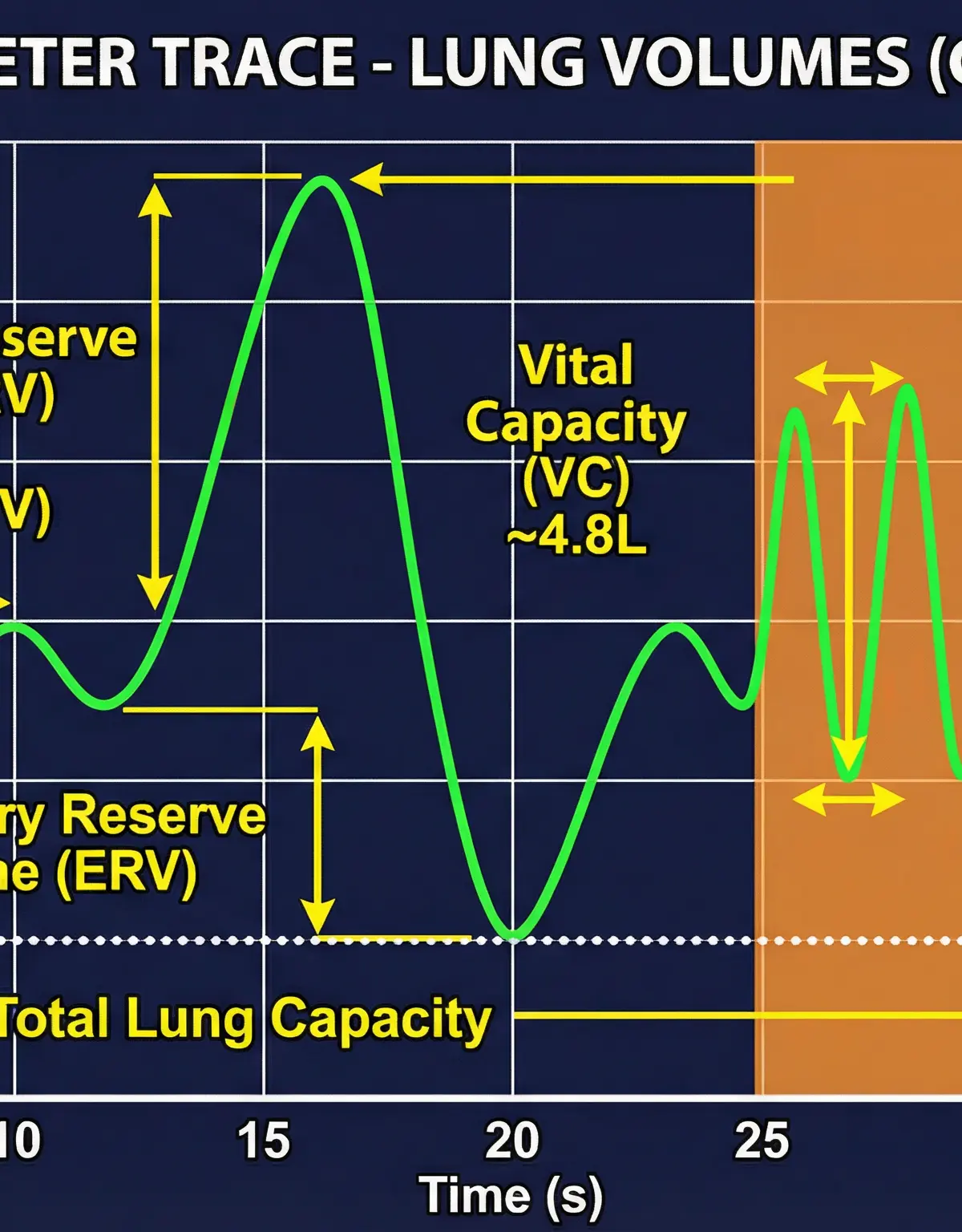
- Tidal Volume (TV): The volume of air inhaled or exhaled in a single normal breath (approx. 0.5 litres at rest).
- Vital Capacity (VC): The maximum amount of air that can be forcibly exhaled after a maximal inhalation.
- Residual Volume (RV): The volume of air remaining in the lungs after a maximal exhalation. This air cannot be expelled.
- Minute Ventilation (VE): The total volume of air breathed per minute (VE = Tidal Volume x Breathing Rate).
Key Practitioners/Artists/Composers
| Name | Period/Style | Key Works | Relevance |
|---|---|---|---|
| Sir Roger Bannister | 1950s Athletics | First sub-4-minute mile | A practical example of an athlete pushing the limits of their cardiovascular and respiratory systems. His training and performance demonstrate the principles of VO2 max and respiratory efficiency under extreme stress. |
| Dr. Nathan Zuntz | Late 19th Century | Development of the portable respirometer | A pioneer in exercise physiology whose work laid the foundation for understanding metabolism and respiratory responses to exercise. His inventions allowed for the direct measurement of oxygen consumption. |
Technical Vocabulary
Candidates must use precise terminology. Vague descriptions will not be credited.
- Diffusion: The net movement of particles from a region of higher concentration to a region of lower concentration.
- Partial Pressure: The pressure exerted by a single type of gas when it is in a mixture of gases.
- Thoracic Cavity: The chest cavity, which contains the heart and lungs.
- Diaphragm: A large, dome-shaped muscle at the base of the lungs that is the primary muscle of respiration.
- Intercostal Muscles: Muscles located between the ribs that assist with breathing.
- Spirometer: An instrument for measuring the air capacity of the lungs.
Practical Skills
Techniques & Processes
Measuring Lung Volumes: While you won't perform spirometry in a practical exam, you can demonstrate your understanding.
- Peak Flow Meter: A simple device to measure peak expiratory flow rate (PEFR). To use it, take a deep breath in, seal your lips around the mouthpiece, and blow out as hard and fast as you can. The reading indicates the speed of air moving out of the lungs.
- The Cooper 12-Minute Run: This is a test of aerobic fitness that heavily relies on the efficiency of the respiratory system. The objective is to run as far as possible in 12 minutes. The distance covered can be used to estimate VO2 max, a key indicator of respiratory and cardiovascular health.
Materials & Equipment
- Peak Flow Meter: For measuring PEFR.
- Spirometer: For detailed lung function tests.
- Stopwatch and Marked Track: For conducting fitness tests like the Cooper Run.
- Heart Rate Monitor: To track cardiovascular response alongside respiratory changes during exercise.
Portfolio/Coursework Guidance
Assessment Criteria
For the practical component of your GCSE, your performance in your chosen sports will be assessed. Your respiratory fitness is a key factor underpinning your ability to perform.
- AO4 (Performance): Your ability to sustain effort, recover between bouts of exercise, and perform skills under fatigue is directly linked to the efficiency of your respiratory system. A high level of aerobic and anaerobic fitness, supported by a well-functioning respiratory system, will allow for higher marks.
Building a Strong Portfolio
When analysing your performance in your coursework, you should be able to link your fitness levels to these physiological concepts.
- Example Annotation: "In the final 10 minutes of the match, my performance dropped. This was due to fatigue caused by a build-up of lactic acid and carbon dioxide in my muscles. My respiratory system was unable to supply enough oxygen to my working muscles and remove waste products quickly enough, leading to a decrease in my work rate. Improving my aerobic endurance through interval training would enhance my respiratory efficiency."
Exam Component
Written Exam Knowledge
All the core concepts listed above are examinable. You will face multiple-choice, short-answer, and extended-response questions.
- Data Analysis: You MUST be able to interpret a spirometer trace, identifying the different lung volumes and calculating minute ventilation.
- Application: You will be asked to apply your knowledge to different sporting contexts, explaining how the respiratory system responds to varying intensities and durations of exercise.
Practical Exam Preparation
Your practical performance is a demonstration of your body's systems in action. To maximise your marks:
- Aerobic Training: Incorporate continuous training (e.g., long-distance running, cycling) to improve the efficiency of your respiratory muscles and increase your vital capacity.
- Anaerobic Training: Use interval training (e.g., HIIT, sprint repetitions) to improve your body's ability to tolerate and remove carbon dioxide and lactic acid, which will improve your recovery rate.
"
Worked Examples
3 worked examples — open one to explore the question and available guidance.
Practice Questions
Test your understanding — click to reveal model answers
Identify the muscle that is primarily responsible for the mechanics of breathing at rest.
Hint: Think about the large, dome-shaped muscle at the bottom of your chest cavity.
Describe the process of gaseous exchange at the alveoli.
Hint: Remember to mention diffusion and the role of partial pressure for both oxygen and carbon dioxide.
Explain why the breathing rate of a 100m sprinter increases dramatically towards the end of their race.
Hint: What is the main chemical trigger for an increase in breathing rate? Think about the waste products of anaerobic exercise.
A games player's minute ventilation increases from 6 L/min at rest to 90 L/min during a match. Analyse how changes in tidal volume and breathing rate allow this to happen.
Hint: Minute ventilation is tidal volume x breathing rate. How do both of these variables change during exercise?