Half Caste Poem Analysis: GCSE Exam Guide
You're in the exam hall, the question mentions Half-Caste, and your mind goes blank. You remember the Picasso example, perhaps the repeated “explain yuself”, but you're not sure how to turn those details into a developed argument. That's a common problem, especially if you've left revision late.
The good news is that strong half caste poem analysis isn't about memorising a huge list of devices. It's about understanding what John Agard is challenging, hearing the poem as a performance, and explaining why his choices matter. This guide builds that process step by step, whether you're trying to recover your grade or aiming for the highest marks.
Understanding the Context of Half-Caste
You open the paper and see a poem that sounds unlike the neat, formal English you may expect from a GCSE anthology. The speaker addresses someone directly, uses Caribbean Creole, and refuses to accept the language being used about mixed-race identity. Before analysing individual words, identify the situation behind that confrontation.
John Agard's Half-Caste is a 2005 poem in his collection Half-Caste and Other Poems. It's commonly taught as a dramatic monologue and an anti-racist protest poem. Agard moved to Britain in 1977, a date often used to connect the poem with lived experiences of racism in postwar Britain. This context and timeline are discussed in a detailed poem analysis.
The title names the term Agard attacks. In the poem's historical setting, “half-caste” was used to classify people of mixed heritage as though they were incomplete. Agard does not just say the word is offensive. He makes the reader test its logic by applying it to things that are obviously complete.
Why the classroom context matters
The poem's social history involves the policing of mixed-race identity and the language used to describe people of Caribbean and other mixed heritage in Britain. That background helps you avoid a shallow interpretation such as “Agard dislikes a word”. His deeper argument is that people in power often use labels to decide what counts as normal, whole or acceptable.
The poem later became a recurring school text through its inclusion in UK GCSE study materials, including the Pearson Edexcel GCSE (9–1) English Literature Poetry Anthology. Its place in classrooms gives it a second historical role. A personal protest has become a standard text through which British pupils study racism, identity, voice and power.
Exam focus: Use context to sharpen your interpretation. Don't add a biography paragraph that has no connection to the poem's language.
A concise introduction might say that Agard presents a mixed-race speaker who confronts the racist label “half-caste” through humour, direct address and spoken Creole. You can then connect the poem's dramatic voice to its challenge against a society that treats mixed identity as partial. For broader revision habits, this GCSE English poem study guide can help you organise context alongside language and structure.
Exploring the Core Themes and Message
At the centre of the poem is a question of who has the right to name another person. The speaker treats “half-caste” as an absurd description because mixed elements don't automatically produce something incomplete. A painting can combine colours, music can combine notes, and weather can combine conditions without becoming defective.
Agard's analogies expose prejudice by making it sound ridiculous. If a person is supposedly only “half” because of mixed heritage, should a painting be judged as only partly finished because it contains mixed colours? The logic collapses when the label is transferred to art, music and nature.
Identity is not a fraction
The poem rejects the idea that identity can be measured as though it were a mathematical quantity. The speaker wants the listener to recognise mixed heritage as a full identity, not as a reduced version of another one. This is why the poem's examples matter beyond their surface humour. They attack the assumption that one side of a person must be treated as the standard and the other as a deviation.
The poem remains relevant to contemporary Britain because the 2021 Census reported 2.9 million people in the mixed or multiple ethnic group in England and Wales, up from 1.2 million in 2011. The figures and their relevance to Agard's exploration of mixed heritage are discussed by Oxbridge GCSE Tutor. You don't need to force this data into every essay, but it can support a thoughtful point about why questions of belonging and classification still matter.
Discussing the term responsibly
Students sometimes worry that analysing the poem means repeating a racial slur carelessly. A mature response can acknowledge the term, explain its historical use and make clear that Agard is rejecting it, not endorsing it. Quoting a short phrase from the poem is academically justified when you analyse how the poet exposes its harm.
You can also write “the derogatory label” after establishing what you mean. That avoids repeating the word unnecessarily while keeping your argument precise. Don't erase the term from your analysis completely, because then you may lose the opportunity to explain the poem's central language politics.
A strong thematic point could argue that Agard attacks both the insult and the system behind it. The speaker challenges the person who uses the label, but he also challenges the authority that allows one group to define another group's identity. That makes the poem a protest about language, power and belonging, not an angry response to an individual insult.
Analyzing the Structure and Form
Many students count the stanzas and stop there. Examiners need more than “the poem has four sections”. They want you to explain how the poem's movement develops its argument and changes the reader's experience.
The poem is commonly described as having four sections or movements, with each one escalating the speaker's challenge to racist assumptions. This structural reading is supported by Save My Exams' Edexcel revision analysis.
Read the poem as a performance
Start by asking what would happen if Agard performed the poem aloud. The irregular layout, limited punctuation and enjambment make the voice feel immediate rather than carefully contained. Lines run forward, so the speaker appears to keep pressing the listener for an answer.
The refrain “explain yuself” works like a verbal challenge. It returns insistently, creating a rhythm that resembles a repeated demand in a live confrontation. The Creole spelling also affects how you hear the poem. Agard doesn't translate the speaker into standard English, so the voice refuses to change itself to satisfy the person being challenged.
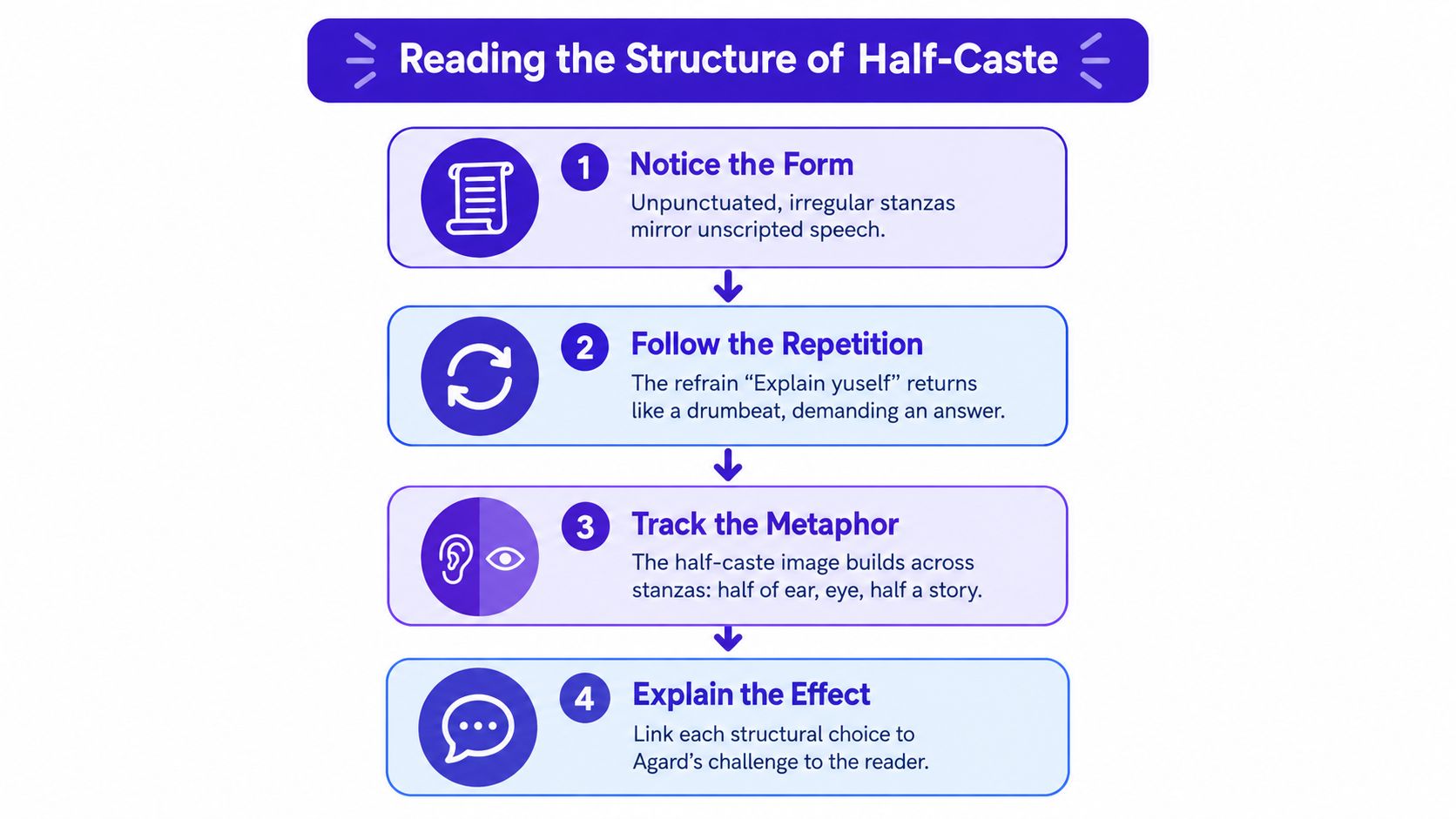
A useful sequence for structural analysis is:
- Notice the form. The irregular, speech-like presentation makes the poem sound spontaneous and performed.
- Follow the repetition. The repeated demand keeps responsibility on the listener.
- Track the comparisons. The examples develop the argument that mixture creates a complete whole.
- Explain the escalation. Humour develops into sarcasm and more direct accusation.
The poem is often understood as moving from humorous comparisons in its first half towards a more sarcastic and openly accusatory second half. That change matters. At first, the speaker invites the listener to recognise the absurdity of the label. Later, the speaker becomes less interested in persuading politely and more determined to expose the listener's prejudice.
Watch this performance before revising, then listen for pauses, emphasis and changes in tone.
The visual layout also prevents the poem from looking controlled and conventional. Its form supports the speaker's resistance to imposed rules. For further practice in linking choices to effects, use this Edexcel GCSE English literature vocabulary analysis.
Breaking Down Language Devices and Key Quotations
Agard's language is memorable because it combines humour with confrontation. He doesn't begin by delivering a dry definition of racism. Instead, he makes the reader enter a strange comparison, then realise that the comparison has exposed the label's weakness.
The opening direct address, “explain yuself”, immediately creates a challenge. The imperative verb places pressure on the listener, while the Creole spelling establishes a distinctive voice. The speaker isn't asking for permission to explain his identity. He's demanding that the person who uses the label justify it.
Use quotations as evidence, not decoration
A quotation becomes useful when you connect it to a clear idea. Consider these approaches:
- “explain yuself” can support analysis of direct address, imperative language and confrontation. The speaker demands accountability from the person using the label.
- “half a story” can support the argument that the label reduces a complete person to an incomplete category.
- The references to painting, weather and music show that mixture can produce a whole, vivid or harmonious result.
- The phrase “whole of yu eye” can be used to explore the speaker's refusal to be seen as partial or diminished.
The music example is particularly effective because it turns mixture into composition. Black and white keys do not make a “half-caste” symphony. They work together to create music. This comparison makes racial prejudice look not only cruel but intellectually foolish.
Hear the linguistic rebellion
Agard's use of Caribbean Creole alongside standard English is not a mistake for students to correct. It's part of the poem's resistance. The speaker controls the sound of the poem and makes the reader engage with his voice on its own terms.
That choice also creates a contrast between the authority of official language and the vitality of spoken language. A racist label may sound formal or administrative, but Agard answers it with a voice that is energetic, comic and unmistakably personal.
The poem's language shifts as its argument develops. Revision guidance describes the first half as using humorous comparisons to expose the absurdity of the term, while the second becomes more sarcastic and openly accusatory. A Parkwood Academy resource outlines this movement, including the direct address and speech-like structure.
A useful sentence pattern: Agard uses [short quotation] to [identify the choice], suggesting [meaning]. This makes the reader [effect] and reinforces the poem's challenge to [theme].
Don't label every comparison as a metaphor and move on. Explain why Agard chooses ordinary experiences such as music or weather. Their familiarity lets him show that mixture is normal everywhere, so treating mixed-race people as incomplete has no sensible basis.
Mastering Assessment Objectives for Top Marks
A detailed understanding of the poem won't automatically produce a high mark. Your response has to show the examiner that you can interpret the text, analyse the writer's methods, use context meaningfully and communicate accurately.
Turn the objectives into actions
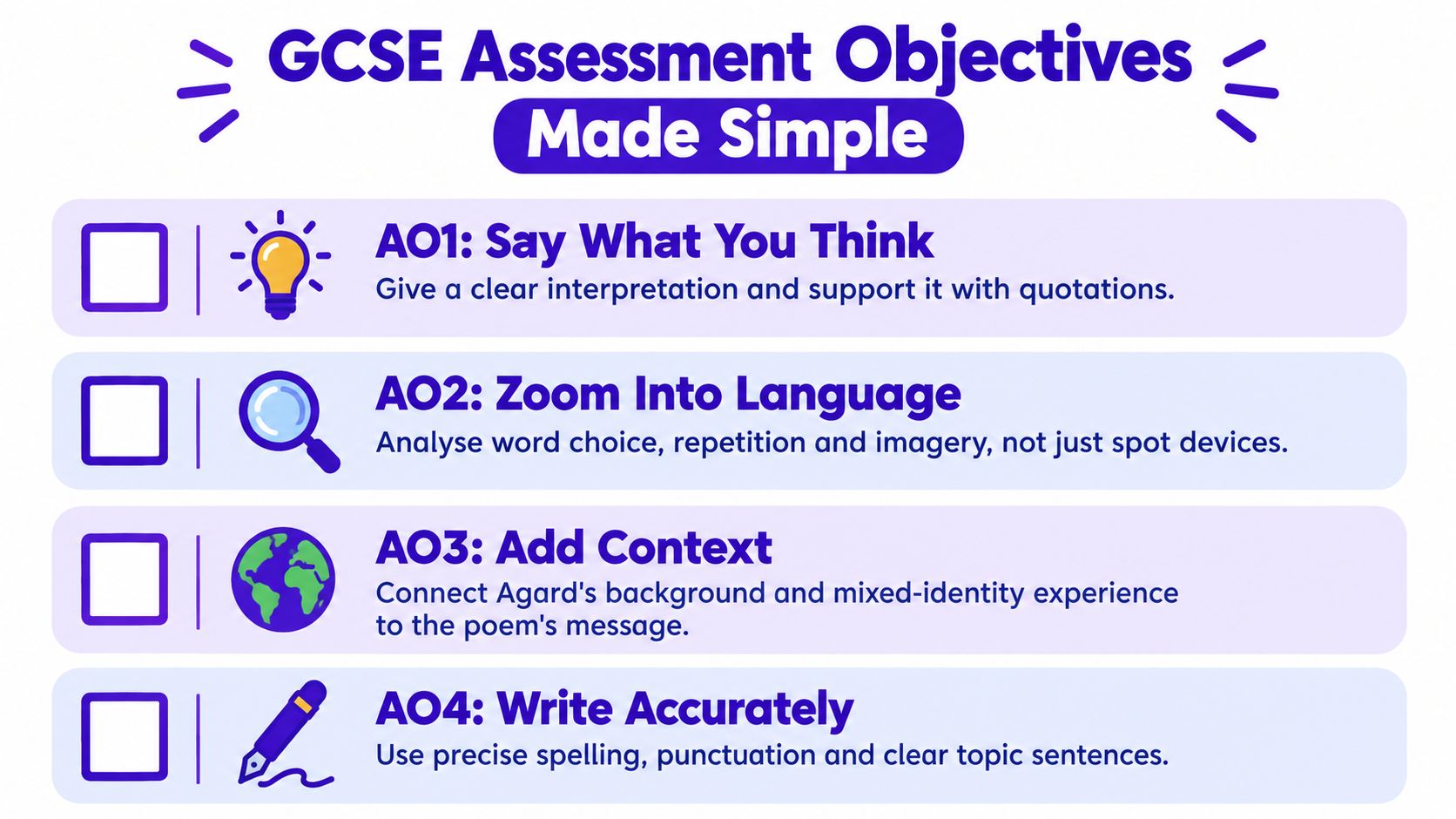
AO1 means make an argument. Begin each paragraph with a point that answers the question. “Agard presents the speaker as angry” is a starting point, but “Agard presents anger as a form of resistance against people who claim the authority to classify him” gives your paragraph a sharper direction.
AO2 means explain choices. Name a method only when it helps your explanation. Instead of writing “Agard uses repetition”, explain that the repeated demand makes the poem sound like a live interrogation and keeps responsibility with the listener.
AO3 means connect context to meaning. Agard's move to Britain in 1977 can matter when you discuss the poem's connection to racism in postwar Britain, but it shouldn't become an unrelated biography section. The context must illuminate the speaker's challenge to racial language.
AO4 means write clearly. Accurate spelling, punctuation and paragraphing make your thinking easier to follow. You don't need an artificial academic voice. You need precise sentences that show a controlled interpretation.
A practical self-check
Before moving on from a paragraph, ask:
- Have I answered the question? My point should relate directly to the wording.
- Have I used a short quotation? Choose a phrase that gives you something to analyse.
- Have I zoomed in? Discuss a word, sound, image, line break or structural shift.
- Have I explained the effect? Say what the choice makes the reader think or feel.
- Have I connected context carefully? Add it when it deepens the interpretation.
- Have I stayed accurate? Check spelling, punctuation and terminology.
Practising with GCSE Past Papers helps you apply this checklist to different command words and question styles. The important habit is to review your own paragraph afterwards, rather than writing another one without identifying what needs improvement.
Crafting a Top-Grade Sample Paragraph
Suppose the question asks how Agard presents the speaker's attitude towards the term “half-caste”. A weak answer might list “rhetorical questions, repetition and dialect”. A stronger paragraph turns those methods into one connected argument.
Agard presents the speaker as refusing to accept any identity imposed on him by others. The imperative “explain yuself” directly challenges the person who uses the derogatory label, placing the burden of justification on the listener rather than the mixed-race speaker. The Creole spelling of “yuself” makes the line sound like spoken confrontation, while also allowing Agard to resist the expectation that he should express himself in standard English. His humorous comparisons with art, weather and music then expose the term's illogicality, because mixture creates complete and meaningful forms rather than damaged ones. As the poem develops from comic examples towards a more openly accusatory tone, the speaker's voice becomes increasingly unwilling to negotiate with prejudice. Agard therefore presents language itself as a site of power, showing that rejecting a racist label also means reclaiming the authority to define one's own identity.
Why this paragraph works
The first sentence gives a clear interpretation. It doesn't merely say that the speaker is angry. It identifies the larger issue of imposed identity.
The quotation is embedded naturally in the sentence. That keeps the focus on the argument rather than making the evidence look pasted in. The analysis then zooms in on the imperative verb and the Creole spelling, explaining both meaning and sound.
The paragraph also avoids feature spotting. It mentions the comparisons, but it doesn't stop at “this is a metaphor”. Instead, it explains what the examples prove about mixture and completeness.
Finally, the contextual idea is integrated rather than bolted on. The reference to language and power connects Agard's technique with the poem's anti-racist purpose. That's much more effective than adding a sentence about the poet's life that doesn't affect the reading.
A flexible paragraph frame
You can adapt this structure without copying it mechanically:
Agard presents [idea] as [interpretation]. The phrase [quotation] uses [specific method] to suggest [meaning]. The choice of [individual word or sound] implies [deeper implication], making the reader [effect]. This develops when [structural or tonal change], which shows [argument]. In the context of [relevant social history], Agard's choice challenges [attitude or power structure].
The frame is a support, not a replacement for thought. The best responses adapt their argument to the exact question.
Final Revision Checklist and Next Steps
If you're revising under pressure, don't try to memorise every line. Build a compact set of ideas that you can apply flexibly.
Your essential knowledge
- Context: Agard moved to Britain in 1977, and the poem challenges the language used to classify mixed-race identity.
- Message: The label “half-caste” treats a complete identity as partial, so Agard exposes its prejudice and illogicality.
- Voice: The poem is a dramatic monologue delivered through direct address and spoken Creole.
- Structure: The four movements escalate the challenge, moving from humorous comparisons towards stronger accusation.
- Language: The examples involving art, weather and music show that mixture can create something complete and valuable.
- Tone: The poem combines comedy, sarcasm, anger and insistence.
- Form: Irregular presentation, enjambment and limited punctuation support the sense of live protest.
Revise actively
Write the central themes on one side of a card and explain them aloud without looking. Then choose a quotation and answer three questions: what does it mean, how does Agard create that meaning, and why does it matter to the poem's message?
Create comparison links by theme rather than memorising isolated pairings. For example, you might compare how poets present identity, conflict, power or belonging. The comparison should focus on methods as well as ideas, using phrases such as “similarly”, “in contrast” and “whereas”.
Final exam habit: Every quotation should earn its place. If you can't explain a word, image, sound or structural choice, choose a more useful quotation.
Write one timed paragraph, then improve it in a different colour. Look for a clearer point, a shorter quotation and a more precise explanation of effect. You can use Exam Practice for GCSE to practise poetry analysis and comparison questions in an exam-focused format.
When you enter the exam, remember the main argument: Agard isn't only rejecting an insult. He's challenging the power behind the label, reclaiming his voice and showing that mixed identity is not incomplete.
MasteryMind offers UK GCSE English Literature practice for poetry analysis and comparison, with questions organised around command words, assessment objectives and mark allocations. Use MasteryMind to practise embedding quotations, analysing language and structure, and improving paragraphs with examiner-style feedback.
Ready to master this topic?
Practise with quizzes, blurt exercises and exam questions on MasteryMind.
7 days Premium · Then free forever · No card, no charge