8 Pythagoras Theorem Examples for GCSE Maths
You know the formula, but the exam diagram still feels like a trap. You square the wrong side, forget to rearrange, round before the final step, or write an answer without enough working to show how you got there. The arithmetic may be fine, yet the marks disappear because the geometry wasn't translated into a method.
Use the same routine every time: inspect or draw the right angle, identify the hypotenuse, choose the equation, show each step, then check the answer. The Pythagoras theorem examples below move from confidence-building calculations to exact answers, coordinates, 3D shapes and mixed trigonometry problems.
At GCSE, straightforward questions often assess accurate substitution and calculation. Harder questions ask you to reason about the diagram and connect several methods. In examiner language, AO1 is accurate mathematical work, AO2 is explaining and applying a method, and AO3 is solving an unfamiliar or multi-step problem. You can prepare for all three by making your side labels and decisions visible.
1. Finding the Height of a Ladder Against a Wall
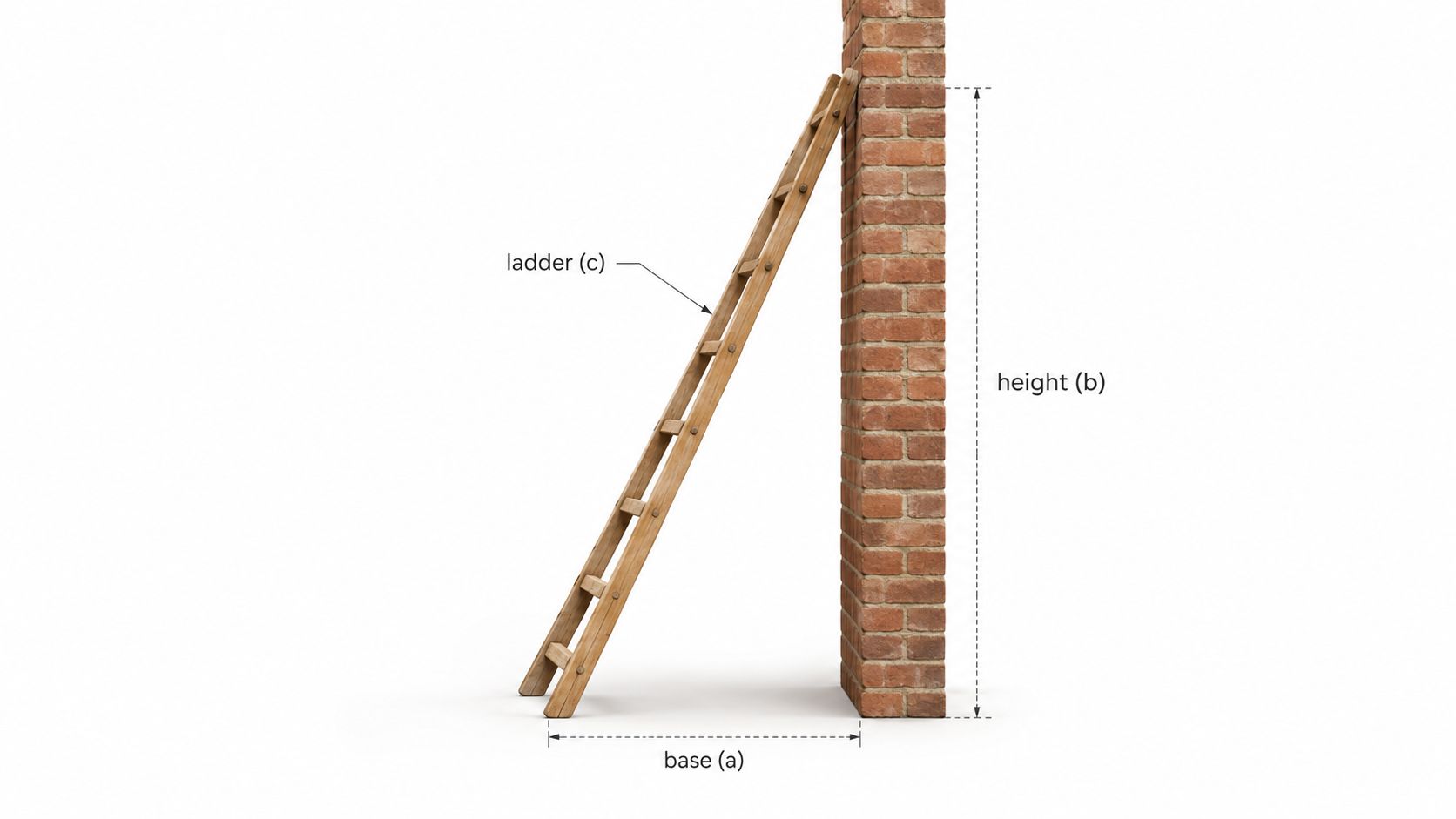
A ladder rests against a wall. The ground and wall meet at a right angle, so the ladder forms the hypotenuse of a right-angled triangle. Suppose the ladder is 10 m long and its foot is 6 m from the wall. How high up the wall does it reach?
Start by naming the sides:
- Hypotenuse: the ladder, because it's opposite the right angle.
- One shorter side: the distance from the wall, 6 m.
- Missing shorter side: the height, which we'll call (h).
Because the unknown is a shorter side, rearrange the theorem:
[
h^2 + 6^2 = 10^2
]
[
h^2 = 10^2 - 6^2
]
[
h^2 = 100 - 36 = 64
]
[
h = \sqrt{64} = 8
]
Answer: the ladder reaches 8 m up the wall.
What the examiner wants to see
The key AO1 marks come from using the correct relationship and calculating accurately. The rearrangement is not optional. Many learners remember (a^2+b^2=c^2), but then add when they should subtract. UK exam support from BBC Bitesize's Pythagoras guidance highlights the importance of identifying the relevant sides and rearranging when the hypotenuse isn't the unknown. OCR delivery guidance also flags side identification as a common difficulty.
Practical rule: If the missing side is not opposite the right angle, subtract its known shorter side's square from the hypotenuse's square.
A ladder calculation can represent safe placement on a building site, a window cleaner estimating reach, or a fire service access problem. In every setting, the longest side must be the hypotenuse, and the final height must be shorter than the ladder.
Transfer question: A ladder is 13 m long and its base is 5 m from a wall. Find the height it reaches.
2. Calculating Diagonal Distance in a Rectangle
A rectangular TV screen has a length of 16 cm and a width of 12 cm. Find the diagonal distance from one corner to the opposite corner.
The diagonal divides the rectangle into two congruent right-angled triangles. That means you can use the length and width as the two shorter sides, while the diagonal is the hypotenuse.
Call the diagonal (d):
[
d^2 = 16^2 + 12^2
]
[
d^2 = 256 + 144 = 400
]
[
d = \sqrt{400} = 20
]
Answer: the diagonal is 20 cm.
The examiner is testing whether you can see the hidden right-angled triangle, not whether you know anything special about televisions. A retailer might describe a screen by its diagonal, a graphic designer might position an element across a display, and someone planning a gaming setup might check whether a monitor fits in a space.
Units and reasonableness
Keep all measurements in the same unit before substituting. If a question gives one side in metres and another in centimetres, convert one measurement first. Otherwise, the squared values won't represent comparable lengths.
The diagonal should also be longer than either the length or width, but it shouldn't be wildly larger. Here, 20 cm is greater than 16 cm and 12 cm, which is sensible. If your calculator gives a diagonal shorter than one of the rectangle's sides, revisit the substitution.
This is a useful early example because it makes the geometry visible. Draw the diagonal, mark the right angle, and write the formula before reaching for the calculator.
Transfer question: A rectangle measures 9 cm by 40 cm. Find its diagonal.
3. Checking if a Triangle is Right-Angled Using Pythagoras
Sometimes the question gives you all three side lengths and asks whether the triangle is right-angled. You aren't finding a missing length. Instead, you're testing whether the longest side obeys Pythagoras' theorem.
Consider side lengths 7 cm, 24 cm and 25 cm. Identify the longest side first, so (c=25). Then compare the square of the longest side with the sum of the squares of the other two:
[
7^2 + 24^2 = 25^2
]
[
49 + 576 = 625
]
[
625 = 625
]
The two sides are equal, so the triangle is right-angled.
The examiner logic
Write the comparison clearly. A final statement such as “yes, it works” is weaker than showing both sides of the equation. A typical question may reward separate marks for selecting the longest side, carrying out the squares and making the correct conclusion, so unsupported answers throw away method credit.
If the result had been unequal, the correct conclusion would be that the triangle isn't right-angled. Don't assume that three given lengths form a right-angled triangle just because the question mentions Pythagoras.
For practical work, a carpenter could use this test to check whether a corner is square, while quality control staff might check whether parts meet at the intended angle. The mathematical test remains the same.
For broader revision, you can browse GCSE trigonometry study materials.
Transfer question: Test whether a triangle with side lengths 8 cm, 15 cm and 17 cm is right-angled. Show your calculation and conclusion.
4. Finding Distance Between Two Points on a Coordinate Grid
Coordinates turn Pythagoras into a distance method. Take the points (A(2,3)) and (B(8,11)). To find the straight-line distance, calculate the horizontal and vertical changes first.
The horizontal change is:
[
8-2=6
]
The vertical change is:
[
11-3=8
]
These changes form the shorter sides of a right-angled triangle. If the distance between the points is (d):
[
d^2 = 6^2 + 8^2
]
[
d^2 = 36 + 64 = 100
]
[
d=\sqrt{100}=10
]
Answer: the distance between (A) and (B) is 10 units.
Avoiding coordinate mistakes
Plotting the points helps, particularly when coordinates are negative. The general differences are (|x_2-x_1|) and (|y_2-y_1|), but once each difference is squared, the sign no longer affects the result.
Use brackets carefully:
[
(x_2-x_1)^2
]
means subtract first, then square. Don't calculate (x_2-x_1^2), because that squares only the second coordinate and changes the expression.
A GPS system can use the same geometric idea for a direct distance, and a video game may use it to measure the separation between a player and an object. On a GCSE paper, the context may be less exciting, but the examiner is checking whether you can turn coordinate differences into a right-angled triangle.
The straight-line distance must be longer than either the horizontal or vertical change alone.
Transfer question: Find the distance between (P(-1,4)) and (Q(5,-4)).
5. Area of a Composite Shape Using Pythagoras
Composite shape questions become manageable when you separate the geometry into stages. Suppose a shape consists of a rectangle measuring 8 m by 6 m, with a right-angled triangular section attached to one side. The triangle has a hypotenuse of 10 m and a perpendicular base of 6 m. Find the total area.
First find the triangle's missing perpendicular height, (h):
[
h^2+6^2=10^2
]
[
h^2=100-36=64
]
[
h=8
]
Now calculate the two areas.
Rectangle:
[
8\times6=48\text{ m}^2
]
Triangle:
[
\frac12\times6\times8=24\text{ m}^2
]
Total:
[
48+24=72\text{ m}^2
]
Answer: the total area is (72\text{ m}^2).
Make the construction lines do the work
On a real exam diagram, draw a perpendicular construction line if the shape doesn't already show a right angle. Label every new length. This turns an unfamiliar floor plan, field boundary or patio outline into rectangles and right-angled triangles.
A surveyor might divide irregular land into simpler regions, while an architect may split a floor plan around a sloped feature. The marks usually come from the sequence, not just the final area:
- Find the missing dimension: Use Pythagoras and show the rearrangement.
- Calculate each simple area: Keep units consistent.
- Combine the regions: Add areas that make up the whole shape.
Don't add lengths that belong to different edges, and don't use a sloping side as a triangle height unless it is perpendicular to the base.
Transfer question: A composite garden contains a rectangle of 12 m by 5 m and a right-angled triangular section with base 5 m and perpendicular height 4 m. Find the total area.
6. 3D Pythagoras, Finding the Space Diagonal of a Cuboid
A cuboid has length 3 cm, width 4 cm and height 12 cm. Find the space diagonal from one corner to the opposite corner.
The safest method is to apply Pythagoras twice. First find the diagonal across the base:
[
d^2=3^2+4^2
]
[
d^2=9+16=25
]
[
d=5
]
Now use that base diagonal with the height:
[
s^2=5^2+12^2
]
[
s^2=25+144=169
]
[
s=\sqrt{169}=13
]
Answer: the space diagonal is 13 cm.
You can also write the combined relationship:
[
s^2=3^2+4^2+12^2
]
The two-stage method is often better in an exam because it shows where each right-angled triangle comes from. The diagonal across the base is not the final answer. It becomes one side of the second triangle.
Seeing the hidden triangles
Sketch the cuboid and mark all three dimensions. A delivery worker might check whether a long item fits diagonally inside packaging, while an architect could calculate a direct sight line through a room. In each case, the longest straight measurement is the space diagonal.
A common error is to apply Pythagoras to three dimensions in a diagram without explaining the intermediate triangle. Another is to use the wrong pair of edges for the base diagonal. Build the answer in stages and label the new length.
For targeted work, try GCSE further maths Pythagoras practice.
Transfer question: Find the space diagonal of a cuboid measuring 6 cm by 8 cm by 10 cm.
Before practising, watch this visual explanation of the 3D method.
7. Pythagoras with Surds and Exact Answers
A calculator decimal isn't always the required answer. If a question asks for an exact answer, keep the square root rather than rounding it.
Suppose a right-angled triangle has shorter sides 5 cm and 5 cm. Its hypotenuse is (c):
[
c^2=5^2+5^2
]
[
c^2=25+25=50
]
[
c=\sqrt{50}
]
Simplify the surd by taking out the largest square factor:
[
\sqrt{50}=\sqrt{25\times2}=5\sqrt2
]
Answer: (5\sqrt2\text{ cm}).
The decimal approximation is useful as a check, but it isn't the exact form. Since (\sqrt2) is approximately (1.41), (5\sqrt2) is approximately (7.05) cm. The exact answer preserves the mathematical value without introducing rounding.
How to simplify and combine surds
Look for a square number inside the root. For example:
[
\sqrt{18}=\sqrt{9\times2}=3\sqrt2
]
Like surds can be collected in the same way as like algebraic terms:
[
3\sqrt2+2\sqrt2=5\sqrt2
]
Don't add unlike surds directly. An answer such as (\sqrt2+\sqrt3) usually stays in that form unless the question asks for a decimal approximation.
Exact values matter in later calculations because rounding one side early can affect the next step. Keep (5\sqrt2) until the final line if the result will be used in another part of the problem.
Use Surds practice for GCSE students to practise recognising when an answer should remain exact.
Transfer question: A triangle has shorter sides 6 cm and 6 cm. Find the hypotenuse in simplest surd form.
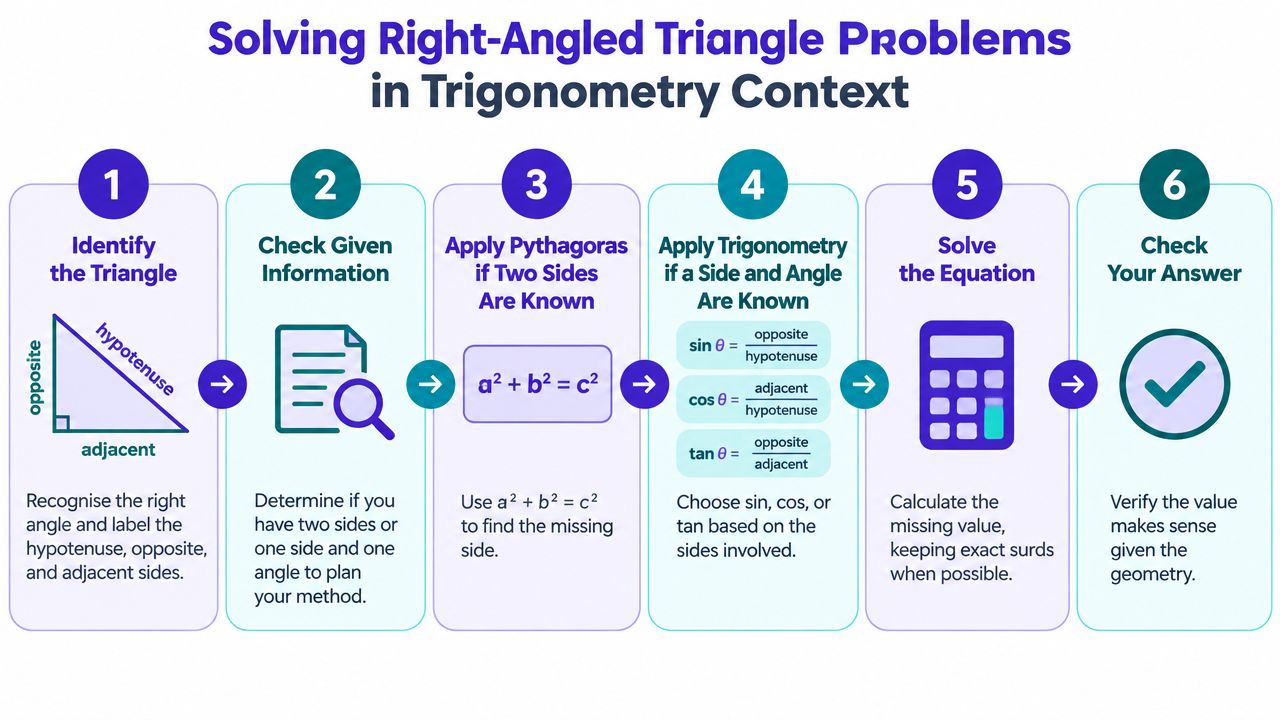
8. Solving Right-Angled Triangle Problems in Trigonometry Context
A multi-step question may require Pythagoras first and trigonometry second. Consider a right-angled triangle with perpendicular sides 6 cm and 8 cm. First find the hypotenuse:
[
c^2=6^2+8^2
]
[
c^2=36+64=100
]
[
c=10
]
Now suppose angle (\theta) is opposite the side of length 6 cm. Relative to (\theta), the hypotenuse is 10 cm and the opposite side is 6 cm. Use sine:
[
\sin\theta=\frac{\text{opposite}}{\text{hypotenuse}}
]
[
\sin\theta=\frac6{10}=0.6
]
[
\theta=\sin^{-1}(0.6)
]
Use your calculator to find the angle, then round as the question requests.
Choosing between the methods
Ask what information the question gives you:
- Two sides known: Pythagoras may find the missing side.
- One side and an angle known: Sine, cosine or tangent may be more direct.
- A side found by Pythagoras, then an angle required: Keep the calculated value accurate before using trigonometry.
A construction engineer might find a rafter length before calculating a roof angle. A surveyor could use an angle of elevation alongside a measured distance to estimate a building height. The context changes, but the examiner still wants a labelled diagram and a justified choice of method.
Check that your calculator is in degree mode for GCSE angle questions. Also check the answer's size. An angle in a triangle should fit the diagram, and a side found by Pythagoras should be longer than either shorter side when it is the hypotenuse.
For wider mixed practice, try Exam Practice for A-Level.
Transfer question: A right-angled triangle has hypotenuse 13 cm and opposite side 5 cm. Find the angle opposite the 5 cm side.
Comparison of 8 Pythagoras Theorem Examples
| Topic | Implementation Complexity (🔄) | Resources / Tools Needed (⚡) | Expected Outcome (⭐) | Ideal Use Cases (📊) | Key Advantages / Tips (💡) |
|---|---|---|---|---|---|
| Finding the Height of a Ladder Against a Wall | Low 🔄, single rearrangement of a²+b²=c² | Minimal ⚡, pencil, ruler, basic calculator | High ⭐, direct numeric height, quick to check | Construction, fire service, window cleaning | 💡 Draw diagram, identify hypotenuse, round sensibly |
| Calculating Diagonal Distance in a Rectangle (TV/Screen) | Low 🔄, straightforward diagonal calc | Minimal ⚡, tape measure/values, calculator | High ⭐, accurate diagonal from sides | Screen sizing, retail specs, graphic layout | 💡 Watch units/bezel effects; use diagonal = √(l²+w²) |
| Checking if a Triangle is Right-Angled Using Pythagoras | Low–Medium 🔄, comparison of squared values | Minimal ⚡, calculator or mental squares | High ⭐, clear yes/no verification | Carpentry, surveying, manufacturing QC | 💡 Identify longest side first; square separately before comparing |
| Finding Distance Between Two Points on a Coordinate Grid | Medium 🔄, algebraic application of distance formula | Moderate ⚡, graph paper or plotting tool, calculator | High ⭐, exact straight-line distances | GPS, game dev, mapping apps | 💡 Plot points, compute Δx and Δy, use brackets carefully |
| Area of a Composite Shape Using Pythagoras | Medium–High 🔄, multi-step planning + Pythagoras | Moderate ⚡, clear diagram, calculator, decomposition skills | High ⭐, accurate area after finding missing dimensions | Architecture, landscaping, land surveying | 💡 Break shape into parts, add construction lines, find missing lengths first |
| 3D Pythagoras, Space Diagonal of a Cuboid | Medium–High 🔄, two-stage Pythagoras or d²=l²+w²+h² | Moderate ⚡, 3D sketching, calculator, spatial visualisation | High ⭐, reliable 3D straight-line result | Packaging, engineering, furniture fitting | 💡 Sketch cuboid, compute base diagonal then combine with height |
| Pythagoras with Surds and Exact Answers | Medium 🔄, algebraic surd manipulation required | Low–Moderate ⚡, algebra skills, avoid decimal rounding | Very High ⭐, exact, exam‑preferred answers | Higher-tier GCSE, A‑Level, precision engineering | 💡 Simplify roots (e.g., √50=5√2); keep exact form until final step |
| Solving Right-Angled Triangle Problems in Trigonometry Context | High 🔄, multi-step: Pythagoras + trig choices | Moderate–High ⚡, calculator (inverse trig), clear diagrams | Very High ⭐, solves complex angle/side problems | A‑Level, surveying, roof/rafter design, navigation | 💡 Draw labels, decide Pythagoras vs trig per step, use exact values until final answer |
Make the Method Automatic Under Pressure
The strongest Pythagoras answers start before the calculator. Find the right angle, identify the side opposite it as the hypotenuse, and decide what the question is asking you to do. If you're finding the hypotenuse, add the squares. If you're finding a shorter side, subtract from the squared hypotenuse. If all three sides are given, test whether the equation balances.
For a mixed problem, build the solution in layers. Use a construction line to create a right-angled triangle, find the missing length, then use that result in an area, coordinate, 3D or trigonometry calculation. Keep exact values when the question asks for them, and round only at the end unless the instructions say otherwise.
Try this short practice run:
- Confidence: A right triangle has shorter sides 9 cm and 12 cm. Find the hypotenuse.
- Secure: A right triangle has hypotenuse 17 cm and one shorter side 8 cm. Find the other side.
- Reasoning: Decide whether side lengths 9 cm, 40 cm and 41 cm form a right-angled triangle.
- Coordinates: Find the distance between ((1,2)) and ((7,10)).
- Composite area: Find a missing perpendicular height before calculating the area of a triangle joined to a rectangle.
- 3D: Find a cuboid's base diagonal, then use it with the height to find the space diagonal.
- Exact form: Simplify the square root after calculating a hypotenuse.
- Mixed trigonometry: Find a missing side with Pythagoras, then use sine, cosine or tangent to find an angle.
Use an error check after every answer:
- Wrong hypotenuse: Is your (c) side opposite the right angle?
- Wrong operation: Did you subtract when finding a shorter side?
- Missing units: Have you included cm, m, square units or another required unit?
- Premature rounding: Did you keep the calculator value or surd until the final step?
- Calculator mode: Is the calculator set to degrees for GCSE trigonometry?
- Unsupported answer: Have you shown the formula, substitution, rearrangement and conclusion?
The diagnostics for struggling math learners can also help identify whether the main problem is recall, diagram reading, calculation or exam technique. MasteryMind is another optional way to practise examiner-style maths, with step-by-step verification, AO breakdowns, adaptive difficulty and spaced review. It should support your understanding, not replace the work of labelling the triangle and making the decision yourself.
MasteryMind offers UK-focused GCSE and A-Level practice that connects questions, command words and mark allocations to exam-board expectations. Use its step-by-step maths verification and adaptive review to practise these Pythagoras theorem examples, then visit MasteryMind to build a regular revision routine.
Ready to master this topic?
Practise with quizzes, blurt exercises and exam questions on MasteryMind.
7 days Premium · Then free forever · No card, no charge