7 Questions on Ionic Bonding with Worked Answers
You might already recognise sodium chloride as ionic and still drop marks on the actual question. That usually happens when the answer stops at “electrons are transferred” and misses the charge, the state symbol, or the link between giant structure and property. A lot of chemistry marks sit in those missing words.
These seven questions on ionic bonding build from the fast marks to the harder judgement calls. Each worked answer separates the chemistry idea from the wording that usually earns credit, so you can see the difference between “basically right” and “mark-scheme right”. If you're rebuilding confidence for GCSE, start at Question 1 and write before you peek. If you're aiming higher, use the later questions to tighten precision and cut vague phrasing.
Teachers tend to be sceptical of model answers that sound smooth but dodge the mechanism. Fair enough. The reasoning here stays explicit, step by step, and keeps the exam focus on electron transfer, ion charge, lattice structure, state, and evidence. If you also need clearer quiz instructions that reduce confusion, fix that first, then come back and test yourself properly.
1. Explaining Ionic Bonding Formation Between Named Elements
Use a named example and say exactly what moves. “Ionic bonding happens by electron transfer” is a start, but by itself it's too thin for a full answer.
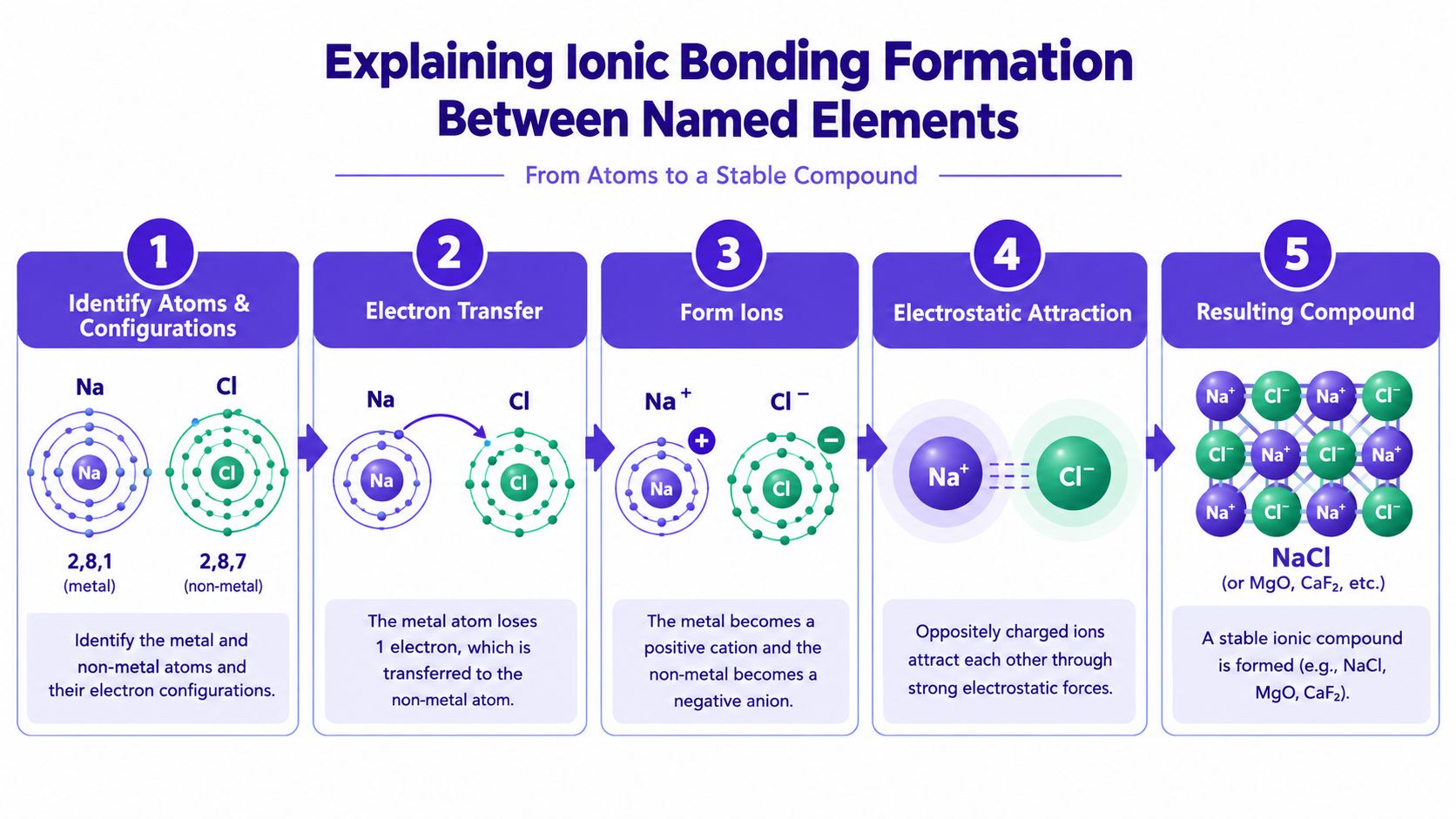
Take sodium and chlorine. Sodium is a metal, so it loses one electron. Chlorine is a non-metal, so it gains one electron. Sodium becomes Na⁺ and chlorine becomes Cl⁻.
A worked answer
A mark-winning version would sound like this:
Sodium transfers one electron to chlorine. Sodium loses an electron and forms a positive ion, Na⁺. Chlorine gains that electron and forms a negative ion, Cl⁻. The ionic bond is the strong electrostatic attraction between the oppositely charged ions.
That answer works because it includes all the moving parts. It says who loses, who gains, what charges form, and what force holds them together.
Common trap
Students often write that sodium and chlorine “share” electrons. That's covalent bonding, not ionic bonding.
Another common mistake is treating the bond like a single pair connection and stopping there. AQA's GCSE chemistry specification defines ionic bonding as electron transfer between a metal and a non-metal, and states that ionic compounds form a giant structure of ions held together by strong electrostatic forces in all directions in the lattice in the AQA bonding specification.
Practical rule: Name the electron transfer first, then name the ions, then finish with “strong electrostatic attraction”.
You can reuse the same method for magnesium oxide. Magnesium loses two electrons, oxygen gains two, so the ions are Mg²⁺ and O²⁻. Same structure of answer, same logic.
2. Predicting Ionic Charges and Formulae from Group Number
If the exam gives you the elements, you can often predict the formula before doing anything fancy. Quick recall becomes a method question.
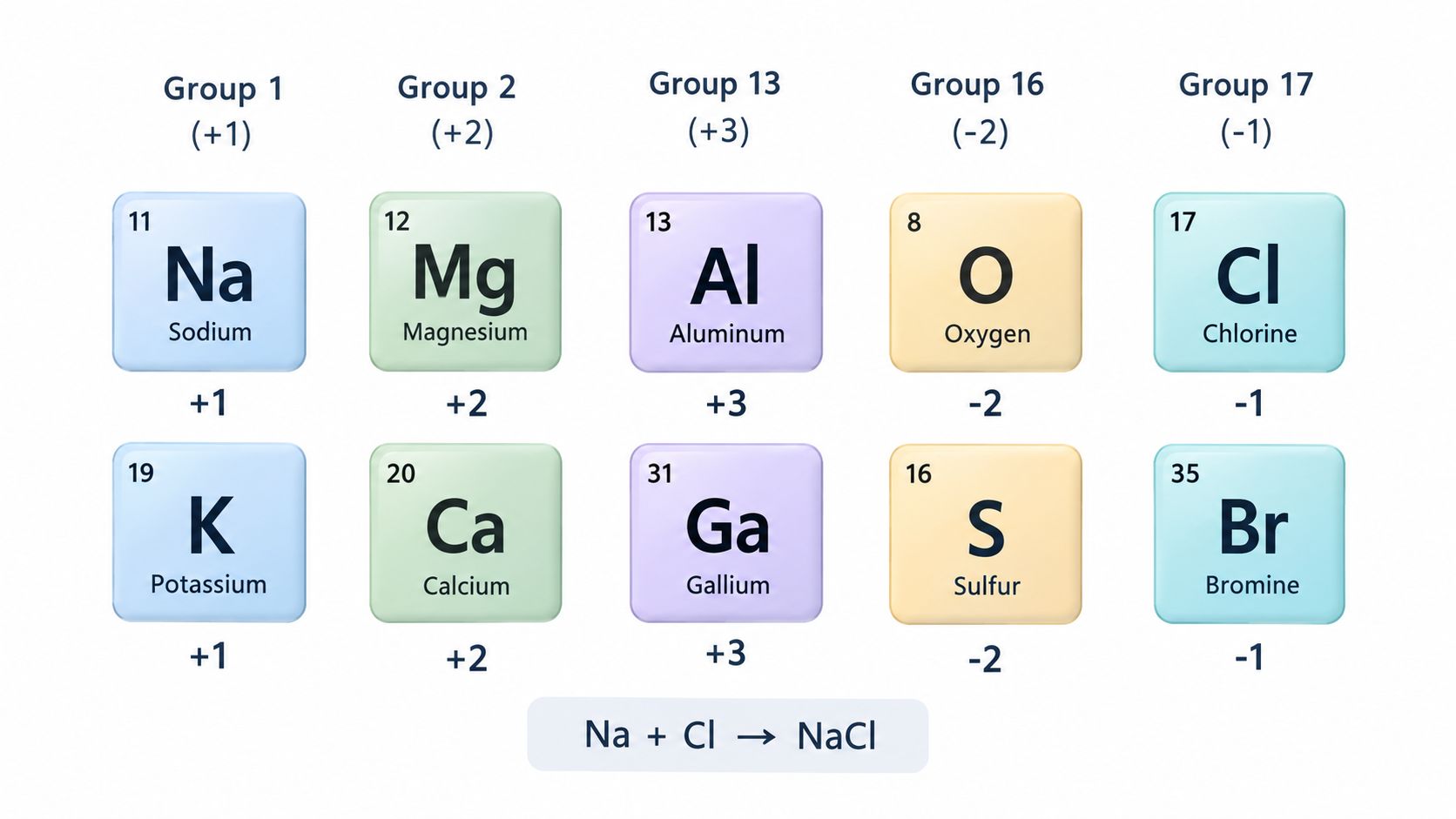
For common main-group ions, a reliable pattern is: Group 1 forms +1 ions, Group 2 forms +2 ions, Group 13 forms +3 ions, Group 15 forms -3 ions, Group 16 forms -2 ions, and Group 17 forms -1 ions. OCR Gateway also expects students to construct dot-and-cross diagrams for simple ionic substances and explain electron transfer and charge patterns for Group 1, 2, 6, and 7 elements in the OCR-aligned UK curriculum summary.
Example chain
Magnesium is in Group 2, so it forms Mg²⁺. Oxygen is in Group 16, so it forms O²⁻. The charges balance in a one-to-one ratio, so the formula is MgO.
Aluminium and oxygen are a better test. Aluminium forms Al³⁺. Oxygen forms O²⁻. You need a total charge of zero, so use two aluminium ions and three oxide ions. That gives Al₂O₃.
A method you can reuse
- Find the ion charges: metal positive, non-metal negative.
- Balance total charge to zero: the whole compound must be neutral.
- Write the simplest ratio: don't leave a formula that can be simplified.
If you're doing A-Level chemistry revision, keep one extra warning in mind. Transition metals don't always follow the simple group pattern, so only use this shortcut when the ion charge is clear.
If your formula doesn't balance to zero overall, it isn't finished.
3. Identifying Ionic Compounds From a List and Justifying Choices
A list question looks easy until the examiner asks for reasons. Then “NaCl is ionic” isn't enough.
Try this list: NaCl, CO₂, MgO, CuO, H₂O, NaBr.
Sort them with a reason
NaCl is ionic because sodium is a metal and chlorine is a non-metal.
MgO is ionic because magnesium is a metal and oxygen is a non-metal.
CuO is ionic because copper is a metal and oxygen is a non-metal.
NaBr is ionic because sodium is a metal and bromine is a non-metal.
CO₂ is covalent because carbon and oxygen are both non-metals.
H₂O is covalent because hydrogen and oxygen are both non-metals.
What earns the mark
The safest justification is still “metal plus non-metal gives ionic bonding”. That won't answer every chemistry question ever, but it does answer this one well.
BBC Bitesize matches this exam-board approach by explaining that ionic bonding forms when a metal transfers electrons to a non-metal, producing oppositely charged ions that arrange into a lattice, and that solid ionic compounds do not conduct but molten or aqueous ones do in its GCSE ionic bonding guide.
Common trap
Some students rely on appearance alone and assume anything with two capital letters must be ionic. That fails fast with compounds made only of non-metals.
- Check for a metal first: sodium, magnesium, calcium, aluminium, copper and zinc are strong clues.
- Check the partner atom next: oxygen, chlorine, bromine and nitrogen are non-metals.
- Write the reason in words: don't just label the answer.
4. Writing and Balancing Ionic Equations With State Symbols
The careless student leaks marks they already know. The chemistry may be right, but the formula or state symbol isn't.
Start with the word equation. Then convert each substance into the correct formula. After that, balance the atoms. Only then add state symbols.
Worked example
Sodium reacting with chlorine becomes:
2Na(s) + Cl₂(g) → 2NaCl(s)
Why this scores well: sodium is a solid metal, chlorine is a gas, sodium chloride is written with the correct ionic formula, and the atoms balance on both sides.
A second example:
Ca(s) + 2HCl(aq) → CaCl₂(aq) + H₂(g)
That answer shows calcium forming calcium chloride, not CaCl. It also shows hydrochloric acid dissolved in water as aqueous.
The exam routine
- Write the product formula correctly first: if the ionic formula is wrong, balancing won't rescue it.
- Balance with coefficients only: never change the small numbers inside a formula.
- Add state symbols last: solids are (s), gases are (g), dissolved substances are (aq).
Students who want more repetition from auto-marked practice often do well with interactive quiz platform features that force them to spot whether the mistake is formula, balancing, or state.
Most balancing errors in ionic questions start before balancing. The product formula was wrong.
5. Explaining Physical Properties Using Ionic Structure
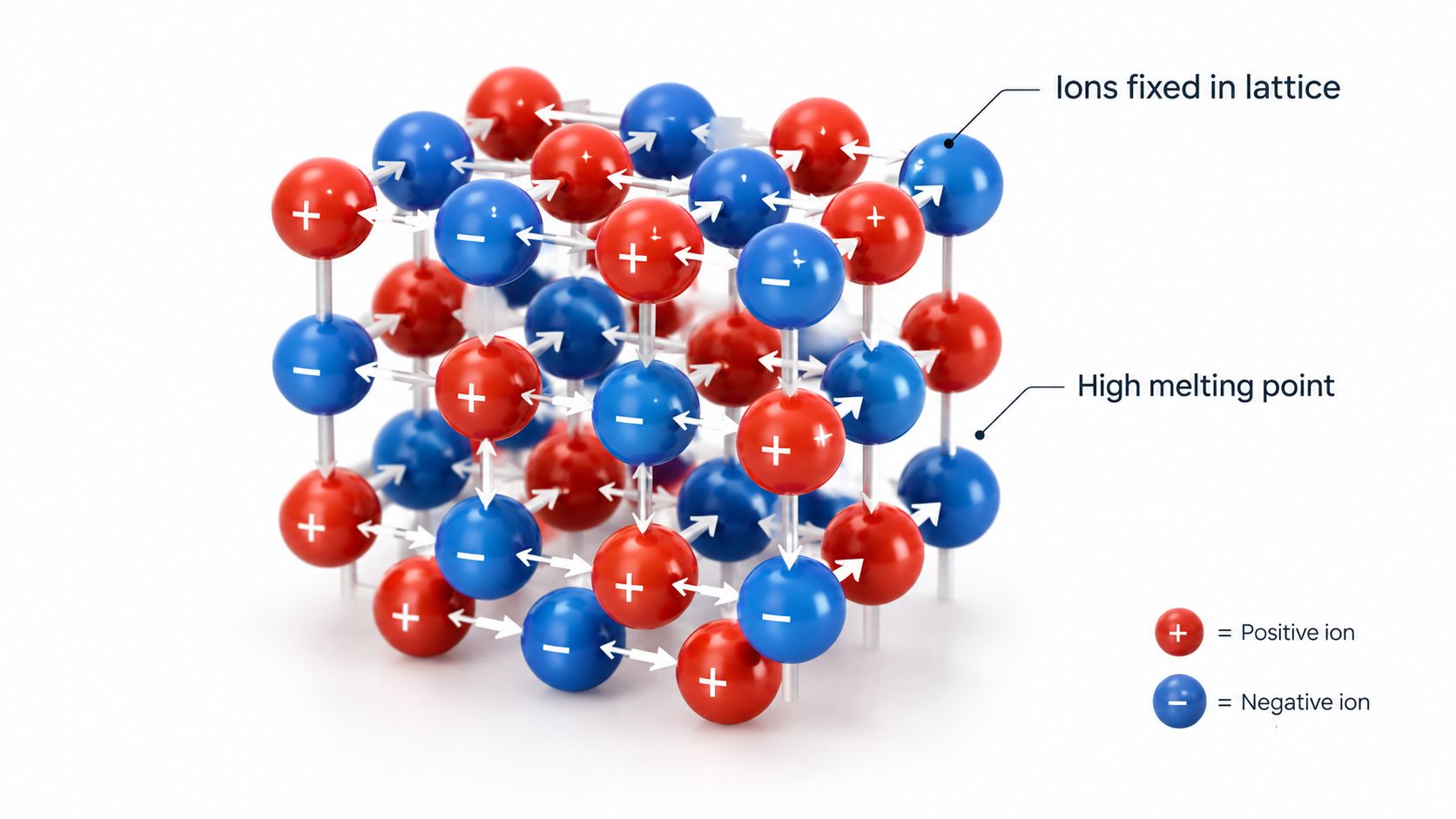
This is one of the biggest exam areas because it joins structure, bonding, and properties. AQA states that ionic compounds are giant ionic lattices held together by strong electrostatic forces acting in all directions, and that they conduct electricity when molten or dissolved because the ions are free to move in this ionic bonding explanation.
That's the full chain you need. Not just “strong bonds” or “ions move”. The mark usually sits in the link.
A concrete example helps. BBC Bitesize gives sodium chloride a melting point of 801°C and a boiling point of 1,413°C, which makes the “lots of energy needed” idea much more than a vague slogan.
Turn the property into a sentence
For melting point:
Sodium chloride has a high melting point because it has a giant ionic lattice with strong electrostatic attractions between oppositely charged ions, so a lot of energy is needed to overcome those attractions.
For conductivity when molten:
An ionic compound conducts electricity when molten because the ions are free to move and carry charge.
For conductivity when solid:
A solid ionic compound does not conduct because the ions are fixed in place and cannot move.
Here's a visual refresher before you test yourself:
The trap teachers keep seeing
Students often describe ionic compounds as if they are made of little molecules. That loses the structure mark. BBC Bitesize stresses that ionic compounds form giant ionic lattices with strong electrostatic forces acting in all directions between oppositely charged ions in its lattice explanation.
If you need a clean content recap, structure and properties of matter is the exact topic area to revisit.
6. Comparing Ionic and Covalent Bonding With Justification
A comparison question punishes half-answers. If you only define ionic bonding and forget to explain covalent bonding, the response stays lopsided.
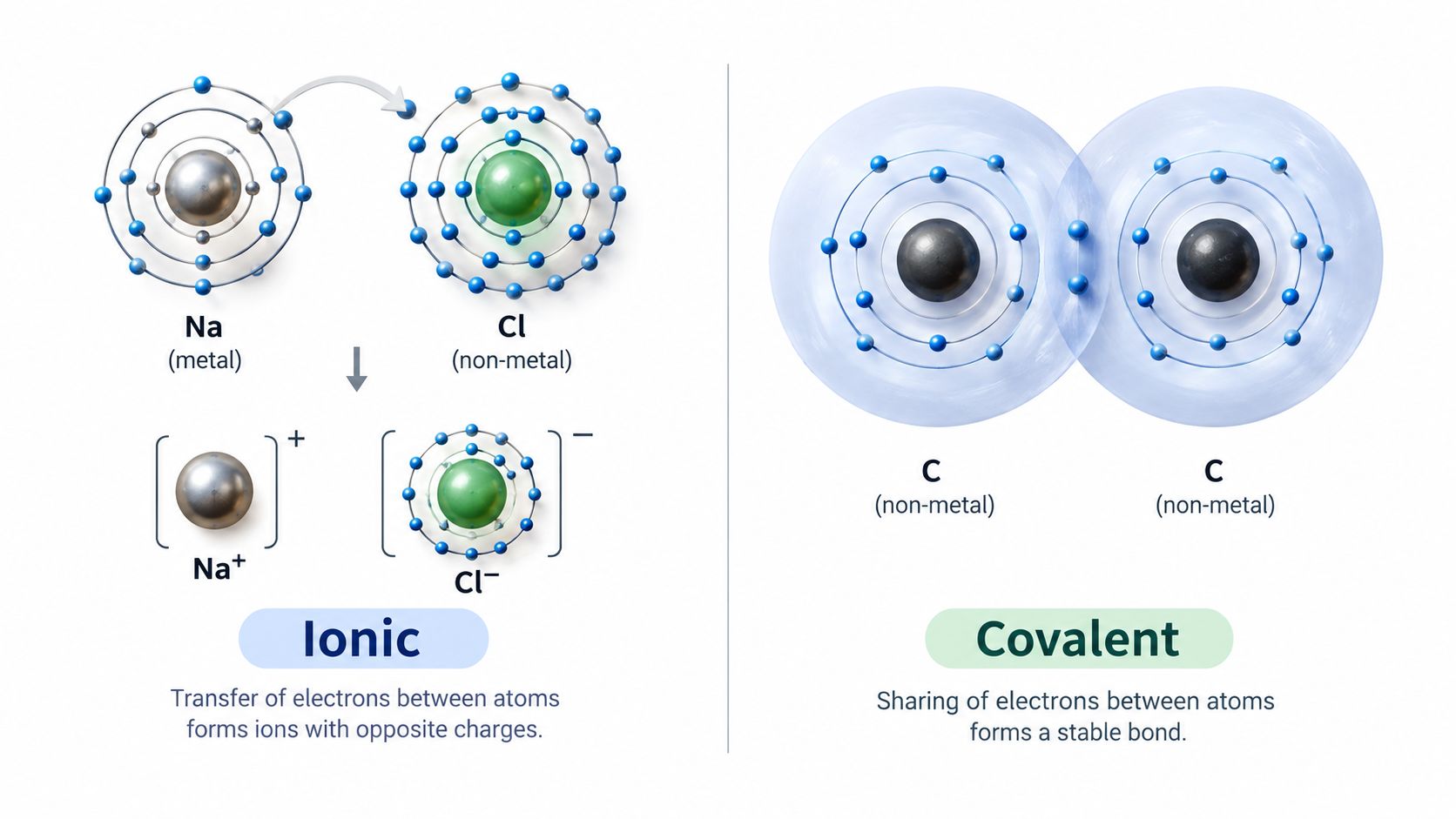
Put sodium chloride next to hydrogen chloride. Both contain chlorine, but that doesn't make the bonding the same. Sodium chloride is ionic because sodium is a metal and chlorine is a non-metal, so electrons are transferred and ions form. Hydrogen chloride is covalent because hydrogen and chlorine are non-metals, so electrons are shared.
Strong comparison language
A good answer sounds like this:
Sodium chloride is ionic because it forms by electron transfer between a metal and a non-metal, producing oppositely charged ions. Hydrogen chloride is covalent because it forms by sharing electrons between non-metals.
That's the bonding mechanism. Then add property evidence if the question asks for it.
Where students slip
They often write that ionic bonding means “atoms are joined” and covalent means “molecules are joined”. That wording is messy and doesn't explain the actual process.
UK teaching guidance also points out a deeper misconception. Students often imagine ionic compounds as one-to-one ion pairs or molecules, instead of a giant lattice where each ion is attracted to many oppositely charged ions. Diagnostic material warns that a formula like NaCl shows an ion ratio, not a discrete molecule in this ionic lattice teaching note.
- For ionic: say electron transfer, ions, electrostatic attraction.
- For covalent: say shared pair of electrons.
- If properties are included: connect them back to structure, not just a memorised list.
7. Evaluating Statements About Ionic Bonding and Selecting Evidence
This is the hardest style because it asks for judgement, not recall. Words like “always”, “never”, and “cannot” are there to test whether you can qualify a statement properly.
Try this one: “Ionic compounds cannot conduct electricity.”
A model evaluation
This statement is partially true. Solid ionic compounds do not conduct electricity because the ions are not free to move. Molten ionic compounds and solutions of ionic compounds do conduct because the ions are free to move and carry charge.
That's already better than just saying “false”. You've judged the statement and explained why.
Another statement: “Ionic bonding only occurs between metals and non-metals.”
That's the easiest one to defend. In GCSE chemistry for England, AQA says ionic bonding happens when electrons in the outer shell of a metal atom are transferred to a non-metal atom, forming positive and negative ions, and that the compound is a giant structure held together by strong electrostatic forces in all directions in this GCSE ionic bonding summary.
The subtle point that lifts answers
The conduction explanation is often underdone. Students mix up electron transfer during bond formation with charge movement during conduction. Diagnostic guidance highlights that the key distinction is ion mobility. Ions must be free to move for current to flow, and that doesn't mean the whole substance is “breaking bonds everywhere” as current passes in this misconceptions guide.
Don't just label a statement true or false. Test the condition. Ask, “In what state?” or “By what mechanism?”
If you want timed practice on these judgement questions, Exam Practice for GCSE is the kind of setup that suits them because wording matters as much as the chemistry.
7-Point Comparison of Ionic Bonding Questions
| Topic | Complexity 🔄 | Required knowledge / Resources ⚡ | Expected outcomes 📊⭐ | Ideal use cases 💡 | Key advantages ⭐ |
|---|---|---|---|---|---|
| Explaining Ionic Bonding Formation Between Named Elements | Moderate, stepwise electron-transfer explanation and diagram | Periodic table, electron configurations, simple diagram tools | 3–4 marks; demonstrates mechanism (which electrons move, ion charges) | GCSE short-answer questions; targeted practice on common pairs | Clear mechanistic reasoning; visual diagrams aid clarity |
| Predicting Ionic Charges and Formulae from Group Number | Low–Moderate, pattern application and criss-cross balancing | Periodic table, memorised group→charge rules | 2–4 marks; produces correct ionic charges and balanced formulas | Rapid formula writing in tests; data-given questions | Fast, repeatable method for many elements |
| Identifying Ionic Compounds from a List and Justifying Choices | Low, pattern recognition plus brief justification | Knowledge of metals vs non-metals and common element lists | 3–6 marks; classification with short explanations | Timed identification tasks; multiple-item exam sections | Builds speed and clear justification skills; exposes edge cases |
| Writing and Balancing Ionic Equations with State Symbols | Moderate–High, stoichiometry and correct state assignment | Formula writing, balancing skills, state-symbol conventions | 2–3 marks per equation; accurate formulas, coefficients, states | Reaction problems linking bonding to chemical change | Teaches quantitative accuracy and real reaction representation |
| Explaining Physical Properties Using Ionic Structure | Moderate, link microscopic lattice to macroscopic properties | Understanding of ionic lattice, electrostatic forces, examples | 3–5 marks; reasoned explanations for MP, conductivity, brittleness | Longer explain questions; synoptic property analysis | Deep conceptual linkage of structure → properties |
| Comparing Ionic and Covalent Bonding with Justification | High, requires comparison of mechanisms and properties | Broad bonding knowledge, electronegativity, property evidence | 4–6 marks; comparative evaluation and justification | Extended-response exam prompts; concept consolidation | Develops evaluative skills and corrects misconceptions |
| Evaluating Statements About Ionic Bonding and Selecting Evidence | High, critical evaluation, exceptions and counterexamples | Wide factual knowledge, data/examples, reasoning ability | 4–6 marks; nuanced verdicts supported by evidence | Synoptic/interpretation questions; higher-tier assessment | Strengthens critical thinking and recognition of limits |
Turn Every Lost Mark Into a Routine
The best way to use these questions on ionic bonding is boring in the best possible sense. Try each one without notes. Compare your answer against the mark points. Fix the exact gap, not just the overall question. Then come back later and do the same question again.
That matters because not all mistakes are the same. One student forgot the ion charge. Another knew the charges but wrote the wrong formula. Another described conductivity without saying that ions must be free to move. Another gave a judgement answer with no evaluation word such as “partially true”. If you track the type of error, your revision gets faster.
A simple tracking grid in your notebook works well:
- Recall error: you didn't know the charge, definition, or formula pattern.
- Formula-writing error: you knew the ions but didn't balance them to zero.
- Structure-to-property error: you named a property but didn't link it to the lattice and electrostatic attraction.
- Evaluation error: you gave an opinion but didn't test the condition or justify it.
Teachers can use the seven-question progression as a quick diagnostic. It shows whether the issue is vocabulary, symbolic chemistry, reasoning, or exam judgement. That's far more useful than a single score.
For students, the win is consistency. Write, check, correct, repeat. If you keep missing the same type of point, isolate that skill and drill it. If you're mostly secure, move to mixed practice so ionic bonding sits alongside formulae, equations, and bonding comparison rather than living in a neat revision bubble.
MasteryMind is one option for doing that kind of examiner-aligned practice across GCSE and A-Level topics. Its adaptive difficulty and spaced review setup fit this topic well because ionic bonding questions range from quick recall to longer explanation and evaluation, and they usually need more than one pass before the wording becomes automatic.
If you want more practice like this, MasteryMind gives UK students chemistry questions that match exam-board wording, mark allocations, and command words. It's useful for ionic bonding because you can practise everything from ion charges and formulae to longer structure-and-properties answers, then get examiner-style feedback on what was missing.
Ready to master this topic?
Practise with quizzes, blurt exercises and exam questions on MasteryMind.
7 days Premium · Then free forever · No card, no charge