Standard Electrode Potential Explained for GCSE and A-Level
You're halfway through a redox question. The table is open, two half-equations are staring back at you, and the minus signs suddenly look more threatening than the chemistry. Should the arrow point forwards or backwards? Which half-cell is the anode? Why does one value have a plus sign while another has a minus sign?
Standard electrode potential, written as E°, becomes much easier once you stop treating the table as a list of random values. It measures how strongly a species attracts electrons compared with hydrogen. From that one reference point, you can work out cell potentials, identify strong oxidising and reducing agents, and judge whether a redox reaction is feasible under standard conditions.
This guide builds the idea from the ground up, then applies it to the style of reasoning expected by AQA, Edexcel, OCR and WJEC. If you're recovering an exam, the method gives you a dependable route through unfamiliar questions. If you're aiming for the highest grades, the explanations help you justify each decision rather than quote a formula. For a wider revision approach, see these MasteryMind revision guides.
Why Standard Electrode Potential Feels Hard And What Unlocks It
A typical exam question gives you two reduction half-equations and an E° table. The difficulty isn't usually the subtraction. It's deciding what the subtraction means. Students often reverse a half-equation and forget what happens to its sign, choose the wrong half-cell as the anode, or assume that a more negative value must somehow mean a weaker reaction overall.
The table can feel arbitrary because it doesn't explain itself. You see positive and negative values, but you may not yet have an instinct for why a species belongs near one end or the other. Memorising that zinc is reactive can help with a familiar question, but it won't reliably solve a question involving unfamiliar ions.
The key is to treat each E° value as a comparison with one fixed reference. Standard electrode potential measures the voltage of a half-cell connected to the standard hydrogen electrode, or SHE. The SHE is assigned a potential of exactly 0.00 V, so every other half-cell can be described as more willing or less willing to accept electrons than hydrogen.
The decisions that follow from one reference
Once you know what the sign means, the later steps become connected rather than separate facts:
- A more positive E° points towards easier reduction and a stronger oxidising agent.
- A more negative E° points towards easier oxidation of the reduced form and a stronger reducing agent.
- The more positive half-equation is normally the reduction at the cathode.
- The other half-equation is reversed to show oxidation at the anode.
- The cell potential is found by subtracting the anode value from the cathode value.
The phrase “as written” matters throughout. E° belongs to the half-reaction in the direction shown in the table. Reverse the reaction, and you reverse the sign. Multiply the equation to balance electrons, and you don't multiply E°.
By the end, E° should feel less like a memorised number and more like an intuitive judge of who steals electrons from whom. That is the central skill behind the calculation questions, prediction questions and explanation questions appearing across the major UK exam boards.
The Core Idea Behind Standard Electrode Potential
Redox chemistry is about electrons moving between substances. Reduction is gain of electrons, while oxidation is loss of electrons. A species that gains electrons readily has a strong pull on electrons. A species that gives electrons away readily acts as a strong reducing agent.
Standard electrode potential gives that pull a measurable comparison. It's the potential difference of a half-cell connected to the standard hydrogen electrode under standard conditions. The SHE is assigned 0.00 V by definition. The standard conditions are 298 K, an aqueous ion concentration of 1.00 mol dm⁻³, and a gas pressure of 100 kPa.
Think of a tug of war. One side is the half-cell you're testing, and the other side is hydrogen. Both sides are competing for electrons. The standard hydrogen electrode is the neutral referee, not because hydrogen has no chemistry, but because scientists need one agreed reference against which all other half-cells can be compared.
What the sign tells you
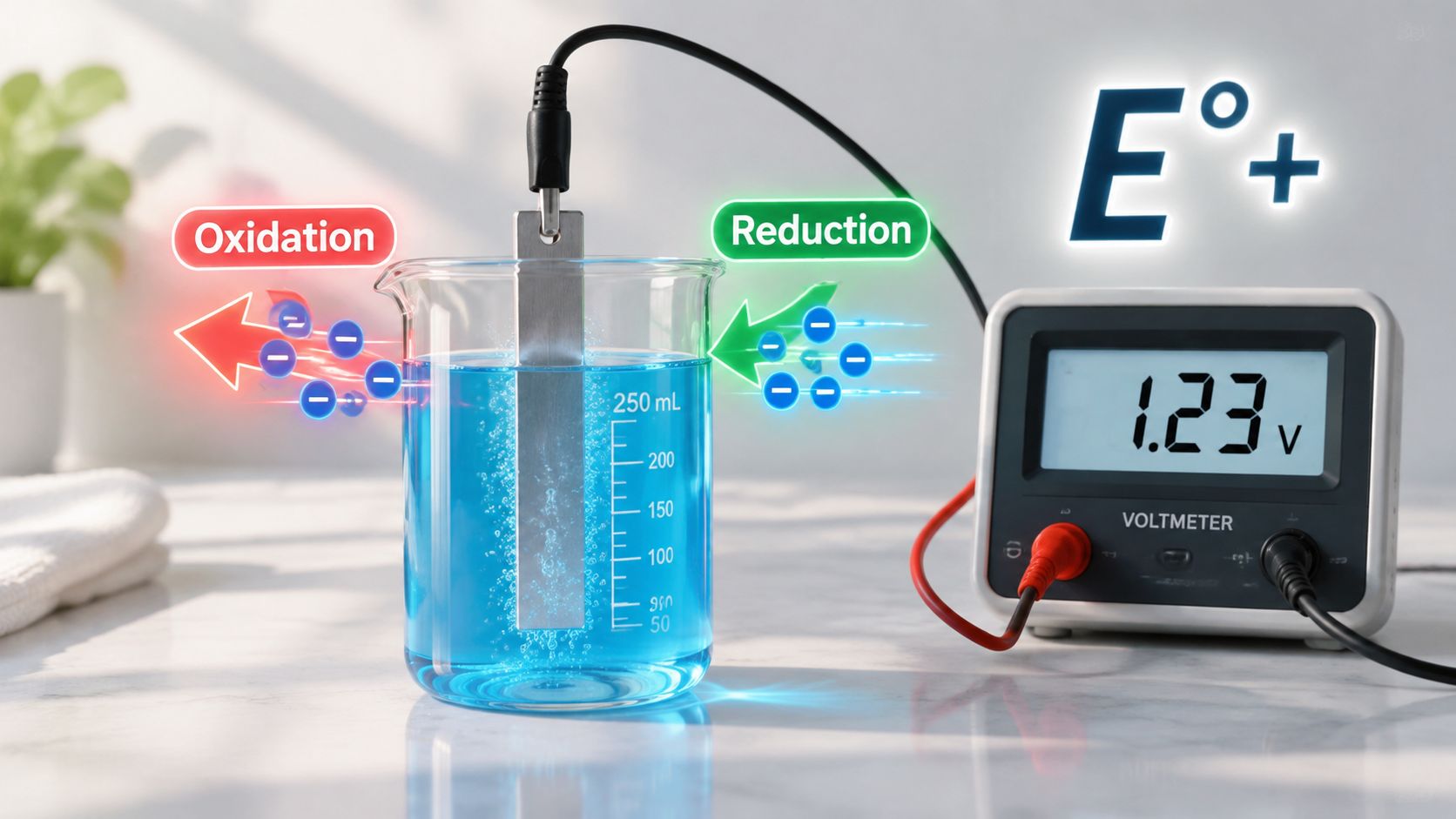
A positive E° means the species in the reduction half-equation pulls electrons more strongly than hydrogen does under the stated conditions. It tends to gain electrons, so the species being reduced is a stronger oxidising agent.
A negative E° means reduction is less favourable than it is for hydrogen under those conditions. The reverse reaction, oxidation, is more favourable. The reduced form therefore tends to behave as a stronger reducing agent.
| E° value direction | Preferred electron behaviour | Agent strength |
|---|---|---|
| More positive | Gains electrons more readily | Stronger oxidising agent |
| More negative | Reduced form loses electrons more readily | Stronger reducing agent |
The comparison is always tied to the equation shown. If a table gives a metal ion being reduced to a metal, the E° value describes that reduction. It doesn't directly describe the oxidation until you reverse the equation and change the sign.
Practical rule: Read the half-equation first, then interpret the number. Never interpret the sign without checking which species is gaining electrons.
For extra practice with electron transfer and half-equations, use this Redox I A Level Edexcel practice material. The key habit is simple: ask which particle accepts electrons, then ask how strongly it competes with hydrogen for them.
How E° Is Actually Measured in the Lab
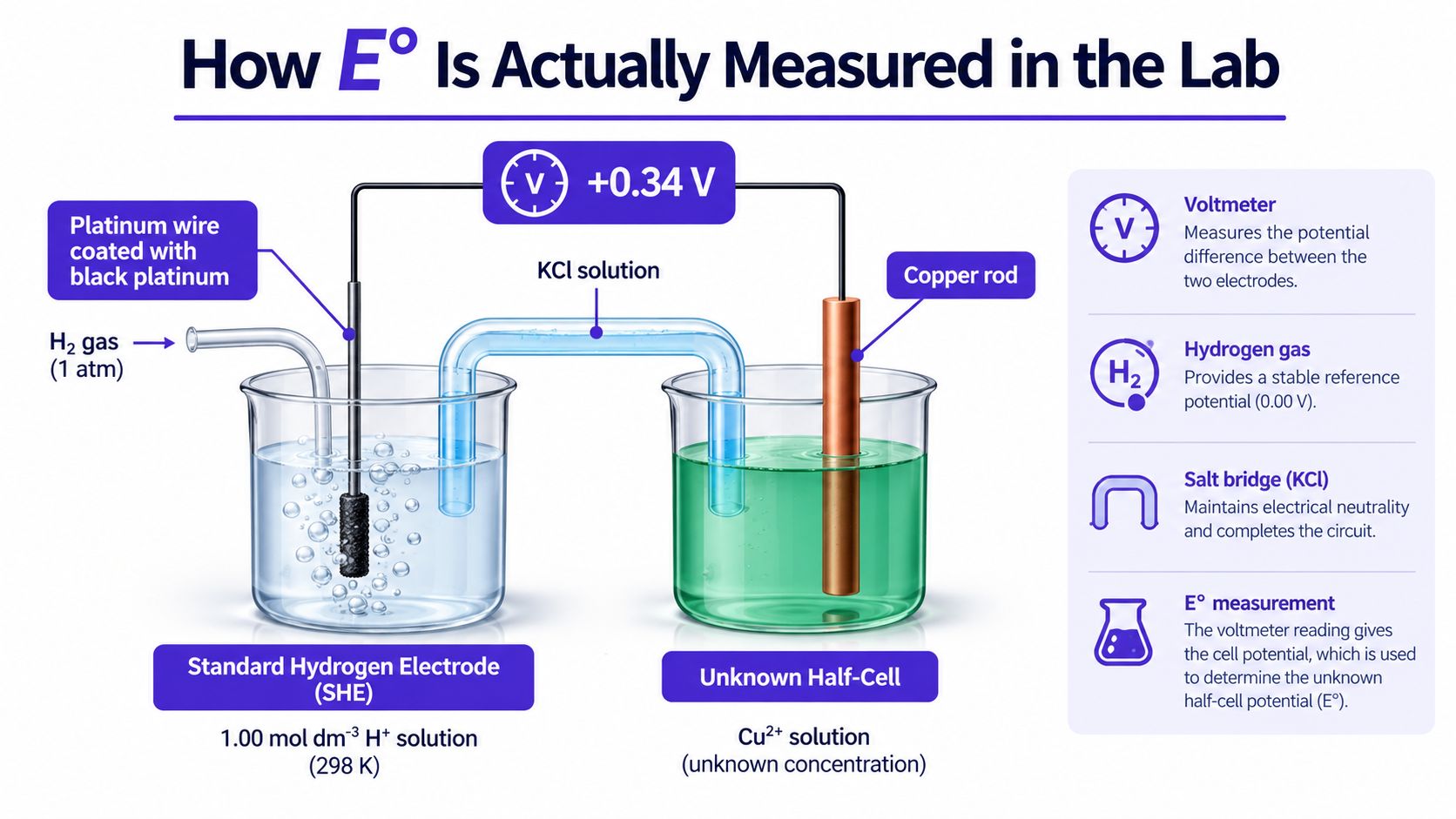
A standard electrode potential isn't guessed from a metal's appearance or reactivity. Chemists measure an unknown half-cell against the standard hydrogen electrode and record the resulting potential difference.
The reference half-cell is placed on one side. It contains a platinum wire coated in black platinum, immersed in a solution containing 1.00 mol dm⁻³ H⁺ ions. Hydrogen gas bubbles over the platinum surface at 100 kPa, while the temperature is held at 298 K. Platinum provides an inert conducting surface for the hydrogen oxidation and reduction processes.
The test half-cell sits on the other side. For a copper example, a copper strip is immersed in 1.00 mol dm⁻³ Cu²⁺ solution. A salt bridge, often containing KNO₃ or KCl, connects the solutions and allows ions to move so charge doesn't build up in either half-cell.
Why the voltmeter must have high resistance
The electrodes are connected to a high-resistance voltmeter. High resistance limits the current, allowing the apparatus to measure the potential difference without drawing substantial charge through the cell. The reading, including its sign, gives the standard electrode potential of the test half-cell relative to the SHE.
A result reported to ±0.001 V reflects the precision expected from the measuring instrument in this described setup. If the reading is positive, the test half-cell has a greater tendency towards reduction than the hydrogen reference. If it's negative, the test half-cell has a lower reduction tendency.
Some metals react with water, making a straightforward metal and ion half-cell difficult to maintain. In those cases, chemists use alternative reference arrangements or obtain values through calculations based on other measured data.
Why control matters
The word standard isn't decorative. Changing temperature, ion concentration or gas pressure changes the balance between the oxidised and reduced forms, so the measured potential can shift. Careful control makes values comparable between laboratories and allows an E° table to act as a shared reference rather than a collection of unrelated readings.
Reading An E° Table Like A Pro
Most standard electrode potential tables list half-equations as reductions. That convention gives every entry the same starting direction, even though a cell may use one reaction as an oxidation.
Read the equation from left to right. The species on the left accepts electrons and becomes the species on the right. The E° value tells you how favourable that reduction is compared with the standard hydrogen electrode.
A simplified excerpt can be organised like this:
| Half-equation, reduction | E° / V |
|---|---|
| F₂ + 2e⁻ → 2F⁻ | Most positive region |
| MnO₄⁻ + electrons → reduced manganese species | Positive region |
| Cl₂ + 2e⁻ → 2Cl⁻ | Positive region |
| H⁺ + e⁻ → hydrogen-containing product | 0.00 V reference |
| Cu²⁺ + 2e⁻ → Cu | Positive or near-reference region |
| Mg²⁺ + 2e⁻ → Mg | Negative region |
| K⁺ + e⁻ → K | Very negative region |
| Li⁺ + e⁻ → Li | Most negative region |
The exact entries and values depend on the table supplied with your course, so use the table in the question rather than relying on memory.
The top and bottom of the table
At the more positive end, species such as F₂, MnO₄⁻ and Cl₂ have a strong tendency to accept electrons. Their reduced forms are produced by reduction, so the original species act as strong oxidising agents.
At the more negative end, species such as Li, K and Mg are readily oxidised in the reverse direction. Their reduced forms act as strong reducing agents because they can donate electrons to a species with a greater reduction tendency.
Use the tug-of-war model. A species higher on the reduction side can often oxidise a reduced species lower down. A reduced species lower down can often reduce an oxidised species higher up.
The value +0.34 V is a useful point of reference in many common comparisons, especially where copper appears, but don't treat it as a universal magic boundary. The test is the calculated E°cell. A positive value indicates feasibility under standard conditions.
Read the table in the direction written. Reverse only when you've chosen the oxidation half-equation.
Standard conditions remain important: 298 K, 1 mol dm⁻³ solutions and the stated standard gas pressure. E° is a starting point for prediction, not a guarantee that every real reaction behaves identically outside those conditions.
Calculating Cell Potential Step By Step
The calculation is built around one equation:
E°cell = E°cathode − E°anode
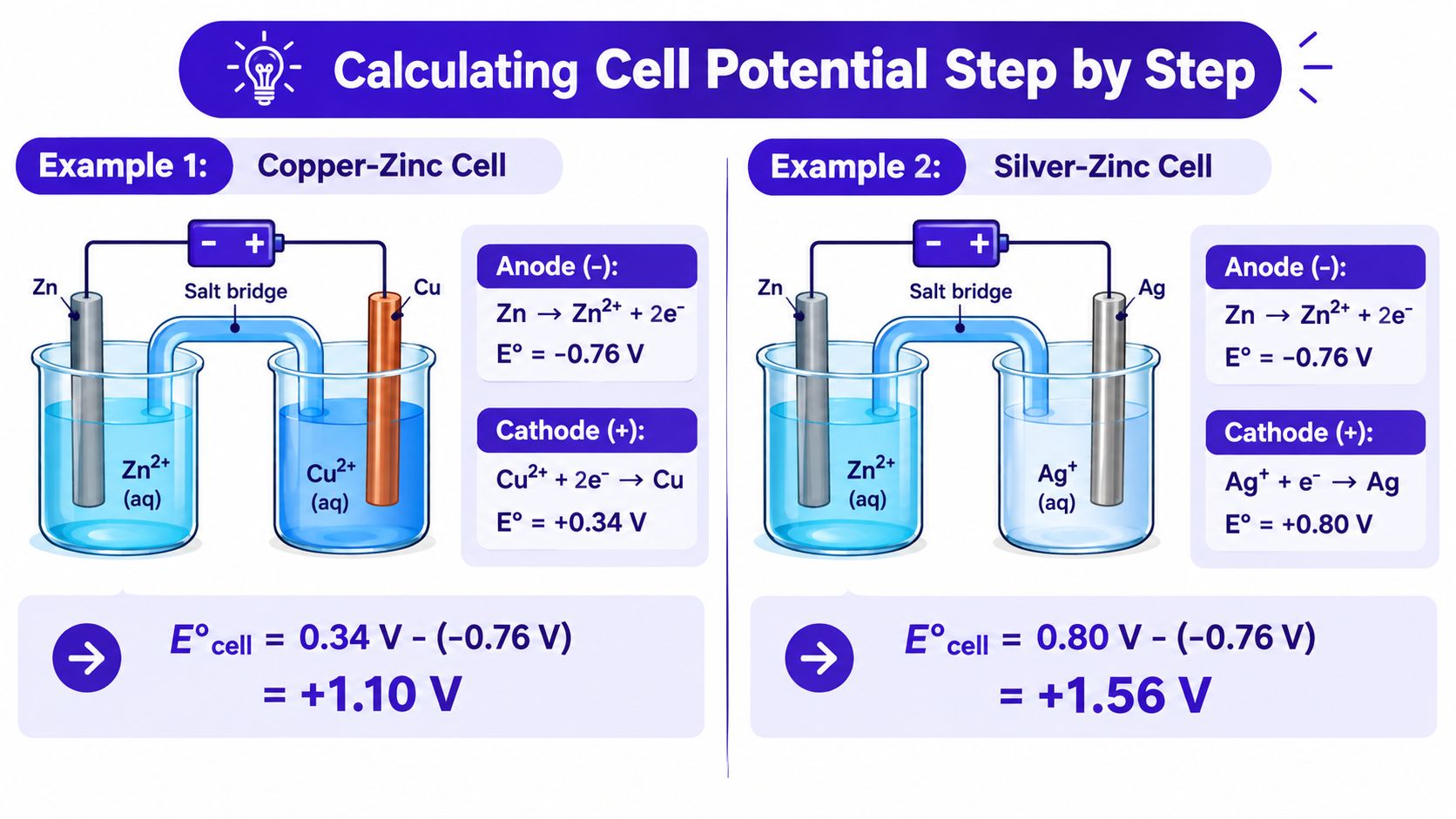
The cathode is where reduction occurs. The anode is where oxidation occurs. Because tables list reductions, choose the more positive reduction as the cathode and reverse the other half-equation for oxidation.
Example one with copper and zinc
Use these half-equations:
- Cu²⁺ + 2e⁻ → Cu, E° = +0.34 V
- Zn²⁺ + 2e⁻ → Zn, E° = −0.76 V
Copper has the more positive reduction potential, so copper ions are reduced at the cathode. Zinc is oxidised at the anode, meaning its listed equation is reversed:
Zn → Zn²⁺ + 2e⁻
Now substitute into the formula:
E°cell = +0.34 − (−0.76)
E°cell = +1.10 V
The two negative signs matter. Subtracting a negative value increases the result.
Example two with iron and iodide
Suppose the relevant reductions are:
- Fe³⁺ + e⁻ → Fe²⁺
- I₂ + 2e⁻ → 2I⁻
The iron half-equation has the more positive E° value in the supplied table, so Fe³⁺ is reduced at the cathode. Iodide is oxidised, so reverse the iodine equation:
2I⁻ → I₂ + 2e⁻
The calculation still follows the same structure:
E°cell = E° reduction at the cathode − E° reduction value for the anode
Use the values printed in your question, keeping the brackets around the anode value. A positive result supports feasibility under standard conditions.
The exam checklist
- Read both half-equations as reductions.
- Choose the more positive E° as the cathode reduction.
- Reverse the other half-equation for oxidation.
- Balance electrons by multiplying equations if needed.
- Do not multiply E° values.
- Calculate E°cell = E°cathode − E°anode.
- Interpret a positive result as feasible under standard conditions.
The equation coefficients balance electron transfer, but E° is a potential, not an amount of chemical substance. It doesn't scale when the equation is multiplied.
Copy this answer template into your practice:
The half-equation with the more positive E° is reduction at the cathode. The other half-equation is reversed and represents oxidation at the anode. Therefore, E°cell = E°cathode − E°anode = [value] V. Since E°cell is positive, the reaction is feasible under standard conditions.
Common Misconceptions That Cost Exam Marks
Many wrong answers come from one small decision made too quickly. The chemistry becomes much safer when you separate equation direction, potential values and reaction feasibility.
Sign confusion
Students often reverse the anode equation but leave its tabulated E° unchanged, or change the sign and then subtract it incorrectly. You don't need to manually reverse the sign in the main formula if you use the table convention consistently. Keep the tabulated reduction value for the anode and calculate:
E°cell = E°cathode − E°anode
If you write the oxidation potential explicitly instead, then you add the cathode reduction potential to the oxidation potential. Don't mix the two approaches.
Direction traps with non-metals
A non-metal isn't automatically the reduction side just because it appears in a familiar redox reaction. Check the half-equation. If the species on the left gains electrons, it's written as a reduction. If the actual reaction loses electrons, reverse the equation before combining it.
Electrons flow through the external circuit from the anode to the cathode, not the other way around. Oxidation occurs at the anode, and reduction occurs at the cathode, whether the cell is being discussed as a galvanic cell or in another electrochemical context.
Feasibility isn't speed
A positive E°cell indicates thermodynamic feasibility under standard conditions. It doesn't tell you how quickly the reaction will happen. A reaction involving MnO₄⁻ and many organic substrates may be thermodynamically favourable yet kinetically slow because activation energy and reaction pathways still matter.
Likewise, changing concentration, temperature or gas pressure can alter the actual potential. The E° table describes standard conditions, while non-standard behaviour leads towards the Nernst equation.
Multiplying equations
If one half-equation produces one electron and another consumes two, multiply the first equation so the electrons cancel. Don't multiply its E° value. Potential is an intensive property, so it doesn't depend on the amount of reaction represented.
Use Exam Practice for A-Level to practise separating these decisions under time pressure. A mark scheme usually rewards the correct half-equation direction, the correct substitution and an interpretation that includes “under standard conditions”.
Exam Style Practice Questions And Model Answers
These questions move from identification to evaluation. The wording reflects the command words you'll meet across AQA, Edexcel, OCR and WJEC, although the exact mark allocation and presentation can vary.
Question one
Which species is the strongest reducing agent in the supplied E° table?
Model answer: Choose the reduced species associated with the most negative reduction potential.
Examiner commentary: The command word “identify” needs a clear choice, not a paragraph. Link the answer to the most negative E° because that shows the reverse oxidation is most favourable.
Question two
Use the copper and zinc half-equations to calculate E°cell.
Model answer:
Copper is the cathode because Cu²⁺ has the more positive reduction potential. Zinc is the anode because zinc is oxidised.
E°cell = +0.34 − (−0.76) = +1.10 V
Examiner commentary: Show the formula and substitution. The answer earns credit for selecting the electrodes, using the correct subtraction and giving the sign and unit. Don't write only the final number.
Question three
Use E° values to justify whether a proposed redox reaction is feasible. Comment on reaction rate.
Model answer: Calculate E°cell = E°cathode − E°anode. A positive E°cell indicates that the reaction is feasible under standard conditions. However, E° predicts thermodynamic feasibility rather than rate, so the reaction may still be slow because kinetic factors affect its pathway.
Examiner commentary: “Justify” requires evidence and a conclusion. Quote the calculated sign, state the standard-conditions limitation and distinguish feasibility from rate. A bare statement that the reaction is spontaneous misses the qualification.
Question four
Two electrochemical cells have positive E°cell values. Select the more suitable cell for an industrial use and explain your choice.
Model answer: Select the cell with the more appropriate combination of potential, chemical stability, safety, availability and operating conditions. A larger positive E°cell indicates a greater thermodynamic driving force under standard conditions, but it doesn't alone prove that the cell is the most suitable industrial option. Practical factors, including reaction rate, materials, cost and non-standard conditions, must also be considered.
Examiner commentary: A five-mark comparison needs more than one number. Address the data, explain what the potential means, then evaluate limitations and practical criteria. Use comparative language such as “whereas”, “however” and “therefore” to make the reasoning visible.
For more structured practice, work through these A-Level Past papers, marking every response against the command word before checking the chemistry.
Recap And Where To Go Next
Keep these five ideas together:
- E° is measured relative to the SHE, whose potential is defined as 0.00 V under standard conditions, including 298 K and the specified standard concentrations and gas pressure.
- A more positive E° means easier reduction, so the oxidising agent is stronger.
- E°cell = E°cathode − E°anode.
- A positive E°cell indicates feasibility under standard conditions, but it doesn't predict reaction rate.
- E° informs real reactions, but it doesn't determine every practical outcome alone.
The next useful skill is conventional cell notation. Learn how single vertical lines show phase boundaries and double vertical lines represent salt bridges. Then move to the Nernst equation, which explains how potentials change under non-standard conditions.
From there, electrochemical cells connect to electrolysis, metal extraction, fuel cells, hydrogen production and corrosion protection. Sacrificial anodes, for example, apply the same electron-transfer logic to protect iron. The table isn't an isolated exam topic. It's a map for understanding how chemical energy and electrical energy change places.
MasteryMind offers curriculum-aligned chemistry practice covering redox, chemical cells and related GCSE and A-Level topics, with examiner-style feedback and adaptive revision. Visit MasteryMind to practise standard electrode potential calculations and build confidence with the exact reasoning your exam questions demand.
Ready to master this topic?
Practise with quizzes, blurt exercises and exam questions on MasteryMind.
7 days Premium · Then free forever · No card, no charge