Themes in Lord of the Flies: A GCSE Guide for Top Grades
You're probably here in one of two moods. Either you've looked at a question like “Explore how Golding presents savagery” and thought, “I know the story, but I don't know what to write,” or you already know the plot and want the kind of analysis that pushes you into the top bands.
Both problems usually come from the same issue. Students often revise events when exams reward ideas, methods, and argument. In Lord of the Flies, the plot matters, but only because it gives you evidence for a bigger point about society, power, fear, and what people become when rules stop working.
Why Lord of the Flies Themes Still Matter in 2026
A blank exam page can make this novel feel much harder than it is. You remember the island, the conch, the fire, the hunts. But the examiner isn't asking whether you can retell the story. They're asking whether you understand what Golding is saying through it.
That's why the themes in lord of the flies still matter so much in schools. William Golding's novel was first published in 1954 and is commonly classified as an allegory and dystopian novel, with its central conflict built around the struggle between civilization and savagery after boys are marooned without adult authority, as noted in SparkNotes' facts page on Lord of the Flies. That basic setup is exactly why the book still appears in UK classrooms. It gives students a clear, intense way to study order, morality, innocence, and human behaviour.
Why exam boards keep returning to it
This novel is useful for exam questions because Golding turns the island into a pressure test. He strips away adults, law, and institutions, then asks what's left. That makes almost every big exam topic available at once: power, conflict, identity, leadership, fear, responsibility.
It also helps that the symbols are memorable. Even if you're revising late, you can usually recall the conch, Piggy's glasses, the fire, and the beast. The challenge is not remembering them. The challenge is turning them into analysis.
Practical rule: Don't treat the novel like an adventure story with symbols attached. Treat it like an argument about what happens when social rules collapse.
Why context actually helps
Context isn't an extra bolt-on paragraph you tack onto the end. It shapes the whole novel. Golding published the book less than a decade after the end of World War II, and the novel draws on post-war anxieties about human nature and social breakdown. That matters because Golding isn't saying, “Look how wild these boys are.” He's asking whether violence is something civilisation controls rather than removes.
If you're revising for timed assessments, it helps to practise these ideas with real question wording. Using GCSE Past Papers is useful because you can see how themes get phrased under pressure, especially command words like explore, how far, and how does Golding present.
The Core Themes You Need to Know
Before you write anything complex, get the map clear in your head. The main themes are connected. If you split them into isolated boxes, your essays can sound flat. Golding's point is stronger than that. One theme triggers another.
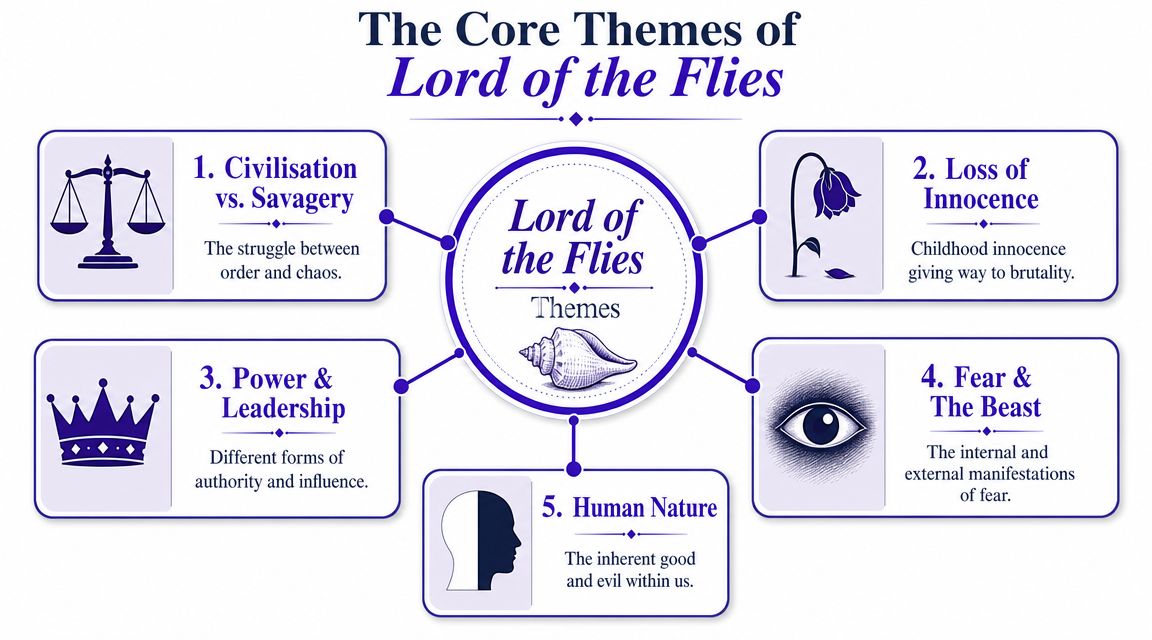
The big five at a glance
Here's the quickest useful overview.
| Theme | One-Sentence Summary | Key Symbols | Key Characters |
|---|---|---|---|
| Civilisation vs Savagery | Golding shows how order weakens when rules lose authority and violence becomes attractive. | Conch, signal fire, face paint | Ralph, Jack |
| Loss of Innocence | The boys don't simply grow up. They lose moral restraint and become capable of cruelty. | Blood, fire, the island itself | Ralph, Simon, Piggy |
| Power and Leadership | Golding compares responsible leadership with leadership based on fear, force, and reward. | Conch, spear, feast | Ralph, Jack, Piggy |
| Fear and the Beast | Fear distorts judgement and makes the boys easier to control. | The beast, darkness, the Lord of the Flies | Simon, Jack, littluns |
| Human Nature | The novel suggests that darkness comes from within people, not just from outside threats. | The pig's head, masks, hunting ritual | Simon, Jack, Roger |
How these themes connect
Students often ask which theme is “most important”. That's not always the best question. A better one is: which theme is driving the moment you're analysing?
For example:
- Fear helps Jack gain power
- Jack's power accelerates savagery
- Savagery destroys innocence
- The destruction of innocence reveals Golding's view of human nature
That chain matters in essays. It stops you from listing ideas and helps you build an argument.
If you want support with close reading and discussion beyond plot recall, Kubrio's piece on educational resources for deeper readers is worth a look because it focuses on moving from “what happened?” to “what does it mean?”
You'll also do better if your revision matches the way your paper is assessed. Using exam-aligned English Literature resources can help because question style and mark schemes shape the kind of theme analysis that scores well.
The strongest essays don't name a theme and leave it there. They show how one theme produces another.
Unpacking Civilisation vs Savagery
If you remember only one major idea from the novel, make it this one. Everything else grows out of it.

Golding builds the novel around a contest between rule-based order and impulse-driven violence. Ralph represents the first force. He focuses on meetings, shelters, and the signal fire. Jack represents the second. He offers hunting, excitement, meat, and a more thrilling kind of belonging.
That contrast is easy to spot. What students miss is that Golding doesn't present civilisation as something permanent and solid. He presents it as something fragile. It only works if people agree to respect it.
What civilisation looks like on the island
Early on, the boys try to create a society. They hold assemblies. They use the conch to regulate speech. They organise tasks. Those details matter because they show civilisation as shared agreement, not just good intentions.
The conch is the clearest symbol of that agreement. It doesn't have physical power. It works because the boys believe it should work. The moment that belief weakens, order weakens too.
A useful way to remember the “civilised” side of the novel is this short list:
- The conch shows structured speech and a basic democracy.
- The signal fire shows long-term thinking and commitment to rescue.
- The shelters show cooperation and responsibility.
- Piggy's thinking shows reason trying to survive in a hostile group.
What savagery offers instead
Jack's side grows because savagery isn't presented as random madness. It offers rewards. It gives the boys food, excitement, identity, and a group to belong to. Face paint matters because it frees the boys from shame. Once hidden behind the mask, they can act without the same sense of personal responsibility.
That's where many essays get sharper. Savagery doesn't just “appear”. It becomes attractive.
Golding suggests that chaos wins not because rules are useless, but because rules require effort, restraint, and collective loyalty.
Later, UK-aligned teaching resources emphasise that the boys begin by using the conch shell in assemblies to regulate speech, but later become a violent mob, with Piggy's death marking the collapse of reason, as outlined in Study.com's analysis of the novel's themes. That gives you a clean line of argument in an exam: organised speech becomes mob noise, and rational order becomes collective violence.
The turning points examiners notice
A good paragraph on civilisation and savagery usually tracks decline. Don't jump straight from Chapter 1 to the ending. Show the process.
Key turning points include:
The first assemblies
The boys still believe rules can hold them together.Neglect of the fire
Immediate pleasure starts beating long-term rescue.The rise of hunting
Group identity shifts from cooperation to aggression.The rejection of the conch
Legitimate authority loses status.Piggy's death and the shattering of the conch
Civilisation doesn't merely weaken. It is symbolically destroyed.
A short visual explainer can help if you want to hear the central conflict framed clearly before writing about it:
The examiner-level insight
Many students write, “Ralph is civilised and Jack is savage.” True, but not enough.
A stronger point is this: Golding shows civilisation as a system that depends on recognition, while savagery spreads when status comes from force instead of legitimacy. That's why symbols matter so much. The conch, fire, and shelters are not decorative details. They measure whether civilised values are still alive.
Tracing the Loss of Innocence
This theme can sound simple at first. Students often reduce it to “the boys grow up” or “they lose their childhood.” Golding is doing something darker than that.
He uses children who should represent discipline, schooling, and British civility to show how moral restraint can erode under pressure. According to College Transitions' analysis of the novel's themes, Golding uses schoolboys as a controlled sample to show how quickly prosocial norms degrade when survival pressure and peer reinforcement dominate, suggesting innocence depends on external scaffolding such as supervision, shared codes, and institutions.
Innocence is not the same as naivety
In this novel, innocence doesn't mean the boys are cute or clueless. It means they still live within a moral framework that limits what they will do. Early on, that framework exists. The boys still talk about rescue. They still imitate grown-up procedures. They still assume rules matter.
That's why their later actions are so disturbing. Golding doesn't show innocence fading naturally. He shows it being stripped away.
The stages of moral decline
A clear essay often traces innocence through changes in behaviour.
At first, the island feels almost like freedom.
The boys are excited. There's energy, movement, and the sense that this might become a game.Then violence becomes rehearsed.
Hunting starts as performance and turns into habit. The boys begin to enjoy the role savagery gives them.Then the group normalises cruelty.
What would once have felt shocking starts to feel acceptable inside the tribe.
That middle stage is where many essays become vague. Be precise. Golding shows that cruelty becomes easier when it is shared. Group behaviour weakens personal guilt.
Revision shortcut: If you're writing about innocence, don't stop at “they become savage.” Explain how the group makes savagery feel normal.
Simon and Piggy as markers of what is lost
Simon's death matters because it shows what happens when fear and frenzy replace thought. He represents insight and a more truthful understanding of the “beast,” but the boys cannot recognise that truth once they are locked into ritual and panic.
Piggy's death matters for a different reason. It marks the destruction of reason, but it also shows how far the boys have travelled from ordinary schoolboy cruelty into something much worse. Mockery becomes dehumanisation, and dehumanisation makes brutality easier.
A useful comparison looks like this:
| Character | What he represents | What his fate reveals |
|---|---|---|
| Simon | Insight, moral clarity, spiritual truth | The group destroys truth when fear and ritual take over |
| Piggy | Logic, reason, civil order | The group destroys restraint when power no longer respects reason |
Why Golding makes them children
This is the point that lifts the theme beyond plot summary. Golding chooses children precisely because many readers assume children are naturally innocent. He then tests that assumption. His argument is grim: innocence may depend less on inner purity than on structures that train, supervise, and restrain people.
That makes the ending especially painful. The boys are not rescued back into childhood. They are exposed as children who have already crossed moral lines they can't undo.
Analysing Power Leadership and Fear
The island doesn't descend into chaos because everyone suddenly becomes equally violent. It changes because some boys gain influence, others submit, and fear reshapes the group.
That's why leadership matters so much in the novel. Golding compares different kinds of authority and shows that the most effective leader is not the most ethical one.
Ralph and Jack are not just opposites
Students often set Ralph up as “good” and Jack as “bad”. That's too blunt for strong analysis.
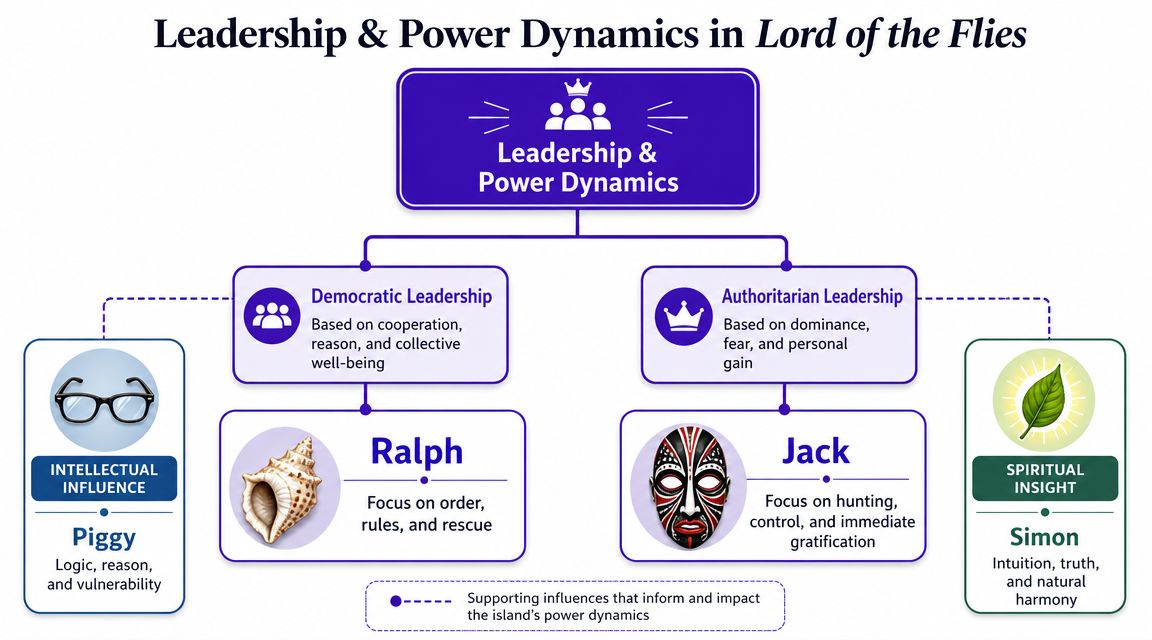
Ralph leads through procedure. He wants assemblies, task-sharing, and the signal fire. His leadership depends on cooperation, which means it's slower and less glamorous. Jack leads through spectacle and appetite. He offers certainty, action, and reward. Meat now beats rescue later.
Here's the contrast in a GCSE-friendly form:
| Leader | Source of authority | Main priority | Weakness |
|---|---|---|---|
| Ralph | Election, shared rules, the conch | Order and rescue | Depends on others choosing responsibility |
| Jack | Charisma, intimidation, hunting success | Control and immediate gratification | Turns leadership into domination |
Why fear changes everything
Fear is the accelerant. Without it, Jack is only a rival. With it, he becomes much more powerful.
The beast is important because it gives the boys a shape for their anxiety. Once fear takes hold, rational argument loses force. Piggy can reason. Simon can understand. But fear doesn't answer to logic very well, especially in a group already slipping toward superstition and violence.
Fear makes the boys easier to rule because frightened people often prefer confidence to truth.
That's the political insight inside the novel. Jack doesn't merely react to fear. He uses it. He gives the boys a threat and then presents himself as the answer.
Why Piggy and Simon fail to lead
This is one of the most revealing parts of the book. Piggy has intelligence but lacks social power. Simon has insight but not public authority. Golding seems interested in a painful fact about groups: being right isn't enough.
- Piggy's reason is mocked because the group associates weakness with irrelevance.
- Simon's truth is ignored because it cuts against the fear the boys want to believe.
- Ralph's authority declines because practical leadership becomes less attractive than emotional control.
That pattern gives you an excellent essay line. Golding suggests that in unstable societies, groups may reject the very voices that could save them.
Fear as a method of rule
If you're aiming high, write about fear as a leadership tool rather than just a feeling. Jack strengthens his position by turning anxiety into obedience. The boys don't just believe in the beast. They build behaviour around it. They accept rituals, violence, and group conformity because fear has made those things feel necessary.
The theme's scope expands beyond the island. Golding shows that leadership can be judged not only by what it promises, but by what emotional state it creates in followers.
How to Write an A-Grade Essay on Themes
Knowing the themes is one job. Turning them into marks is another.
The biggest jump in quality happens when students stop writing theme essays as lists of symbols and start writing them as arguments about cause and effect. SparkNotes' themes page makes that move especially useful for students by stressing that you should write about theme as a process, citing the breakdown of the conch-based assembly, the shift from rescue-oriented behaviour to hunting, and the way collective fear replaces rational deliberation in one chain of evidence, which is especially helpful for AO2 and AO3 style essays in this analysis of the novel's themes.
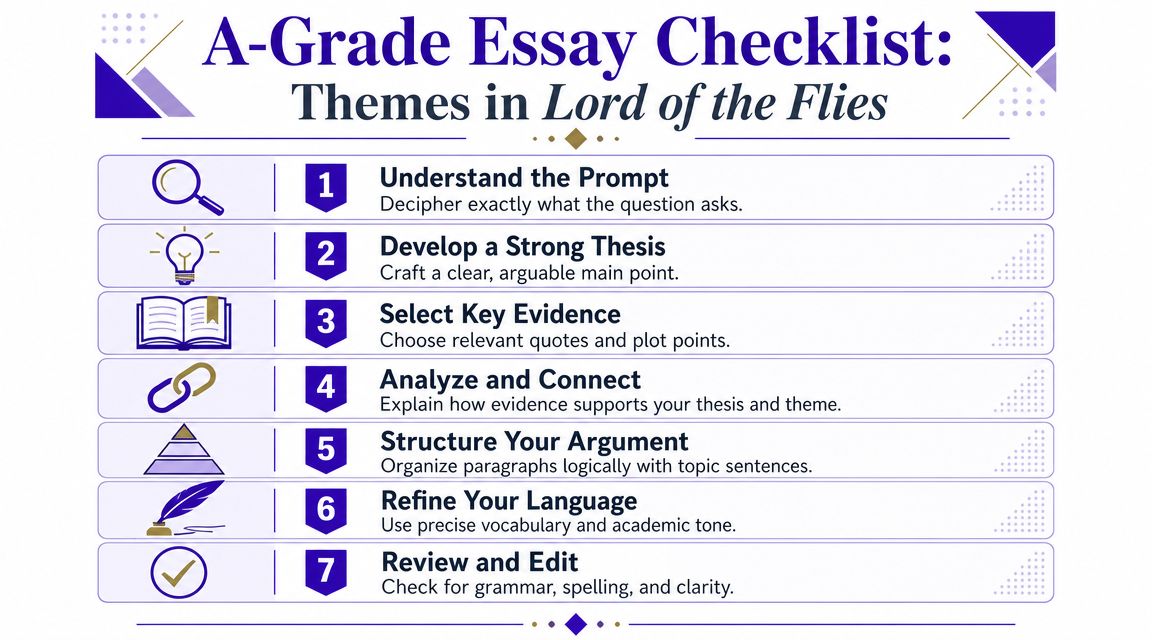
The method that actually works
PETAL is still useful, but only if you don't use it mechanically.
Point
Make a claim, not a topic label.
Weak: “Golding shows savagery.”
Better: “Golding presents savagery as something that spreads when social authority stops carrying weight.”Evidence
Use a short quotation or precise reference to an event.Technique
Comment on symbol, contrast, structure, motif, or characterisation.Analysis
Explain how the evidence develops the theme.Link
Return to the question and, if relevant, connect to context.
Write theme as movement, not wallpaper
This is the trick many top answers use. Don't write “the conch represents civilisation” and stop. Write about the decline of the conch's authority. Don't write “fear is important.” Write about how fear moves the boys from discussion to obedience.
A strong paragraph often follows this pattern:
- start with a theme claim
- track a change across the novel
- connect symbol to behaviour
- show what Golding is arguing about human nature or society
Examiner mindset: They reward students who explain why things change, not students who simply identify what things mean.
A model paragraph shape
Here's a clean example you could adapt:
Golding presents civilisation as fragile because it depends on collective belief rather than physical force. Early on, the conch helps the boys create assemblies and regulate speech, which makes order seem possible. However, as the boys become more drawn to hunting and fear, the conch loses authority, showing that rules only work when a community chooses to respect them. Golding uses this decline to suggest that social order can collapse quickly when people prefer excitement, aggression, or security over responsibility. In the novel's post-war context, that idea becomes a warning about how thin the surface of civilisation may be.
Notice what that paragraph does. It doesn't list a symbol. It tracks a process.
Common mistakes that drag marks down
- Retelling the plot instead of analysing methods
- Using one quotation and overexplaining it without linking it to the whole novel
- Forgetting the question wording
- Treating context like a detached paragraph
- Writing “this shows” repeatedly without sharpening the point
A fast plan for timed essays
If you've only got a few minutes to plan, do this:
- Underline the command and theme in the question
- Choose three moments across the novel, not three quotations from one scene
- Give each paragraph a mini-argument
- Add one context link only where it is helpful
- Finish by returning to Golding's overall warning
If revision is the problem rather than writing itself, build a short routine and repeat it. An effective English Lit study plan helps because Literature improves when you revisit characters, themes, and question types in cycles rather than cramming everything the night before. One option students use is MasteryMind, which offers exam-board-aligned English practice, including structured essay support and AO-focused feedback.
Key Takeaways Golding's Lasting Warning
The strongest way to understand the themes in lord of the flies is to stop seeing them as separate revision headings. They form one argument.
Civilisation and savagery are not just opposing ideas. They show a struggle over what kind of society the boys will build. Loss of innocence is not just “growing up.” It shows what happens when moral restraint is no longer supported. Power and leadership are not only character traits. They reveal how groups can be shaped by fear, reward, and force.
The big picture you can take into the exam
If you remember one central line of thought, make it this:
- Rules collapse
- Fear spreads
- Violence becomes rewarding
- Reason loses authority
- The boys become capable of cruelty they once would have rejected
That chain is Golding's warning.
What Golding finally suggests
The island works like a laboratory. Golding removes adult authority and watches what emerges. His view is pessimistic. He suggests that the savage impulse is not an alien force invading the boys from outside. It lives within human beings and can surface when the structures of civilisation fail.
That's why the novel still unsettles readers. It doesn't let us dismiss the boys as monsters who are different from us. It asks whether civilisation is something we actively maintain, or something we only wear while circumstances are easy.
If you can explain how Golding turns symbols, character conflict, and group behaviour into that wider warning, you're writing the kind of essay examiners remember.
For your final revision, don't just memorise quotations. Build arguments. Use a few core moments well. Track changes across the novel. If planning is the part that slows you down, MasteryMind's guide to essay planning is a sensible place to tighten your structure before the exam.
If you want more GCSE and A-Level revision support, MasteryMind offers curriculum-aligned practice for UK learners, including English Literature questions, essay guidance, and feedback built around assessment objectives.
Ready to master this topic?
Practise with quizzes, blurt exercises and exam questions on MasteryMind.
7 days Premium · Then free forever · No card, no charge