Unseen Poetry GCSE How to Analyse and Compare Poems
You turn the page, read the unseen poem, and suddenly every line seems to mean nothing. Your mind jumps to similes, enjambment and rhyme, but the question is asking about feelings or ideas. That freeze is common, whether you're trying to recover an exam or push towards the highest grades. The good news is that unseen poetry GCSE questions don't test whether you already know the poem. They test whether you can make a clear, supported interpretation under pressure.
What Unseen Poetry Really Tests at GCSE
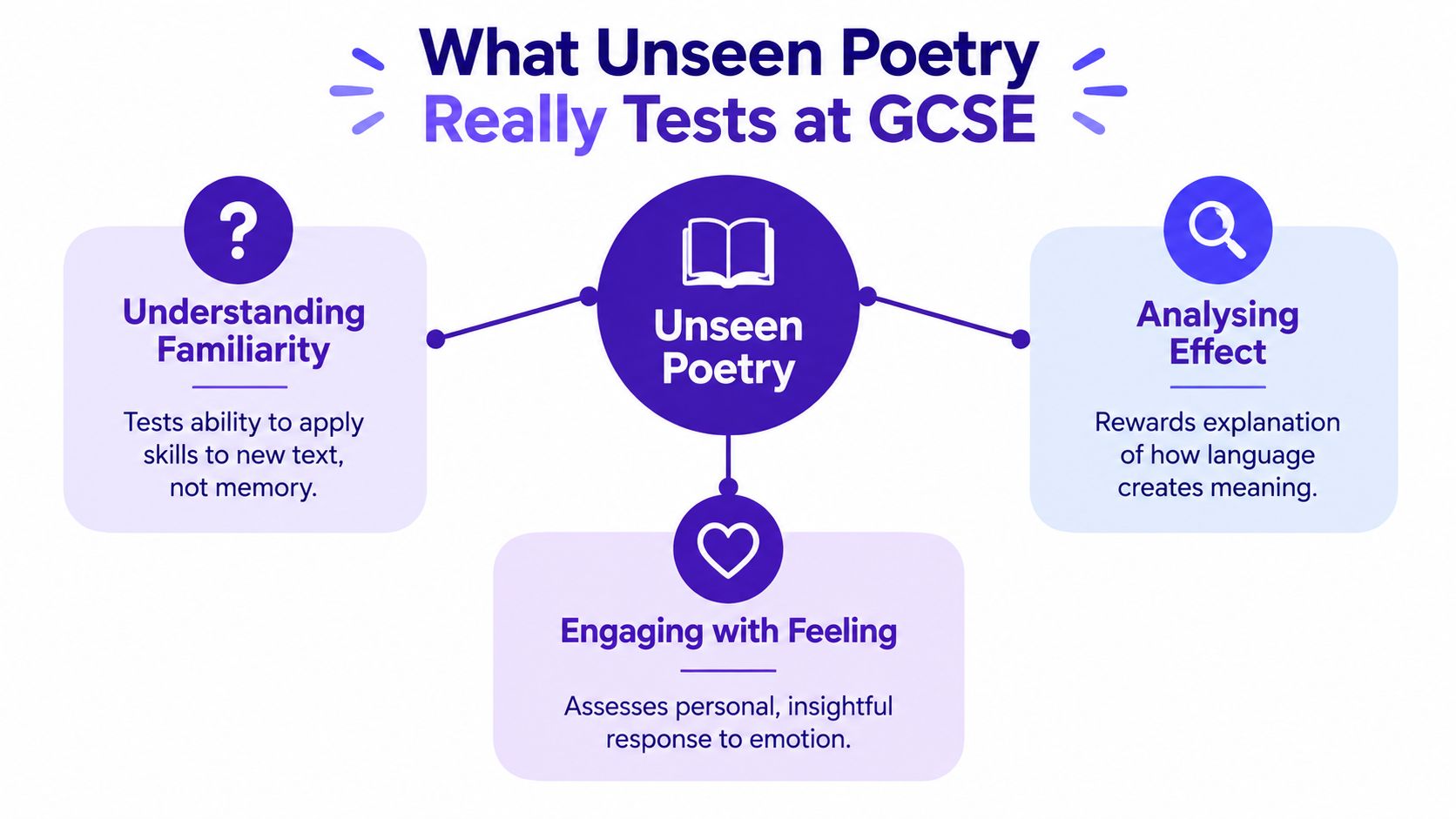
You turn the page and meet a poem you have never studied. There is no biography to recall, no prepared context paragraph and no memorised interpretation to adapt. That pressure is intentional. GCSE English Literature uses unseen texts to assess independent reading, so your evidence must come from the words, patterns and choices on the page.
For AQA, unseen poetry appears in Paper 2, Section C and carries 32 marks. The first unseen-poem question is worth 24 marks, while the comparison question on a second poem is worth 8 marks. The AQA unseen poetry overview explains that students answer one question on an unfamiliar poem before comparing it with a second poem. That weighting should shape your timing. Give the main poem most of your thinking and writing time, then make the comparison focused rather than allowing it to take over.
Memory matters less than interpretation
Anthology poetry rewards preparation because you can know the poem, context and likely themes in advance. Unseen poetry tests what you can do with limited preparation. You need to decide what the speaker appears to feel, choose precise references and explain how language, structure and form shape that meaning.
A technique only earns its place when it supports an interpretation. “The poet uses a metaphor to make the poem interesting” names a feature but leaves its meaning unexplained. A stronger answer examines the image, connects it to the speaker's attitude and considers why it appears at that moment. The difference is like naming a map symbol versus explaining where the route leads.
Practical rule: Treat every technique as evidence for an idea, not as an achievement to list.
The assessment focus usually centres on AO1 and AO2. AO1 asks you to show understanding and develop an interpretation with references. AO2 asks you to analyse how methods create meaning. The UK subject-content guidance states that unseen examination texts require independent analysis of content, theme, structure and language. A top response therefore makes a clear argument, then tests that argument against details from across the poem.
Context isn't the hidden trap
Students can lose time trying to identify when or why a poem was written. In AQA unseen poetry, there are no AO3 marks, so you are not expected to know the poems' contexts, as explained in this AQA unseen poetry guide. Use the title, voice and wording in front of you instead of inventing background.
Other boards organise the task differently. In WJEC Eduqas, unseen poetry represents 20% of the GCSE English Literature qualification, and the task includes two questions, including comparison. The weighting changes, so check your board's requirements before practising. The shared skill is careful reading, a defensible interpretation and analysis of how poetic choices create meaning.
Guided resources such as Online Revision for GCSE can support classroom notes and timed practice. The aim is straightforward: build a reading you can prove, rather than guess the interpretation the examiner expects.
How to Read and Annotate an Unseen Poem Under Pressure
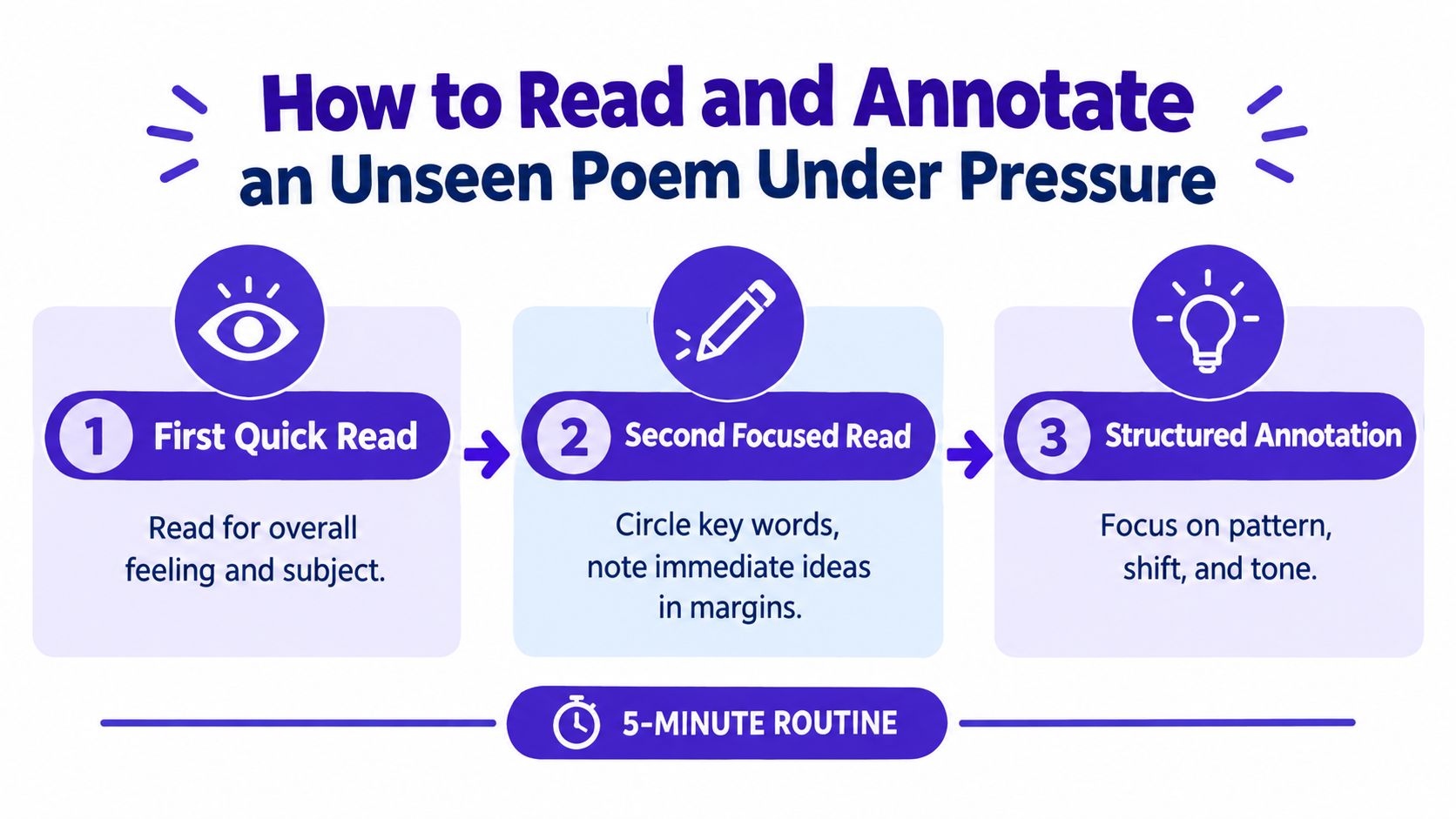
The first minutes matter because panic makes you annotate everything and understand very little. Use a repeatable routine instead. You need notes that help you write, not a page covered in coloured ink.
First read for the whole picture
Read the question before the poem, then read the poem once without hunting for devices. Ask yourself three basic questions:
- What is happening?
- Who is speaking, or who is being described?
- What feeling does the poem leave you with?
Write a few ordinary words in the margin, such as “protective”, “uneasy”, “memory” or “freedom”. These aren't your final ideas. They're anchors that stop you from feeling you have no response at all.
Pay attention to the title and the final lines. The title may establish an attitude before the poem begins, while the ending often confirms, complicates or reverses the opening impression. If you freeze, read the first and last stanza again and ask what has changed between them.
Second read for patterns and movement
On the second reading, circle only words that carry clear weight. Look for repeated vocabulary, striking images, changes in pronouns, and shifts in tone. Mark a turning point if the poem moves from calm to threatening, distance to closeness, confidence to doubt, or observation to direct address.
You don't need to label every sound pattern. If a repeated word appears, ask why the poet returns to it. If a stanza break separates two ideas, ask what the space makes you notice. If the speaker uses “I” at first and later uses “we”, that change may reveal a developing relationship or a new sense of belonging.
Build a working thesis
Your thesis can be provisional. You aren't required to be certain before you start writing. Use this pattern:
The poem presents [subject or feeling] as [main interpretation], but it shifts towards [change by the ending].
For example, you might decide that a poem first presents a family memory as comforting, then makes it feel painful because the speaker recognises that the past can't return. That gives you a route through the poem. Your paragraphs can follow the opening, the shift and the ending.
When you practise wider English exam skills, resources such as this guide to how to pass AP English exam can offer broader advice about reading questions and organising responses, although your GCSE assessment objectives and board timings still control your poetry strategy.
Use Exam Practice for GCSE to rehearse the routine with unfamiliar texts. The aim isn't to produce perfect annotations. It's to make reading, selecting and arguing feel familiar enough that a difficult poem doesn't control the first minutes of your exam.
Turning Language Form and Structure Into Meaning
Technique spotting becomes useful only when it leads to interpretation. Suppose a poem contains an image of a locked door. Calling it a metaphor is the starting point. You still need to decide whether the door suggests exclusion, emotional self-protection, fear or a choice to remain separate.
Choose evidence you can actually explain
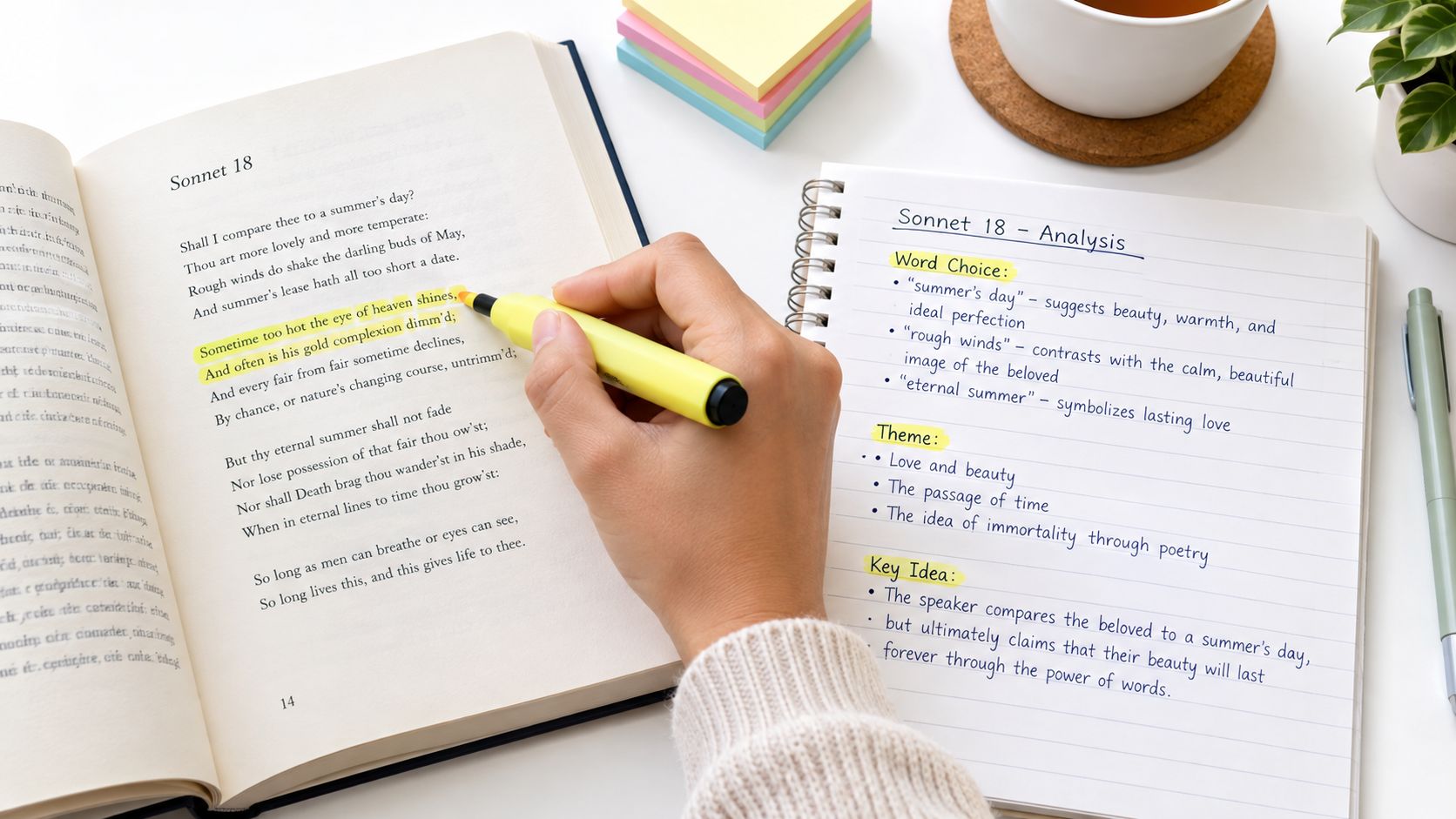
Short quotations usually give you more control than copying whole lines. Select a word or brief phrase, then explore its associations and place in the poem.
- Word choice: What does the word suggest beyond its literal meaning?
- Image: What picture or comparison does the reader form?
- Pronouns: Does the speaker use “I”, “you” or “we”, and does that change?
- Sound: Does repetition make an idea seem persistent, comforting or intrusive?
- Tone: Does the voice sound restrained, angry, playful, uncertain or affectionate?
A weak sentence says, “The poet uses a simile to show sadness.” A more developed sentence says, “The simile makes the speaker's sadness seem inescapable because the comparison turns an inner feeling into something surrounding them.” The second version explains an idea and connects the method to its effect.
Structure is the poem's journey
Structure isn't just stanza counting. Ask how the poem moves. Does the speaker begin with a memory and end in the present? Does the focus move from a physical place to an emotional realisation? Does a volta, or turning point, change the reader's understanding?
Stanza breaks can separate stages of thought. Enjambment may make a feeling appear to continue before the reader can pause, while a short end-stopped line may create certainty or finality. Repetition can hold the poem in one emotional state, but a repeated word can also change meaning when it returns near the ending.
Better question: What does this choice make the reader understand at this exact moment?
Track the opening, middle and ending rather than treating every line as equal. A poem's progression often gives you the strongest argument. If the opening uses soft natural imagery but the ending contains harsh verbs, you can argue that the speaker's original calm has been disturbed.
Form should support your argument
Form includes the poem's overall shape and voice. A dramatic monologue may reveal a speaker who tries to control how another person sees them. Irregular line lengths may reflect unsettled thought, though you must explain the specific effect rather than treating irregularity as automatically chaotic.
Your explanation should remain flexible. A pause might suggest hesitation, but it could also create emphasis or make the next phrase sound more deliberate. Examiners reward interpretations that are sensitive and defensible, not guesses presented as facts. You can find structured exam preparation materials to practise moving from a method to a precise meaning.
Building High Scoring Paragraphs That Track the Poem
A strong paragraph has a job. It should make a point about the question, use evidence, analyse a method and connect the detail to the poem's wider movement. You don't need to force every possible technique into the same paragraph.
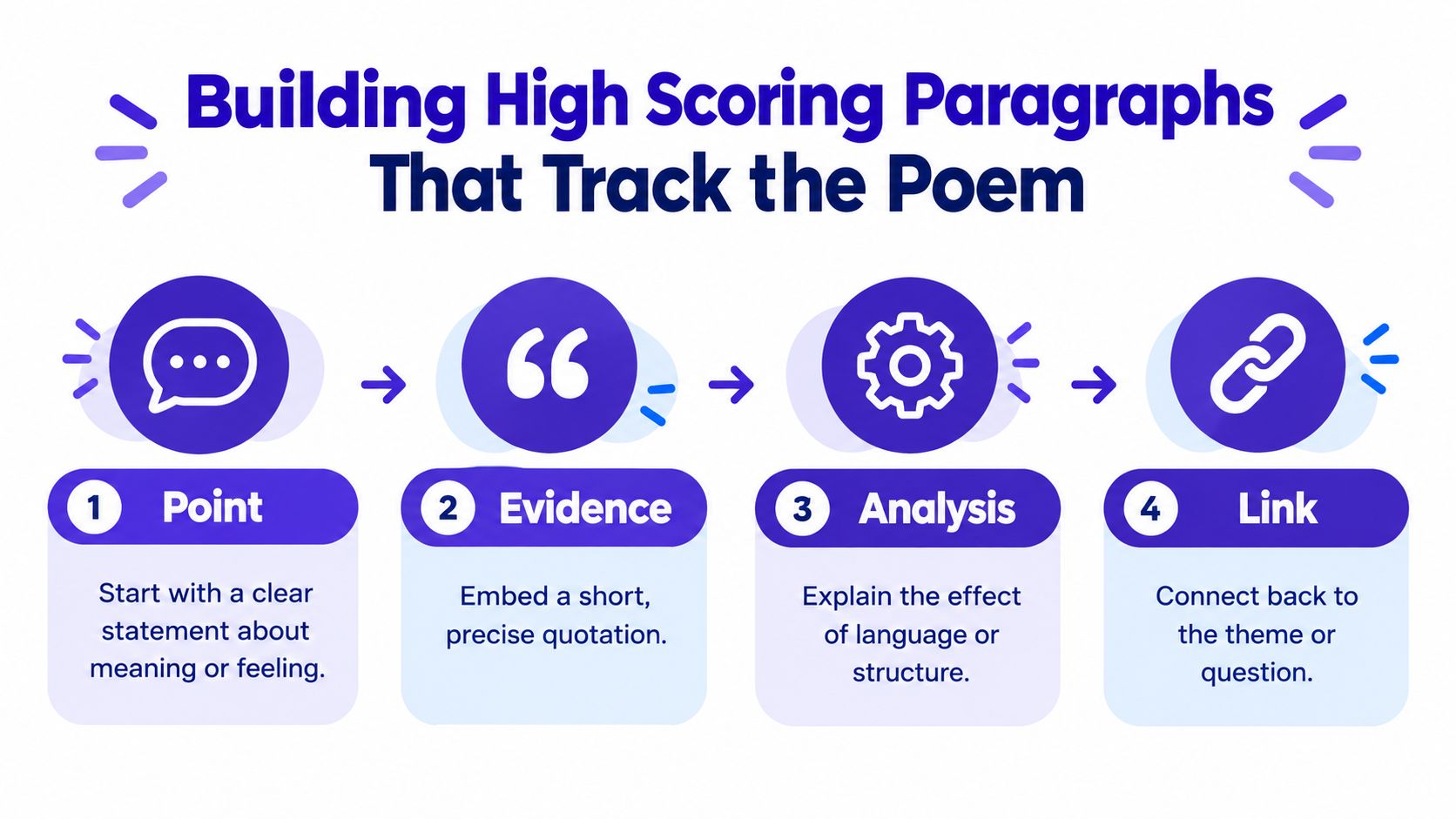
Start with meaning, not terminology
Begin with an arguable idea:
At the opening, the speaker presents the place as safe, but the calm appears fragile.
Then add a short quotation:
The setting is described as “quiet”, a word that initially suggests peace.
Now analyse the choice:
However, its simplicity also makes the silence feel unnatural, as if the speaker is noticing the absence of ordinary life.
Finally, link to the poem's journey:
This prepares the later shift towards suspicion, where the same setting no longer feels protective.
That sequence keeps AO1 and AO2 working together. The point answers what the poem means. The quotation supports it. The analysis explains how the writer creates it. The link returns to the changing interpretation.
Follow the poem in order
Chronological paragraphs usually help because they mirror the reader's experience. You might organise the response around:
- The opening impression and central situation.
- A repeated image, conflict or development in the middle.
- A turning point in tone, focus or voice.
- The ending and what it reveals about the question.
You won't always need four paragraphs. Choose the structure that fits the poem and question. A confident student may combine two closely related developments, while a resitter may find it safer to write three clear paragraphs than attempt a complicated plan.
Here is a compact model using an invented example rather than a poem you could quote in an exam:
At first, the speaker presents the old house as comforting through the image of “warm windows”. The adjective “warm” suggests welcome and protection, making the building seem connected to family security. Yet the plural noun “windows” also places the speaker outside, looking in rather than belonging fully. When the poem later describes the house as “waiting”, the personification changes the atmosphere: the place appears to hold a memory that the speaker has avoided. By the ending, the house is no longer simply a safe setting, but a reminder that returning home cannot restore the past.
Notice what the paragraph doesn't do. It doesn't name every device. It follows the poem's movement and offers a possible interpretation that the evidence can support.
Keep your argument visible
Return to the question's key word in each paragraph. If the question asks how the poet presents regret, don't allow a paragraph about weather to become a detached technique exercise. Explain how the weather reflects, intensifies or challenges the speaker's regret.
Strong analysis doesn't mean finding more devices. It means making the reader understand why the writer's choices matter.
How to Compare Two Unseen Poems Without Wasting Time
The comparison question rewards a clear relationship between the poems, not two mini-essays placed beside each other. Begin with the same question focus for both texts, then explain where their ideas or methods meet and where they separate.
Use the mark weighting discussed earlier to set your priorities. Give the first poem the larger share of your planning and writing time, while reserving a focused block for comparison. WJEC Eduqas students should rehearse the complete two-poem format within the board's stated one-hour response. The WJEC Eduqas unseen poetry guidance explains that board-specific approach. Your timing plan must fit the question paper in front of you, not a different specification.
Build the comparison around one shared idea
As soon as you finish reading, make a quick two-column note:
| Poem one | Poem two |
|---|---|
| Speaker sees separation as painful | Speaker presents separation as freeing |
| Repeated “we” suggests connection | Repeated “I” stresses independence |
| Ending remains uncertain | Ending sounds decisive |
Choose the strongest shared idea, then connect method, evidence and meaning. A useful paragraph could begin:
Both poems present separation as important, but the first uses repeated collective pronouns to show emotional dependence, whereas the second uses the solitary pronoun to create independence.
Add a short quotation from each poem and explain the difference. The comparison becomes convincing when you show how the choices produce different interpretations, rather than placing two quotations in the same paragraph.
The methods may be different. One poet might use a metaphor, while the other creates meaning through stanza structure or a change in tone. That difference still gives you something to compare. For example, a flowing metaphor may make emotion seem difficult to control, whereas a sudden stanza break can make a change feel abrupt and final.
Keep returning to the question's key idea. If it asks about freedom, explain how each method presents freedom, limits it or questions it. Avoid links such as “Both poems use language.” Name the choice, its effect and its connection to the theme.
Two developed comparison paragraphs usually serve you better than a long catalogue of similarities. In each paragraph, use this sequence: shared focus, poem one method and evidence, poem two method and evidence, then the contrast in meaning. That structure keeps comparison active and prevents one poem from disappearing while you summarise the other.
Your Practice Plan and Mistakes to Avoid Before Exam Day
Improvement comes from repeating the whole process, not from collecting technique definitions. Use an unseen poem, read the question, annotate with restraint, write a response, and then review the quality of your interpretation.
For each practice attempt, check:
- Meaning: Have you made a clear argument about the speaker's feelings or the poem's central idea?
- Evidence: Are your quotations short and precise?
- Methods: Have you explained language, structure and form rather than merely naming them?
- Movement: Have you tracked a shift from the opening towards the ending?
- Comparison: Have you linked both poems directly rather than writing separate summaries?
- Timing: Did you leave enough attention for the comparison task required by your board?
Past papers are useful because they reveal how unfamiliar poems behave under real question wording. Use a reliable collection of GCSE Past Papers, then mark your work against the relevant assessment objectives. Don't only count techniques. Highlight the sentences where you explain meaning, and circle places where the evidence isn't clearly connected to the question.
Mistakes that quietly limit marks
Reading once often leaves students with a vague mood but no argument. Technique dumping creates the opposite problem, a crowded response with little explanation. Another common weakness is stopping after the first stanza, even though the ending may challenge the initial interpretation.
Comparison answers also suffer when students describe one poem and add “similarly” at the end. Build the connection into the point itself. “Both poems present memory as powerful, but the first treats it as comforting while the second makes it threatening” gives you a clear route into evidence and methods.
Whether you're resitting or chasing a top grade, use the same core habits: read twice, identify the emotional journey, argue rather than label, and compare with purpose. Keep a record of the weakness you notice each time, then target that weakness in your next practice instead of starting from scratch.
MasteryMind offers UK GCSE English Literature practice for unseen poetry analysis and comparison, with questions organised around exam-board command words, assessment objectives and mark allocations. Visit MasteryMind to practise unfamiliar poems, receive examiner-style feedback and build a revision routine that fits your AQA, OCR or WJEC preparation.
Ready to master this topic?
Practise with quizzes, blurt exercises and exam questions on MasteryMind.
7 days Premium · Then free forever · No card, no charge