8 Unseen Poetry Tips for Better Exam Answers
You turn the page and meet a poem you've never seen before. You understand parts of it, perhaps the setting or one striking image, but you can't decide what to write first. That moment feels worse when the clock is moving and every line seems to demand a different technique.
Strong unseen poetry answers don't depend on guessing a hidden meaning. They come from making a few defensible observations, choosing precise evidence, linking methods to meaning, and managing time. The approach below gives GCSE and A-Level learners a repeatable route from first reading to finished paragraph. It also makes the assessment focus visible for teachers checking whether advice leads to genuine analysis rather than formulaic technique spotting.
For AQA GCSE English Literature, unseen poetry appears in Paper 2, Section C and carries 32 marks. The first poem question is worth 24 marks, while the comparison question is worth 8 marks, as set out in the AQA unseen poetry teaching guide. The aim here is useful analysis, not memorised formulae. If you're rebuilding confidence after under-preparing, start with one strategy and practise it until the next move feels clear. You can also use this training video script template to turn your revision explanation into a short spoken walkthrough.
1. The SMILE framework for a controlled first read
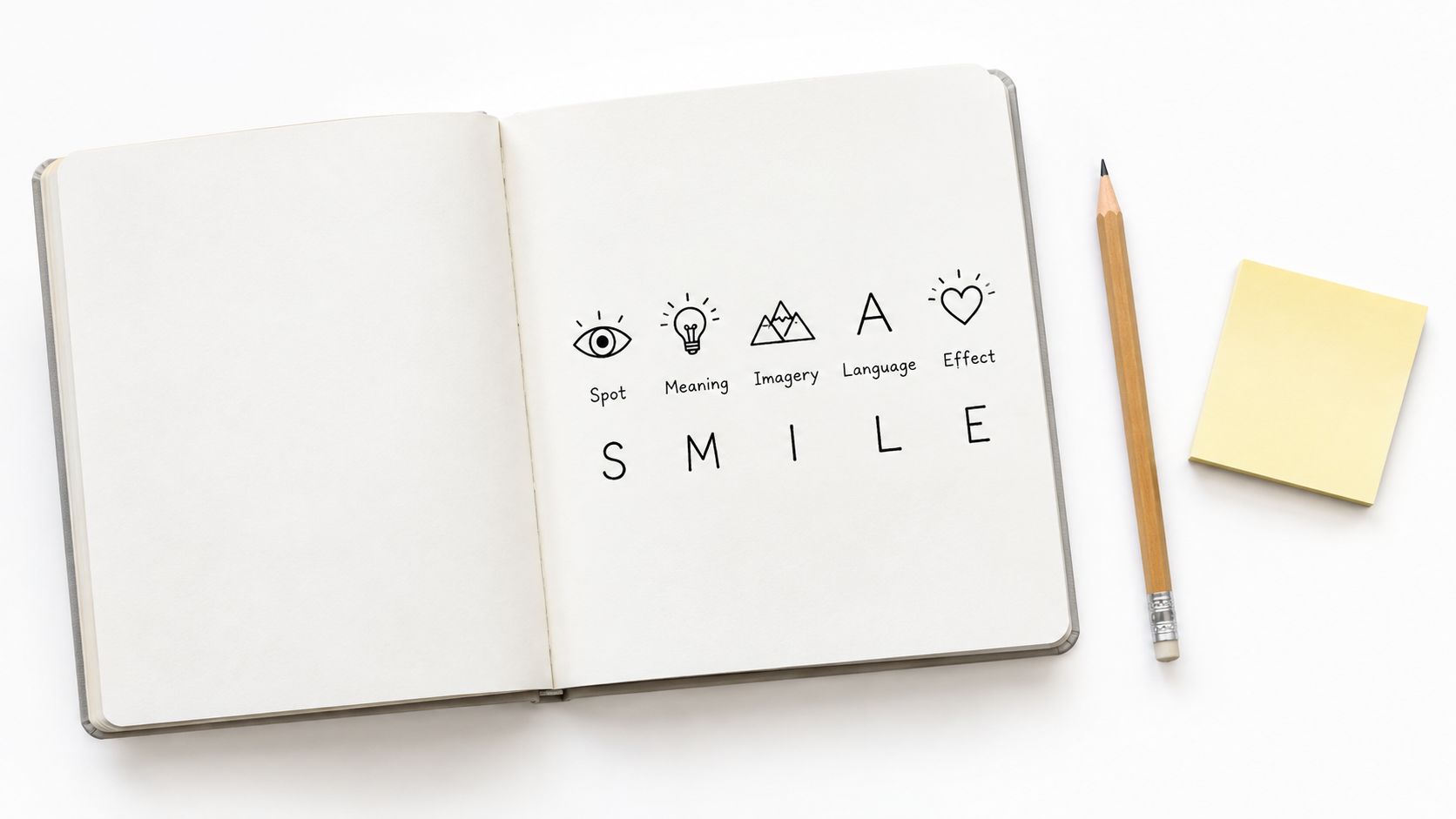
The SMILE framework gives you a controlled route through an unfamiliar poem: Spot, Meaning, Imagery, Language, Effect. Use it as a sequence, not a checklist of techniques. It moves your first reading from orientation to a small number of defensible analytical points.
Spot the situation first. Identify who is speaking, what is happening, where the poem seems to be set, and whether the speaker's position changes. Then express the likely meaning in plain terms. If the speaker is remembering someone, watching an event, or responding to a place, begin there before proposing a wider theme.
Choose the most striking imagery, especially pictures that are unusual, repeated, or emotionally charged. Then examine language closely. A verb, adjective, pronoun, sound pattern, or comparison can provide stronger evidence than a long list of devices. Finish by explaining the effect: how the choice shapes the speaker's experience and the reader's understanding.
Practical rule: Write SMILE lightly at the top of your planning space, then give most of your attention to language and effect.
Naming “dark imagery” identifies a feature but does not explain its meaning. A sharper note would argue that “consumed” suggests an emotion taking control of the speaker, so sadness appears destructive rather than temporary. The technique label is only the handle. The interpretation is the point you can develop into a paragraph.
The Poetry Society's practical unseen-poetry guidance recommends reading first for gist, then considering the title, theme, tone, perspective, punctuation, stanza length, and line length. It also supports selecting a focused group of points instead of feature-spotting. For deeper theoretical grounding, this literary theory lesson sample shows how similar analytical moves apply beyond unseen poetry. MasteryMind's unseen poetry quizzes repeat this sequence under timed conditions.
2. Read the poem's structure as carefully as its words
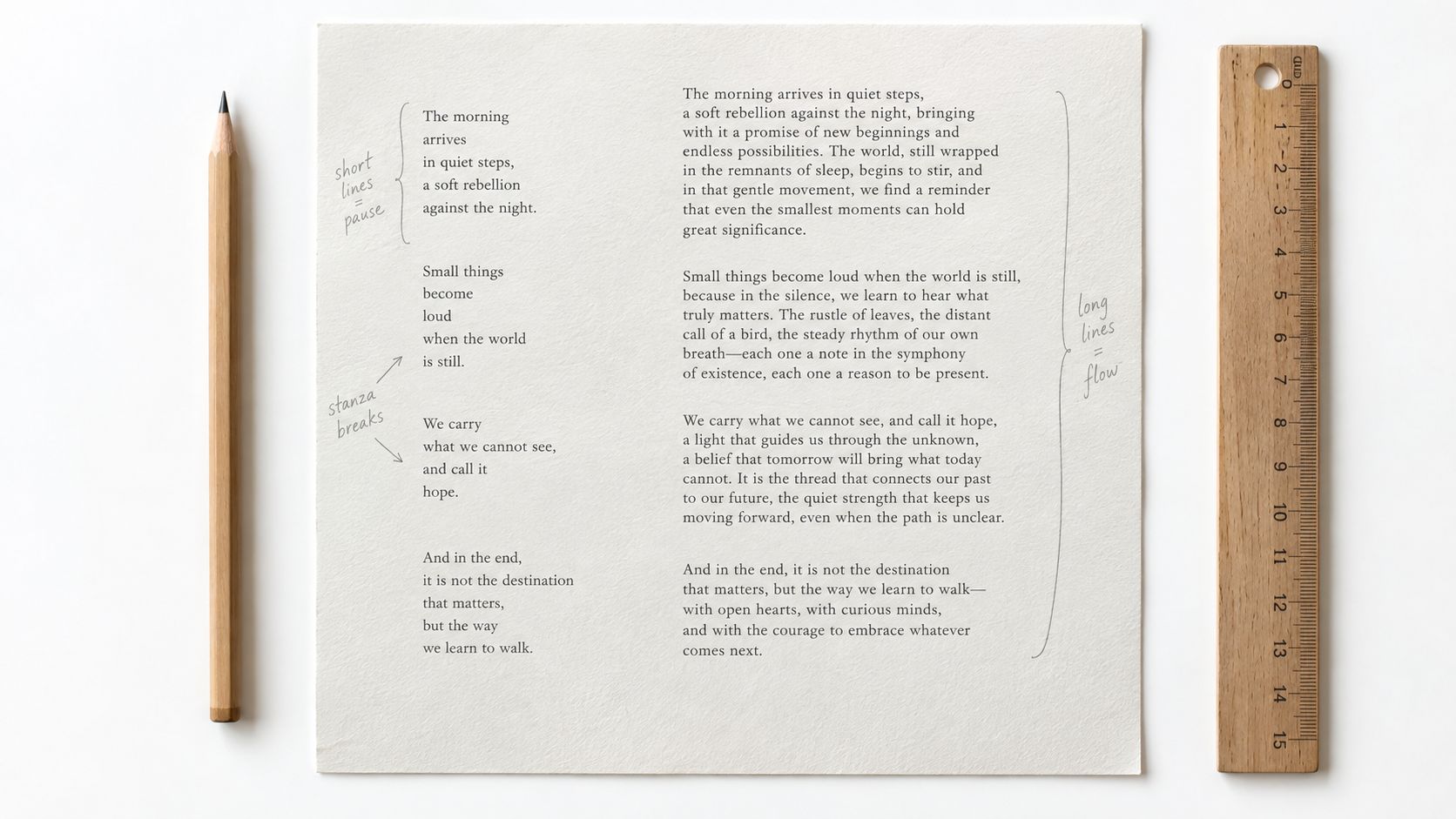
A poem's shape can reveal an argument before you've fully understood every line. Look at the form, stanza pattern, line length, punctuation, rhyme, rhythm, enjambment, and caesura. These choices may reinforce the speaker's feelings, create a change in pace, or make the ending feel controlled, sudden, or unresolved.
A short, abrupt line might mirror panic or hesitation. A long flowing sentence could suggest excitement, certainty, or thoughts that the speaker can't contain. Enjambment may carry an idea forward, while a full stop or mid-line pause can interrupt that movement. The useful question isn't “What technique can I name?” It's “Why has the poet shaped the poem this way at this moment?”
Track movement, not isolated features
Suppose a poem begins with regular stanzas and then breaks into single lines. You could argue that the change reflects a speaker's growing loss of control. A sonnet that disrupts its expected pattern might similarly present emotional conflict, but only if the disruption connects to the poem's meaning.
The ending deserves special attention. A final image may confirm the speaker's earlier attitude, expose a contradiction, or leave the reader with a more uncertain interpretation. Structure-first reading is a useful response to the common habit of listing metaphors while ignoring shifts, endings, and sound. The Cognito guidance on GCSE unseen poetry also stresses that students should follow what changes across a poem rather than merely collect devices.
When revising, highlight enjambment and caesura in different colours, then write a sentence about the pattern you notice. MasteryMind poetry analysis tasks can help you practise connecting form to meaning, but you can do the same with any printed poem and a clear question.
This short visual explanation can help you hear how structure and sound affect a reading:
3. Zoom in on individual words
Close reading begins when you stop treating a line as a single block of meaning. Choose a word or short phrase and ask why the poet selected it instead of an ordinary alternative. This is especially useful when a word carries several possible connotations.
“Old” tells you that something has existed for a long time. “Corroded” suggests damage, chemical decay, and a surface being eaten away. If a speaker describes a memory as “corroded”, the image may imply that time has not merely passed. It may have actively changed or weakened what the speaker remembers.
The same principle applies to tone. Saying that a poem has a sad tone is broad. A more precise reading might argue that repeated words such as “hollow” and “empty” create emotional numbness, which feels more disturbing than direct expressions of grief. The analysis becomes convincing because it identifies the exact evidence and explains the particular quality of the emotion.
Use the alternative-word test
For each important word, ask:
- Connotations: What feelings or associations does the word carry?
- Context: What does it mean in this line and in the wider poem?
- Alternatives: What would change if the poet had chosen a different word?
- Sound: Does the word's sound slow, sharpen, soften, or disturb the line?
You don't need to analyse every word. Select a small number and develop them properly. A micro-analysis might read: “The verb ‘consumed’ suggests that the speaker's emotion is overpowering them, so the experience seems destructive and involuntary rather than painful.”
Keep a vocabulary journal of words that create strong effects in poems you study. Don't memorise them as quotations for an unseen exam. Use them to train your attention, so unusual choices stand out more quickly. MasteryMind feedback can also show whether your explanation has moved beyond naming a technique into evidence-based reasoning.
4. Explain the reader's response
Technique spotting can make an answer look busy without making it analytical. “The poet uses repetition” tells the examiner what happens, but it doesn't explain what repetition achieves. Continue the sentence by linking the pattern to the speaker, the reader, or the poem's larger idea.
For example, “The repetition of ‘never’ emphasises finality, which could make the reader feel that the speaker is trapped by an irreversible decision.” The modal verb “could” signals interpretation rather than pretending that every reader must respond identically.
Turn labels into explanations
Compare these two comments:
“The poet uses a metaphor of drowning.”
“By comparing emotional pain to drowning, the poet makes the feeling physical and immediate. The reader may sense panic and helplessness, so the speaker's distress seems impossible to escape.”
The second comment identifies the method, explains the image, and considers its impact. It also avoids claiming that a response is guaranteed. That balance matters because different readers may notice different possibilities, but each interpretation still needs support from the poem.
A tone analysis works in the same way. “The tone is angry” is undeveloped. “Aggressive verbs such as ‘smash’ and ‘shatter’, alongside exclamation marks, create a confrontational tone. The speaker might be challenging the reader to face their rage rather than inviting quiet sympathy” gives the judgement a textual basis.
After naming a method, try completing the phrase “which means the reader…”. If the sentence sounds mechanical, read it aloud and revise it. MasteryMind's instant feedback is designed to support this movement from identification to explanation, but you can practise independently by underlining every sentence in which you explain why a choice matters.
5. Compare poems while you analyse them
A comparison becomes much stronger when you notice relationships between poems before you start writing. Read the poems side by side, even if the comparison is brief, and mark shared images, contrasting tones, similar structural choices, and different endings. This prevents the common problem of writing a complete response on one poem and adding a rushed comparison at the end.
Consider water imagery. Poem A might use the sea to suggest freedom, movement, and release, while Poem B uses water to suggest drowning and loss of control. Both poets have chosen the same broad image, but the different effects reveal contrasting attitudes towards nature or emotional escape.
The same method works with speakers. Two speakers may both experience isolation, yet one chooses solitude and finds peace while the other is excluded and feels pain. The comparison should explain the difference, not just announce it.
Build a comparison around writer's choices
Before writing, make a quick mental or written Venn diagram. Look for:
- Shared methods: Do both poets use natural imagery, repetition, or a shift in tone?
- Different effects: Does one image comfort while the other threatens?
- Structural movement: Does one poem end with acceptance while the other ends in uncertainty?
- Speaker and perspective: Are the situations similar but the attitudes different?
Use phrases such as “whereas,” “in contrast,” “similarly,” “unlike,” and “both, yet.” Don't force an equal number of similarities and differences. Follow the strongest relationship between the texts.
For AQA, the first unseen-poem response carries 24 marks, while the comparison carries 8 marks, with the published allocation showing that the comparison focuses on AO2. The AQA unseen poetry sample mark scheme supports a practical approach: keep the first answer balanced between argument and method, then make the shorter comparison precise and focused on writer's choices.
For targeted practice, use practice for contemporary poetry comparison. Write comparisons inside paragraphs rather than leaving all comparison to the final sentence.
6. Pause and challenge your interpretation
A confident interpretation isn't always a single, fixed claim. Poetry can leave room for tension, irony, or uncertainty. Once you've formed an argument, pause and ask whether another reading could also fit the evidence.
You might argue that a poem celebrates nature because its imagery is vivid and beautiful. A counterargument could suggest that the beauty is ironic, showing a speaker who describes nature carefully while remaining emotionally disconnected from it. You don't have to abandon the first reading. You need to test it against the poem.
Keep the alternative controlled
Counterargument works best when it appears at a point where the poem is particularly complex. For example:
“Although the speaker's precise details could suggest reliability, the emotional contradictions in the poem may make them psychologically unreliable. The facts seem accurate, but their interpretation of those facts remains unstable.”
That paragraph doesn't drift into “some people might think” language. It makes a clear alternative, identifies the evidence that supports it, and returns to a reasoned judgement.
At GCSE, one carefully chosen alternative reading can sharpen a developed paragraph. At A-Level, it can help demonstrate evaluation and critical independence, but it should never replace close analysis. The poem remains the authority. A counterargument without textual evidence is only a possibility, not a convincing interpretation.
MasteryMind feedback can help you identify where an alternative reading adds value and where it becomes padding. In revision, circle one sentence in your paragraph that makes your main claim, then add a brief “however” sentence only if the poem contains evidence that complicates it.
7. Use context only when the poem earns it
Context can deepen an unseen-poetry reading, but it shouldn't become a detached history paragraph. Start with the words on the page. If you know something relevant about the poem's time, place, or author, connect that knowledge immediately to a specific image, tone, or structural choice.
A poem about colonialism may invite a different reading when the poet writes from a formerly colonised nation. War imagery may carry a particular force if the poem was written during wartime rather than long afterwards. A poem about gender roles may become more layered when connected to the social debates surrounding the writer's period.
The weak version says, “This poem was written in 1950,” then moves on without explaining why the date matters. The stronger version says that, in the context of a society shaped by a particular conflict or movement, the image of destruction may suggest more than personal sadness. The context must change or deepen your interpretation of the line.
Make the evidence do the work
Use a simple test before adding context:
- Relevance: Does it explain a specific word, image, voice, or form?
- Accuracy: Are you confident that the information is correct?
- Connection: Have you shown how it affects the meaning?
- Proportion: Is it supporting analysis rather than replacing it?
GCSE students can work with broad historical ideas such as war, industrialisation, social change, or contemporary life. A-Level learners may explore more specific movements or biographical circumstances, but only when those details illuminate the text.
MasteryMind's subjects covered by MasteryMind include resources that can help you keep revision connected to curriculum demands. For an unseen poem, however, context is usually secondary to the evidence in front of you. If you don't know relevant background, don't invent it. Build the answer from language, form, structure, and perspective instead.
8. Revisit one poem through different lenses
Revision becomes more useful when you return to the same poem with a new purpose. On the first pass, use SMILE to establish the situation and main movement. Later, zoom in on individual words, then study the form and structure, and finally compare the poem with another text.
A simple cycle could look like this:
- First pass: Identify the speaker, situation, tone, imagery, and main shift.
- Second pass: Select the most important words and test alternative choices.
- Third pass: Track stanzas, punctuation, line movement, sound, and the ending.
- Fourth pass: Compare the poem's methods and ideas with another poem.
You'll often notice something new because your question has changed. A poem that first appears to describe peaceful nature may later reveal tension through its final line or through a shift from flowing enjambment to abrupt punctuation.
The aim isn't to memorise one poem. It's to practise the moves you'll need when the poem is genuinely unfamiliar.
Keep a revision portfolio organised by the lens you used. Record the evidence you noticed, the interpretation you formed, and the question you still have. When you revisit the poem, add a different analytical angle instead of copying the earlier paragraph.
MasteryMind's Exam Practice for GCSE can fit into this routine when you need timed questions and examiner-style guidance. You can also vary the conditions of each practice session. Start untimed while learning the method, then introduce shorter planning periods and eventually write under the conditions of your exam board. The purpose is deliberate practice, not rushing before you understand what a strong paragraph does.
9. Build speed with mixed practice and past papers
Repeated analysis only improves exam performance when you practise transferring the method to new poems. Keep older poems in your revision mix, but add unfamiliar material so you learn to decode rather than rely on recognition. A useful session might begin with a fast SMILE scan, move to one developed paragraph, and finish with a short self-review.
Your review should ask better questions than “What mark did I get?” Check whether your topic sentence answers the question, whether each quotation is precise, and whether your explanation connects a method to meaning. Look for the moment where the paragraph stops analysing and starts retelling.
The exam mechanics make this focus important. In the Pearson York Notes AQA study guide, the first question is shown as 12 marks for AO1 and 12 marks for AO2, while the comparison question carries 8 marks for AO2. That means a response needs both a personal, supported argument and detailed analysis of language, form, and structure. A long introduction or plot summary can't replace either one.
For OCR learners, the exam-board approach is different. OCR places unseen poetry in Paper 2, describes it as worth 25% of the total marks, and suggests around 45 minutes for the task in its guidance, available through MasteryMind's OCR unseen poetry exam advice. Check your own specification before applying timing advice, then practise dividing your attention between reading, planning, writing, and checking.
Use GCSE Past Papers to meet real question wording and mark-scheme expectations. After each attempt, improve one paragraph rather than rewriting everything. That creates a clear feedback loop: identify the missed move, practise it, and test it again on a different poem.
Unseen Poetry: 9-Point Comparison
| Technique | Implementation 🔄 (complexity) | Resources & Time 💡 | Expected outcomes ⭐ / Impact 📊 | Ideal use cases | Key advantages ⚡ |
|---|---|---|---|---|---|
| The SMILE Framework: Spot, Meaning, Imagery, Language, Effect | Low–Medium 🔄, simple five-step process | Low, checklist, brief practice to internalise | ⭐⭐, reliable coverage of AO2/AO3; 📊 consistent exam structure | Timed unseen poems; quick scaffolding under pressure | Clear roadmap; reduces omissions; repeatable ⚡ |
| Form and Structure Analysis: How the poem is built | Medium–High 🔄, requires technical knowledge | Medium, study poetic forms and practise scansion | ⭐⭐⭐, high reward for distinctive insights; 📊 differentiates answers | A‑Level and high‑grade GCSE; poems with pronounced form choices | Reveals why poem "feels" a way; academic credibility ⭐ |
| Word‑Level Dissection: Close reading of word choices | High 🔄, deep lexical work, precise justification | Medium–High, vocabulary building and timed practice | ⭐⭐⭐, top-band AO2 work; 📊 shows maturity and precision | A‑Level, comparative tasks, high‑mark responses | Adds nuance; separates top answers; strong textual evidence ⭐ |
| The Reader Response Technique: Explain the effect, not just the technique | Medium 🔄, requires interpretive confidence | Low–Medium, practice linking technique → reader effect | ⭐⭐, strong AO3 performance; 📊 improves persuasive evaluation | Any exam answer where AO3/interpretation is rewarded | Turns technique into impact; makes analysis engaging ⚡ |
| Comparative Annotation: Mark differences and similarities | Medium–High 🔄, mental juggling of two texts | Medium, side‑by‑side annotation practice | ⭐⭐, integrated comparative essays score higher; 📊 clearer contrasts | Comparative questions (two unseen or unseen vs studied) | Encourages integrated comparison; prevents separate‑essay pitfall ⚡ |
| The Counterargument Pause: Challenge your own interpretation | Medium 🔄, needs concise, confident phrasing | Low, brief practice adding one counterpoint per paragraph | ⭐, elevates evaluation; 📊 signals critical thinking | A‑Level and top‑band GCSE conclusions and complex claims | Demonstrates sophistication; hedges risky readings ⭐ |
| Contextual Connections: Link poem to time/place/author | Medium 🔄, research + careful linking required | Medium–High, background reading; selective use in exam | ⭐⭐, strengthens AO3 when relevant; 📊 deepens interpretation | A‑Level, poems with clear historical/biographical signals | Adds depth and authority when directly linked to text ⭐ |
| The Revision Cycle: Repeatedly analyse same poem in different ways | Medium 🔄, planning and spaced practice needed | High, scheduled revisits over weeks; portfolio tracking | ⭐⭐, builds automaticity; 📊 improves speed and depth on exam day | Long‑term revision programs; exam preparation periods | Deepens learning via spaced repetition; reduces exam anxiety ⚡ |
Make your next analysis faster and sharper
Unseen poetry becomes less intimidating when you replace the search for a perfect interpretation with a reliable sequence. Begin with a quick SMILE scan. Work out what's happening, identify the poem's main movement, and notice the title, tone, imagery, and ending. Then select a small number of precise words instead of trying to mention every device.
Your paragraph should keep moving from evidence to method, then from method to meaning and reader response. If the poem changes shape, explain why that change matters. If the ending contradicts the opening, make that tension part of your argument. If you compare poems, connect them through writer's choices rather than writing two separate mini-essays.
AQA's live June 2024 mark scheme gives a useful reminder of the first-question structure: Section C, Question 27, is marked out of 24, with 12 marks for AO1 and 12 marks for AO2, as shown in the published June 2024 mark scheme. Use that knowledge to check your balance. A clear interpretation without method analysis is incomplete, and a list of techniques without an argument is equally limited.
Teachers can use these frameworks as scaffolding, not scripts. The strongest classroom routine keeps students anchored to the actual poem, asks them to justify each claim, and rejects forced context or decorative terminology. Students should leave feedback sessions knowing what to do next, whether that means selecting shorter evidence, explaining a structural shift, or making the reader effect more precise. If you're creating revision resources, this lyric publishing advice for artists can also help you think about how word choice and structure shape a written voice, although exam analysis must always return to the poem and the question.
Take one unseen poem now and complete a timed response. Improve one paragraph using the method-to-effect approach, then revisit the same poem later through a different lens, such as structure, sound, or word choice. MasteryMind can provide examiner-style guidance, AO-focused feedback, and spaced review to help make that routine consistent, but your most important step is to practise making a precise claim and proving it from the text.
MasteryMind offers UK curriculum-aligned revision for GCSE and A-Level learners, including unseen poetry practice, adaptive questions, examiner-style essay feedback, and spaced review. Visit MasteryMind to practise turning close reading into clearer, more exam-ready answers.
Ready to master this topic?
Practise with quizzes, blurt exercises and exam questions on MasteryMind.
7 days Premium · Then free forever · No card, no charge