AQA · GCSE · Art and Design
Progression
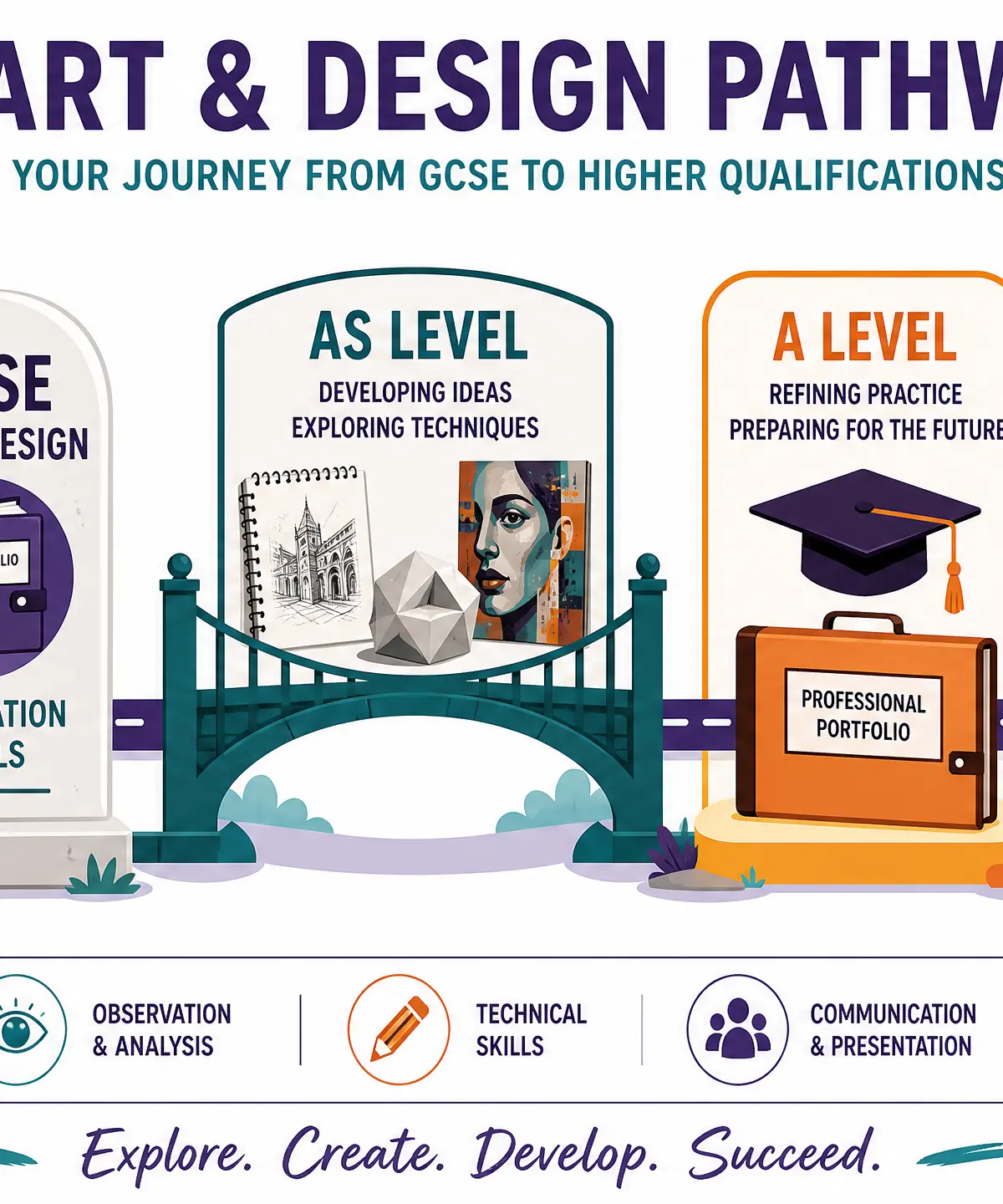
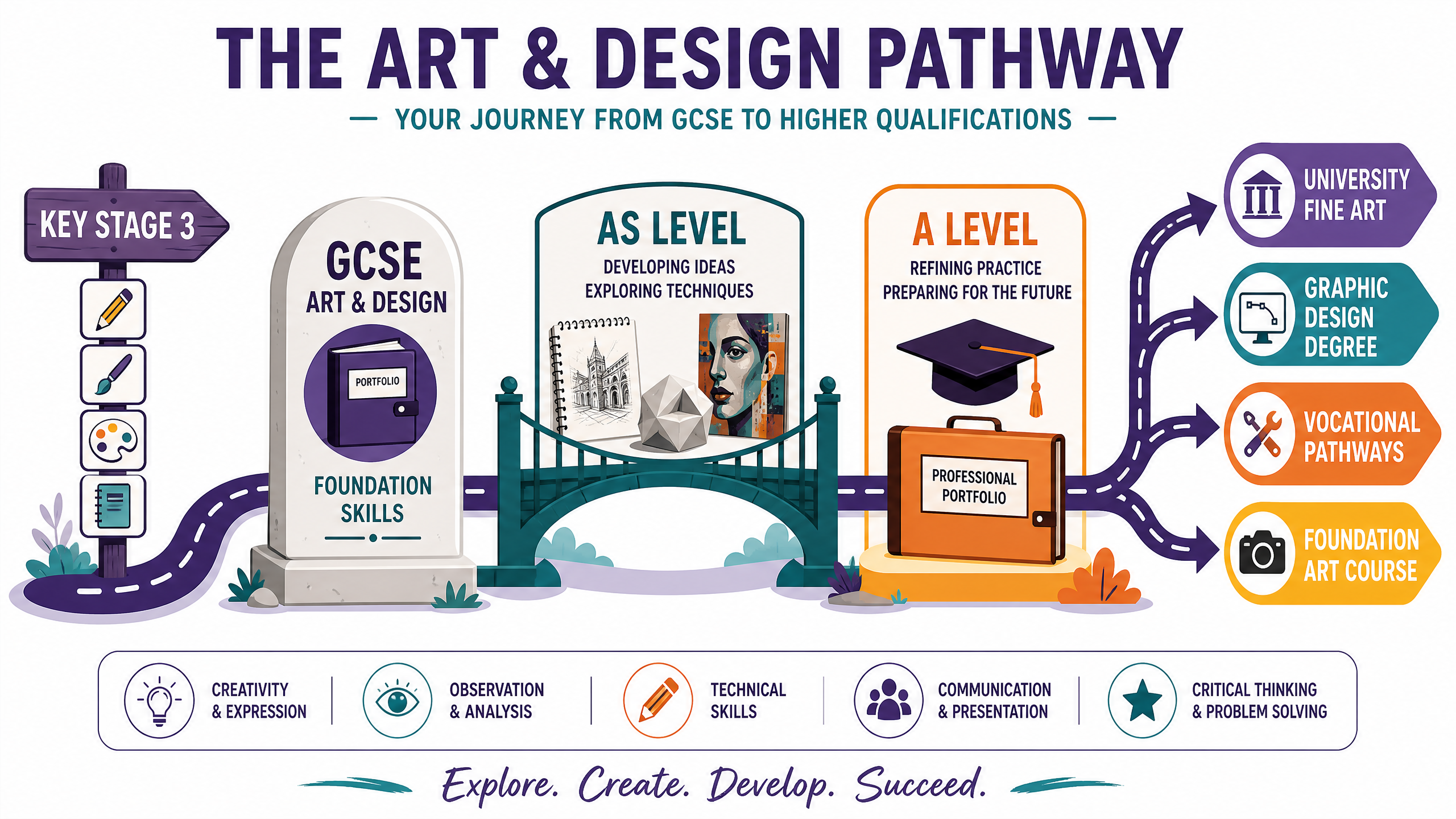
This topic covers how the GCSE Art and Design course serves as a bridge to higher education, including A-levels and vocational pathways. It explains how Assessment Objectives, practical skills, and portfolio development align with advanced study, ensuring a smooth transition for creative students.
- 6 min read
- 3 worked examples
- 3 practice questions
- 6 key terms
Study Notes
Overview
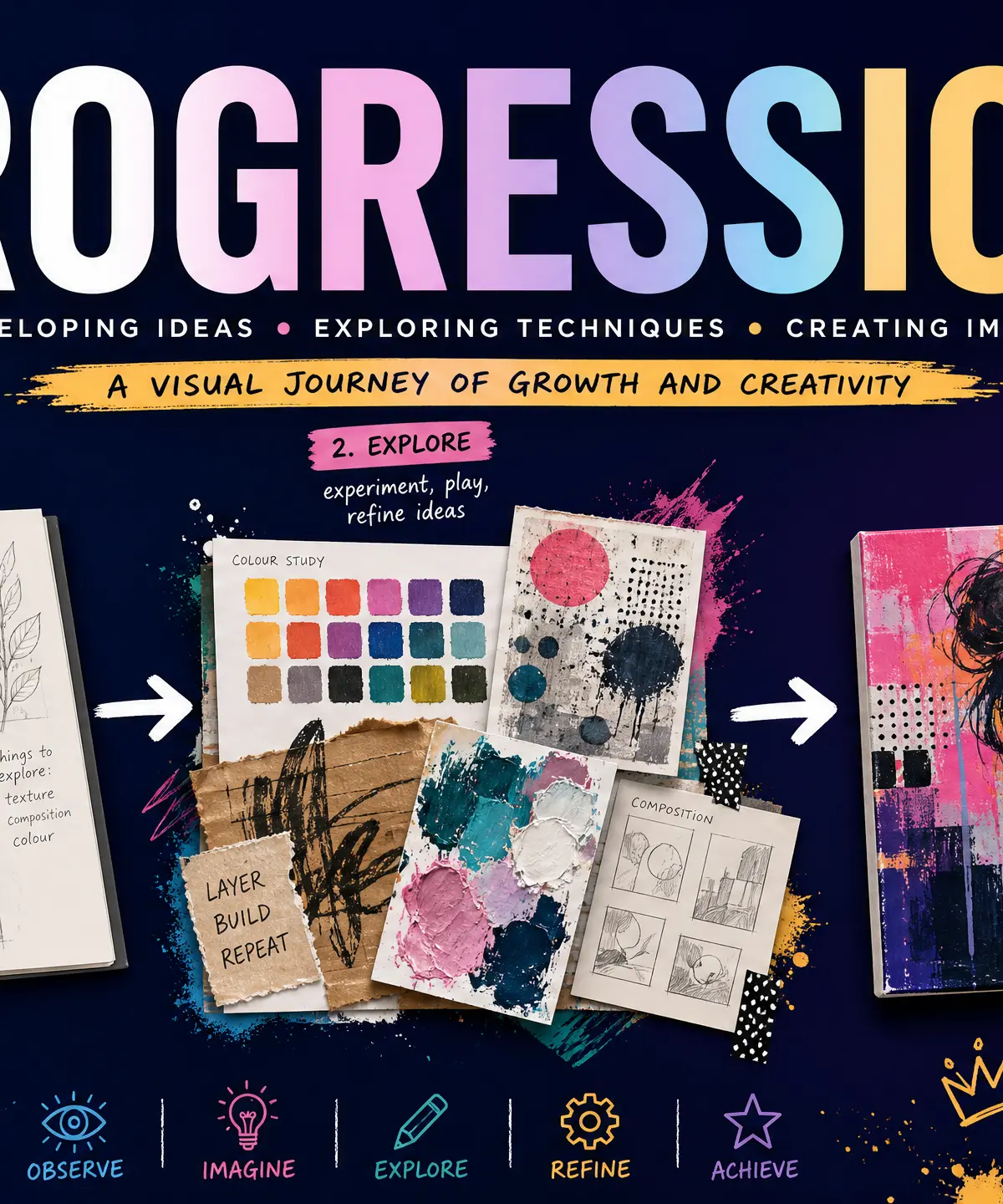
The 'Progression' topic within GCSE Art and Design outlines how your current studies serve as a crucial bridge between Key Stage 3 and further education. Whether you are aiming for AS and A-level study, vocational pathways like a BTEC, or a Foundation Art course, the structure of your GCSE is designed to align with these higher-level qualifications. Understanding this progression helps you see the long-term value of the skills you are developing now, from annotating sketchbooks to refining final pieces.
Key Knowledge & Theory
Core Concepts
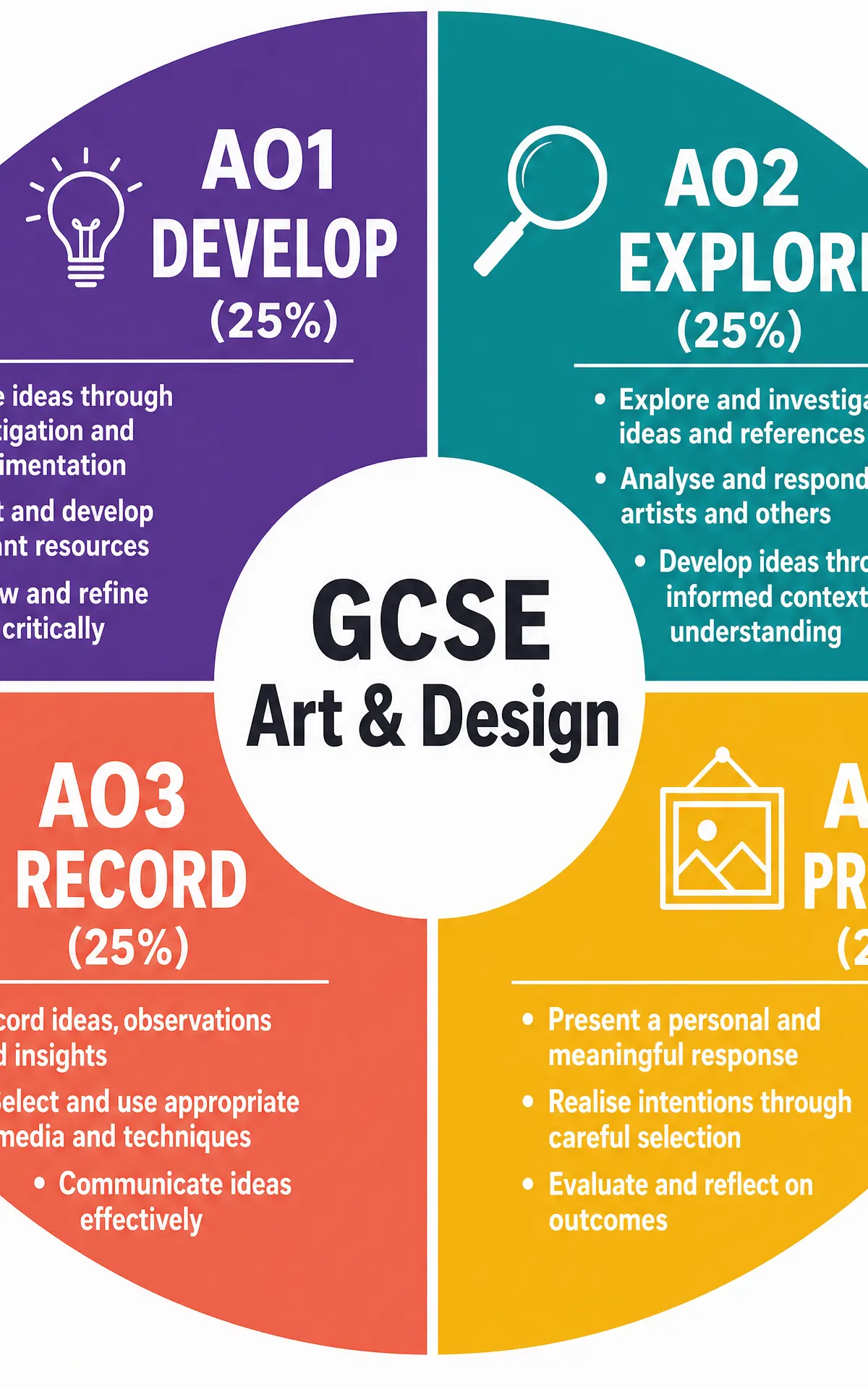
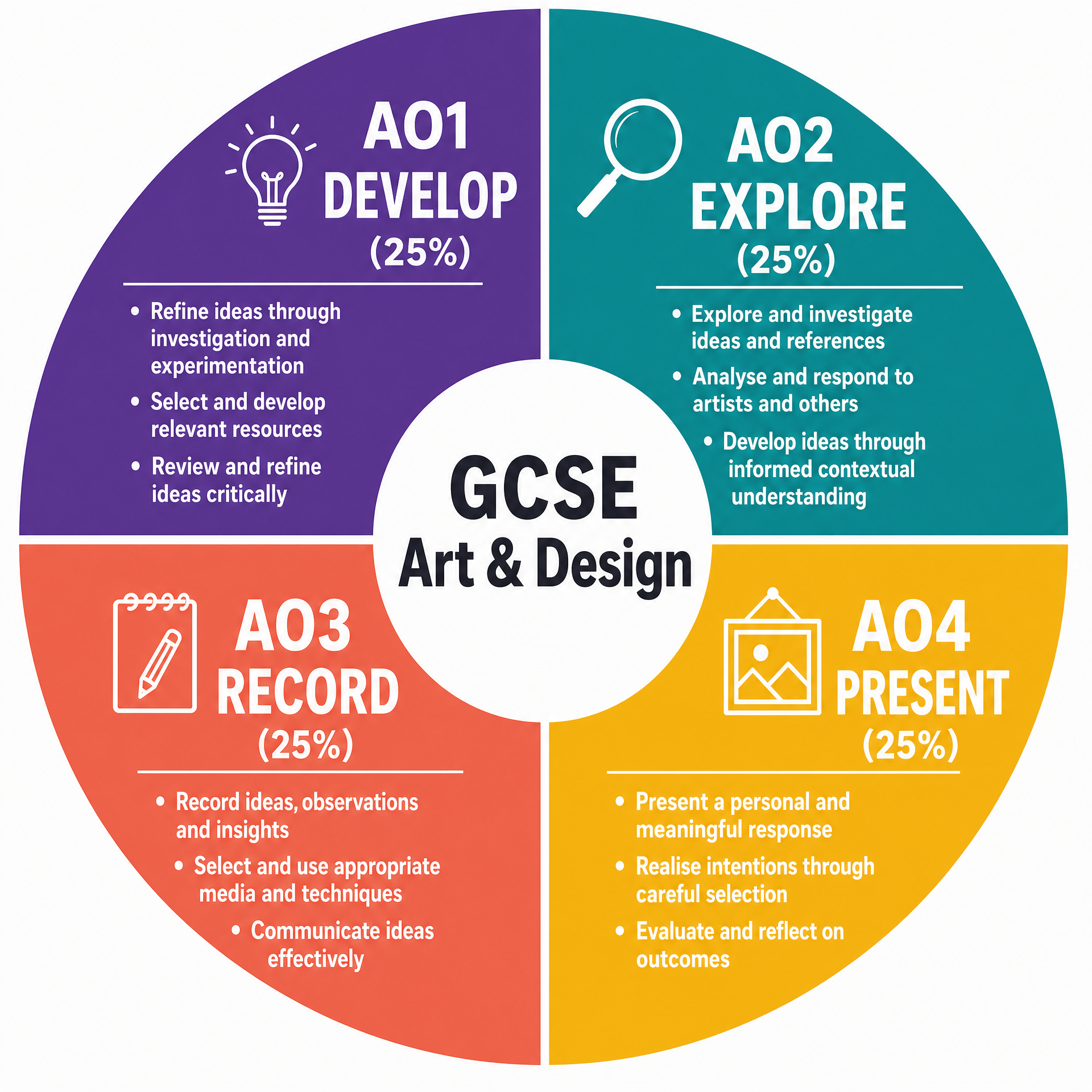
The foundation of your progression in Art and Design rests on the four Assessment Objectives (AOs). These are not just criteria for your GCSE; they are the identical pillars used at A-level. Understanding them deeply now will prepare you for future creative studies:
- AO1: Develop (25%) - Refining ideas through sustained investigation and experimentation. This involves critical understanding of sources.
- AO2: Explore (25%) - Selecting and experimenting with appropriate media, materials, techniques, and processes.
- AO3: Record (25%) - Recording ideas, observations, and insights relevant to intentions as work progresses.
- AO4: Present (25%) - Presenting a personal and meaningful response that realises intentions and demonstrates understanding of visual language.
Key Practitioners and Influences
While Art and Design covers countless artists, understanding how to study them is key to progression. Higher-level study requires deep, analytical engagement rather than superficial copying.
| Approach | Description | GCSE Level | A-Level Progression |
|---|---|---|---|
| Contextual Analysis | Understanding the 'why' behind an artwork. | Identifying the artist's basic influences and style. | Deeply analyzing socio-political context and critical theory. |
| Technical Deconstruction | Breaking down how a piece was made. | Trying out the artist's medium or technique. | Mastering the technique and adapting it for a personal, original outcome. |
| Conceptual Response | Reacting to the ideas within the work. | Creating a piece inspired by the artist's theme. | Developing a highly personal, sustained line of enquiry sparked by the artist's philosophy. |
Technical Vocabulary
To progress effectively, you must use the language of a practitioner. Examiners reward the accurate use of specialist terminology.
- Composition: The arrangement of visual elements within an artwork.
- Chiaroscuro: The use of strong contrasts between light and dark.
- Impasto: A technique where paint is laid on an area of the surface very thickly.
- Juxtaposition: Placing two or more things side-by-side to create a contrasting effect.
- Visual Hierarchy: The arrangement of elements in a way that implies importance.
Practical Skills
Techniques & Processes
Progression is visible in how you handle materials. It is the journey from initial, perhaps clumsy, experiments to confident, refined execution.
- Initial Exploration: Trying a new medium (e.g., lino printing) to understand its basic properties. Marks are awarded for taking risks, even if the outcome isn't perfect.
- Sustained Investigation: Repeatedly using the medium, testing different variables (e.g., varying ink consistency, different paper types).
- Refinement: Selecting the most successful approach and applying it with control and intention to communicate a specific idea.
Materials & Equipment
Understanding the appropriate use, safety, and creative potential of materials is essential. At higher levels, you are expected to select materials independently that best suit your conceptual intentions, rather than just using what is provided.
Portfolio/Coursework Guidance
Assessment Criteria
Your portfolio (Component 1) is worth 60% of your GCSE. Examiners look for a cohesive journey. A disjointed sketchbook with random, unconnected pages will score poorly. They want to see a clear narrative: Inspiration → Research → Experimentation → Refinement → Final Outcome.
Building a Strong Portfolio
- Show the Process: Include the mistakes and the 'happy accidents'. Explain why an experiment failed and what you learned from it. This is high-level AO1 and AO2 work.
- Critical Annotation: Do not just label what you have drawn. Explain why you drew it, how it connects to your artist research, and what you will do next based on this outcome.
Exam Component
Practical Exam Preparation (Externally Set Assignment)
Component 2 is the Externally Set Assignment (40%). You receive a starting point and have a preparatory period followed by a 10-hour sustained focus period.
- The Preparatory Period: Treat this exactly like a mini-portfolio. You must hit all four AOs before the 10-hour exam begins. The preparatory work is marked alongside the final piece.
- The 10-Hour Exam: This is for realising your intentions (AO4). You should not be doing new artist research or basic experimentation during this time. It is for executing the planned final outcome.
Audio Resource: Progression Podcast
Listen to our comprehensive 10-minute podcast episode on Progression, covering core concepts, exam tips, and a quick-fire recall quiz.

Visual Resources
2 diagrams and illustrations
Interactive Diagrams
1 interactive diagram to visualise key concepts
Conceptual Flow Outline
The interconnected flow of Assessment Objectives leading to progression.
Worked Examples
3 worked examples — open one to explore the question and available guidance.
Practice Questions
Test your understanding — click to reveal model answers
Identify the four Assessment Objectives in GCSE Art and Design.
Hint: Think of the acronym DERP.
Explain why it is important to include 'failed' experiments in your portfolio.
Hint: Consider what examiners are looking for in AO1 and AO2 regarding your creative journey.
Analyse how the skills developed during the GCSE Externally Set Assignment prepare a student for A-Level Art and Design.
Hint: Think about independence, time management, and the alignment of the AOs.