OCR · GCSE · Art and Design
Constructed Textiles
This guide provides a comprehensive overview of Constructed Textiles for OCR GCSE Art and Design. It covers core techniques, key practitioners, and portfolio development, with a strong focus on the assessment objectives to help candidates maximise their marks.
- 8 min read
- 3 worked examples
- 4 practice questions
- 6 key terms
Study Notes
Overview
Constructed Textiles is a specialist area within Art and Design that focuses on the creation of surfaces and forms from the ground up. Unlike other textile disciplines that might decorate an existing piece of cloth, constructed textiles is about the act of building the material itself. Candidates are expected to explore a range of technical processes, manipulate diverse materials, and develop a personal visual language informed by in-depth research. This field offers a rich opportunity to blend traditional craft with contemporary art, creating work that can be two-dimensional, sculptural, or even architectural in scale. Success in this component hinges on a candidate's ability to sustain a line of enquiry, moving from initial research and experimentation through to a resolved and personal final outcome.

Key Knowledge & Theory
Core Concepts
To excel, candidates must grasp the fundamental principles that underpin constructed textiles. This is not just about practical skill, but about understanding the 'why' behind the 'how'. The structural integrity of a piece is determined by the interplay of material properties, tension, and the chosen technique. For instance, a woven fabric's character is defined by the relationship between the warp (the threads held under tension) and the weft (the threads interlaced through the warp). The density of the warp, the thickness of the weft, and the weave structure (e.g., plain, twill, satin) are all variables that can be manipulated. Similarly, in knitting, the size of the needles and the yarn thickness determine the gauge, or stitch density, which affects the fabric's drape and elasticity. Felting relies on the unique microscopic scales of animal fibres, which lock together under heat, moisture, and agitation. Understanding these principles allows a candidate to make informed, intentional choices, which is a hallmark of high-level work.
Key Practitioners/Artists/Composers
| Name | Period/Style | Key Works | Relevance |
|---|---|---|---|
| Anni Albers | (1899-1994) Bauhaus | Black White Yellow (1926), On Weaving (1965) | A pioneer who elevated weaving from a craft to a fine art. Her work is a masterclass in geometric abstraction and the expressive potential of thread. Credit is given for analysing how she used structure and colour to create rhythm and depth. |
| Sheila Hicks | (1934-Present) Contemporary | The Evolving Tapestry, Pillar of Inquiry/Supple Column | Known for her monumental, vibrant installations and fearless use of colour and scale. She demonstrates how constructed textiles can interact with architectural space. Candidates can explore her use of unconventional materials and wrapping techniques. |
| Magdalena Abakanowicz | (1930-2017) Post-war/Contemporary | Abakans, Crowds | Famous for her large, coarse, three-dimensional woven forms known as Abakans. Her work is deeply personal and often relates to the human condition. She is an excellent reference for candidates exploring sculptural or installation-based outcomes. |
| Gunta Stölzl | (1897-1983) Bauhaus | Slit Tapestry Red/Green (1927/28) | As the only female master at the Bauhaus, she was instrumental in developing the weaving workshop. Her work is notable for its complex rhythms, colour theory, and technical innovation. |
Technical Vocabulary
Using precise terminology is critical for high-level annotation (AO3) and written analysis. Marks are awarded for the confident use of specialist language.
- Warp: The set of longitudinal threads held in tension on a loom.
- Weft: The thread that is drawn through and inserted over-and-under the warp.
- Heddle: A frame or wire with an eye through which a warp thread is passed on a loom to control its movement.
- Gauge: In knitting, the number of stitches and rows per inch; it determines the density of the fabric.
- Fibre: The basic, hair-like raw material used to make yarn (e.g., wool, cotton, acrylic).
- Yarn: A continuous length of interlocked fibres, used for weaving, knitting, or crocheting.
- Drape: The way a fabric hangs or falls under its own weight.
- Tensile Strength: The resistance of a material to breaking under tension.
Practical Skills
Techniques & Processes
Candidates must demonstrate proficiency in a range of construction techniques. It is vital to experiment with these processes to understand their unique qualities.
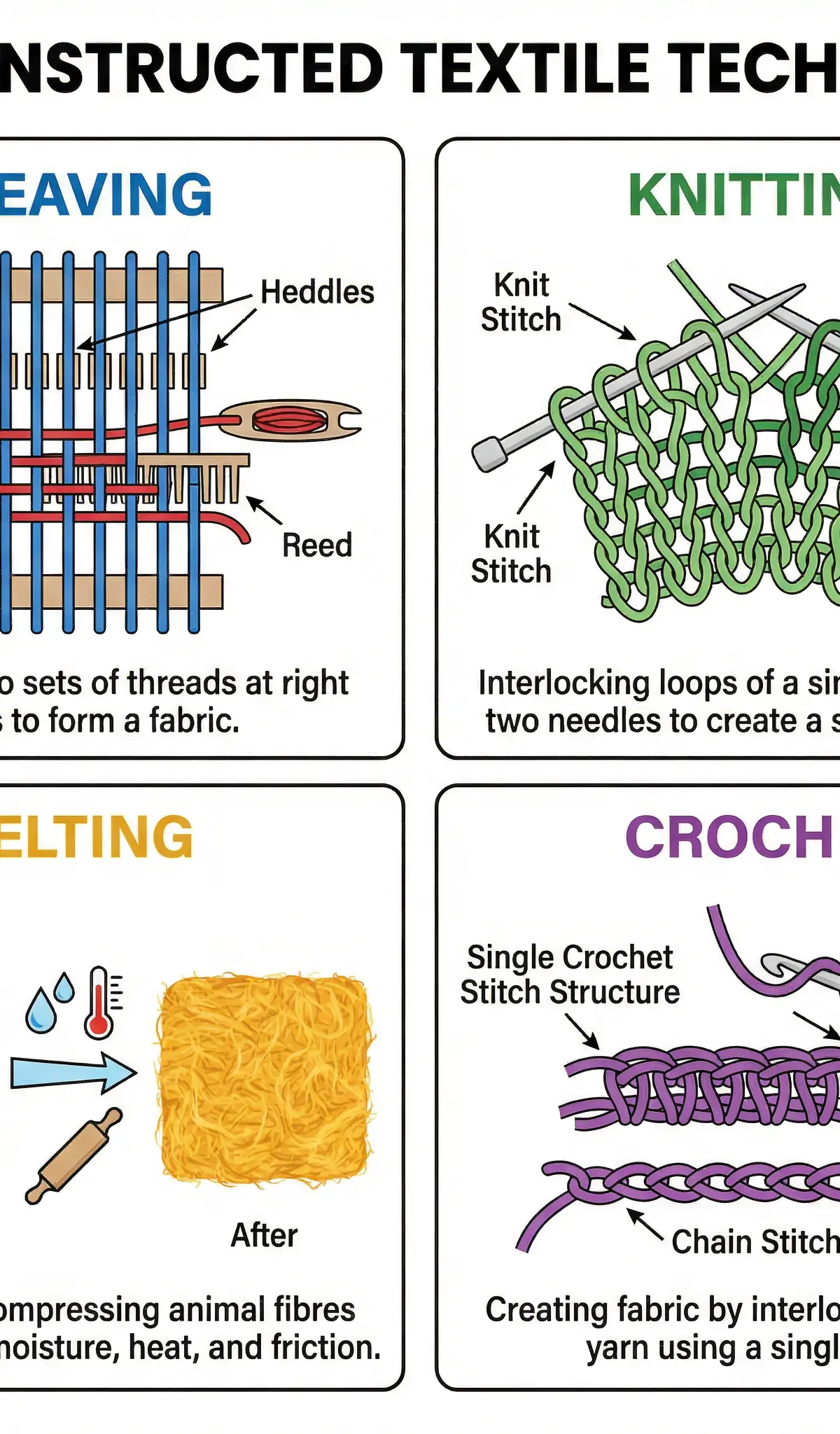
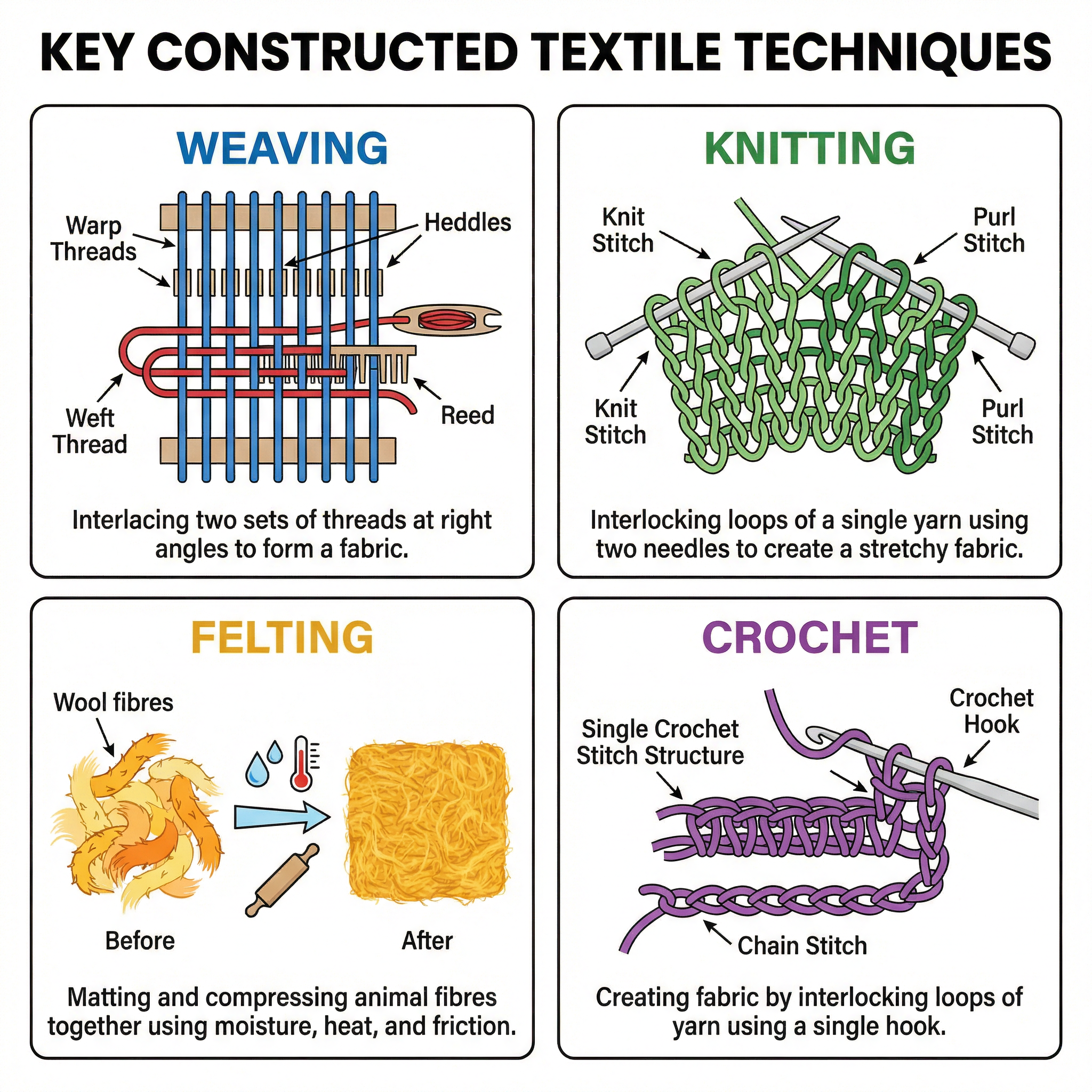
- Weaving: Start with a simple frame loom. Experiment by varying the tension of the warp and the thickness of the weft. Introduce unconventional materials like wire, plastic, or paper strips. Document how these changes affect the final fabric.
- Knitting: Master the basic knit and purl stitches. Explore how changing needle size affects the gauge and drape. Experiment with increasing and decreasing stitches to create shapes.
- Felting: Begin with wet felting using merino wool roving. Layer colours and experiment with adding other fibres like silk or bamboo for texture. For 3D work, explore needle felting to create sculptural forms.
- Crochet: Learn the basic chain stitch and single/double crochet. Crochet is excellent for creating 'freeform' or organic structures that can be difficult to achieve on a loom.
Materials & Equipment
An informed selection of materials is crucial for AO2. Your choices should be justified by the properties of the materials and how they relate to your artistic intentions.
- Fibres: Understand the difference between animal (wool, silk), plant (cotton, linen), and synthetic (acrylic, polyester) fibres. Wool is excellent for felting due to its scales, while cotton provides a strong, smooth yarn for weaving.
- Yarns: Explore different yarn weights (e.g., lace, DK, aran, chunky) and plys (the number of strands twisted together). A high-twist yarn will create a different texture to a loose, soft-spun yarn.
- Tools: Ensure you can use looms, knitting needles, crochet hooks, and felting needles safely and effectively. For weaving, a simple frame loom is sufficient for GCSE, but understanding the principles of a table loom can enhance your technical knowledge.
Portfolio/Coursework Guidance
Assessment Criteria
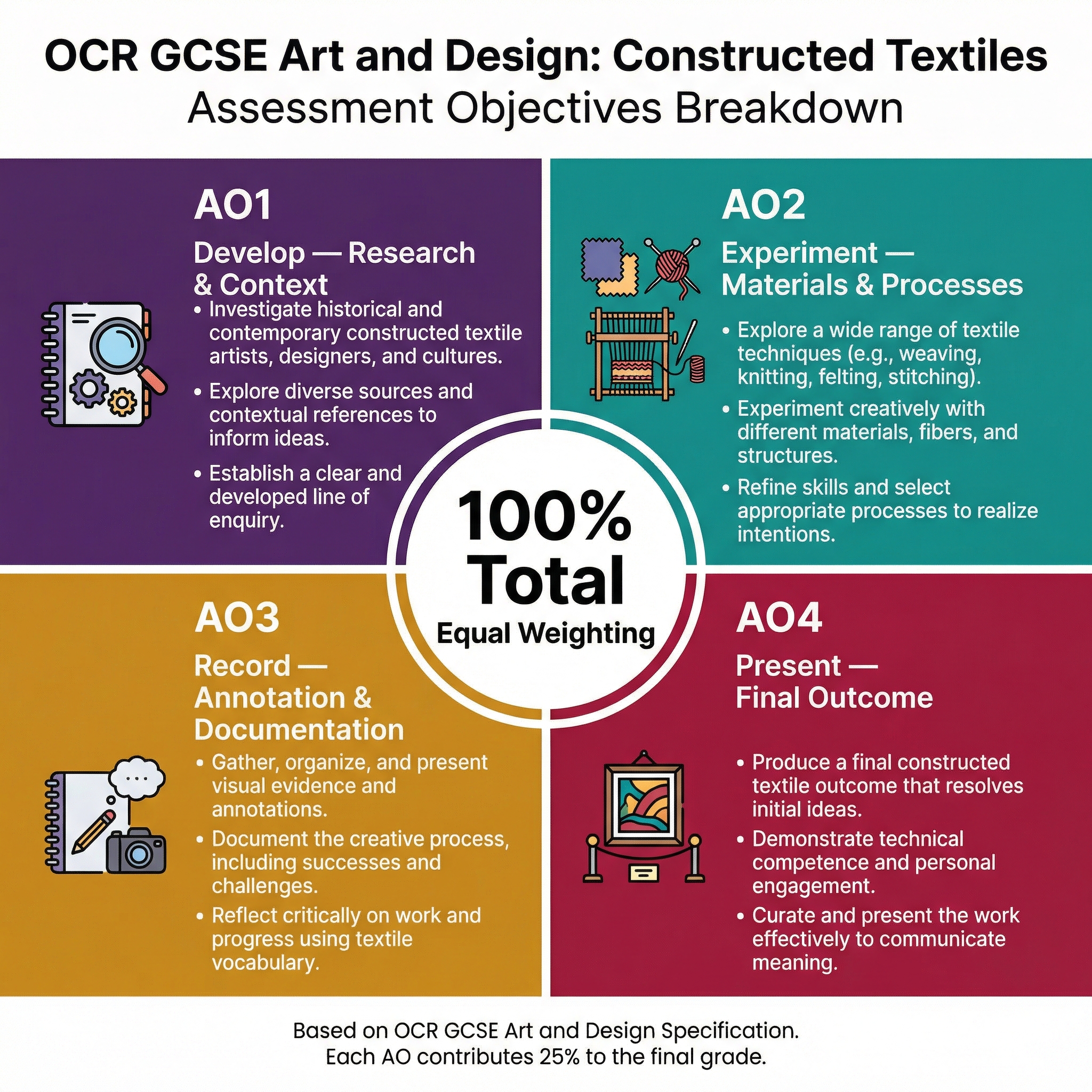
Your portfolio is marked against four equally weighted Assessment Objectives (AOs). You must provide evidence for all four in your project.
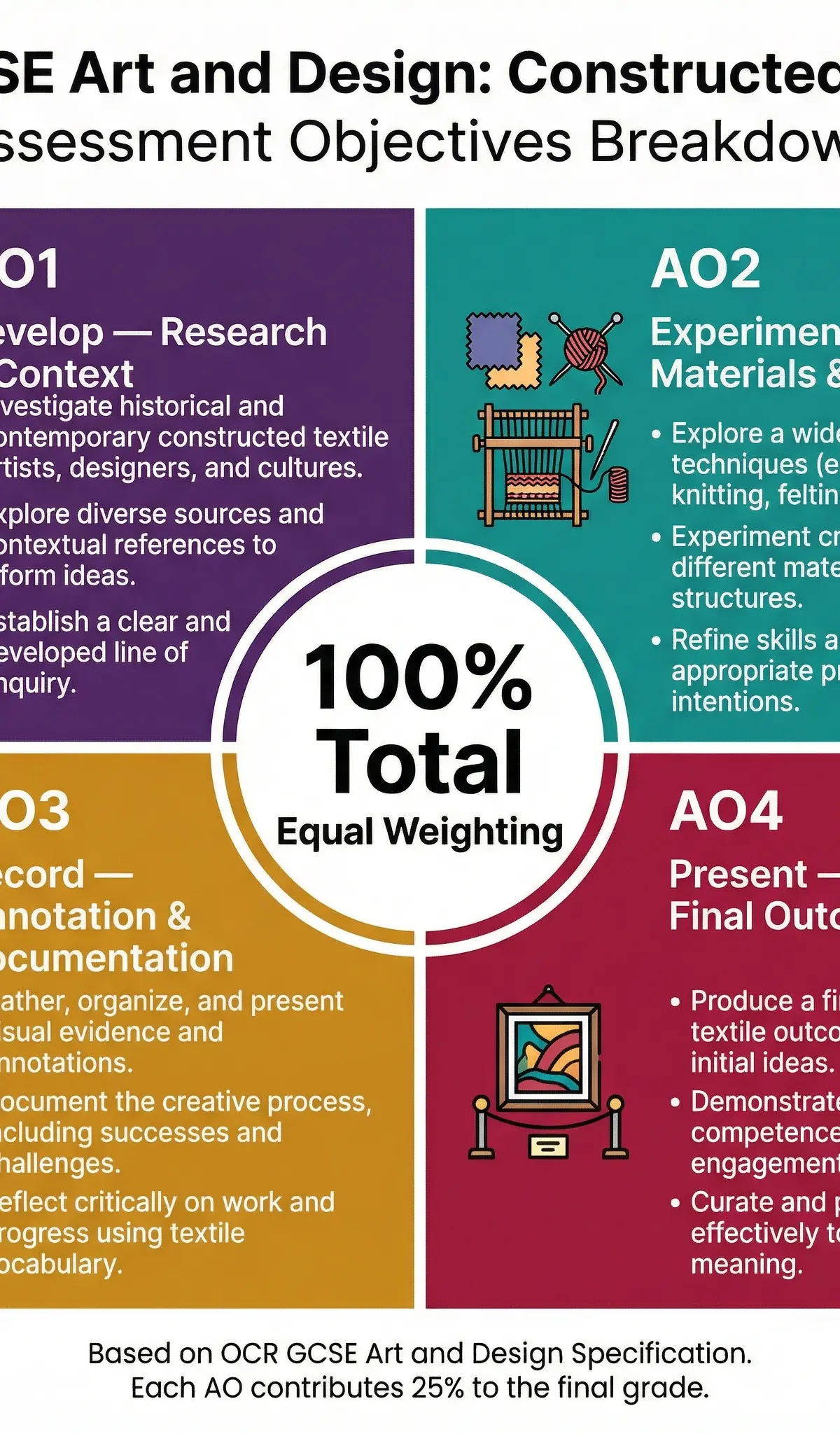
- AO1: Develop: Research artists, gather primary source imagery, and develop your ideas. Examiners look for a clear line of enquiry that is informed by your research.
- AO2: Experiment: Explore and refine your ideas through experimentation with media, materials, techniques, and processes. This is where your samples and test pieces are crucial.
- AO3: Record: Document your creative journey. This includes drawings, photographs, and, most importantly, detailed, critical annotations.
- AO4: Present: Create a personal and meaningful final outcome that successfully realises your intentions.
Building a Strong Portfolio
- Annotation is King: Every sample must be annotated. Explain what you did, why you did it, what the result was, and how it informs your next step. Use technical vocabulary.
- Show Your Thinking: Your sketchbook should be a visual diary of your thought process. Include mind maps, sketches, and written reflections. Don't be afraid to show mistakes; document what you learned from them.
- Quality over Quantity: A few well-documented, insightful experiments are worth more than a hundred meaningless samples. Each piece of work should have a purpose.
- Link Everything: The examiner should be able to see a clear link from your AO1 research to your AO2 experiments, your AO3 recording, and your final AO4 piece. It should tell a coherent story.
Exam Component
Written Exam Knowledge
While the majority of marks are for the portfolio, some specifications include a written exam. This typically tests your knowledge of artists and designers, your understanding of technical processes, and your ability to analyse and evaluate artworks. You must be able to write fluently about your own work and the work of others, using the correct terminology.
Practical Exam Preparation
For the externally set assignment (practical exam), you are given a theme and a set amount of preparation time before a timed practical test (e.g., 10 hours). Use the prep time to complete a mini-portfolio of research (AO1), experiments (AO2), and recording (AO3). In the timed test, you will create your final outcome (AO4). Time management is critical. Plan your final piece carefully so you can complete it within the allotted time.
Visual Resources
2 diagrams and illustrations
Interactive Diagrams
1 interactive diagram to visualise key concepts
Conceptual Flow Outline
The iterative creative process in Constructed Textiles, linking all four Assessment Objectives.
Worked Examples
3 worked examples — open one to explore the question and available guidance.
Practice Questions
Test your understanding — click to reveal model answers
Identify two different types of fibres and state one property of each.
Hint: Think about where fibres come from: plants, animals, or factories.
Explain how changing the weft material could alter the outcome of a woven sample.
Hint: Consider texture, colour, and structure. Use the word 'because'.
Evaluate the work of a relevant practitioner you have studied. How have they influenced your own work?
Hint: Choose one artist. Use P-E-E (Point, Evidence, Explain). Be specific about your own work.
You have created a series of knitted samples. Compare and contrast two of them.
Hint: You must discuss both similarities and differences. Use comparative language like 'whereas', 'similarly', 'in contrast'.