OCR · GCSE · Art and Design
Mixed Media
This study guide for OCR GCSE Art and Design explores the dynamic world of Mixed Media (2.5). It provides a comprehensive overview of how to purposefully integrate different materials to create a cohesive visual language, moving beyond simple collage to achieve a sophisticated, personal response that scores highly under the OCR assessment criteria."
- 9 min read
- 3 worked examples
Study Notes
Overview
Welcome to the exciting and expressive world of Mixed Media. In this area of Art and Design, candidates are expected to move beyond using a single medium and instead combine multiple materials in a single artwork. The key to success is not simply using lots of different things, but purposefully integrating them to create a unified and powerful visual statement. Examiners are looking for evidence that you have explored the unique properties of different media and combined them in a way that enhances your artistic intention. This guide will equip you with the knowledge and skills to excel in this component.
Key Knowledge & Theory
Core Concepts
Mixed media is a practice that has been explored by artists for over a century. It is rooted in the idea of breaking down the traditional barriers between painting, sculpture, and drawing. The core concept is synthesis, where the combination of materials creates a new visual language that is greater than the sum of its parts. For example, combining the texture of fabric with the transparency of watercolour and the sharp lines of ink drawing can create complex layers of meaning and visual experience. Candidates must understand that their choice of materials is as important as their subject matter.
Key Practitioners/Artists/Composers
| Name | Period/Style | Key Works | Relevance |
|---|---|---|---|
| Kurt Schwitters | (1887-1948) Dada / Surrealism | Merzbau, Merz Pictures | A pioneer of assemblage, Schwitters used found objects and everyday ephemera in his collages. His work is a prime example of how non-traditional art materials can be used to create complex compositions and reflect the world around us. Credit is given for analysing how he transformed rubbish into art. |
| Robert Rauschenberg | (1925-2008) Neo-Dada / Pop Art | Bed (1955), Monogram (1955-59) | Famous for his ‘Combine’ paintings, Rauschenberg blurred the lines between painting and sculpture. He incorporated objects like tyres, beds, and taxidermy into his work. His relevance lies in his fearless experimentation and his ability to make disparate objects work together within a single piece. |
| Hannah Höch | (1889-1978) Dada | Cut with the Kitchen Knife (1919-20) | A master of photomontage, Höch used images from magazines and newspapers to create satirical and critical commentaries on society. She demonstrates how layering and juxtaposing photographic imagery can create powerful new narratives. |
| Wangechi Mutu | (b. 1972) Contemporary | The Bride Who Married a Camel’s Head (2009) | Mutu creates complex collages using images from fashion magazines, medical diagrams, and ethnographic journals to explore themes of identity, gender, and post-colonialism. Her work shows how mixed media can be a powerful tool for social and political commentary. |
Technical Vocabulary
- Assemblage: Creating a three-dimensional artwork by combining and attaching found objects.
- Collage: An artwork made from an assemblage of different forms, thus creating a new whole. Often, collages are made from paper, photographs, and other flat materials, glued to a piece of paper or canvas.
- Décollage: The opposite of collage, involving the tearing away of parts of an image to reveal layers below.
- Frottage: A surrealist and automatic method of creative production that involves creating a rubbing of a textured surface to form the basis of an image.
- Juxtaposition: The act of placing two or more things side by side to create a contrasting effect.
- Layering: Building up surfaces by applying one medium on top of another. This can create physical texture and visual depth.
- Photomontage: A type of collage that is composed primarily of photographs or fragments of photographs in order to direct the viewer's mind to a specific connection.
- Resist: A technique where a substance is applied to a surface to prevent a medium from adhering to it. For example, using wax crayons with watercolour.
- Substrate: The base or surface on which an artwork is created (e.g., paper, canvas, board, wood).
- Synthesis: The combination of components or elements to form a connected whole. In mixed media, this refers to the successful integration of different materials.
Practical Skills
Techniques & Processes
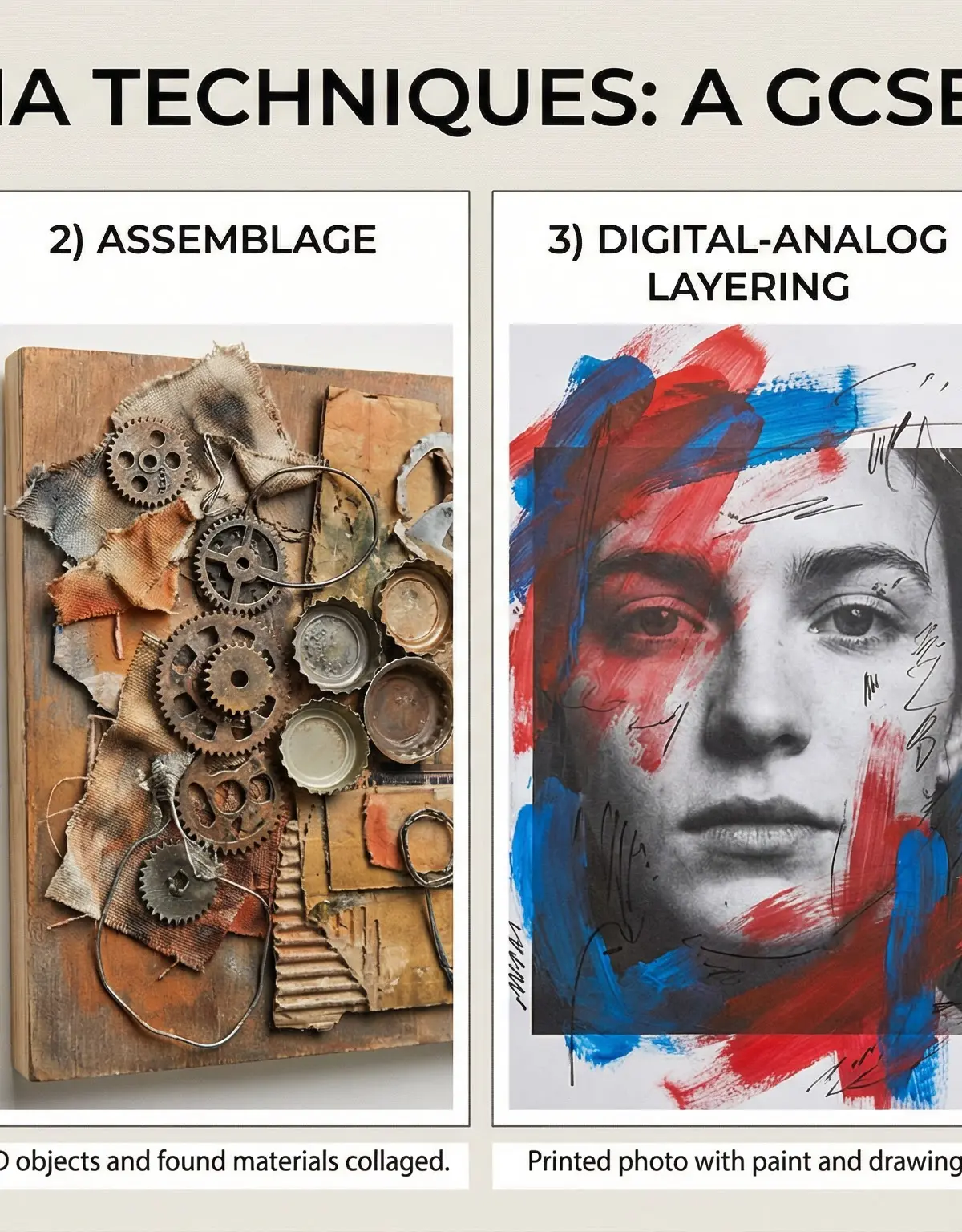
-
Resist Techniques: Start by drawing bold patterns on heavy GSM paper with a wax crayon or oil pastel. Then, apply a wash of watercolour or ink over the top. The wax will repel the water-based medium, creating intricate patterns and textures. Examiner Tip: Annotate photos of this process, explaining how the resist effect could be used to represent a specific surface, like bark or water.
-
Layering and Collage: Experiment with different types of paper – newspaper, tissue paper, brown paper, wallpaper. Tear, cut, and arrange them on your substrate. Use a good quality PVA glue or acrylic medium to adhere them. Consider the transparency and opacity of the papers. A layer of tissue paper over a photograph can create a ghostly, ethereal effect.
-
Image Transfer: This technique allows you to transfer a printed image onto a new surface. Print an image using a laser printer (inkjet won't work). Coat the surface (e.g., a block of wood or a canvas) with gel medium. Place the printed image face down onto the wet medium and press firmly. Allow it to dry completely, then use a damp cloth to gently rub away the paper, leaving the ink transferred to the new surface.
-
Assemblage: Collect a range of found objects that relate to your theme. Think about texture, shape, and colour. Arrange them on a sturdy substrate like a wooden board. Consider how the objects interact with each other. Use a strong adhesive like a hot glue gun or epoxy resin to secure them. Marks are awarded for creating a composition that is visually interesting from multiple angles.
Materials & Equipment
- Substrates: Heavyweight cartridge paper (200gsm+), watercolour paper, mount board, canvas, MDF, or plywood.
- Adhesives: PVA glue, acrylic gel medium (for both gluing and sealing), hot glue gun, epoxy resin.
- Drawing Media: Charcoal, graphite, ink, oil pastels, wax crayons.
- Painting Media: Acrylics, watercolours, gouache, inks.
- Papers: Newspaper, magazines, old books, tissue paper, handmade paper, wallpaper samples.
- Found Objects: Fabric scraps, buttons, wire, plastic, metal, natural forms (leaves, twigs, stones).
- Digital Tools: A camera for documenting your work (AO3), and software like Photoshop for creating digital layers to print and incorporate.
Portfolio/Coursework Guidance
Assessment Criteria
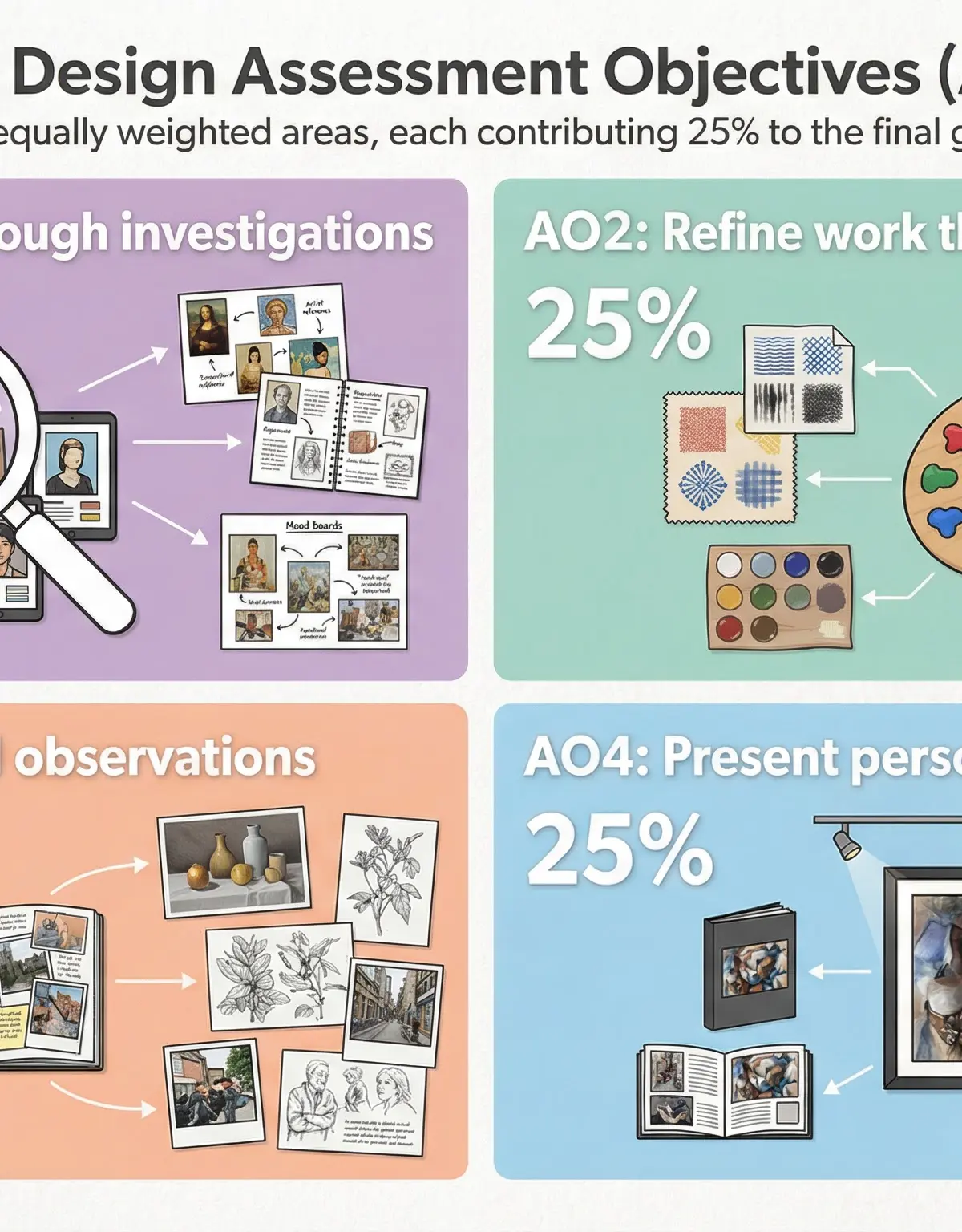
Your coursework is assessed against four Assessment Objectives (AOs), each worth 25% of your final mark.
- AO1: Develop: Researching artists and developing ideas. You must show clear links between your research and your own practical experiments.
- AO2: Refine: Experimenting with media, techniques, and processes. This is where you test out your mixed media combinations and show how you are refining your skills.
- AO3: Record: Documenting your journey. This includes drawings, photographs, and, crucially, high-quality annotation explaining your thoughts and decisions.
- AO4: Present: Creating a personal and meaningful final outcome. Your final piece should be a culmination of all your research and experimentation.
Building a Strong Portfolio
- Document Everything: Photograph your work at every stage. A mixed media piece often involves covering up previous layers; you need to show the examiner the process that led to the final outcome.
- Annotate with Intent: Your annotations are your chance to speak directly to the examiner. Don't just describe what you did; explain why you did it. Use the technical vocabulary listed above. For example: “I chose to juxtapose the rough texture of the sandpaper with the smooth photograph to create a sense of conflict and tension.”
- Show a Journey: Your sketchbook should tell a story. It should show your initial ideas, your artist research, your experiments (both successful and unsuccessful), your development, and your final piece. It should be clear how your ideas have evolved over time.
Exam Component
Written Exam Knowledge
While Art and Design is a practical subject, the written component requires you to analyse and evaluate the work of other artists, as well as your own. You will be expected to use subject-specific terminology to discuss how artists use materials, techniques, and processes. Questions will often ask you to make connections between an artist's work and your own practice. You may be presented with an image of an artwork and asked to explain how the artist has used mixed media to create meaning.
Practical Exam Preparation
For the externally set assignment (the exam), you will be given a theme or starting point. You will have a preparatory period to research and experiment, just like with your coursework. For a mixed media response:
- Analyse the Theme: Brainstorm ideas and create a mind map. How can you interpret the theme in a personal way?
- Focused Research: Find artists whose work relates to the theme and who use mixed media in interesting ways.
- Targeted Experiments: Plan a series of experiments that will help you develop your final idea. Don't try to do everything. Focus on a few techniques that you think will be most effective.
- Plan Your Final Piece: In the timed exam, you will need to work efficiently. Have a clear plan for what you are going to do. You can take your sketchbook and preparatory work into the exam with you."
Worked Examples
3 worked examples — open one to explore the question and available guidance.