OCR · GCSE · Art and Design
Landscape
The Landscape theme for OCR GCSE Art and Design challenges candidates to engage rigorously with the environment through primary observation, critical artist research, and sustained media experimentation. Success depends on building a coherent creative journey — from initial plein air sketches through to a resolved final piece — that demonstrates a sophisticated personal response to place, space, and atmosphere. This guide covers everything you need to earn marks across all four equally-weighted Assessment Objectives.
- 9 min read
- 3 worked examples
- 4 practice questions
- 8 key terms
Study Notes
Overview
The Landscape theme is one of the most open and rewarding in the OCR specification. It invites candidates to look at the world around them — really look at it — and respond through art. That could mean rolling countryside, dramatic coastlines, urban streets, industrial architecture, or even the intimate landscape of a garden. The theme is deliberately broad, and that is a good thing. It gives you creative freedom. But here is the key: examiners want to see a personal response to a real place, not a copy of someone else's photograph from the internet.
A successful Landscape project demonstrates a coherent journey from primary observation and critical artist research through to a resolved final piece that synthesises learning and communicates a personal vision. Examiners are looking for evidence of genuine engagement with the real world, a sophisticated understanding of visual language, and the ability to sustain a creative enquiry across all four Assessment Objectives.

Key Knowledge & Theory
Core Concepts
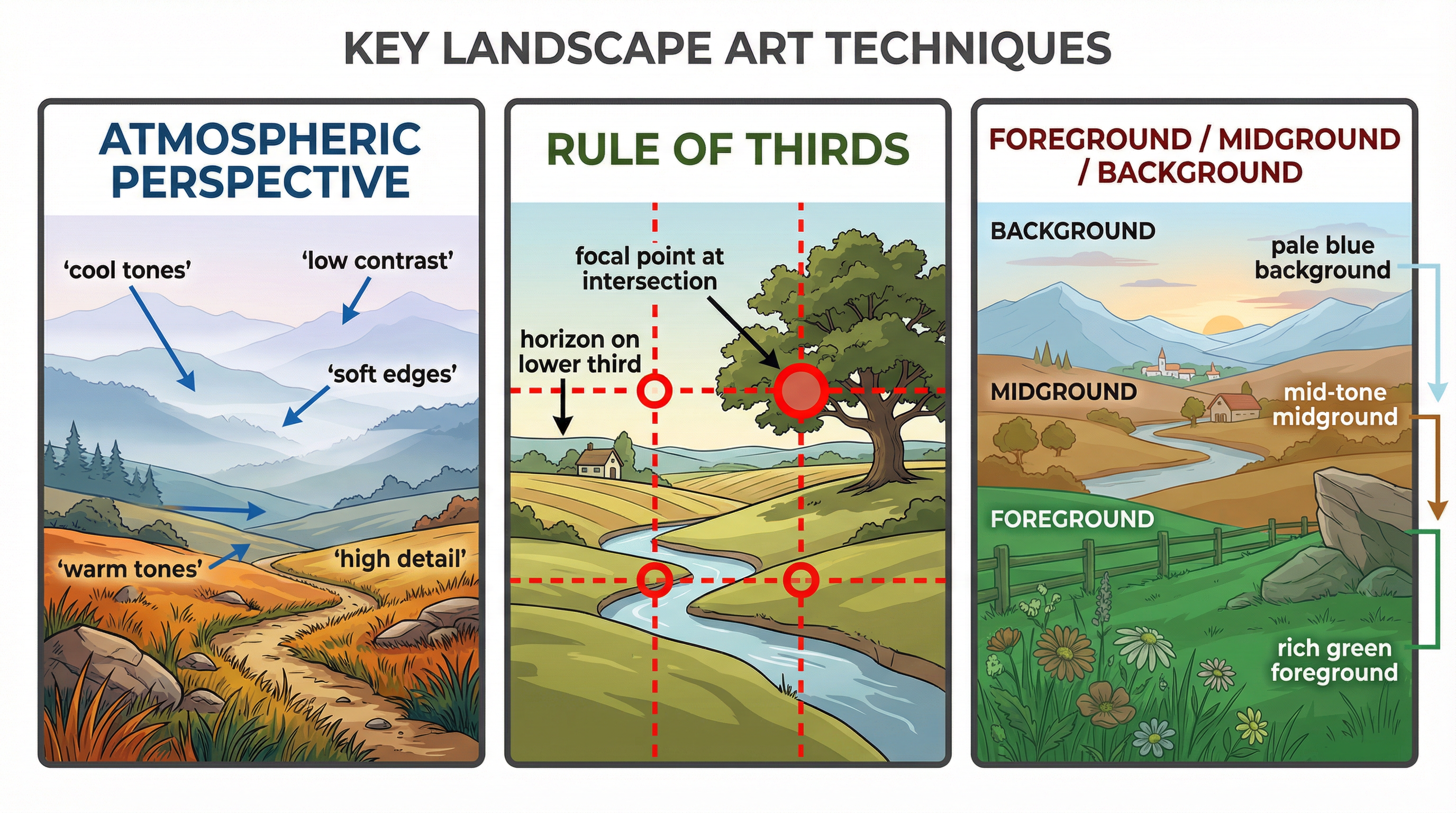
Understanding the theoretical underpinnings of landscape art is crucial for achieving the higher marks. Candidates must move beyond simple description and engage with the formal and conceptual ideas that have shaped the genre. Key concepts include Atmospheric Perspective, the Rule of Thirds, and the division of space into Foreground, Midground, and Background. These are not just technical tricks, but tools for conveying mood, creating depth, and guiding the viewer's eye. Credit is given for annotation that explains why these compositional devices have been used and to what effect.
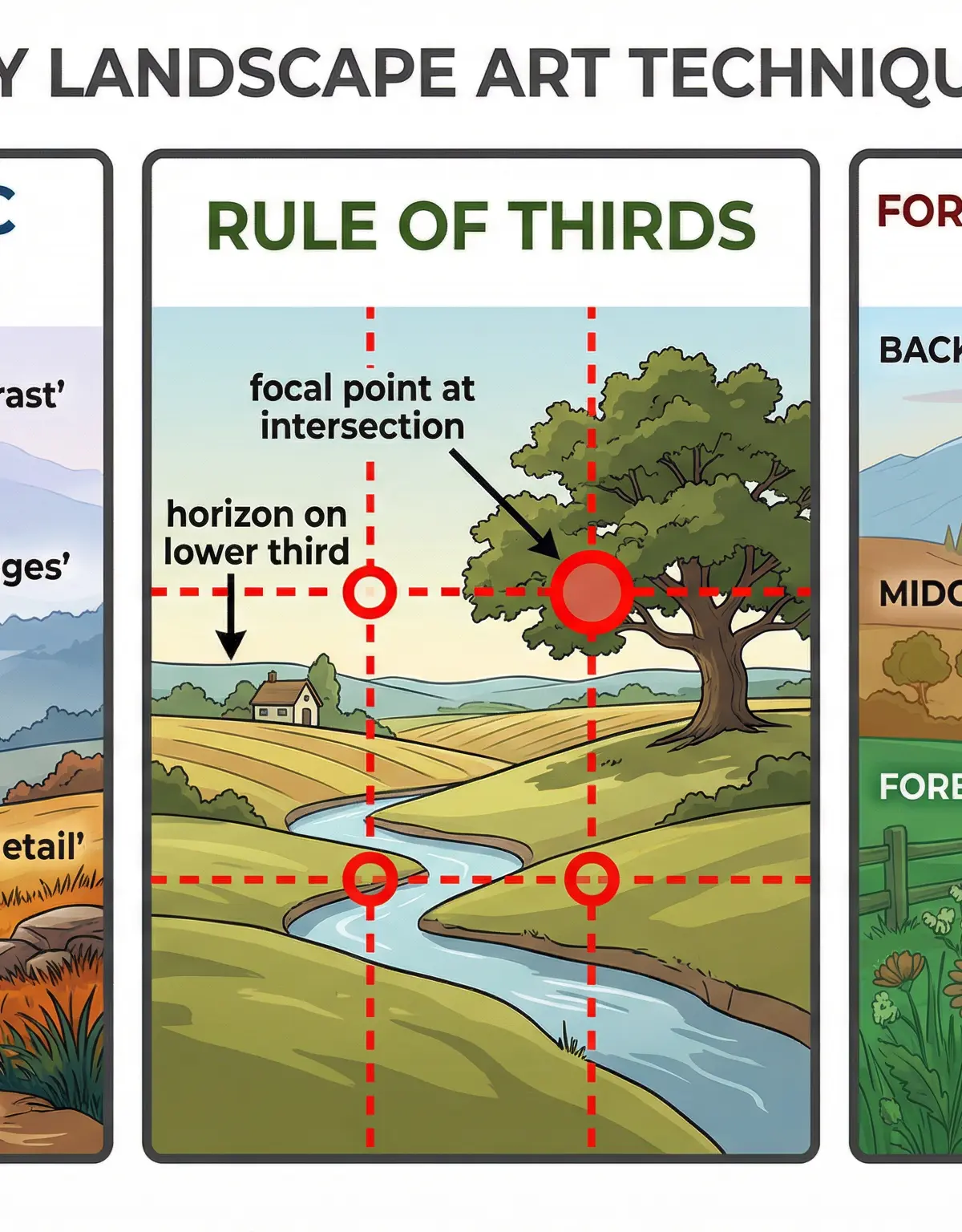
Atmospheric Perspective (also called aerial perspective) is one of the most powerful tools for creating depth. Distant objects appear lighter, cooler in colour, and less detailed than objects in the foreground, due to the atmosphere between the viewer and the subject. To apply this in your work: use warm, saturated, high-contrast colours in the foreground, and progressively cooler, paler, lower-contrast tones as you move toward the background. Edges should become softer and less defined in the distance.
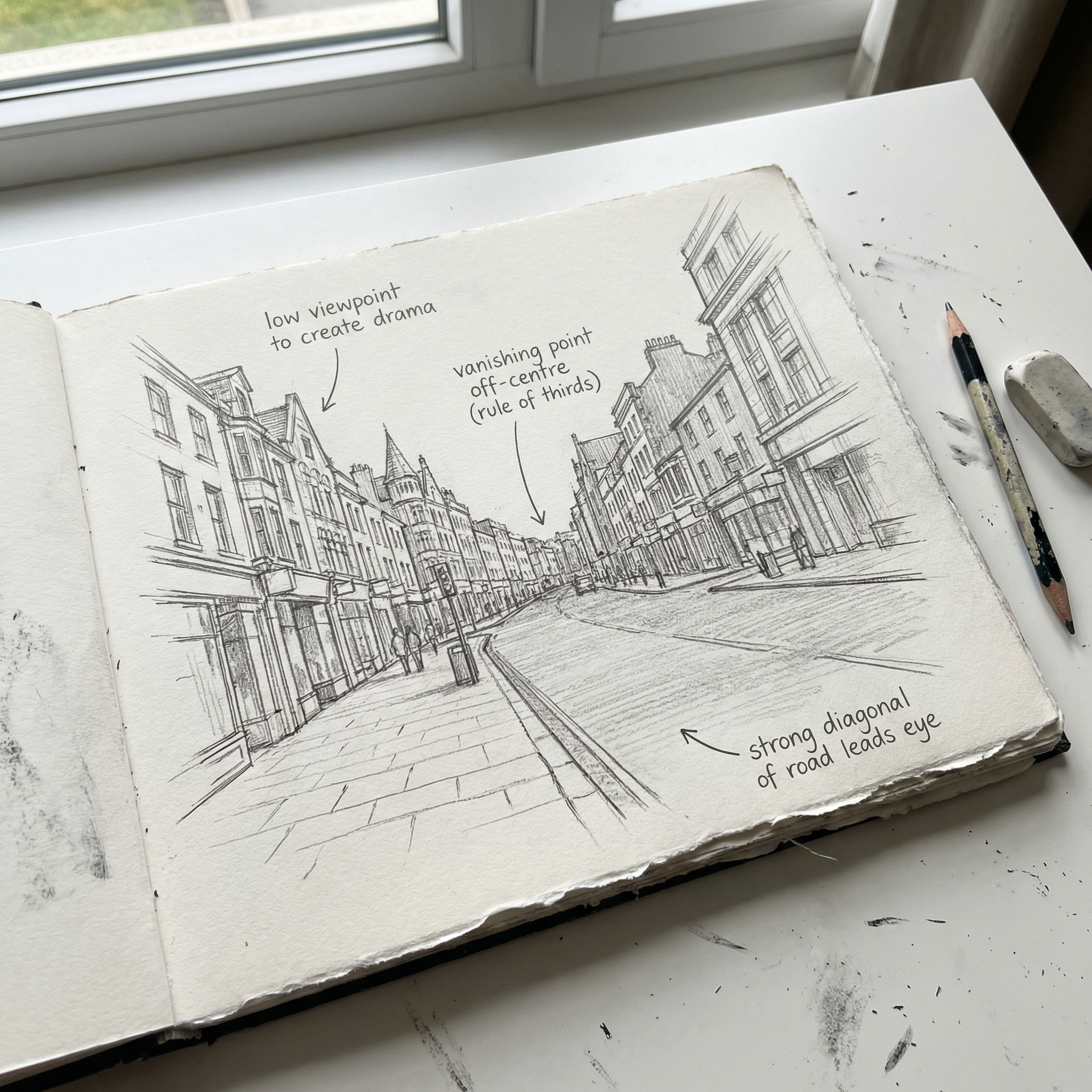
Composition is the deliberate arrangement of visual elements within the picture plane. For landscape, key compositional devices include the Rule of Thirds (placing the horizon on the upper or lower third, not the middle), Leading Lines (roads, rivers, fences that guide the eye into the picture), and Framing (using foreground elements such as trees or archways to frame the view beyond).
Key Practitioners
| Name | Period/Style | Key Works | Relevance |
|---|---|---|---|
| J.M.W. Turner | Romanticism | Rain, Steam and Speed; The Fighting Temeraire | Master of atmospheric perspective; use of light and colour to convey mood and the sublime. |
| Paul Cézanne | Post-Impressionism | Mont Sainte-Victoire series | Structural approach to landscape; using planes of colour and directional brushstrokes to build form. |
| David Hockney | Pop Art / Contemporary | A Bigger Splash; Yorkshire Wolds paintings | Bold use of colour, multiple viewpoints, and embracing new technologies including iPad drawings. |
| Ansel Adams | Modernism (Photography) | The Tetons and the Snake River | Master of tonal range and composition in black-and-white photography; the Zone System. |
| Georgia O'Keeffe | American Modernism | New Mexico landscapes | Abstracting forms from nature; creating a personal, emotional response to place. |
Technical Vocabulary
Using subject-specific terminology correctly is a key differentiator. Candidates should use these terms naturally and accurately in their annotations and any written responses.
- Plein Air: The act of painting or drawing outdoors, directly from the subject. Essential for AO3.
- Topography: The arrangement of the natural and artificial physical features of an area.
- Composition: The arrangement of elements within the work.
- Impasto: Paint applied in very thick layers so that brush or knife strokes are visible.
- Scumbling: A thin layer of lighter opaque or semi-opaque colour applied over a darker colour to create a softened or hazy effect.
- Tonal Range: The full spectrum of light and dark values in a work, from the lightest highlight to the deepest shadow.
- Palette: The range of colours used by an artist in a particular work.
Practical Skills
Techniques & Processes
Candidates must demonstrate a range of practical skills, involving not just proficiency but purposeful selection of techniques to suit an intention.
Observational Drawing is the foundation of all landscape work. Practice drawing from life, focusing on line, tone, and texture. Use a variety of media: graphite, charcoal, fine liner. A viewfinder — a small cardboard frame — helps you select and isolate compositions from the complex world in front of you.
Watercolour Washes are ideal for capturing atmospheric effects. Experiment with wet-on-wet (for soft, diffused skies) and wet-on-dry (for defined shapes and architectural detail). Layering washes builds depth and tonal variation.
Acrylic and Oil Paint offer greater flexibility. Varying the viscosity of acrylics — thinning with water for transparent glazes, using straight from the tube for impasto texture — is exactly the kind of purposeful media manipulation that earns marks for AO2.
Original Photography is a legitimate and valued form of primary recording. Experiment with different viewpoints, depths of field, and times of day. Avoid simply copying your photos; use them as a source to be interpreted and transformed.
Materials & Equipment
Understanding your materials is crucial for AO2. You should experiment with and annotate your findings on:
- Surfaces: The difference between hot-pressed (smooth) and cold-pressed (textured) watercolour paper. The effect of using a coloured ground on a canvas.
- Media: The viscosity of acrylic paint. The properties of different drawing pencils (2H for light layout lines vs. 6B for deep shadows).
- Digital Tools: If using digital media, explore different brushes, layer modes (Multiply, Overlay), and opacity settings.
Portfolio/Coursework Guidance
Assessment Criteria
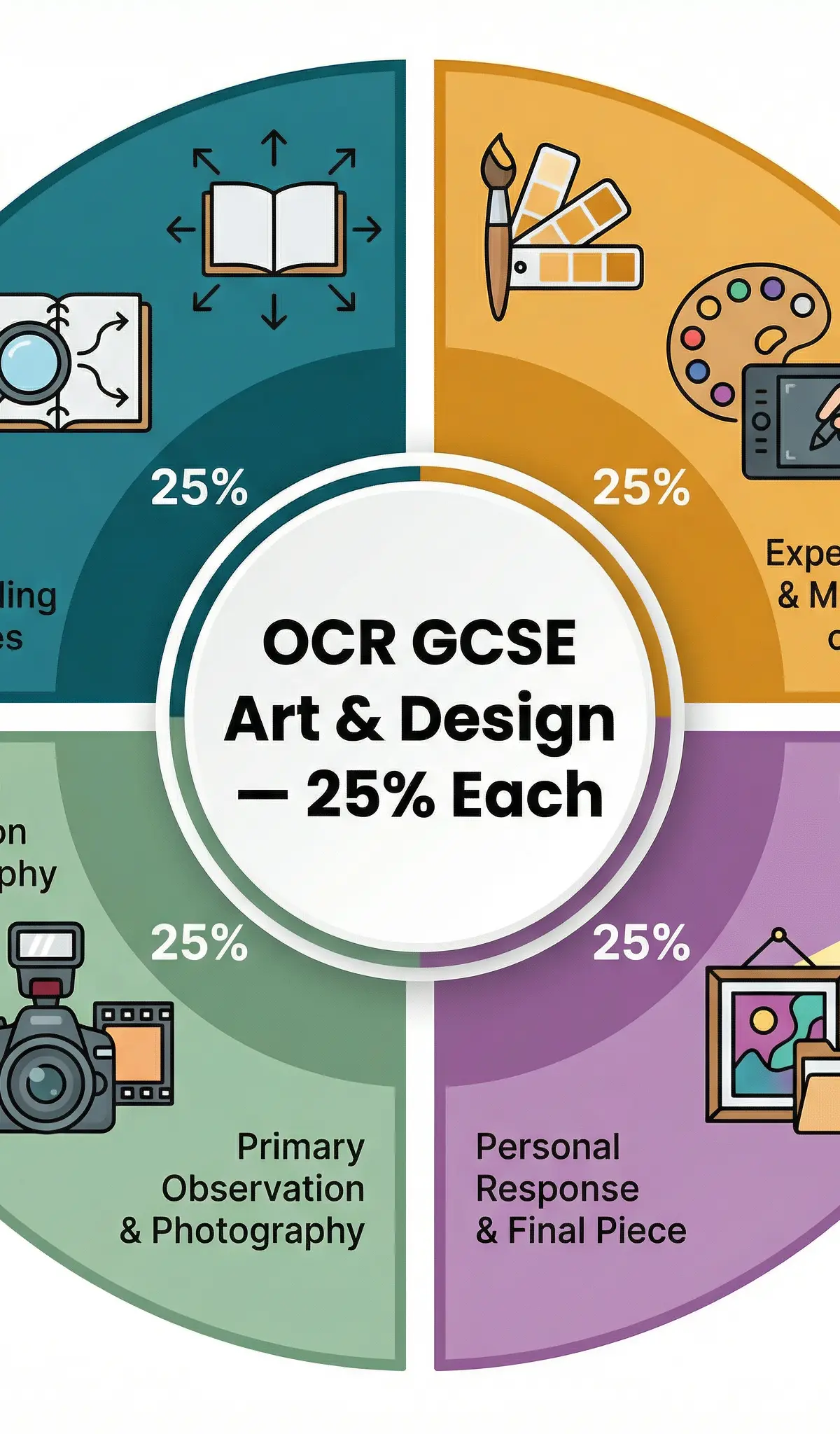
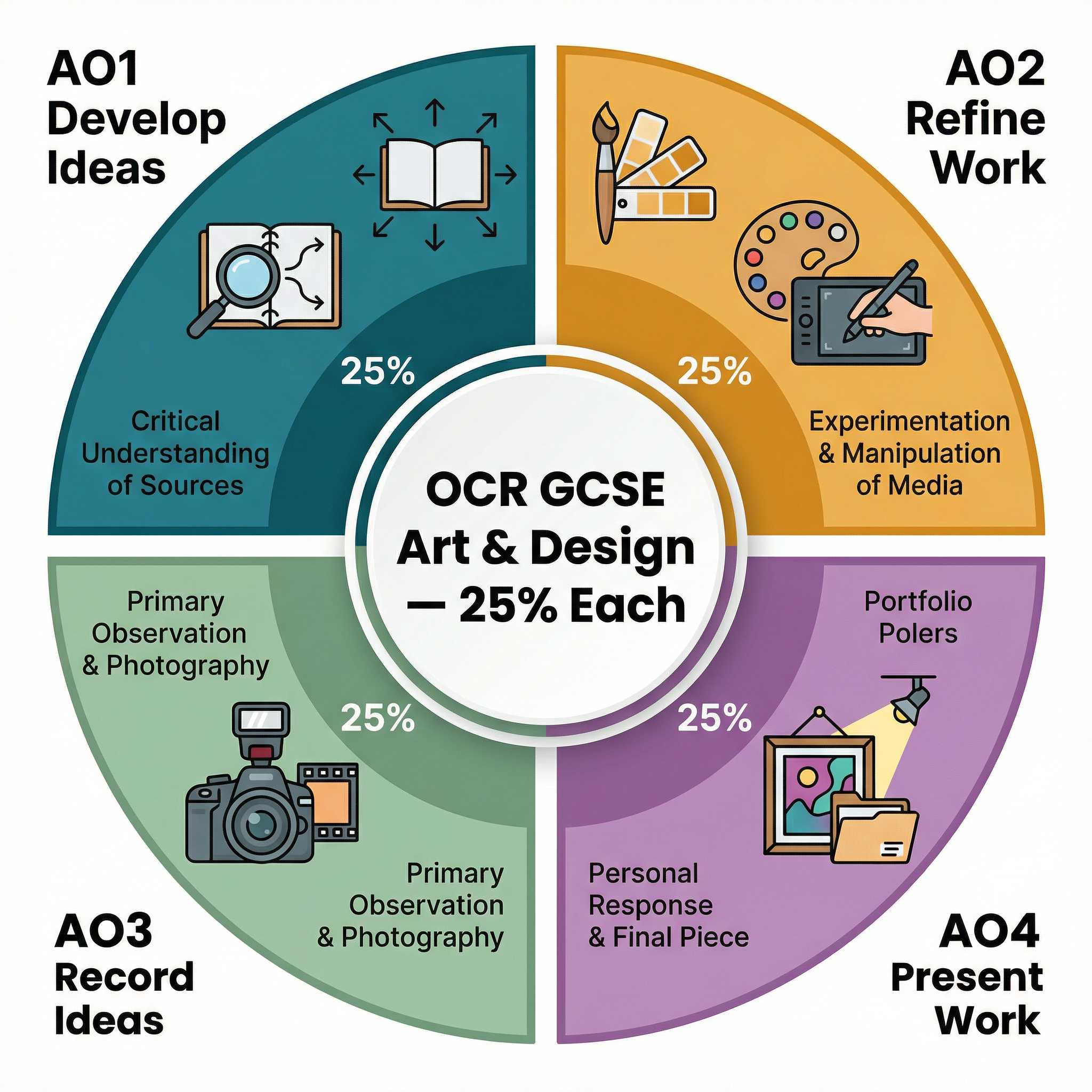
Your portfolio is marked against four equally weighted Assessment Objectives (AOs). You must provide evidence for all four.
| AO | Title | What Examiners Look For |
|---|---|---|
| AO1 | Develop Ideas | Critical analysis of artists, not biography. Explicit links between research and your own work. |
| AO2 | Refine Work | Genuine experimentation. Evidence of problem-solving. Analytical annotation explaining your choices. |
| AO3 | Record Ideas | Primary sketches and photographs. Plein air work. Evidence of direct engagement with a real place. |
| AO4 | Present Work | A coherent, personal final piece that is the natural conclusion of your creative journey. |
Building a Strong Portfolio
Tell a story. Your sketchbook should read like a visual diary, showing the evolution of your project from initial thoughts to final outcome. Examiners should be able to follow your thinking.
Annotate analytically. Your annotation is your voice. Explain your thinking. Why did you choose that artist? Why did that experiment fail? How did you solve that compositional problem? Link everything back to the AOs. A good formula is APE: Analyse, Practitioner link, Effect.
Show your failures. Examiners reward candidates who document problems and explain how they solved them. A page showing a failed composition with analytical annotation about why it did not work and what you did next is worth more than a perfect, unexplained outcome.
Quality over quantity. A few pages of in-depth, analytical research and meaningful experimentation are worth more than a whole sketchbook of superficial copies.
Exam Component
Written Exam Knowledge
Some OCR Art and Design specifications include a written component where you must analyse the work of others or explain your own processes. The knowledge and vocabulary outlined in this guide are essential. You will be expected to refer to specific artists and their techniques, and use technical language with confidence. Use the PEE structure: Point, Evidence, Explain.
Practical Exam Preparation
For the externally set task, you will be given a theme and a preparatory period.
- Deconstruct the Theme: Spend time mind-mapping and exploring different interpretations of the starting point. Do not take the first obvious interpretation.
- Apply Your Learning: Immediately begin primary recording and artist research relevant to the new theme.
- Plan for the Timed Element: In the supervised time, you will create your final piece. Have a clear plan. Practice working under timed conditions to build confidence.
- Manage Your Time: Plan your research, development, and final piece. Do not leave it all to the last minute.
Visual Resources
3 diagrams and illustrations
Interactive Diagrams
1 interactive diagram to visualise key concepts
Conceptual Flow Outline
The OCR GCSE Art and Design Creative Process: A journey from primary observation to final outcome, where each Assessment Objective informs the next.
Worked Examples
3 worked examples — open one to explore the question and available guidance.
Practice Questions
Test your understanding — click to reveal model answers
Identify two artists who have explored the landscape theme and name one key work for each.
Hint: Think about the key practitioners listed in the guide — Turner, Cézanne, Hockney, Adams, or O'Keeffe.
Describe how atmospheric perspective can be used to create a sense of depth in a landscape painting.
Hint: Think about how colour, tone, detail, and edge quality change as objects recede into the distance.
Explain how you would use primary sources to begin a project on the theme of 'Urban Landscape'.
Hint: Focus on AO3 (Record Ideas). What would you do, where would you go, and what would you record?
Analyse how Paul Cézanne's approach to landscape painting differed from that of the Impressionists, and explain how his work could inform your own practice.
Hint: Think about structure versus fleeting moments. Consider brushwork, form, and the artist's underlying intention.