OCR · GCSE · Art and Design
Painting
This study guide for OCR GCSE Art and Design (Painting 1.2) provides a comprehensive overview of the practical skills, theoretical knowledge, and assessment criteria required for success. It focuses on developing technical proficiency, evidencing a creative journey, and achieving a personal and meaningful final outcome.
- 8 min read
- 3 worked examples
- 4 practice questions
- 6 key terms
Study Notes
Overview
Painting is a core component of Art and Design, where candidates are expected to demonstrate technical proficiency with wet media while evidencing a sustained creative journey. This journey starts from initial source investigation and culminates in a resolved, personal final piece. The OCR specification places equal emphasis on four Assessment Objectives (AOs), requiring you to develop, experiment, record, and present your ideas effectively. Success in this component hinges on your ability to manipulate the formal elements (colour, tone, texture, form) and use the material properties of paint to realise your unique artistic intentions.

Key Knowledge & Theory
Core Concepts
Understanding the theoretical underpinnings of painting is crucial for making informed artistic decisions and for annotating your work with confidence. Key concepts include the formal elements, principles of composition, and colour theory. Candidates must show they have considered how these concepts operate within their own work and the work of other artists. For instance, understanding complementary colour relationships (e.g., red/green, blue/orange) allows you to create visual vibration and impact, a technique used by artists from the Impressionists to contemporary painters.
Key Practitioners/Artists/Composers
| Name | Period/Style | Key Works | Relevance |
|---|---|---|---|
| Vincent van Gogh | Post-Impressionism | The Starry Night (1889), Sunflowers (1888) | Master of expressive, impasto brushwork and emotional use of colour. Essential for understanding how paint application can convey feeling and energy. |
| Lucian Freud | 20th Century Realism | Benefits Supervisor Sleeping (1995) | His thick, sculptural application of paint to render flesh provides a masterclass in observational painting and depicting surface texture. |
| Georgia O'Keeffe | American Modernism | Jimson Weed/White Flower No. 1 (1932) | Demonstrates how to transform close observation of natural forms into powerful, near-abstract compositions with masterful tonal control. |
| Bridget Riley | Op Art | Movement in Squares (1961) | A key reference for exploring pattern, rhythm, and optical effects. Her work is a study in precision and the systematic use of formal elements. |
Technical Vocabulary
Using subject-specific terminology correctly in your annotations and any written responses is a straightforward way to gain credit. Examiners look for this as evidence of your understanding.
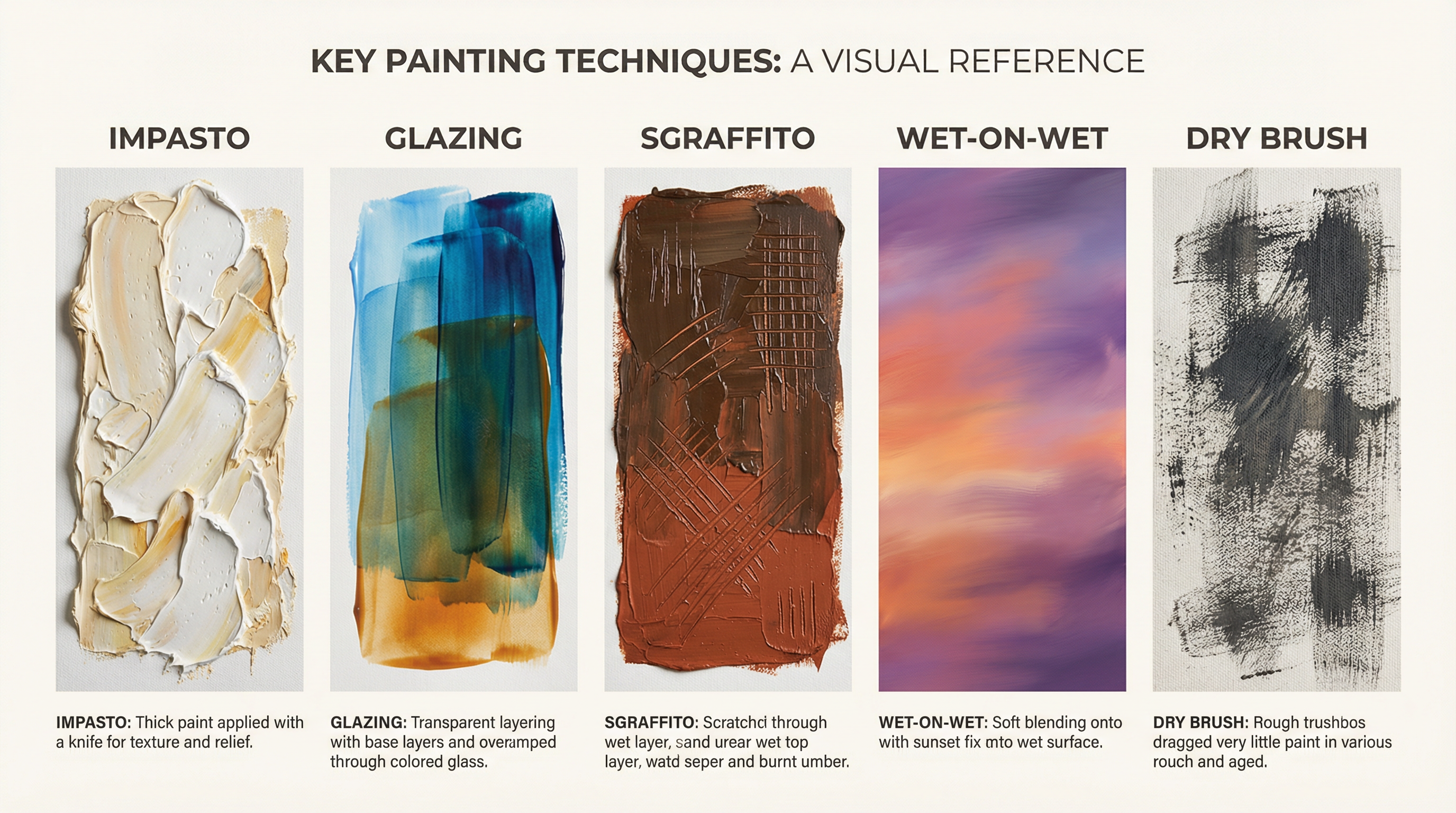
- Impasto: Paint applied thickly, so it stands out from a surface.
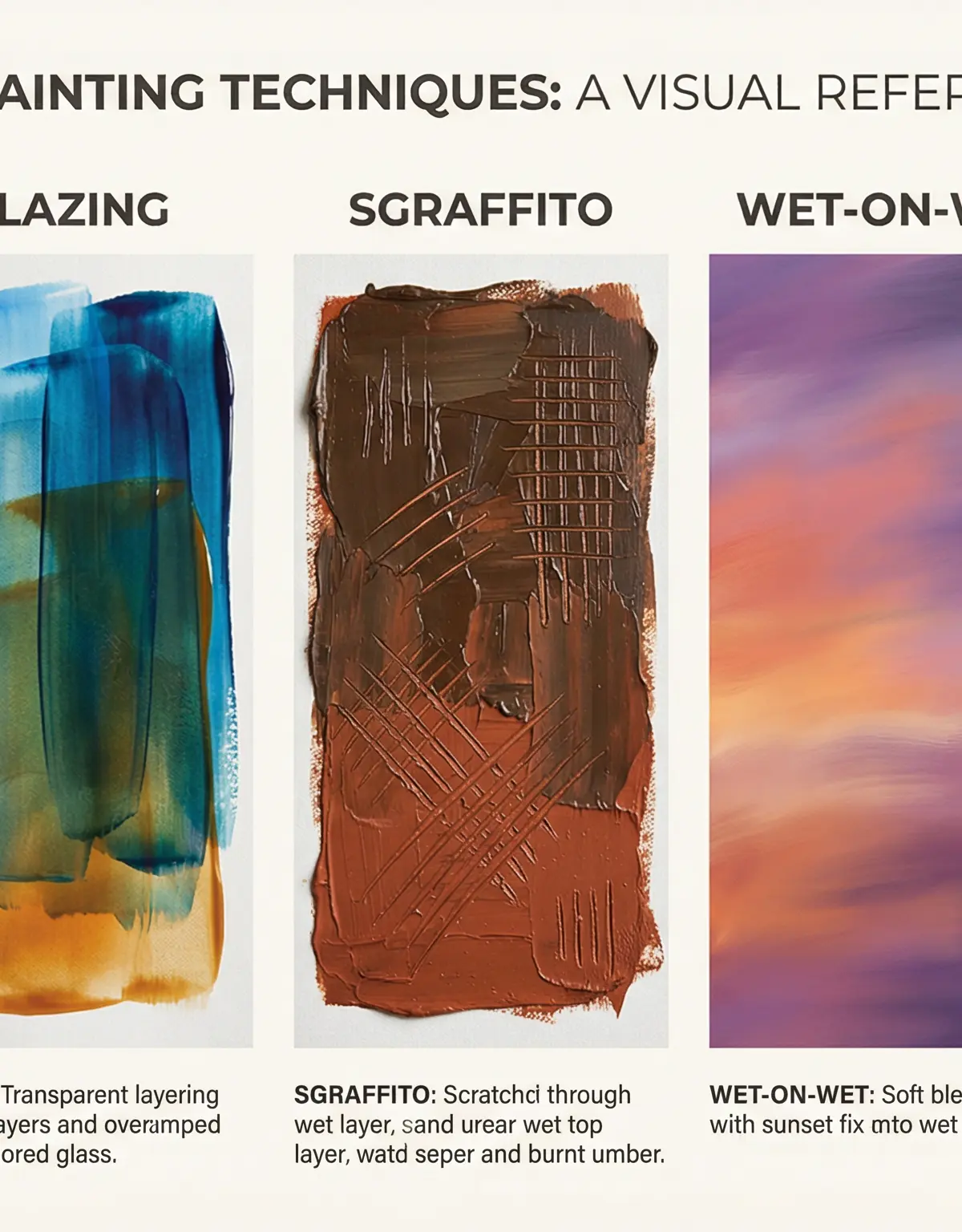
- Glazing: Applying a thin, transparent layer of paint over a dry one.
- Sgraffito: A form of decoration made by scratching through a surface to reveal a lower layer of a contrasting colour.
- Alla Prima (Wet-on-wet): A painting technique in which layers of wet paint are applied to previously administered layers of wet paint.
- Chiaroscuro: The use of strong contrasts between light and dark, usually bold contrasts affecting a whole composition.
- Gesso: A white paint mixture consisting of a binder mixed with chalk, gypsum, pigment, or any combination of these. It is used in artwork as a preparation for any number of substrates such as wood panels, canvas and sculpture as a base for paint and other materials that are applied over it.
- Palette: The range of colours used by a particular artist or in a particular picture.
- Viscosity: The thickness or resistance to flow of a liquid (paint).
Practical Skills
Techniques & Processes
Your ability to control and manipulate paint is central to this component. You must evidence purposeful experimentation with a range of techniques.
- Surface Preparation: Explore painting on different surfaces (canvas, board, paper, found objects) and with different grounds (gesso, coloured grounds) to see how it affects the final outcome.
- Colour Mixing: Go beyond the basics. Create extensive colour-mixing charts. Learn to mix clean, vibrant secondary and tertiary colours, and understand how to create a range of tones by adding black, white, or complementary colours.
- Brushwork and Mark-Making: Experiment with a wide variety of brushes (flats, rounds, filberts, fans) and other application tools (palette knives, sponges, rollers, rags). The marks you make should be intentional and varied.
- Layering Techniques: Build up surfaces using techniques like glazing to create depth and luminosity, or use scumbling (applying a thin, broken layer of opaque paint) to create texture and atmospheric effects.
Materials & Equipment
Demonstrate a clear understanding of your chosen materials and their properties. This includes:
- Paints: Acrylic, Oil, Watercolour, Gouache. Understand their different drying times, finishes, and handling properties.
- Mediums: Gels, pastes, retarders, flow improvers. Show how you use mediums to alter the viscosity, transparency, and drying time of your paint.
- Supports: Canvas (stretched or board), wood panels, heavyweight paper. Explain why you chose a particular support for your final piece.
- Safety: Be aware of health and safety procedures, especially when using oil paints and solvents. Ensure good ventilation and proper disposal of materials.
Portfolio/Coursework Guidance
Assessment Criteria
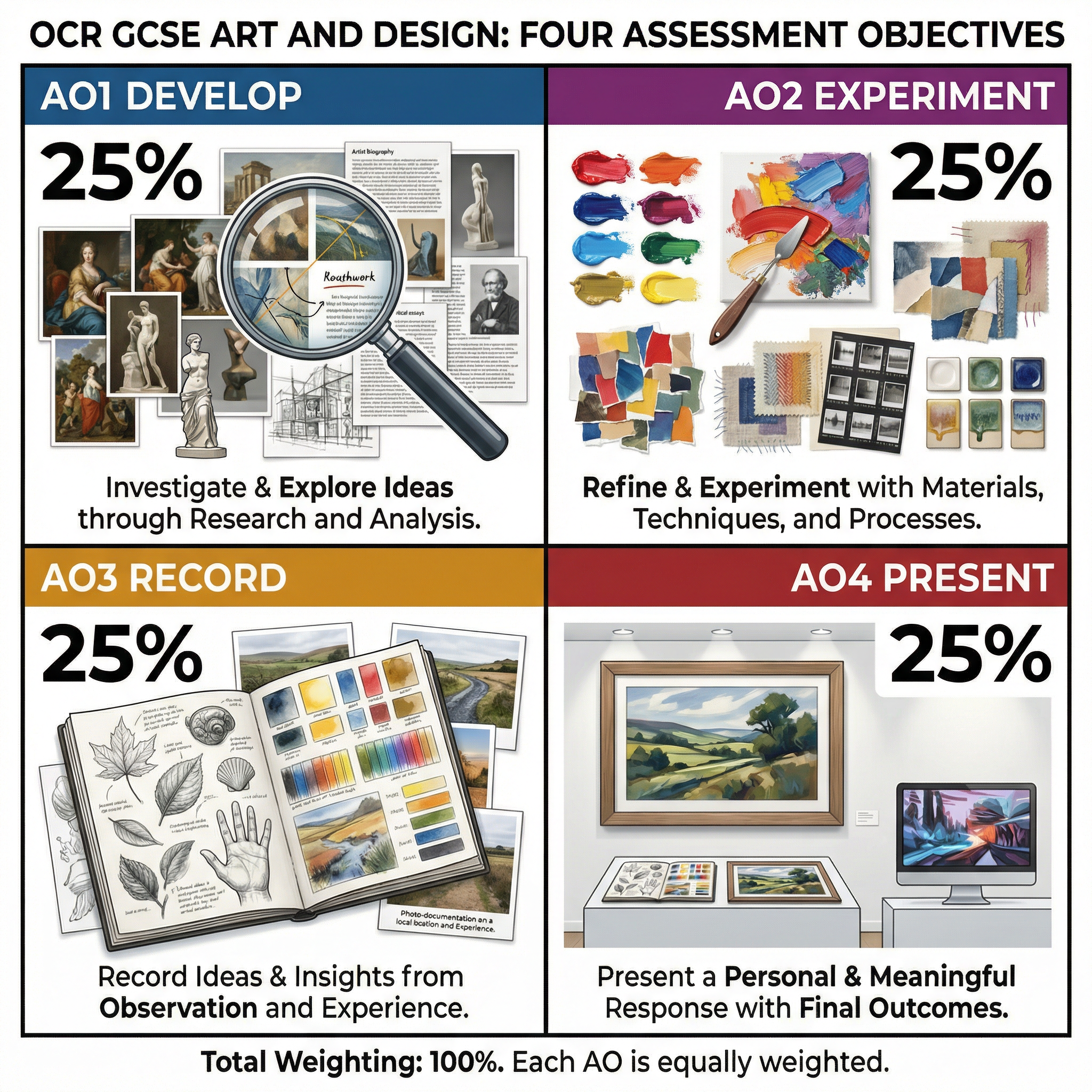
Your portfolio is assessed against the four AOs. It must tell a coherent story of your creative journey.
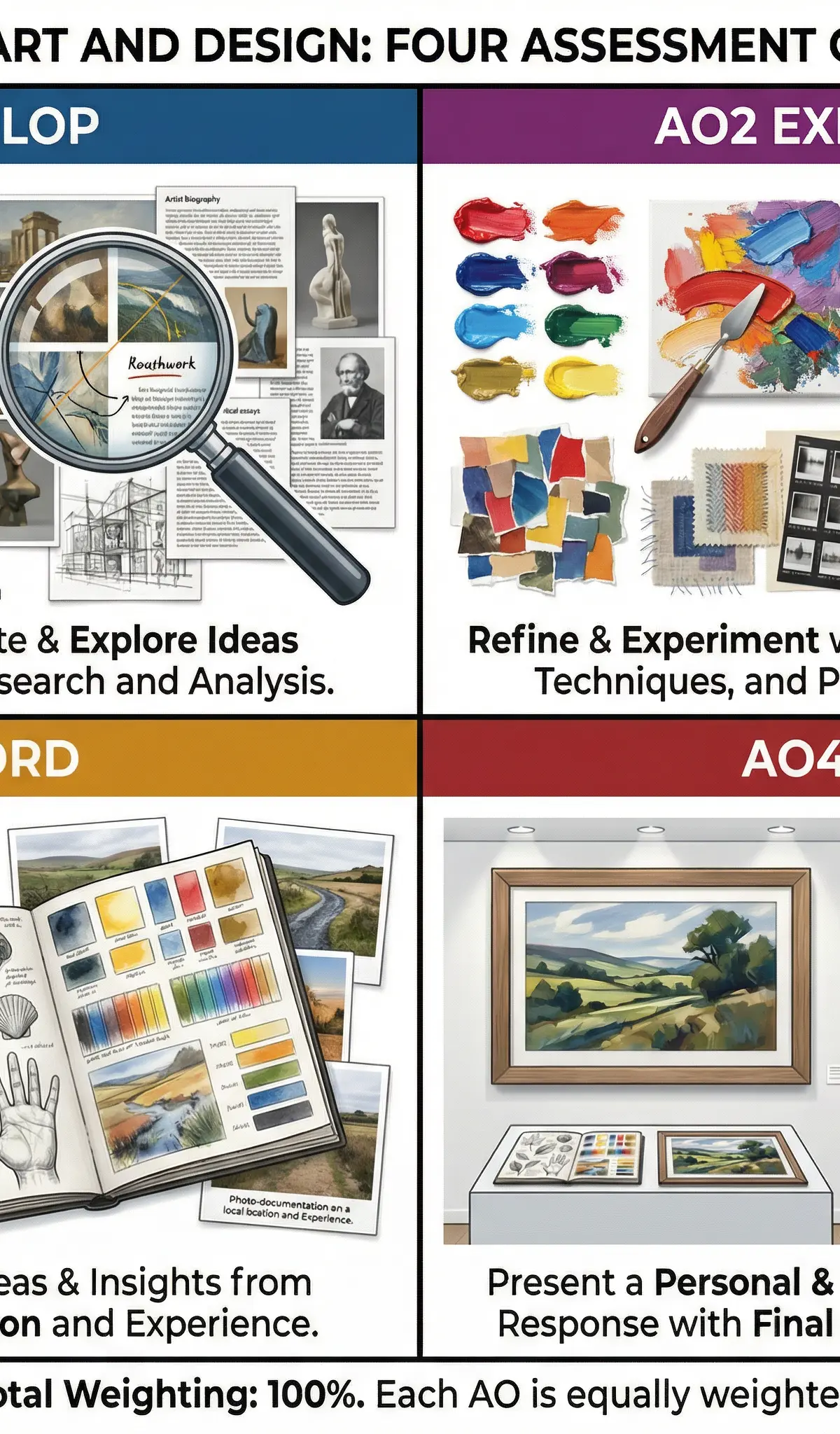
- AO1 (Develop): Show clear links between your research into other artists and your own practical experiments.
- AO2 (Experiment): Evidence a wide range of experiments with materials and techniques, with clear annotation showing refinement.
- AO3 (Record): Include high-quality observational studies (drawings, painted studies) from primary sources.
- AO4 (Present): Ensure your final outcome is a resolved, personal, and meaningful piece that connects to all your preparatory work.
Building a Strong Portfolio
- Annotate Everything: Explain your thought process. Why did you choose that artist? Why did you use that colour? What did you learn from that experiment? Your annotations are your voice.
- Show Your Failures: A sketchbook full of perfect outcomes looks suspicious. Include experiments that went wrong and explain what you learned from them. This is crucial evidence for AO2.
- The Red Thread: An examiner should be able to see a clear 'red thread' of an idea running through your entire project, from the first page of research to the final painting.
- Quality over Quantity: While you need to show a body of work, it is the quality of the investigation and the depth of the experimentation that earns the highest marks.
Exam Component
Written Exam Knowledge
There is no formal written exam for OCR GCSE Art and Design. All marks are derived from your portfolio (Component 01, 60%) and the Externally Set Task (Component 02, 40%). However, your ability to write and use specialist language is assessed through the annotations in your portfolio.
Practical Exam Preparation
The Externally Set Task (EST) is a practical exam where you are given a theme or starting point by the exam board. You have a preparatory period to develop ideas in a sketchbook, just like your coursework project, before undertaking a timed practical exam (10 hours) to create a final outcome.
- Deconstruct the Theme: Spend time brainstorming and mind-mapping ideas around the given theme. Look at it from different angles.
- Plan Your Time: The 10-hour exam is usually split over several days. Plan what you will achieve in each session. A good plan might be: Session 1: Prepare surface and transfer drawing. Session 2: Block in main colours. Session 3: Develop tones and details. Session 4: Refine, add highlights, and complete.
- Gather Your Resources: Prepare all your primary and secondary source material during the prep period. You can take your sketchbook and supporting studies into the exam with you.
Visual Resources
2 diagrams and illustrations
Interactive Diagrams
1 interactive diagram to visualise key concepts
Conceptual Flow Outline
The iterative creative process in OCR GCSE Art, linking all four Assessment Objectives.
Worked Examples
3 worked examples — open one to explore the question and available guidance.
Practice Questions
Test your understanding — click to reveal model answers
Identify two formal elements and explain how a painter might use them to create a sense of depth.
Hint: Think about how colour and tone change as things get further away.
Compare how Bridget Riley and Vincent van Gogh use mark-making in their work.
Hint: Think about precision vs. expression. Use the word 'whereas' to structure your comparison.
Evaluate the claim that 'good drawing is the foundation of all good painting'.
Hint: Consider both sides of the argument. Refer to artists who support the claim and artists who might challenge it.
You are given a single sheet of A2 white paper. Describe how you would experiment with paint application to create a sense of texture.
Hint: Think beyond just using a brush. How can you add and remove paint?