Sculpture — OCR GCSE Study Guide
Exam Board: OCR | Level: GCSE
This guide provides a comprehensive overview of Sculpture (2.3) for OCR GCSE Art and Design. It focuses on developing practical skills, understanding key practitioners, and mastering the assessment objectives to maximise marks in both coursework and the exam. Candidates who engage critically with the work of sculptors like Hepworth, Moore, and Whiteread, and who document their creative journey rigorously, are best placed to achieve the highest marks.
## Overview
Sculpture is the art of creating three-dimensional forms in space. For your OCR GCSE, this means moving beyond the 2D page and engaging with materials to explore volume, mass, and structure. Examiners are not just looking for a beautiful final object; they are assessing your entire creative journey, from your initial research and sketches to your final, resolved piece. This guide will break down the core knowledge, practical skills, and exam techniques you need to excel.

## Key Knowledge & Theory
### Core Concepts
Understanding the fundamental principles of sculpture is crucial for creating sophisticated work and for analysing the work of others. These concepts are the building blocks of your practical and theoretical understanding.
**Form and Space:** Sculpture is a dialogue between the solid object (positive space) and the area around and within it (negative space). Great sculptors like Barbara Hepworth and Henry Moore were masters of this relationship. Consider how the empty spaces in your work are as important as the solid parts.
**Mass and Volume:** Mass refers to the density and weight of your sculpture, while volume is the amount of space it occupies. A solid block of plaster has a high mass, while a delicate wire construction might have a large volume but low mass. Your choice of material directly impacts these qualities.
**Structure and Armature:** For many materials, an internal support structure, or armature, is essential. This provides stability and allows you to build forms that would otherwise collapse. An armature can be made from wire, wood, or metal and is a key technical consideration for AO2.
### Key Practitioners/Artists
| Name | Period/Style | Key Works | Relevance |
|---|---|---|---|
| Barbara Hepworth | Modernist (Abstract) | *Pelagos*, *Single Form* | Master of abstract form and the use of 'negative space' (the void). Her work is a vital touchstone for exploring the relationship between sculpture and landscape. |
| Henry Moore | Modernist (Figurative/Abstract) | *Reclining Figure* series | Explored the human form in relation to natural forms like hills and rocks. His work shows how to abstract from observation and create monumental, powerful forms. |
| Rachel Whiteread | Contemporary | *House*, *Ghost* | Casts the 'negative space' of objects and rooms, making absence visible. Her conceptual approach is excellent for AO1 analysis and can inspire experimental casting projects for AO2. |
| Antony Gormley | Contemporary | *Angel of the North*, *Field for the British Isles* | Uses his own body as a starting point to explore the human relationship with space and the environment. His work is a great example of how to use repetition and scale. |
### Technical Vocabulary
Using this language in your annotations and written answers will gain you credit for subject-specific knowledge.
**In the Round:** A freestanding sculpture that can be viewed from all sides. **Relief:** A sculpture that projects from a flat background surface. High relief projects significantly, while low relief (bas-relief) is shallower. **Maquette:** A small-scale preliminary model, used to test ideas for composition and form before creating the final piece. **Patina:** The surface colour or texture of a sculpture, either created naturally by weathering or applied artificially. **Biomorphic:** Forms that are inspired by nature but are not realistic copies — think of the smooth, flowing shapes in the work of Hepworth or Jean Arp.
## Practical Skills
### Techniques & Processes
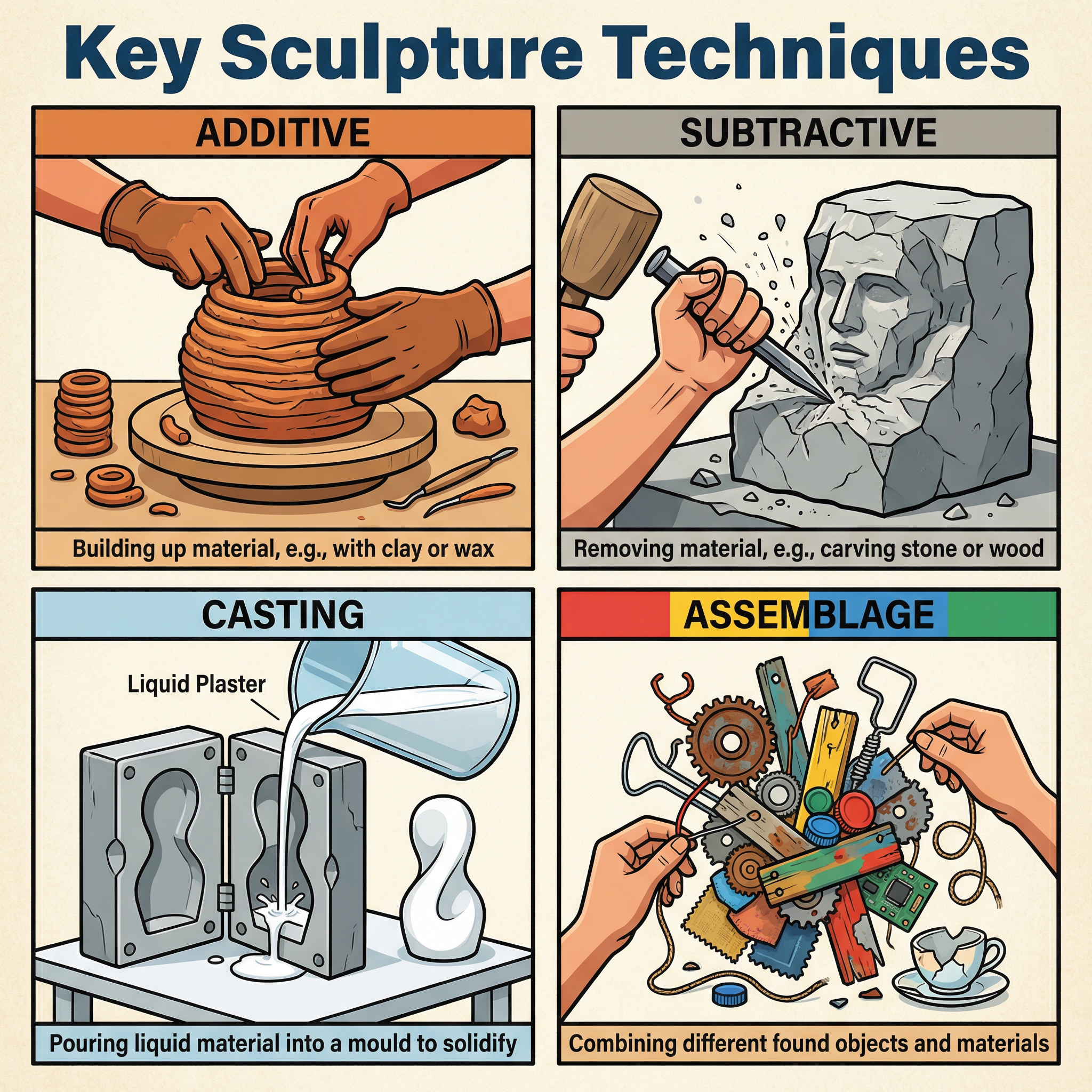
**Additive:** Building up your form. This is the most common approach for beginners. Examples include coiling or slab building with clay, or welding metal pieces together.
**Subtractive:** Removing material to reveal the form. This is the traditional method of carving stone or wood. It requires careful planning as you cannot add material back on.
**Casting:** Creating a mould and then pouring a liquid material (like plaster, bronze, or resin) into it to create a copy. This is a key process used by artists like Rachel Whiteread.
**Assemblage:** Constructing a sculpture by joining together different, often 'found', objects. This technique challenges the traditional idea of sculpture and is great for exploring themes and concepts.
### Materials & Equipment
Your choice of material is a critical decision that affects your process and the meaning of your work. You must demonstrate safe and effective use of all materials and equipment.
**Clay:** Versatile, malleable, and ideal for additive processes. Requires an armature for larger forms and must be fired in a kiln to become permanent. **Plaster:** Can be used for casting (poured into a mould) or for building up forms over an armature (using plaster-soaked fabric like scrim). It is fast-setting and can be carved when dry. **Wire:** Excellent for creating linear, open-form sculptures or for building strong armatures for clay or plaster. **Found Objects:** Anything can be a sculptural material. Using recycled or found objects (assemblage) is a fantastic way to explore themes of consumerism, memory, or the environment.
## Portfolio/Coursework Guidance
### Assessment Criteria
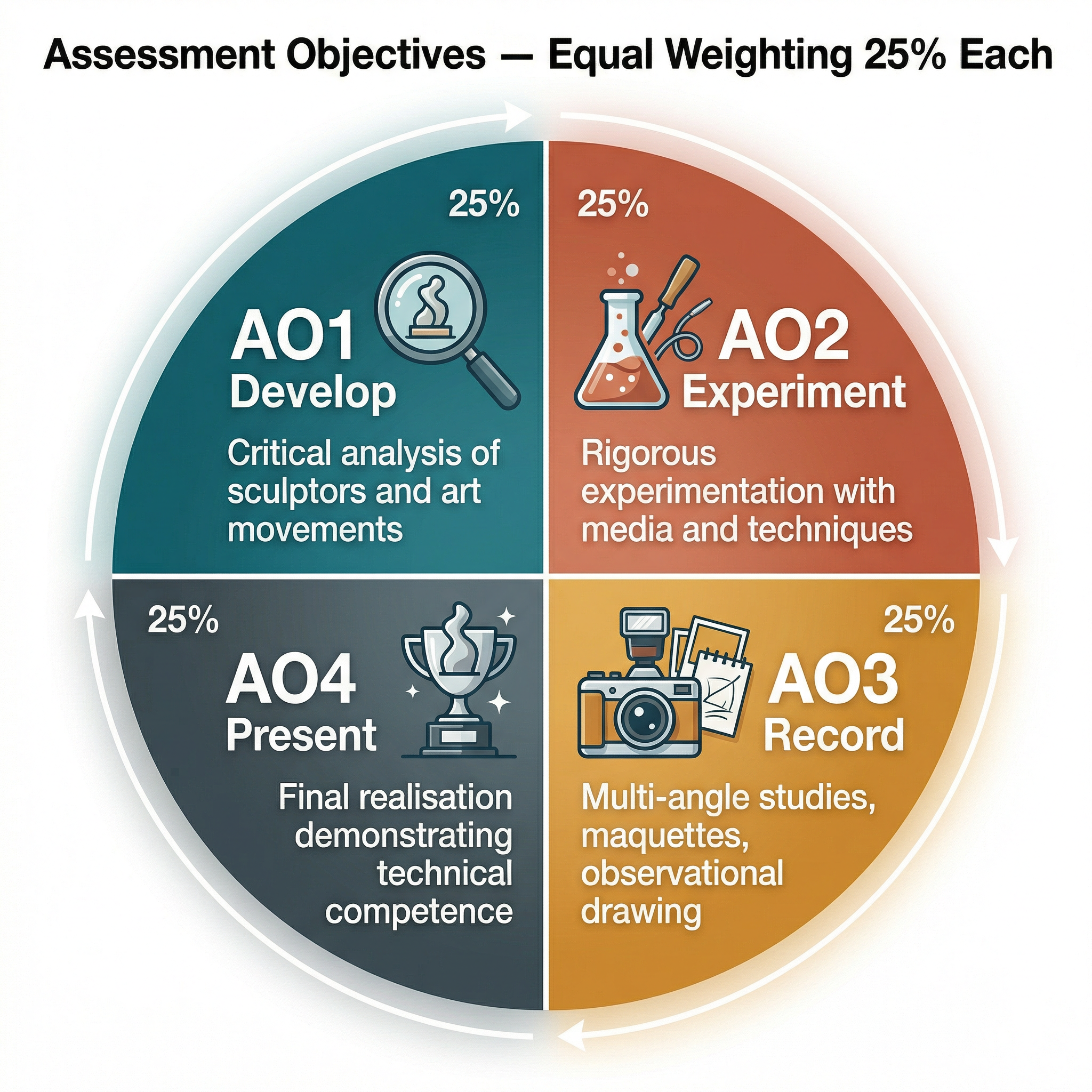
Your portfolio is worth 100% of your coursework marks and is assessed against four equally weighted Assessment Objectives (AOs). You must provide evidence for all four.
**AO1: Develop** — Show you have researched artists and developed ideas. Your annotations must analyse, not just describe, the work of others and explain how it influences your own ideas.
**AO2: Experiment** — This is where you test materials, techniques, and compositions. Photograph everything! Show your successes and your failures, and annotate what you learned from them.
**AO3: Record** — Record your ideas, observations, and insights. This includes drawings, photographs, maquettes, and written notes. For sculpture, it is vital to record your work from multiple viewpoints.
**AO4: Present** — Your final outcome. It should be a personal and meaningful response that is the culmination of all your work in the other AOs. The connection between your research, experimentation, and final piece must be clear.
### Building a Strong Portfolio
**Tell a Story:** Your portfolio should show a clear journey from your starting point to your final piece. Each page should logically follow the last. **Annotate with Purpose:** Don't just say what you did. Explain *why* you did it. How did that choice of material help you communicate your idea? What did you learn from that experiment? How does this link back to the artist you researched? **Quality over Quantity:** A few pages of in-depth, well-annotated experimentation are worth more than a whole sketchbook of superficial drawings. Focus on developing a single idea thoroughly. **Photograph Everything:** Your 3D work only exists in your portfolio as photographs. Take high-quality photos with good lighting and a neutral background. Show the work from multiple angles to give the examiner a true sense of its form.
## Exam Component
### Written Exam Knowledge
The written exam paper for Art and Design requires you to analyse and evaluate the work of others and to make connections with your own practice. You will be expected to use the key terminology and concepts outlined in this guide. You may be shown an image of a sculpture and asked to discuss its formal qualities (form, space, texture) or its conceptual meaning.
### Practical Exam Preparation
The Externally Set Assignment is a timed practical exam (usually 10 hours) where you respond to a theme set by the exam board. The key to success is preparation.
**Deconstruct the Theme:** Spend time brainstorming and mind-mapping all the possible interpretations of the theme. **Focused Research:** Select 2-3 artists whose work is highly relevant to your chosen interpretation of the theme. **Targeted Experimentation:** Your preparatory work should be focused on developing a final idea. Plan what you will make in the exam and practice the techniques you will need. **Time Management:** In the exam, have a clear plan of what you need to achieve each hour. Don't get bogged down in one stage. Remember to leave enough time for refinement and finishing.