AQA · A-Level · Biology
Course version: 7402 · Version from Sept 2016
Structure of the human immunodeficiency virus (HIV) and its replication in…
Full specification wording
Cell recognition and the immune system: Structure of the human immunodeficiency virus (HIV) and its replication in helper T cells.
HIV is a retrovirus containing two RNA strands and reverse transcriptase within a protein capsid.
Checked against the AQA 7402 specification (opens in a new tab) on .
- Point 13 of 18
- 4 key terms
Study notes
From the checked teaching notes for this specification point.
The idea
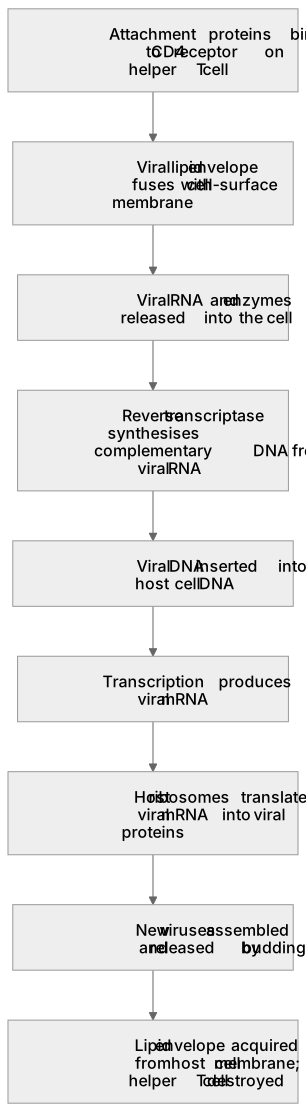
HIV is a retrovirus containing two RNA strands and reverse transcriptase within a protein capsid. This is surrounded by a lipid envelope derived from the previous host's membrane, studded with attachment proteins (gp120) and fusion proteins (gp41). Replication starts when gp120 binds to a CD4 receptor on a helper T cell. The envelope fuses with the host membrane, releasing RNA and enzymes into the cytoplasm. Reverse transcriptase synthesises a DNA copy from viral RNA, which is inserted into the host's DNA. Following transcription, the host's ribosomes translate viral mRNA into viral proteins. New particles assemble and bud from the cell, acquiring their lipid envelope and destroying the helper T cell.
What earns the marks
- Attachment proteins on the virus bind to specific receptors (CD4) on the helper T cell.
- The viral lipid envelope fuses with the cell-surface membrane, releasing viral RNA and enzymes into the cell.
- Reverse transcriptase synthesises a complementary DNA strand from the viral RNA template.
- The newly formed viral DNA is inserted into the host cell's DNA.
- Host cell ribosomes are used to translate viral mRNA into viral proteins (e.g., capsid proteins or enzymes).
- New viruses are assembled and released by budding, acquiring their lipid envelope from the host cell membrane.
Common mistakes and how to put them right
Calling the virus's attachment protein a receptor.
Put it right: Receptors are located on the host cell membrane, whereas the virus possesses attachment proteins.
Stating that HIV contains DNA or replicates by mitosis.
Put it right: HIV is an RNA retrovirus that relies entirely on host cell machinery to replicate, not cell division.
Saying the virus makes its own proteins.
Put it right: Viruses lack ribosomes, so they must use the host cell's ribosomes for translation.
Describing HIV as replicating in B cells.
Put it right: HIV specifically targets and replicates within helper T cells.
Exam tips
- When describing viral replication, structure your answer chronologically: attachment, entry, reverse transcription, integration, protein synthesis, assembly, and release.
- Always name 'reverse transcriptase' when discussing HIV replication; this specific enzyme distinguishes retroviruses from other viral replication cycles.
- If asked to label an HIV diagram, ensure you correctly identify the attachment proteins on the exterior and the RNA and reverse transcriptase within the core.
Try the lesson
The start of the Cell recognition and the immune system: Structure of the human immunodeficiency virus (HIV) and its replication in helper T cells. lesson, made from checked teaching notes for this specification point.
Have a go first
Which enzyme does HIV use to make DNA from its RNA once inside a helper T cell?
Listen
HIV is a retrovirus containing two RNA strands and reverse transcriptase within a protein capsid. This is surrounded by a lipid envelope derived from the previous host's membrane, studded with attachment proteins (gp120) and fusion proteins (gp41). Replication starts when gp120 binds to a CD4 receptor on a helper T cell. The envelope fuses with the host membrane, releasing RNA and enzymes into the cytoplasm. Reverse transcriptase synthesises a DNA copy from viral RNA, which is inserted into the host's DNA. Following transcription, the host's ribosomes translate viral mRNA into viral proteins. New particles assemble and bud from the cell, acquiring their lipid envelope and destroying the helper T cell. A strong answer earns marks for these points. Attachment proteins on the virus bind to specific receptors (CD4) on the helper T cell. The viral lipid envelope fuses with the cell-surface membrane, releasing viral RNA and enzymes into the cell. Reverse transcriptase synthesises a complementary DNA strand from the viral RNA template. The newly formed viral DNA is inserted into the host cell's DNA. A common slip: Calling the virus's attachment protein a receptor. Instead, receptors are located on the host cell membrane, whereas the virus possesses attachment proteins. Exam tip: When describing viral replication, structure your answer chronologically: attachment, entry, reverse transcription, integration, protein synthesis, assembly, and release.
See it
Key words
Say what each word means before you turn the card.
Retrovirus structure
Try answering aloud or in your head before turning the card.
Role of reverse transcriptase
Try answering aloud or in your head before turning the card.
Viral replication cycle
Try answering aloud or in your head before turning the card.
Host cell destruction
Try answering aloud or in your head before turning the card.
See every definition
- Retrovirus structure
- HIV contains two RNA strands and reverse transcriptase within a protein capsid, surrounded by a lipid envelope derived from the previous host's membrane.
- Role of reverse transcriptase
- It synthesises a DNA copy from viral RNA, which is inserted into the host's DNA.
- Viral replication cycle
- Replication starts when gp120 binds to a CD4 receptor on a helper T cell, the envelope fuses with the host membrane, and RNA and enzymes are released into the cytoplasm.
- Host cell destruction
- New particles assemble and bud from the cell, acquiring their lipid envelope and destroying the helper T cell.
Label the diagram
Some boxes have lost their names. Pick the right name for each number.
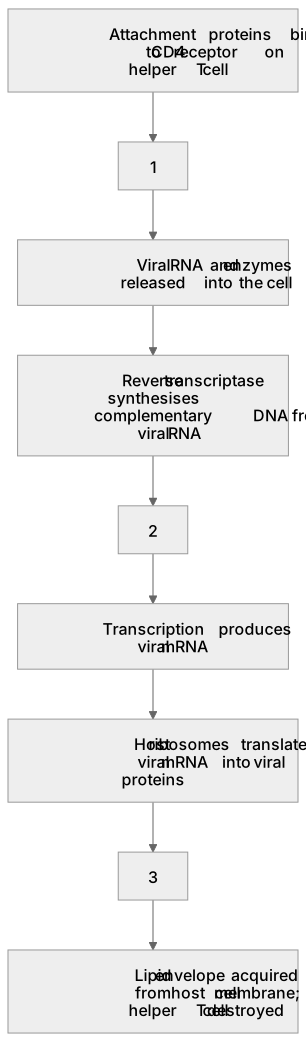
1Box 1
2Box 2
3Box 3
There is more to this lesson
The full lesson goes on to check your understanding and help you earn the marks. Create a free account to carry on, with your progress saved.
A week of Premium from your first lesson · Then the free plan continues · No card, no charge
Test your understanding of Cell recognition and the immune system: Structure of the human immunodeficiency virus (HIV) and its replication in helper T cells.
Active recall beats re-reading. Take an instant quiz now to test what you’ve learned and lock it into long-term memory.
A week of Premium from your first lesson · Then the free plan continues · No card, no charge