AQA · A-Level · Biology
Course version: 7402 · Version from Sept 2016
The differences between active and passive immunity.
Full specification wording
Cell recognition and the immune system: The differences between active and passive immunity.
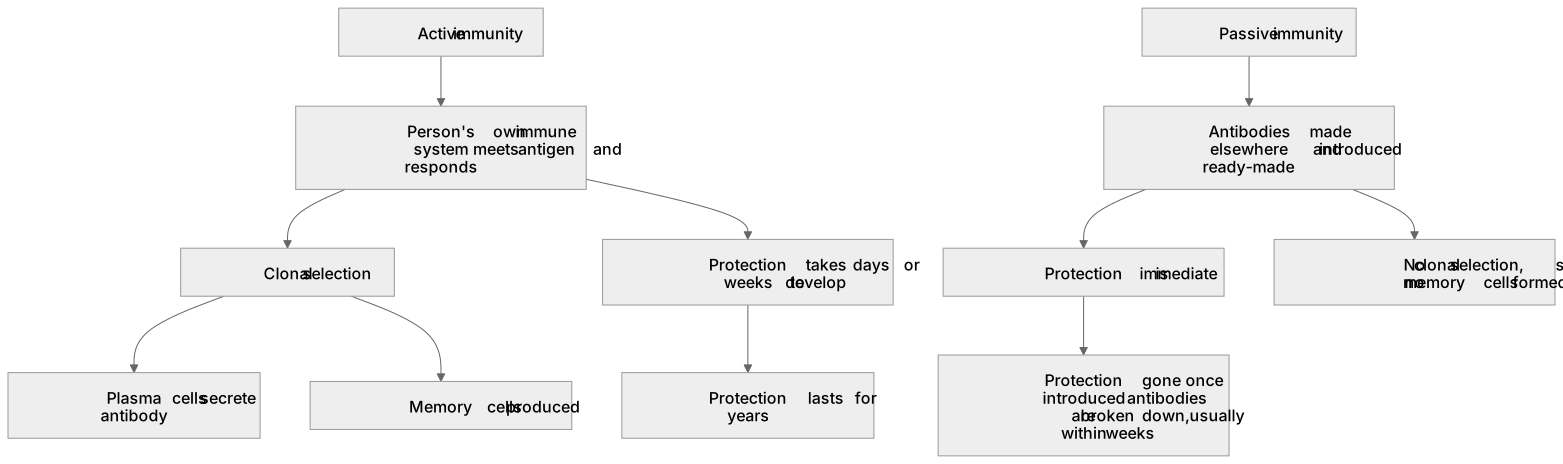
In active immunity the person's own immune system meets an antigen and responds.
Checked against the AQA 7402 specification (opens in a new tab) on .
- Point 12 of 18
- 4 key terms
Study notes
From the checked teaching notes for this specification point.
The idea
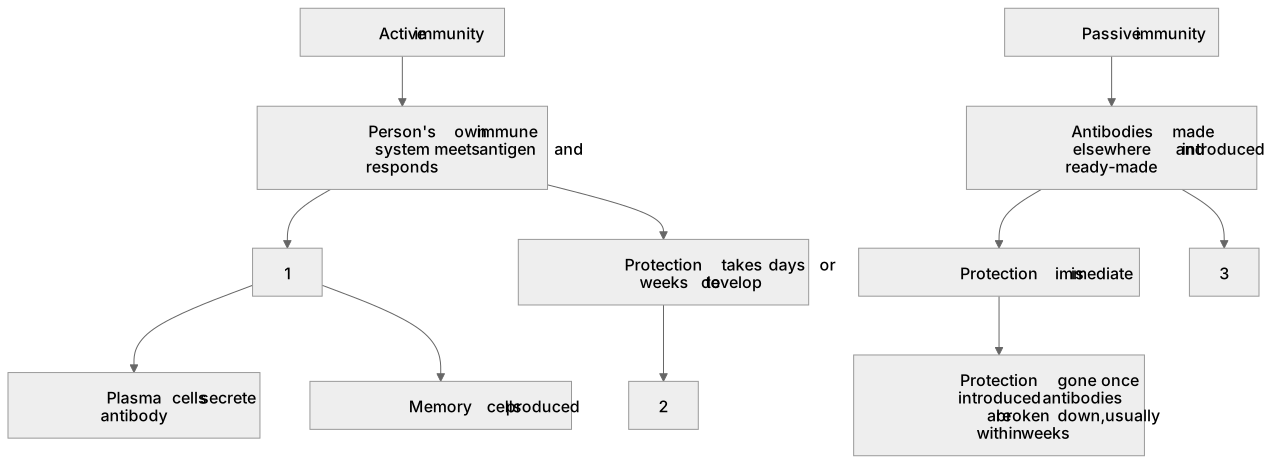
In active immunity the person's own immune system meets an antigen and responds. It can be natural, following infection, or artificial, following vaccination. The antigen triggers clonal selection, plasma cells secrete antibody and memory cells are produced, so protection takes days or weeks to develop but then lasts for years. In passive immunity the antibodies are made elsewhere and introduced ready-made: across the placenta, in colostrum and breast milk, or by injection of an antivenom or an anti-toxin. Protection is immediate because the antibodies are already present, but the person's own immune system has not responded to the antigen, so no clonal selection occurs and no memory cells are formed. Once the introduced antibodies are broken down, usually within weeks, protection is gone.
What earns the marks
- Active immunity involving exposure to antigen and the person's own production of antibody.
- Passive immunity involving antibodies introduced from outside, with the person's own immune system not producing them.
- Active immunity producing memory cells whereas passive immunity does not.
- The contrast in timing: passive protection is immediate but short-lived, active protection is slower to develop but long-lasting.
- A valid example on each side, such as vaccination and an anti-toxin injection or maternal antibodies.
Common mistakes and how to put them right
Answering a 'contrast' question with facts about only one type.
Put it right: The contrast command word requires both sides of each difference.
Saying passive immunity lasts until the antigens are gone, when it ends as the introduced antibodies are broken down.
Treating antibodies in breast milk as active immunity for the baby.
Claiming passive immunity produces memory cells simply because antibodies are present.
Assuming active immunity is always natural and passive immunity always artificial.
Put it right: Both can be natural or artificial.
Exam tips
- Contrast questions need paired statements in one sentence: active produces memory cells whereas passive does not.
- Draft a two-column table in rough, source of antibody, speed, duration, memory cells, then turn each row into one comparative sentence.
- In data questions on anti-toxin treatment, name the group who should receive it and support the choice with a figure.
Try the lesson
The start of the Cell recognition and the immune system: The differences between active and passive immunity. lesson, made from checked teaching notes for this specification point.
Have a go first
Which type of immunity results from the body producing its own antibodies after exposure to an antigen?
Listen
In active immunity the person's own immune system meets an antigen and responds. It can be natural, following infection, or artificial, following vaccination. The antigen triggers clonal selection, plasma cells secrete antibody and memory cells are produced, so protection takes days or weeks to develop but then lasts for years. In passive immunity the antibodies are made elsewhere and introduced ready-made: across the placenta, in colostrum and breast milk, or by injection of an antivenom or an anti-toxin. Protection is immediate because the antibodies are already present, but the person's own immune system has not responded to the antigen, so no clonal selection occurs and no memory cells are formed. Once the introduced antibodies are broken down, usually within weeks, protection is gone. A strong answer earns marks for these points. active immunity involving exposure to antigen and the person's own production of antibody. passive immunity involving antibodies introduced from outside, with the person's own immune system not producing them. active immunity producing memory cells whereas passive immunity does not. the contrast in timing: passive protection is immediate but short-lived, active protection is slower to develop but long-lasting. Exam tip: Contrast questions need paired statements in one sentence: active produces memory cells whereas passive does not.
See it
Key words
Say what each word means before you turn the card.
active immunity
Try answering aloud or in your head before turning the card.
passive immunity
Try answering aloud or in your head before turning the card.
memory cell formation
Try answering aloud or in your head before turning the card.
duration of protection
Try answering aloud or in your head before turning the card.
See every definition
- active immunity
- The person's own immune system meets an antigen and responds, with plasma cells secreting antibody and memory cells produced.
- passive immunity
- Antibodies are made elsewhere and introduced ready-made, so the person's own immune system has not responded to the antigen.
- memory cell formation
- Produced in active immunity when the antigen triggers clonal selection, but not formed in passive immunity.
- duration of protection
- Active protection lasts for years, whereas passive protection is gone once the introduced antibodies are broken down, usually within weeks.
Label the diagram
Some boxes have lost their names. Pick the right name for each number.
1Box 1
2Box 2
3Box 3
There is more to this lesson
The full lesson goes on to check your understanding and help you earn the marks. Create a free account to carry on, with your progress saved.
A week of Premium from your first lesson · Then the free plan continues · No card, no charge
Test your understanding of Cell recognition and the immune system: The differences between active and passive immunity.
Active recall beats re-reading. Take an instant quiz now to test what you’ve learned and lock it into long-term memory.
A week of Premium from your first lesson · Then the free plan continues · No card, no charge