AQA · A-Level · Biology
Course version: 7402 · Version from Sept 2016
Students should be able to: interpret data relating to similarities and…
Full specification wording
Investigating diversity: Students should be able to: interpret data relating to similarities and differences in the base sequences of DNA and in the amino acid sequences of proteins to suggest relationships between different organisms within a species and between species appreciate that gene technology has caused a change in the methods of investigating genetic diversity; inferring DNA differences from measurable or observable characteristics has been replaced by direct investigation of DNA sequences. Knowledge of gene technologies will not be tested.
The interpretation asked for here is a relative one.
Checked against the AQA 7402 specification (opens in a new tab) on .
- Point 2 of 3
- 4 key terms
Study notes
From the checked teaching notes for this specification point.
The idea
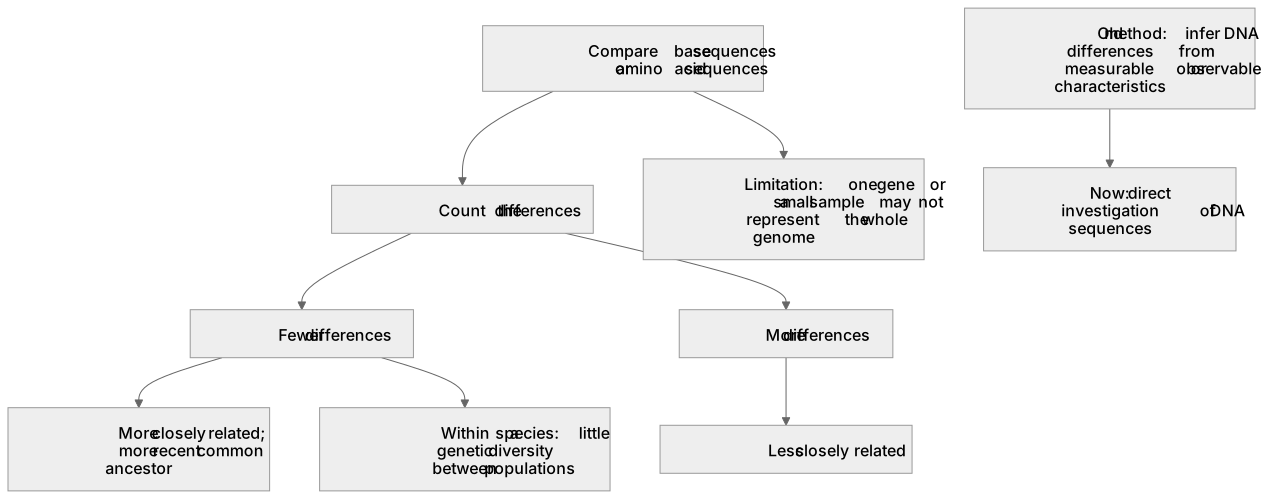
The interpretation asked for here is a relative one. Given base sequences or amino acid sequences from several organisms, count the differences: the fewer the differences, the more recently the organisms shared a common ancestor and the more closely related they are. Within a species the same logic measures diversity between populations, so two populations with few sequence differences have little genetic diversity between them. Do not overclaim from one gene or a small sample, and remember that individuals of one species already share most of their sequence. The second half of the statement is historical. Investigations used to infer DNA differences indirectly from measurable or observable characteristics, which is unreliable because such characteristics are polygenic and environmentally influenced.
What earns the marks
- Comparing the sequences given and stating which pair differs least.
- Concluding that fewer differences indicate a closer relationship or a more recent common ancestor.
- Expressing a comparison within a species as genetic diversity between populations rather than as separate species.
- Stating that DNA sequences are now investigated directly rather than inferred from observable characteristics.
- A limitation, such as one gene or a small sample not being representative of the whole genome or population.
Common mistakes and how to put them right
Concluding that two organisms are the same species because their sequences are similar.
Quoting the number of differences without saying what it means for relatedness.
Describing sequencing techniques such as PCR in detail, which is not credited in this section.
Assuming the organism whose sequence is printed first is the ancestor of the others.
Ignoring the possibility that one gene gives a different answer from the rest of the genome.
Exam tips
- Write the count and the conclusion together: 'only two differences, so these two are the most closely related'.
- Keep answers about the change in method at the level of principle, since direct sequencing has replaced inference from phenotype.
- Where a question compares members of one species, use the words genetic diversity rather than speciation.
Try the lesson
The start of the Investigating diversity: Students should be able to: interpret data relating to similarities and differences in the base sequences of DNA and in the amino acid sequences of proteins to suggest relationships between different organisms within a species and between species appreciate that gene technology has caused a change in the methods of investigating genetic diversity; inferring DNA differences from measurable or observable characteristics has been replaced by direct investigation of DNA sequences. Knowledge of gene technologies will not be tested. lesson, made from checked teaching notes for this specification point.
Have a go first
Which comparison is now used as the most direct method of investigating genetic diversity between organisms?
Listen
The interpretation asked for here is a relative one. Given base sequences or amino acid sequences from several organisms, count the differences: the fewer the differences, the more recently the organisms shared a common ancestor and the more closely related they are. Within a species the same logic measures diversity between populations, so two populations with few sequence differences have little genetic diversity between them. Do not overclaim from one gene or a small sample, and remember that individuals of one species already share most of their sequence. The second half of the statement is historical. Investigations used to infer DNA differences indirectly from measurable or observable characteristics, which is unreliable because such characteristics are polygenic and environmentally influenced. A strong answer earns marks for these points. comparing the sequences given and stating which pair differs least. concluding that fewer differences indicate a closer relationship or a more recent common ancestor. expressing a comparison within a species as genetic diversity between populations rather than as separate species. stating that DNA sequences are now investigated directly rather than inferred from observable characteristics. Exam tip: Write the count and the conclusion together: 'only two differences, so these two are the most closely related'.
See it
Key words
Say what each word means before you turn the card.
relatedness
Try answering aloud or in your head before turning the card.
direct DNA investigation
Try answering aloud or in your head before turning the card.
inference from phenotype
Try answering aloud or in your head before turning the card.
limits of a sample
Try answering aloud or in your head before turning the card.
See every definition
- relatedness
- The fewer the differences in base or amino acid sequences, the more recently the organisms shared a common ancestor and the more closely related they are.
- direct DNA investigation
- Gene technology has caused a change in the methods of investigating genetic diversity, with direct investigation of DNA sequences replacing inference from measurable or observable characteristics.
- inference from phenotype
- Investigations used to infer DNA differences indirectly from measurable or observable characteristics, which is unreliable because such characteristics are polygenic and environmentally influenced.
- limits of a sample
- Do not overclaim from one gene or a small sample, since one gene may give a different answer from the rest of the genome.
Label the diagram
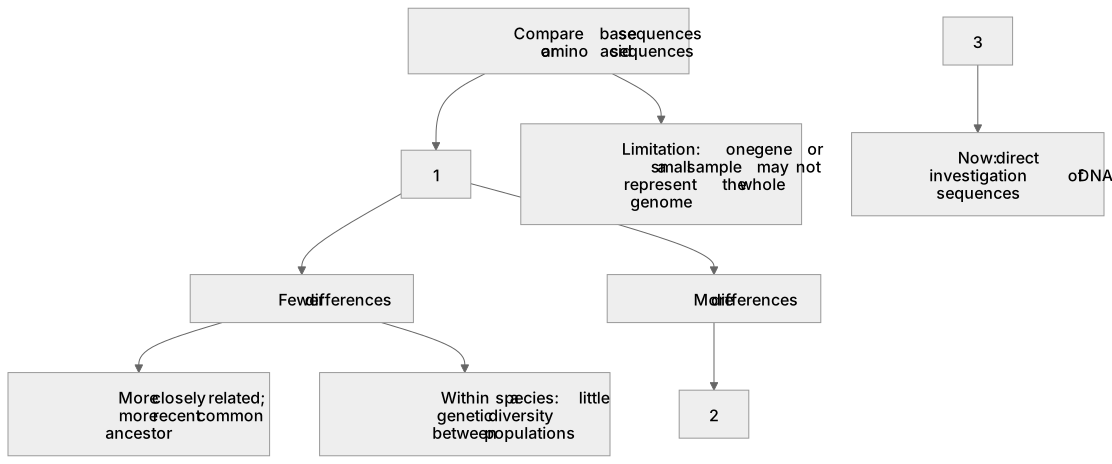
Some boxes have lost their names. Pick the right name for each number.
1Box 1
2Box 2
3Box 3
There is more to this lesson
The full lesson goes on to check your understanding and help you earn the marks. Create a free account to carry on, with your progress saved.
A week of Premium from your first lesson · Then the free plan continues · No card, no charge
Test your understanding of Investigating diversity: Students should be able to: interpret data relating to similarities and differences in the base sequences of DNA and in the amino acid sequences of proteins to suggest relationships between different organisms within a species and between species appreciate that gene technology has caused a change in the methods of investigating genetic diversity; inferring DNA differences from measurable or observable characteristics has been replaced by direct investigation of DNA sequences. Knowledge of gene technologies will not be tested.
Active recall beats re-reading. Take an instant quiz now to test what you’ve learned and lock it into long-term memory.
A week of Premium from your first lesson · Then the free plan continues · No card, no charge