AQA · A-Level · Biology
Course version: 7402 · Version from Sept 2016
Names are required only of the coronary arteries and of the blood vessels…
Full specification wording
Mass transport in animals: Names are required only of the coronary arteries and of the blood vessels entering and leaving the heart, lungs and kidneys.
This statement fixes the list of vessel names you are accountable for.
Checked against the AQA 7402 specification (opens in a new tab) on .
- Point 8 of 14
- 3 key terms
Study notes
From the checked teaching notes for this specification point.
The idea
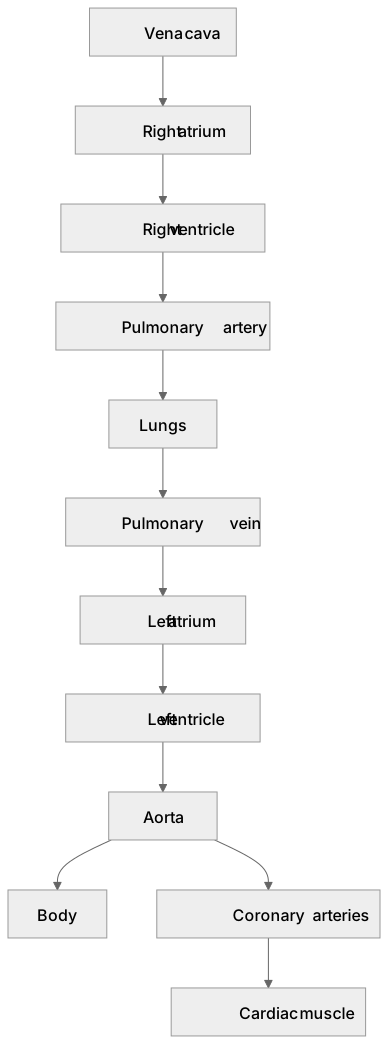
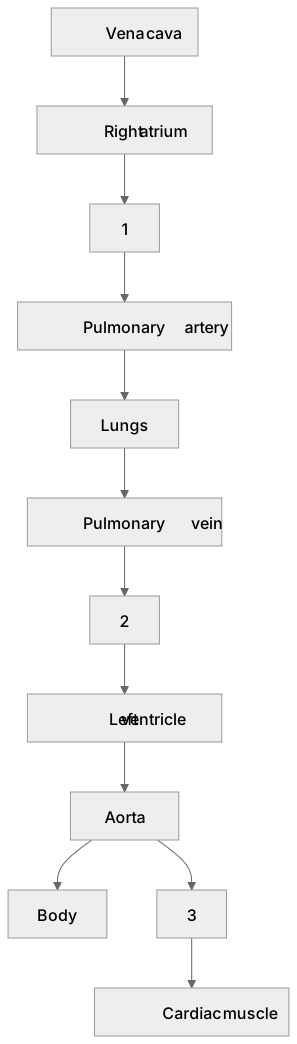
This statement fixes the list of vessel names you are accountable for. At the heart: the vena cava brings deoxygenated blood from the body into the right atrium, the pulmonary artery carries deoxygenated blood from the right ventricle to the lungs, the pulmonary vein returns oxygenated blood from the lungs to the left atrium, and the aorta carries oxygenated blood from the left ventricle to the body. At the kidneys, the renal artery enters and the renal vein leaves. The coronary arteries branch from the base of the aorta and supply the cardiac muscle itself with oxygenated blood; if one is blocked, the muscle it supplies is starved of oxygen, respires anaerobically and dies, which is a myocardial infarction. Two conventions make the list easier: arteries always carry blood away from the heart and veins towards it, and a vessel usually takes the name of the organ it serves.
What earns the marks
- Each vessel named on a labelled diagram: vena cava into the right atrium, aorta out of the left ventricle, renal artery into the kidney and renal vein out of it.
- Stating that the pulmonary artery carries deoxygenated blood and the pulmonary vein carries oxygenated blood.
- Naming the coronary arteries as the vessels supplying the heart muscle itself.
- Describing the consequence of a blocked coronary artery in terms of oxygen supply to cardiac muscle.
- Applying the direction rule, arteries away from the heart and veins towards it.
Common mistakes and how to put them right
Generalising that all arteries carry oxygenated blood and so mislabelling the pulmonary artery.
Answering simply an artery, when a named vessel is required and a named incorrect vessel is rejected outright.
Confusing the renal artery with the renal vein on an unlabelled diagram.
Describing the coronary arteries as the vessels carrying blood out of the heart to the body.
Learning long lists of vessels this specification does not require, and still not knowing the required seven.
Put it right: Vena cava, pulmonary artery, pulmonary vein, aorta, renal artery, renal vein and the coronary arteries.
Exam tips
- Learn the four heart vessels as two in and two out, then add the renal and coronary vessels.
- On an unlabelled heart, find the thick-walled left ventricle first and work outwards from there.
- Spell vessel names accurately; a vague answer is ignored but a named wrong vessel loses the mark outright.
Try the lesson
The start of the Mass transport in animals: Names are required only of the coronary arteries and of the blood vessels entering and leaving the heart, lungs and kidneys. lesson, made from checked teaching notes for this specification point.
Have a go first
Which blood vessel leaves the left ventricle of the heart and carries oxygenated blood to the body tissues?
Listen
This statement fixes the list of vessel names you are accountable for. At the heart: the vena cava brings deoxygenated blood from the body into the right atrium, the pulmonary artery carries deoxygenated blood from the right ventricle to the lungs, the pulmonary vein returns oxygenated blood from the lungs to the left atrium, and the aorta carries oxygenated blood from the left ventricle to the body. At the kidneys, the renal artery enters and the renal vein leaves. The coronary arteries branch from the base of the aorta and supply the cardiac muscle itself with oxygenated blood; if one is blocked, the muscle it supplies is starved of oxygen, respires anaerobically and dies, which is a myocardial infarction. Two conventions make the list easier: arteries always carry blood away from the heart and veins towards it, and a vessel usually takes the name of the organ it serves. A strong answer earns marks for these points. each vessel named on a labelled diagram: vena cava into the right atrium, aorta out of the left ventricle, renal artery into the kidney and renal vein out of it. stating that the pulmonary artery carries deoxygenated blood and the pulmonary vein carries oxygenated blood. naming the coronary arteries as the vessels supplying the heart muscle itself. describing the consequence of a blocked coronary artery in terms of oxygen supply to cardiac muscle. Exam tip: Learn the four heart vessels as two in and two out, then add the renal and coronary vessels.
See it
Key words
Say what each word means before you turn the card.
coronary arteries
Try answering aloud or in your head before turning the card.
vena cava
Try answering aloud or in your head before turning the card.
pulmonary vein
Try answering aloud or in your head before turning the card.
See every definition
- coronary arteries
- Vessels that branch from the base of the aorta and supply the cardiac muscle itself with oxygenated blood.
- vena cava
- Vessel that brings deoxygenated blood from the body into the right atrium.
- pulmonary vein
- Vessel that returns oxygenated blood from the lungs to the left atrium.
Label the diagram
Some boxes have lost their names. Pick the right name for each number.
1Box 1
2Box 2
3Box 3
There is more to this lesson
The full lesson goes on to check your understanding and help you earn the marks. Create a free account to carry on, with your progress saved.
A week of Premium from your first lesson · Then the free plan continues · No card, no charge
Test your understanding of Mass transport in animals: Names are required only of the coronary arteries and of the blood vessels entering and leaving the heart, lungs and kidneys.
Active recall beats re-reading. Take an instant quiz now to test what you’ve learned and lock it into long-term memory.
A week of Premium from your first lesson · Then the free plan continues · No card, no charge