AQA · A-Level · Biology
Course version: 7402 · Version from Sept 2016
Pressure and volume changes and associated valve movements during the…
Full specification wording
Mass transport in animals: Pressure and volume changes and associated valve movements during the cardiac cycle that maintain a unidirectional flow of blood.
One cardiac cycle has three stages.
Checked against the AQA 7402 specification (opens in a new tab) on .
- Point 10 of 14
- 3 key terms
Study notes
From the checked teaching notes for this specification point.
The idea
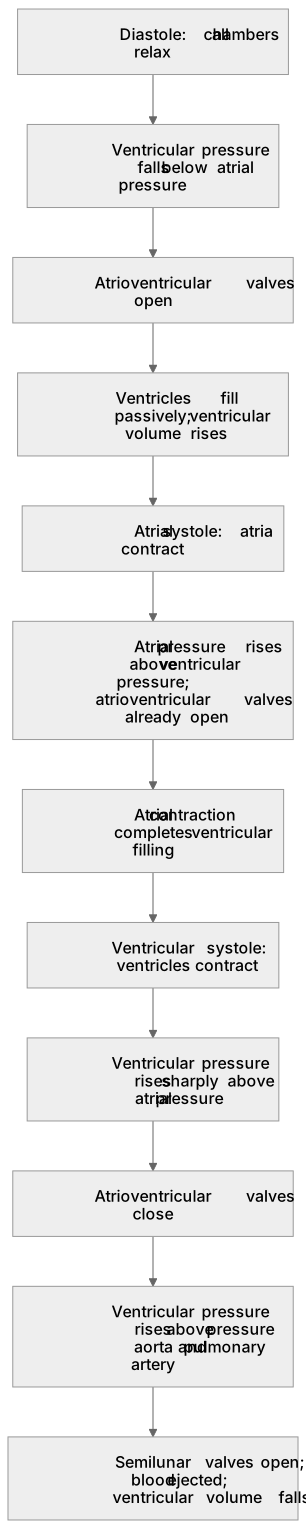
One cardiac cycle has three stages. In diastole all chambers relax, ventricular pressure falls below atrial pressure so the atrioventricular valves open and the ventricles fill passively, and ventricular volume rises. In atrial systole the atria contract, atrial pressure rises above ventricular pressure, the atrioventricular valves are already open and atrial contraction completes ventricular filling. In ventricular systole the ventricles contract, ventricular pressure rises sharply above atrial pressure and closes the atrioventricular valves; when it rises above the pressure in the aorta and pulmonary artery the semilunar valves open and blood is ejected, so ventricular volume falls. The essential principle is that valves are passive: each opens when the pressure behind it is greater than the pressure in front, and closes when that reverses.
What earns the marks
- Stating that a valve opens when the pressure behind it is greater than the pressure in front of it.
- Identifying the point where two pressure curves cross as a named valve opening or closing.
- Linking contraction of a chamber to a decrease in its volume and an increase in its pressure.
- Explaining that the closed atrioventricular valves during ventricular systole prevent backflow into the atria.
- Calculating heart rate in beats per minute from the duration of one cycle read from the graph.
Common mistakes and how to put them right
Saying valves open and close by themselves, or that muscles open them.
Put it right: Valves are passive and respond to pressure differences.
Naming the wrong valve because the atrial, ventricular and aortic curves were never identified first.
Put it right: Label the curves before answering.
Describing ventricular systole as the stage when blood flows into the ventricle.
Put it right: Blood enters the ventricle during diastole and atrial systole, and leaves during ventricular systole.
Giving heart rate in beats per second, or dividing by the wrong time value when converting.
Put it right: Read one full cycle in seconds and use 60 divided by that value.
Claiming ventricular pressure is always higher than atrial pressure.
Put it right: During diastole and atrial systole atrial pressure exceeds ventricular pressure, which is why the atrioventricular valves open.
Exam tips
- Label the three curves on a cardiac cycle graph before answering anything: atrium, ventricle, aorta.
- Every valve answer needs the words pressure greater than; the valve shuts to stop backflow is only half an answer.
- To find heart rate, read the length of one full cycle in seconds and work out sixty divided by that value.
Try the lesson
The start of the Mass transport in animals: Pressure and volume changes and associated valve movements during the cardiac cycle that maintain a unidirectional flow of blood. lesson, made from checked teaching notes for this specification point.
Have a go first
During which phase of the cardiac cycle do the atrioventricular valves close?
Listen
One cardiac cycle has three stages. In diastole all chambers relax, ventricular pressure falls below atrial pressure so the atrioventricular valves open and the ventricles fill passively, and ventricular volume rises. In atrial systole the atria contract, atrial pressure rises above ventricular pressure, the atrioventricular valves are already open and atrial contraction completes ventricular filling. In ventricular systole the ventricles contract, ventricular pressure rises sharply above atrial pressure and closes the atrioventricular valves; when it rises above the pressure in the aorta and pulmonary artery the semilunar valves open and blood is ejected, so ventricular volume falls. The essential principle is that valves are passive: each opens when the pressure behind it is greater than the pressure in front, and closes when that reverses. A strong answer earns marks for these points. stating that a valve opens when the pressure behind it is greater than the pressure in front of it. identifying the point where two pressure curves cross as a named valve opening or closing. linking contraction of a chamber to a decrease in its volume and an increase in its pressure. explaining that the closed atrioventricular valves during ventricular systole prevent backflow into the atria. Exam tip: Label the three curves on a cardiac cycle graph before answering anything: atrium, ventricle, aorta.
See it
Key words
Say what each word means before you turn the card.
diastole
Try answering aloud or in your head before turning the card.
atrial systole
Try answering aloud or in your head before turning the card.
pressure differences across valves
Try answering aloud or in your head before turning the card.
See every definition
- diastole
- All chambers relax, ventricular pressure falls below atrial pressure so the atrioventricular valves open and the ventricles fill passively, and ventricular volume rises.
- atrial systole
- The atria contract, atrial pressure rises above ventricular pressure, the atrioventricular valves are already open and atrial contraction completes ventricular filling.
- pressure differences across valves
- Valves are passive: each opens when the pressure behind it is greater than the pressure in front, and closes when that reverses.
Label the diagram
Some boxes have lost their names. Pick the right name for each number.
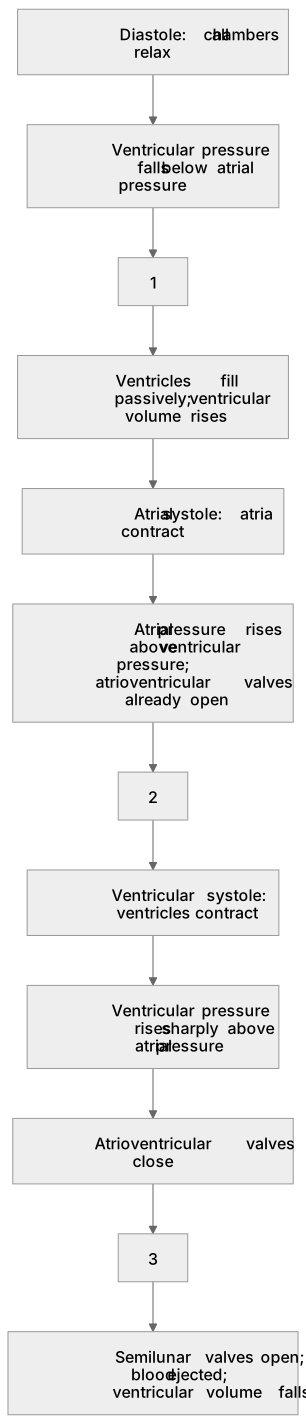
1Box 1
2Box 2
3Box 3
There is more to this lesson
The full lesson goes on to check your understanding and help you earn the marks. Create a free account to carry on, with your progress saved.
A week of Premium from your first lesson · Then the free plan continues · No card, no charge
Test your understanding of Mass transport in animals: Pressure and volume changes and associated valve movements during the cardiac cycle that maintain a unidirectional flow of blood.
Active recall beats re-reading. Take an instant quiz now to test what you’ve learned and lock it into long-term memory.
A week of Premium from your first lesson · Then the free plan continues · No card, no charge