AQA · A-Level · Biology
Course version: 7402 · Version from Sept 2016
Unipotent cells, exemplified by the formation of cardiomyocytes.
Full specification wording
Most of a cell’s DNA is not translated (A-level only): Unipotent cells, exemplified by the formation of cardiomyocytes.
Unipotent cells are a highly restricted category of stem cell found in mature mammals.
Checked against the AQA 7402 specification (opens in a new tab) on .
- Point 6 of 8
- 4 key terms
Study notes
From the checked teaching notes for this specification point.
The idea
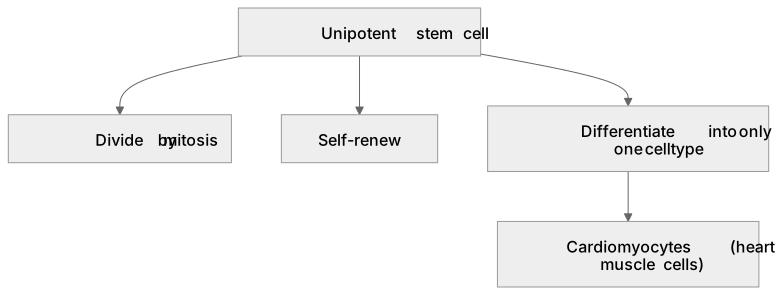
Unipotent cells are a highly restricted category of stem cell found in mature mammals. They retain the capacity to divide by mitosis and self-renew, but they can only differentiate into one specific cell type. The specification explicitly requires knowledge of cardiomyocytes (heart muscle cells) as the key example of cells formed from unipotent stem cells. While other stem cells like multipotent or pluripotent cells can form multiple lineages, unipotent cells are specialised for producing a single lineage. Understanding this concept is crucial when comparing the differentiation potential of various stem cell types in mammalian tissues.
What earns the marks
- Unipotent cells are stem cells that can divide by mitosis and differentiate into only one specific type of cell.
- Cardiomyocytes (heart muscle cells) are the specific specification example of cells formed from unipotent cells.
- Unipotent cells differ from multipotent cells because they have a more restricted differentiation potential (one cell type versus multiple).
- Like all stem cells, unipotent cells retain the ability to self-renew alongside their capacity to differentiate.
Common mistakes and how to put them right
Confusing unipotent cells with multipotent cells.
Put it right: Multipotent cells can differentiate into a limited number of different cell types (e.g. bone marrow forming various blood cells), whereas unipotent cells differentiate into only one type.
Stating that unipotent cells cannot divide.
Put it right: Unipotent cells are stem cells, meaning they retain the capacity to divide by mitosis to self-renew, as well as differentiate.
Assuming unipotent cells can form any tissue.
Put it right: Unipotent cells have the most restricted differentiation potential and are limited to a single lineage, such as forming cardiomyocytes.
Exam tips
- Always use the specific term 'cardiomyocytes' when asked for an example of unipotent cell differentiation, as this is explicitly required by the specification.
- Be prepared to compare the properties of unipotent cells with totipotent, pluripotent, and multipotent stem cells in extended response questions.
Try the lesson
The start of the Most of a cell’s DNA is not translated (A-level only): Unipotent cells, exemplified by the formation of cardiomyocytes. lesson, made from checked teaching notes for this specification point.
Have a go first
What name is given to stem cells that can differentiate into only one cell type, such as the formation of cardiomyocytes?
Listen
Unipotent cells are a highly restricted category of stem cell found in mature mammals. They retain the capacity to divide by mitosis and self-renew, but they can only differentiate into one specific cell type. The specification explicitly requires knowledge of cardiomyocytes (heart muscle cells) as the key example of cells formed from unipotent stem cells. While other stem cells like multipotent or pluripotent cells can form multiple lineages, unipotent cells are specialised for producing a single lineage. Understanding this concept is crucial when comparing the differentiation potential of various stem cell types in mammalian tissues. A strong answer earns marks for these points. Unipotent cells are stem cells that can divide by mitosis and differentiate into only one specific type of cell. Cardiomyocytes (heart muscle cells) are the specific specification example of cells formed from unipotent cells. Unipotent cells differ from multipotent cells because they have a more restricted differentiation potential (one cell type versus multiple). Like all stem cells, unipotent cells retain the ability to self-renew alongside their capacity to differentiate. A common slip: Confusing unipotent cells with multipotent cells. Instead, Multipotent cells can differentiate into a limited number of different cell types (e.g. bone marrow forming various blood cells), whereas unipotent cells differentiate into only one type. Exam tip: Always use the specific term 'cardiomyocytes' when asked for an example of unipotent cell differentiation, as this is explicitly required by the specification.
See it
Key words
Say what each word means before you turn the card.
unipotent cells
Try answering aloud or in your head before turning the card.
cardiomyocytes
Try answering aloud or in your head before turning the card.
cellular differentiation
Try answering aloud or in your head before turning the card.
stem cell potency
Try answering aloud or in your head before turning the card.
See every definition
- unipotent cells
- A highly restricted category of stem cell found in mature mammals that can only differentiate into one specific cell type.
- cardiomyocytes
- Heart muscle cells, which are the specific specification example of cells formed from unipotent cells.
- cellular differentiation
- The process by which a stem cell develops into a specific type of cell, with unipotent cells limited to a single lineage.
- stem cell potency
- The differentiation potential of a stem cell, which for unipotent cells is the most restricted, being limited to a single lineage.
Label the diagram
Some boxes have lost their names. Pick the right name for each number.
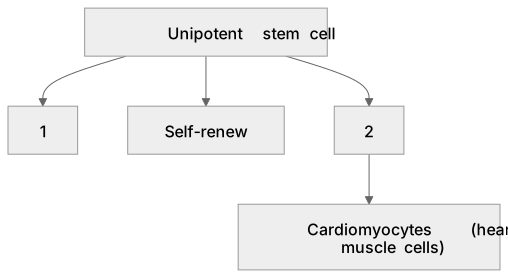
1Box 1
2Box 2
There is more to this lesson
The full lesson goes on to check your understanding and help you earn the marks. Create a free account to carry on, with your progress saved.
A week of Premium from your first lesson · Then the free plan continues · No card, no charge
Test your understanding of Most of a cell’s DNA is not translated (A-level only): Unipotent cells, exemplified by the formation of cardiomyocytes.
Active recall beats re-reading. Take an instant quiz now to test what you’ve learned and lock it into long-term memory.
A week of Premium from your first lesson · Then the free plan continues · No card, no charge