AQA · A-Level · Biology
Course version: 7402 · Version from Sept 2016
Within a habitat, a species occupies a niche governed by adaptation to…
Full specification wording
Populations in ecosystems (A-level only): Within a habitat, a species occupies a niche governed by adaptation to both abiotic and biotic conditions.
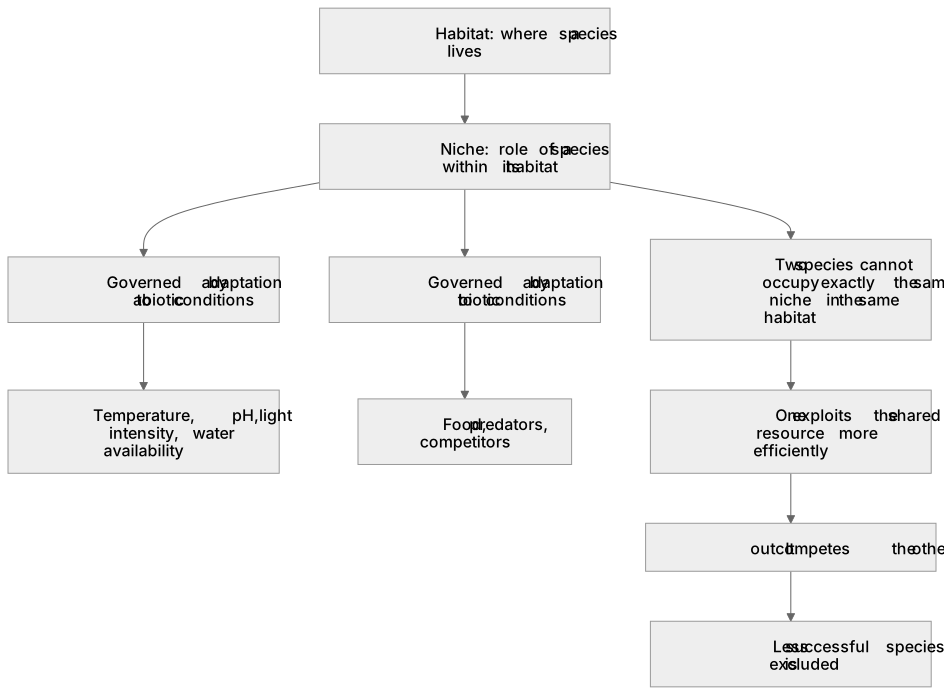
A habitat is where a species lives; a niche is its role, governed by adaptation to abiotic and biotic conditions.
Checked against the AQA 7402 specification (opens in a new tab) on .
- Point 4 of 14
- 4 key terms
Study notes
From the checked teaching notes for this specification point.
The idea
A habitat is where a species lives; a niche is its role, governed by adaptation to abiotic and biotic conditions. A niche includes tolerated abiotic conditions (temperature, pH, light intensity, water availability) and biotic relationships (food, predators, competitors). For example, a red squirrel's niche includes feeding on pine cones in coniferous woodland and being active during the day; the woodland itself is its habitat, not its niche. Because a niche is defined by adaptation, each species has its own. Two species cannot occupy exactly the same niche in the same habitat. One will exploit the shared resource more efficiently, outcompete the other, and the less successful species will be excluded.
What earns the marks
- A niche being the role or position of a species within its habitat, not simply where it lives.
- Naming an abiotic condition such as temperature, pH, light intensity, salinity or water availability.
- Naming a biotic condition such as food source, predators, competitors or pollinators.
- Stating that two species cannot occupy the same niche in the same habitat.
- Explaining exclusion, where one species outcompetes the other so that its population falls.
Common mistakes and how to put them right
Defining a niche as where an organism lives, which is the habitat.
Giving different altitudes or depths as the abiotic factor, which is insufficient without naming temperature, light intensity or oxygen concentration.
Claiming two species sharing a food source must share a niche, when the niches differ in feeding height, timing or prey size.
Classifying predators or competitors as abiotic conditions.
Assuming the outcompeted species must become extinct rather than being excluded from that habitat.
Exam tips
- If you write altitude, depth or distance up a shore, immediately add the abiotic factor that changes along it.
- Use adapted to explicitly, because the specification wording ties the niche to adaptation.
- In distribution questions, match each species to the conditions given in the stem before writing the explanation.
Try the lesson
The start of the Populations in ecosystems (A-level only): Within a habitat, a species occupies a niche governed by adaptation to both abiotic and biotic conditions. lesson, made from checked teaching notes for this specification point.
Have a go first
What is meant by the niche of a species within a habitat?
Listen
A habitat is where a species lives; a niche is its role, governed by adaptation to abiotic and biotic conditions. A niche includes tolerated abiotic conditions (temperature, pH, light intensity, water availability) and biotic relationships (food, predators, competitors). For example, a red squirrel's niche includes feeding on pine cones in coniferous woodland and being active during the day; the woodland itself is its habitat, not its niche. Because a niche is defined by adaptation, each species has its own. Two species cannot occupy exactly the same niche in the same habitat. One will exploit the shared resource more efficiently, outcompete the other, and the less successful species will be excluded. A strong answer earns marks for these points. a niche being the role or position of a species within its habitat, not simply where it lives. naming an abiotic condition such as temperature, pH, light intensity, salinity or water availability. naming a biotic condition such as food source, predators, competitors or pollinators. stating that two species cannot occupy the same niche in the same habitat. Exam tip: If you write altitude, depth or distance up a shore, immediately add the abiotic factor that changes along it.
See it
Key words
Say what each word means before you turn the card.
niche
Try answering aloud or in your head before turning the card.
habitat
Try answering aloud or in your head before turning the card.
abiotic conditions
Try answering aloud or in your head before turning the card.
biotic conditions
Try answering aloud or in your head before turning the card.
See every definition
- niche
- The role or position of a species within its habitat, governed by adaptation to both abiotic and biotic conditions.
- habitat
- Where a species lives, rather than its role or position.
- abiotic conditions
- Tolerated conditions such as temperature, pH, light intensity and water availability.
- biotic conditions
- Relationships such as food, predators and competitors.
Label the diagram
Some boxes have lost their names. Pick the right name for each number.
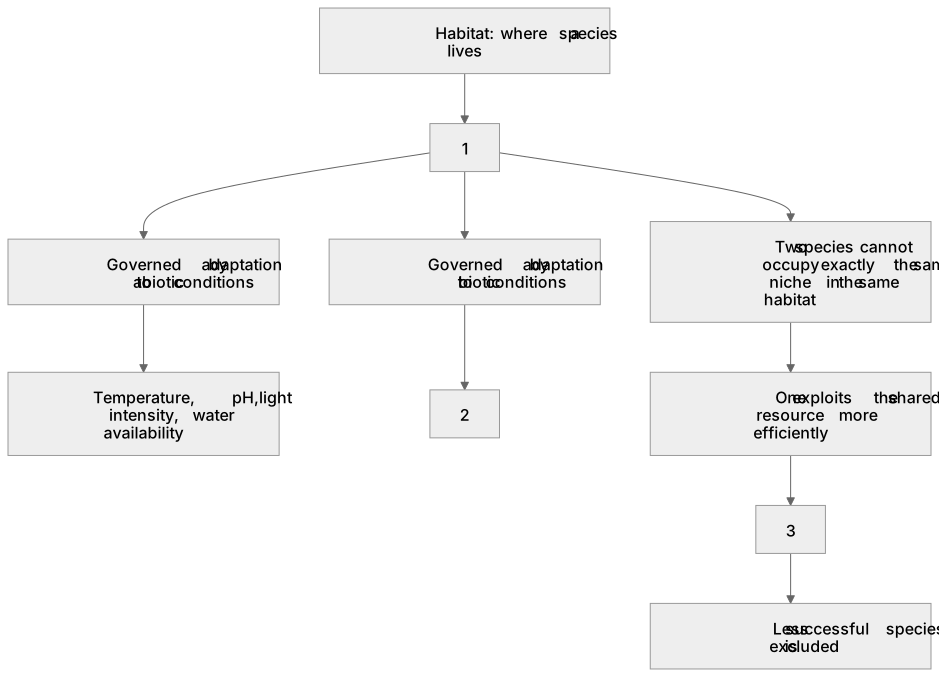
1Box 1
2Box 2
3Box 3
There is more to this lesson
The full lesson goes on to check your understanding and help you earn the marks. Create a free account to carry on, with your progress saved.
A week of Premium from your first lesson · Then the free plan continues · No card, no charge
Test your understanding of Populations in ecosystems (A-level only): Within a habitat, a species occupies a niche governed by adaptation to both abiotic and biotic conditions.
Active recall beats re-reading. Take an instant quiz now to test what you’ve learned and lock it into long-term memory.
A week of Premium from your first lesson · Then the free plan continues · No card, no charge