AQA · A-Level · Biology
Course version: 7402 · Version from Sept 2016
A phylogenetic classification system attempts to arrange species into…
Full specification wording
Species and taxonomy: A phylogenetic classification system attempts to arrange species into groups based on their evolutionary origins and relationships.
A phylogenetic classification groups species by evolutionary history: organisms are placed together because they share a common ancestor.
Checked against the AQA 7402 specification (opens in a new tab) on .
- Point 4 of 9
- 2 key terms
Study notes
From the checked teaching notes for this specification point.
The idea
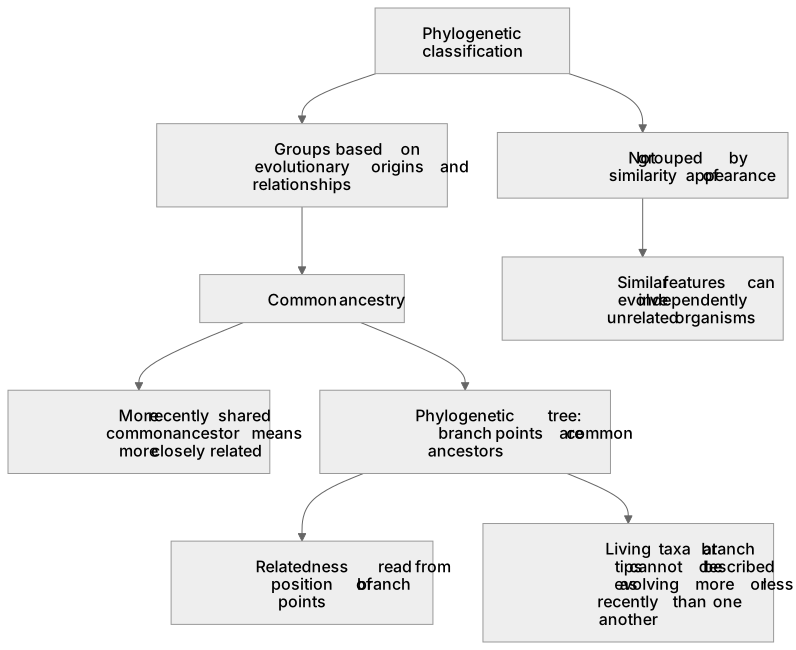
A phylogenetic classification groups species by evolutionary history: organisms are placed together because they share a common ancestor. The more recently they shared that ancestor, the more closely related they are and the smaller the group they share. This differs from grouping by appearance alone, because similar features can evolve independently in unrelated organisms exposed to similar conditions. Phylogeny is usually drawn as a branching tree in which every branch point (node) is a common ancestor and the branches show the order in which lineages separated. Reading such a diagram is a key skill: relatedness is read from the position of the branch points, not from how close two names happen to sit on the page. Living taxa at the tips of the branches cannot be described as having evolved more or less recently than one another.
What earns the marks
- State that groups are based on evolutionary origins and common ancestry rather than on similarity of appearance.
- State that the more recently two species shared a common ancestor, the more closely related they are.
- When reading a phylogenetic diagram, identify the most recent common ancestor shared by specific taxa to determine relatedness.
- Identify a piece of data that does not fit a suggested trend, such as a taxon with an unexpected value compared to its close relatives.
- Name the comparison of DNA base sequences, mRNA, or amino acid sequences as the evidence used to place groups.
Common mistakes and how to put them right
Describing a phylogenetic system as grouping organisms that look alike, which is the definition of a system based on observable characteristics.
Assuming that convergent features, such as the streamlined body of a fish and of a dolphin, show close relatedness.
Reading a tree from left to right and calling the right-hand taxon the most advanced or most evolved.
In a 'do the data support this?' question, giving only supporting points and losing the marks reserved for evidence against.
Saying one living species evolved from another living species rather than from a shared common ancestor.
Exam tips
- In a justify question about a phylogenetic data set, write at least one point for and one point against, because a balanced answer is more likely to access all the available marks.
- Quote the named taxa and the figures from the diagram rather than writing 'the earlier group' and 'the later group'.
- Learn the distinction in one sentence: a phylogenetic system groups by ancestry, and the evidence for ancestry is sequence data.
Try the lesson
The start of the Species and taxonomy: A phylogenetic classification system attempts to arrange species into groups based on their evolutionary origins and relationships. lesson, made from checked teaching notes for this specification point.
Have a go first
What does a phylogenetic classification system use to arrange species into groups?
Listen
A phylogenetic classification groups species by evolutionary history: organisms are placed together because they share a common ancestor. The more recently they shared that ancestor, the more closely related they are and the smaller the group they share. This differs from grouping by appearance alone, because similar features can evolve independently in unrelated organisms exposed to similar conditions. Phylogeny is usually drawn as a branching tree in which every branch point (node) is a common ancestor and the branches show the order in which lineages separated. Reading such a diagram is a key skill: relatedness is read from the position of the branch points, not from how close two names happen to sit on the page. Living taxa at the tips of the branches cannot be described as having evolved more or less recently than one another. A strong answer earns marks for these points. State that groups are based on evolutionary origins and common ancestry rather than on similarity of appearance. State that the more recently two species shared a common ancestor, the more closely related they are. When reading a phylogenetic diagram, identify the most recent common ancestor shared by specific taxa to determine relatedness. Identify a piece of data that does not fit a suggested trend, such as a taxon with an unexpected value compared to its close relatives. Exam tip: In a justify question about a phylogenetic data set, write at least one point for and one point against, because a balanced answer is more likely to access all the available marks.
See it
Key words
Say what each word means before you turn the card.
convergent similarity
Try answering aloud or in your head before turning the card.
branching diagrams
Try answering aloud or in your head before turning the card.
See every definition
- convergent similarity
- Similar features that can evolve independently in unrelated organisms exposed to similar conditions, so they do not show close relatedness.
- branching diagrams
- A tree in which every branch point is a common ancestor and the branches show the order in which lineages separated.
Label the diagram
Some boxes have lost their names. Pick the right name for each number.
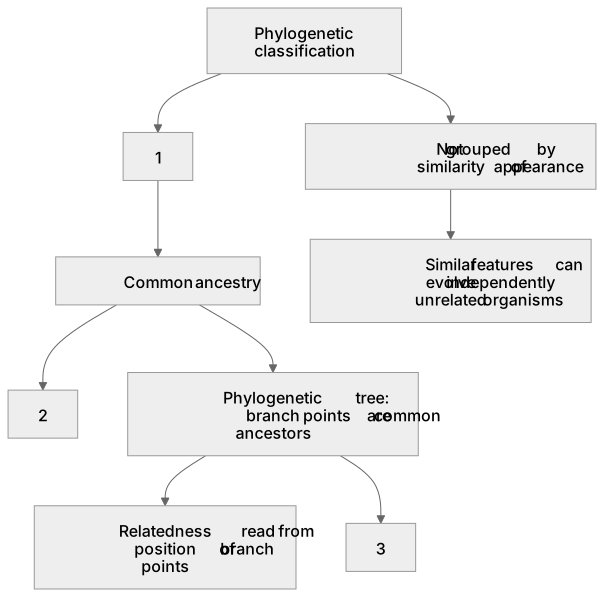
1Box 1
2Box 2
3Box 3
There is more to this lesson
The full lesson goes on to check your understanding and help you earn the marks. Create a free account to carry on, with your progress saved.
A week of Premium from your first lesson · Then the free plan continues · No card, no charge
Test your understanding of Species and taxonomy: A phylogenetic classification system attempts to arrange species into groups based on their evolutionary origins and relationships.
Active recall beats re-reading. Take an instant quiz now to test what you’ve learned and lock it into long-term memory.
A week of Premium from your first lesson · Then the free plan continues · No card, no charge