AQA · A-Level · Biology
Course version: 7402 · Version from Sept 2016
Species and taxonomy: The role of courtship in species recognition.
Courtship displays are species-specific.
Checked against the AQA 7402 specification (opens in a new tab) on .
- Point 3 of 9
Study notes
From the checked teaching notes for this specification point.
The idea
Courtship displays are species-specific. The pattern of movement, sound, or scent is characteristic of one species, and only a member of that species gives the correct response. Because courtship works as a chain of stimulus and response, an individual of another species fails to respond correctly, stopping the chain and preventing mating. This is crucial because interspecific mating often produces no offspring or infertile hybrids (like mules). Therefore, gametes, time, and energy would be wasted. Species recognition prevents this waste, helping to keep the gene pools of closely related species separate. It acts as a mechanism of reproductive isolation.
What earns the marks
- Stating that a courtship display or behaviour is specific to one species.
- Explaining that only a member of the same species gives the correct response, so the stimulus-response chain is not completed with another species.
- Stating that mating with a different species often produces no offspring or infertile offspring.
- Concluding that species recognition prevents the waste of gametes, time, or energy.
- Linking failed recognition to reproductive isolation and the maintenance of separate gene pools.
Common mistakes and how to put them right
Stating courtship allows an animal to recognise 'the right mate' without explicitly specifying 'a member of the same species'.
Put it right: Use the exact terminology.
Claiming cross-species mating always produces no offspring.
Put it right by stating it often produces no offspring, or produces infertile hybrids (such as the mule, which is the infertile offspring of a horse and a donkey).
Confusing species recognition with recognising the opposite sex or sexual maturity.
Put it right: These are distinct functions of courtship and should be treated as separate marking points.
Anthropomorphising by writing that animals 'know' they belong to the same species.
Put it right by describing it as an innate response to a specific stimulus.
Exam tips
- Answer in three steps: the display is species-specific, only that species responds correctly, so gametes are not wasted on an infertile mating.
- If a question features two closely related species in the same habitat, use differences in courtship behaviour as the reproductive isolation mechanism keeping their gene pools separate.
- Always use the phrase 'members of the same species'; vague terms like 'the right partner' or 'compatible mate' rarely score marks.
Try the lesson
The start of the Species and taxonomy: The role of courtship in species recognition. lesson, made from checked teaching notes for this specification point.
Have a go first
What is the primary role of courtship behaviour in ensuring reproductive success?
Listen
Courtship displays are species-specific. The pattern of movement, sound, or scent is characteristic of one species, and only a member of that species gives the correct response. Because courtship works as a chain of stimulus and response, an individual of another species fails to respond correctly, stopping the chain and preventing mating. This is crucial because interspecific mating often produces no offspring or infertile hybrids (like mules). Therefore, gametes, time, and energy would be wasted. Species recognition prevents this waste, helping to keep the gene pools of closely related species separate. It acts as a mechanism of reproductive isolation. A strong answer earns marks for these points. stating that a courtship display or behaviour is specific to one species. explaining that only a member of the same species gives the correct response, so the stimulus-response chain is not completed with another species. stating that mating with a different species often produces no offspring or infertile offspring. concluding that species recognition prevents the waste of gametes, time, or energy. A common slip: Claiming cross-species mating always produces no offspring. Instead, stating it often produces no offspring, or produces infertile hybrids (such as the mule, which is the infertile offspring of a horse and a donkey). Exam tip: Answer in three steps: the display is species-specific, only that species responds correctly, so gametes are not wasted on an infertile mating.
See it
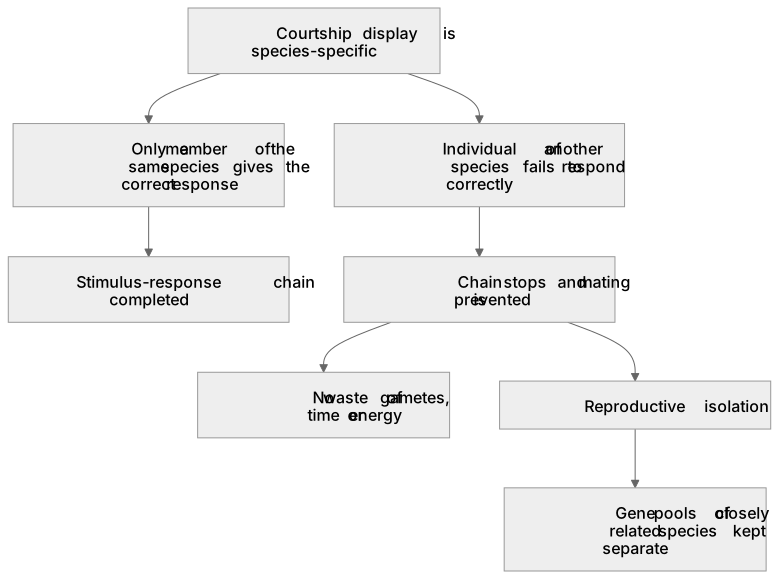
Label the diagram
Some boxes have lost their names. Pick the right name for each number.
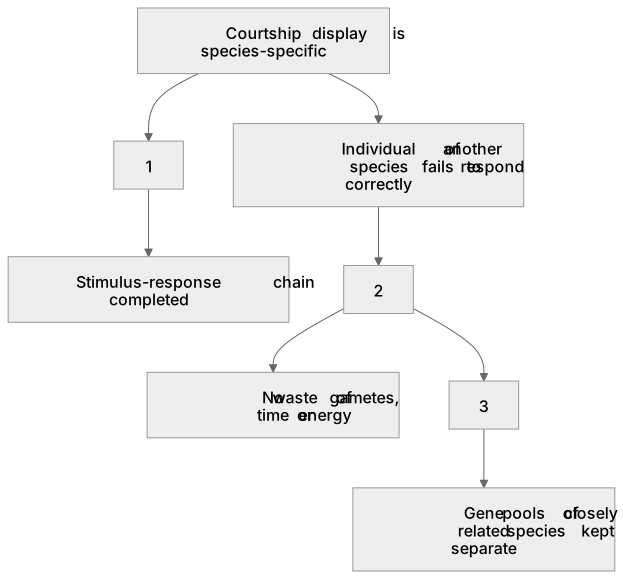
1Box 1
2Box 2
3Box 3
There is more to this lesson
The full lesson goes on to check your understanding and help you earn the marks. Create a free account to carry on, with your progress saved.
A week of Premium from your first lesson · Then the free plan continues · No card, no charge
Test your understanding of Species and taxonomy: The role of courtship in species recognition.
Active recall beats re-reading. Take an instant quiz now to test what you’ve learned and lock it into long-term memory.
A week of Premium from your first lesson · Then the free plan continues · No card, no charge