AQA · GCSE · Biology
Course version: 8461 · Version from Sept 2018
Active transport allows mineral ions to be absorbed into plant root hairs…
Full specification wording
Active transport: Active transport allows mineral ions to be absorbed into plant root hairs from very dilute solutions in the soil. Plants require ions for healthy growth.
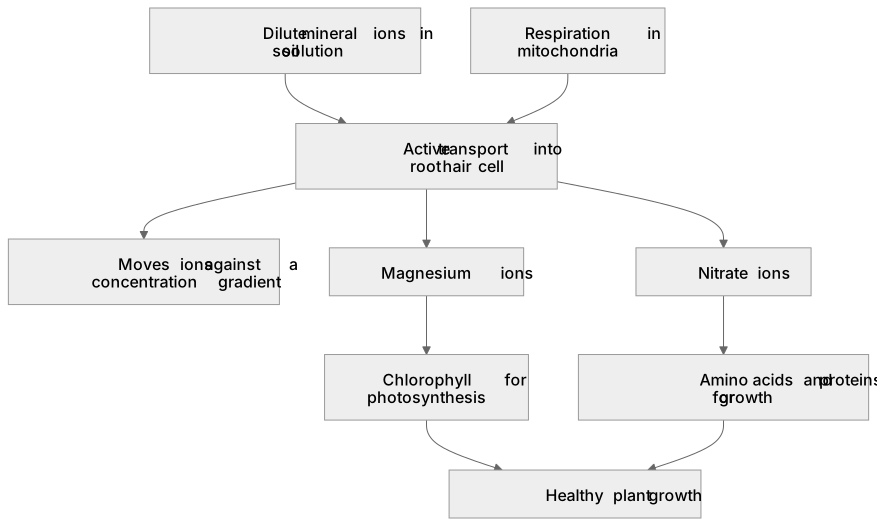
Active transport moves mineral ions into root hair cells against a concentration gradient, from a more dilute solution in the soil to a more concentrated solution in the cytoplasm.
Checked against the AQA 8461 specification (opens in a new tab) on .
- Point 3 of 6
Study notes
From the checked teaching notes for this specification point.
The idea
Active transport moves mineral ions into root hair cells against a concentration gradient, from a more dilute solution in the soil to a more concentrated solution in the cytoplasm. It requires energy from respiration. Root hair cells have a large surface area and many mitochondria to provide the energy needed, so they absorb ions even when soil concentrations are very low. Plants require these ions for healthy growth; for example, magnesium ions are needed to make chlorophyll, and nitrate ions are needed to make amino acids and proteins. If respiration is blocked, ion uptake slows or stops, demonstrating that the process is active rather than passive diffusion.
What earns the marks
- Active transport moves mineral ions against a concentration gradient, from a dilute soil solution into root hair cells.
- The process requires energy released by respiration, which is provided by mitochondria in the root hair cells.
- Root hair cells are adapted with a large surface area to maximise the uptake of water and mineral ions.
- Plants require specific ions for healthy growth: magnesium ions are used to make chlorophyll for photosynthesis.
- Nitrate ions are absorbed and used to make amino acids, which are then synthesised into proteins for growth.
- If respiration is inhibited, ion uptake decreases, providing evidence that active transport is occurring.
Common mistakes and how to put them right
Thinking mineral ions enter by diffusion because the soil solution is dilute.
Put it right by stating that active transport moves ions against the concentration gradient and requires energy.
Incorrectly stating that nitrate or potassium is used to make chlorophyll.
Put it right by specifying that magnesium is required for chlorophyll synthesis.
Believing active transport uses no energy because it happens in plants.
Put it right by linking the process to cellular respiration.
Exam tips
- Name the specific ion and its use, such as magnesium for chlorophyll or nitrate for proteins, when discussing plant growth.
- Link the need for energy to respiration and mitochondria rather than simply writing that energy is needed.
Try the lesson
The start of the Active transport: Active transport allows mineral ions to be absorbed into plant root hairs from very dilute solutions in the soil. Plants require ions for healthy growth. lesson, made from checked teaching notes for this specification point.
Have a go first
Mineral ions in the soil are at a very dilute concentration, yet they are absorbed into plant root hair cells. Which process moves these ions into the root hair cells?
Listen
Active transport moves mineral ions into root hair cells against a concentration gradient, from a more dilute solution in the soil to a more concentrated solution in the cytoplasm. It requires energy from respiration. Root hair cells have a large surface area and many mitochondria to provide the energy needed, so they absorb ions even when soil concentrations are very low. Plants require these ions for healthy growth; for example, magnesium ions are needed to make chlorophyll, and nitrate ions are needed to make amino acids and proteins. If respiration is blocked, ion uptake slows or stops, demonstrating that the process is active rather than passive diffusion. A strong answer earns marks for these points. Active transport moves mineral ions against a concentration gradient, from a dilute soil solution into root hair cells. The process requires energy released by respiration, which is provided by mitochondria in the root hair cells. Root hair cells are adapted with a large surface area to maximise the uptake of water and mineral ions. Plants require specific ions for healthy growth: magnesium ions are used to make chlorophyll for photosynthesis. A common slip: Thinking mineral ions enter by diffusion because the soil solution is dilute. Instead, stating that active transport moves ions against the concentration gradient and requires energy. Exam tip: Name the specific ion and its use, such as magnesium for chlorophyll or nitrate for proteins, when discussing plant growth.
See it
Watch it explained
What happens to mineral ion uptake if respiration is blocked?
Read the described scene instead
Active transport is a way substances move across membranes. In plants, it moves mineral ions into root hair cells against a concentration gradient. The soil solution is more dilute, while the cytoplasm is more concentrated. Because the movement is against the gradient, it needs energy. Root hair cells are adapted for uptake. They have a large surface area, which maximises the absorption of water and mineral ions. They also contain many mitochondria. These mitochondria provide energy from respiration, and that energy drives active transport. In active transport, mineral ions are absorbed into root hair cells even when soil concentrations are very low. The ions move from a more dilute solution in the soil to a more concentrated solution in the cytoplasm. If respiration is blocked, ion uptake slows or stops. That shows the process is active rather than passive diffusion. Here is a useful connection. Suppose a root hair cell is treated so respiration is blocked. Pause and think: what happens to mineral ion uptake? Active transport needs energy from respiration. So ion uptake slows or stops. This helps distinguish active transport from passive diffusion; the result supports active transport rather than passive diffusion. Be careful with three common mistakes. First, do not say mineral ions enter by diffusion just because the soil solution is dilute. Active transport moves ions against the concentration gradient and requires energy. Second, magnesium ions are needed to make chlorophyll; nitrate ions are needed to make amino acids and proteins. Third, do not say active transport uses no energy because it happens in plants. To recap, active transport moves mineral ions into root hair cells against a concentration gradient. It requires energy from respiration, supplied by mitochondria. Root hair cells have a large surface area for uptake. Plants need ions for healthy growth: magnesium for chlorophyll, and nitrate for amino acids and proteins. Blocking respiration slows or stops uptake, showing the process is active.
Label the diagram
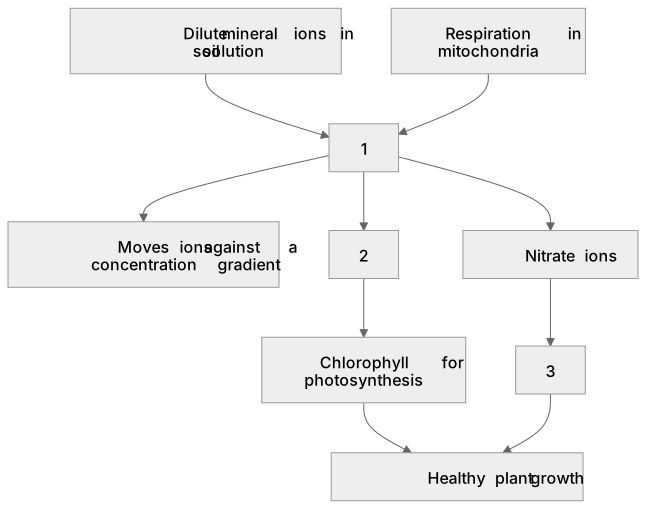
Some boxes have lost their names. Pick the right name for each number.
1Box 1
2Box 2
3Box 3
There is more to this lesson
The full lesson goes on to check your understanding and help you earn the marks. Create a free account to carry on, with your progress saved.
A week of Premium from your first lesson · Then the free plan continues · No card, no charge
Test your understanding of Active transport: Active transport allows mineral ions to be absorbed into plant root hairs from very dilute solutions in the soil. Plants require ions for healthy growth.
Active recall beats re-reading. Take an instant quiz now to test what you’ve learned and lock it into long-term memory.
A week of Premium from your first lesson · Then the free plan continues · No card, no charge