AQA · GCSE · Biology
Course version: 8461 · Version from Sept 2018
Students should be able to: • describe how substances are transported into…
Full specification wording
Active transport: Students should be able to: • describe how substances are transported into and out of cells by diffusion, osmosis and active transport • explain the differences between the three processes.
Substances cross cell membranes in three ways.
Checked against the AQA 8461 specification (opens in a new tab) on .
- Point 6 of 6
- 4 key terms
Study notes
From the checked teaching notes for this specification point.
The idea
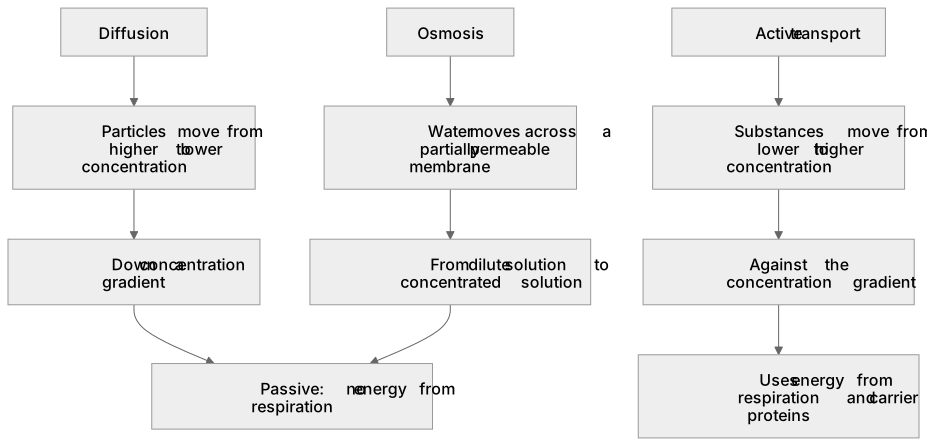
Substances cross cell membranes in three ways. Diffusion is the net movement of particles from a region of higher concentration to a region of lower concentration, down a concentration gradient, and it is passive because no energy is transferred from respiration. Osmosis is the diffusion of water across a partially permeable membrane from a dilute solution (higher water potential) to a concentrated solution (lower water potential). Active transport moves substances from a lower concentration to a higher concentration, against the gradient, using energy from respiration and carrier proteins in the membrane. Root hair cells absorb mineral ions by active transport; oxygen diffuses into alveoli capillaries; water enters root hair cells by osmosis.
What earns the marks
- Diffusion is described as net movement of particles from higher to lower concentration, down a concentration gradient, and as a passive process requiring no energy from respiration.
- Osmosis is described as the diffusion of water through a partially permeable membrane from a dilute solution to a concentrated solution, or from higher to lower water potential.
- Active transport is described as movement of substances from lower to higher concentration, against a concentration gradient, requiring energy from respiration and carrier proteins.
- A valid comparison is made: diffusion and osmosis are passive, whereas active transport is active and uses energy released by respiration.
- A correct example is linked to each process, such as oxygen diffusing into blood, water entering root hair cells by osmosis, and mineral ions being absorbed by root hair cells by active transport.
- The role of the partially permeable membrane is identified in osmosis, and the role of carrier proteins is identified in active transport.
Common mistakes and how to put them right
Saying that diffusion stops when concentrations become equal.
Put it right: Net movement stops at dynamic equilibrium, but particles continue to move in both directions.
Describing osmosis as the movement of any dissolved substance rather than water.
Put it right: Osmosis refers specifically to water moving across a partially permeable membrane.
Stating that active transport happens because particles naturally spread out.
Put it right: Active transport moves substances against the concentration gradient and therefore needs energy from respiration.
Exam tips
- Use the phrase 'net movement' when defining diffusion, because it shows you understand that particles move both ways but the overall movement is down the gradient.
- When comparing the three processes, structure your answer around direction of movement, membrane involvement and energy requirement.
- Link each process to a named biological example, such as gas exchange in alveoli, water uptake by root hair cells or ion uptake by root hair cells, to show applied understanding.
Try the lesson
The start of the Active transport: Students should be able to: • describe how substances are transported into and out of cells by diffusion, osmosis and active transport • explain the differences between the three processes. lesson, made from checked teaching notes for this specification point.
Have a go first
Which process moves a substance into a cell against its concentration gradient?
Listen
Substances cross cell membranes in three ways. Diffusion is the net movement of particles from a region of higher concentration to a region of lower concentration, down a concentration gradient, and it is passive because no energy is transferred from respiration. Osmosis is the diffusion of water across a partially permeable membrane from a dilute solution (higher water potential) to a concentrated solution (lower water potential). Active transport moves substances from a lower concentration to a higher concentration, against the gradient, using energy from respiration and carrier proteins in the membrane. Root hair cells absorb mineral ions by active transport; oxygen diffuses into alveoli capillaries; water enters root hair cells by osmosis. A strong answer earns marks for these points. Diffusion is described as net movement of particles from higher to lower concentration, down a concentration gradient, and as a passive process requiring no energy from respiration. Osmosis is described as the diffusion of water through a partially permeable membrane from a dilute solution to a concentrated solution, or from higher to lower water potential. Active transport is described as movement of substances from lower to higher concentration, against a concentration gradient, requiring energy from respiration and carrier proteins. A valid comparison is made: diffusion and osmosis are passive, whereas active transport is active and uses energy released by respiration. A common slip: Saying that diffusion stops when concentrations become equal. Instead, net movement stops at dynamic equilibrium, but particles continue to move in both directions. Exam tip: Use the phrase 'net movement' when defining diffusion, because it shows you understand that particles move both ways but the overall movement is down the gradient.
See it
Key words
Say what each word means before you turn the card.
Diffusion
Try answering aloud or in your head before turning the card.
Osmosis
Try answering aloud or in your head before turning the card.
Active transport
Try answering aloud or in your head before turning the card.
Carrier proteins
Try answering aloud or in your head before turning the card.
See every definition
- Diffusion
- The net movement of particles from a region of higher concentration to a region of lower concentration, down a concentration gradient, and it is passive because no energy is transferred from respiration.
- Osmosis
- The diffusion of water across a partially permeable membrane from a dilute solution (higher water potential) to a concentrated solution (lower water potential).
- Active transport
- Movement of substances from a lower concentration to a higher concentration, against the gradient, using energy from respiration and carrier proteins in the membrane.
- Carrier proteins
- Proteins in the membrane that are used, with energy from respiration, to move substances from a lower concentration to a higher concentration in active transport.
Label the diagram
Some boxes have lost their names. Pick the right name for each number.
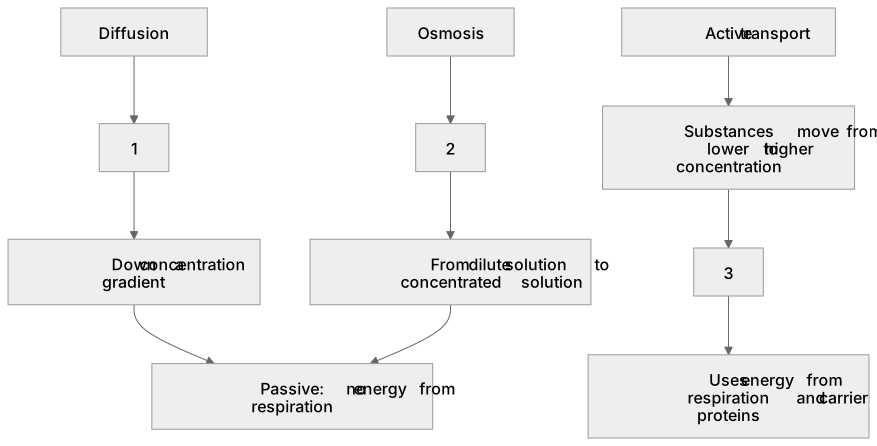
1Box 1
2Box 2
3Box 3
There is more to this lesson
The full lesson goes on to check your understanding and help you earn the marks. Create a free account to carry on, with your progress saved.
A week of Premium from your first lesson · Then the free plan continues · No card, no charge
Test your understanding of Active transport: Students should be able to: • describe how substances are transported into and out of cells by diffusion, osmosis and active transport • explain the differences between the three processes.
Active recall beats re-reading. Take an instant quiz now to test what you’ve learned and lock it into long-term memory.
A week of Premium from your first lesson · Then the free plan continues · No card, no charge