AQA · GCSE · Biology
Course version: 8461 · Version from Sept 2018
Many plants produce seeds sexually, but also reproduce asexually by…
Full specification wording
Advantages and disadvantages of sexual and asexual reproduction (biology only): Many plants produce seeds sexually, but also reproduce asexually by runners such as strawberry plants, or bulb division such as daffodils.
Many plants can reproduce both sexually and asexually.
Checked against the AQA 8461 specification (opens in a new tab) on .
- Point 6 of 8
- 3 key terms
Study notes
From the checked teaching notes for this specification point.
The idea
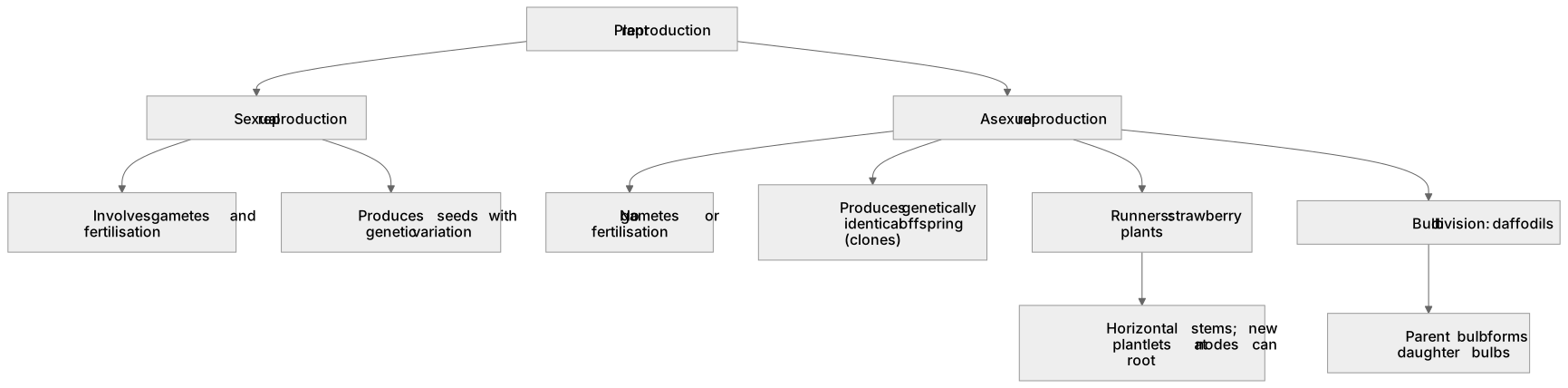
Many plants can reproduce both sexually and asexually. Sexual reproduction involves gametes and fertilisation, producing seeds with genetic variation. Asexual reproduction produces genetically identical offspring (clones) without gametes. Strawberry plants send out horizontal stems called runners; new plantlets grow at nodes and can root to form independent plants. Daffodils reproduce asexually by bulb division: the parent bulb forms smaller daughter bulbs that grow into new plants. These methods let a plant spread rapidly in a favourable spot and survive when pollinators or mates are scarce, but offspring lack variation, so a new disease or environmental change could affect all individuals. Sexual reproduction, by contrast, generates variation that may help some offspring survive changed conditions, though it requires gamete transfer and pollination.
What earns the marks
- Sexual reproduction in plants involves the fusion of male and female gametes, producing seeds that contain genetically varied offspring.
- Asexual reproduction in plants does not involve gametes or fertilisation and produces offspring that are genetically identical to the parent (clones).
- Strawberry plants reproduce asexually by producing runners (horizontal stems) that grow new plantlets at nodes; these can root and become independent plants.
- Daffodils reproduce asexually by bulb division, where the parent bulb forms daughter bulbs that grow into new plants.
- Asexual reproduction gives no genetic variation, so all offspring share the parent's susceptibility to a disease or environmental change.
- Sexual reproduction produces genetic variation, which may help some offspring survive if conditions change, but it depends on pollination and seed dispersal.
Common mistakes and how to put them right
Thinking that asexual reproduction always requires gametes.
Put it right by stating that asexual reproduction produces offspring without gamete fusion, so the offspring are clones.
Confusing runners with roots.
Put it right: Runners are horizontal stems that grow above ground and produce new plantlets, whereas roots normally anchor the plant and absorb water.
Assuming bulb division is sexual because bulbs can grow into new plants.
Put it right by explaining that bulb division is asexual because no gametes fuse and the new bulbs are genetically identical to the parent.
Exam tips
- When asked to compare sexual and asexual reproduction, give one clear similarity and at least two differences, using named plant examples such as strawberry runners and daffodil bulbs.
- Link each reproductive method to an advantage or disadvantage: for example, runners allow rapid spread in a good habitat, but lack of variation means a disease could wipe out the whole clone.
- Use precise terms such as gametes, fertilisation, clone, runner, bulb division and genetic variation; avoid vague words like 'seeds' or 'babies' when describing asexual reproduction.
Try the lesson
The start of the Advantages and disadvantages of sexual and asexual reproduction (biology only): Many plants produce seeds sexually, but also reproduce asexually by runners such as strawberry plants, or bulb division such as daffodils. lesson, made from checked teaching notes for this specification point.
Have a go first
A strawberry plant sends out a runner that grows into a new plant. Which type of reproduction is this?
Listen
Many plants can reproduce both sexually and asexually. Sexual reproduction involves gametes and fertilisation, producing seeds with genetic variation. Asexual reproduction produces genetically identical offspring (clones) without gametes. Strawberry plants send out horizontal stems called runners; new plantlets grow at nodes and can root to form independent plants. Daffodils reproduce asexually by bulb division: the parent bulb forms smaller daughter bulbs that grow into new plants. These methods let a plant spread rapidly in a favourable spot and survive when pollinators or mates are scarce, but offspring lack variation, so a new disease or environmental change could affect all individuals. Sexual reproduction, by contrast, generates variation that may help some offspring survive changed conditions, though it requires gamete transfer and pollination. A strong answer earns marks for these points. Sexual reproduction in plants involves the fusion of male and female gametes, producing seeds that contain genetically varied offspring. Asexual reproduction in plants does not involve gametes or fertilisation and produces offspring that are genetically identical to the parent (clones). Strawberry plants reproduce asexually by producing runners (horizontal stems) that grow new plantlets at nodes; these can root and become independent plants. Daffodils reproduce asexually by bulb division, where the parent bulb forms daughter bulbs that grow into new plants. A common slip: Thinking that asexual reproduction always requires gametes. Instead, stating that asexual reproduction produces offspring without gamete fusion, so the offspring are clones. Exam tip: When asked to compare sexual and asexual reproduction, give one clear similarity and at least two differences, using named plant examples such as strawberry runners and daffodil bulbs.
See it
Key words
Say what each word means before you turn the card.
Asexual reproduction
Try answering aloud or in your head before turning the card.
Runners
Try answering aloud or in your head before turning the card.
Bulb division
Try answering aloud or in your head before turning the card.
See every definition
- Asexual reproduction
- Reproduction that does not involve gametes or fertilisation and produces offspring that are genetically identical to the parent, called clones.
- Runners
- Horizontal stems sent out by strawberry plants, with new plantlets growing at nodes that can root to form independent plants.
- Bulb division
- Asexual reproduction in daffodils where the parent bulb forms smaller daughter bulbs that grow into new plants.
Label the diagram
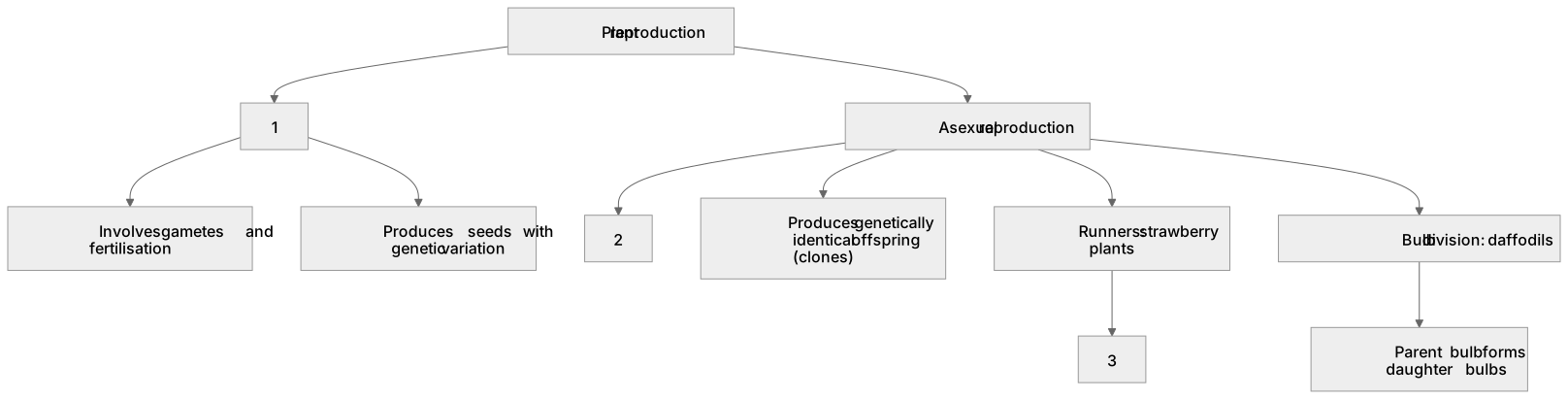
Some boxes have lost their names. Pick the right name for each number.
1Box 1
2Box 2
3Box 3
There is more to this lesson
The full lesson goes on to check your understanding and help you earn the marks. Create a free account to carry on, with your progress saved.
A week of Premium from your first lesson · Then the free plan continues · No card, no charge
Test your understanding of Advantages and disadvantages of sexual and asexual reproduction (biology only): Many plants produce seeds sexually, but also reproduce asexually by runners such as strawberry plants, or bulb division such as daffodils.
Active recall beats re-reading. Take an instant quiz now to test what you’ve learned and lock it into long-term memory.
A week of Premium from your first lesson · Then the free plan continues · No card, no charge