AQA · GCSE · Biology
Course version: 8461 · Version from Sept 2018
Most animal cells have the following parts: • a nucleus • cytoplasm • a…
Full specification wording
Animal and plant cells: Most animal cells have the following parts: • a nucleus • cytoplasm • a cell membrane • mitochondria • ribosomes.
Most animal cells share a common set of parts.
Checked against the AQA 8461 specification (opens in a new tab) on .
- Point 2 of 8
- 4 key terms
Study notes
From the checked teaching notes for this specification point.
The idea
Most animal cells share a common set of parts. The nucleus contains DNA and controls the cell's activities. Cytoplasm is the jelly-like substance where most chemical reactions take place. The cell membrane forms the outer boundary and controls what enters and leaves. Mitochondria are the site of aerobic respiration, releasing energy. Ribosomes are the site of protein synthesis. The word most matters: mature red blood cells, for example, lose their nucleus, and some cells have unusually many mitochondria. When labelling a diagram, place the nucleus centrally, the membrane at the edge, and show mitochondria and ribosomes in the cytoplasm. Learn each part with its job so you can explain, not just list, the structures.
What earns the marks
- The nucleus contains DNA and controls the cell's activities.
- Cytoplasm is where most chemical reactions of the cell take place.
- The cell membrane controls what enters and leaves the cell.
- Mitochondria are the site of aerobic respiration and release energy.
- Ribosomes are the site of protein synthesis.
- The word most shows that some animal cells, such as mature red blood cells, lack a nucleus.
Common mistakes and how to put them right
Listing the parts without their functions.
Put it right by adding a short function for each structure.
Saying all animal cells have a nucleus.
Put it right by noting that most do, but mature red blood cells do not.
Placing ribosomes only on the cell membrane.
Put it right by showing ribosomes in the cytoplasm, where protein synthesis occurs.
Exam tips
- Learn a five-part checklist: nucleus, cytoplasm, membrane, mitochondria, ribosomes.
- When labelling, draw clear lines and keep labels horizontal and outside the cell.
- Add a function next to each label so a describe question becomes an explain answer.
Try the lesson
The start of the Animal and plant cells: Most animal cells have the following parts: • a nucleus • cytoplasm • a cell membrane • mitochondria • ribosomes. lesson, made from checked teaching notes for this specification point.
Have a go first
Which combination of sub-cellular structures is characteristic of most animal cells?
Listen
Most animal cells share a common set of parts. The nucleus contains DNA and controls the cell's activities. Cytoplasm is the jelly-like substance where most chemical reactions take place. The cell membrane forms the outer boundary and controls what enters and leaves. Mitochondria are the site of aerobic respiration, releasing energy. Ribosomes are the site of protein synthesis. The word most matters: mature red blood cells, for example, lose their nucleus, and some cells have unusually many mitochondria. When labelling a diagram, place the nucleus centrally, the membrane at the edge, and show mitochondria and ribosomes in the cytoplasm. Learn each part with its job so you can explain, not just list, the structures. A strong answer earns marks for these points. The nucleus contains DNA and controls the cell's activities. Cytoplasm is where most chemical reactions of the cell take place. The cell membrane controls what enters and leaves the cell. Mitochondria are the site of aerobic respiration and release energy. A common slip: Listing the parts without their functions. Instead, adding a short function for each structure. Exam tip: Learn a five-part checklist: nucleus, cytoplasm, membrane, mitochondria, ribosomes.
See it

Key words
Say what each word means before you turn the card.
Nucleus
Try answering aloud or in your head before turning the card.
Cytoplasm
Try answering aloud or in your head before turning the card.
Cell membrane
Try answering aloud or in your head before turning the card.
Mitochondria
Try answering aloud or in your head before turning the card.
See every definition
- Nucleus
- Contains DNA and controls the cell's activities.
- Cytoplasm
- Jelly-like substance where most chemical reactions take place.
- Cell membrane
- Forms the outer boundary and controls what enters and leaves.
- Mitochondria
- Site of aerobic respiration, releasing energy.
Label the diagram
Some boxes have lost their names. Pick the right name for each number.
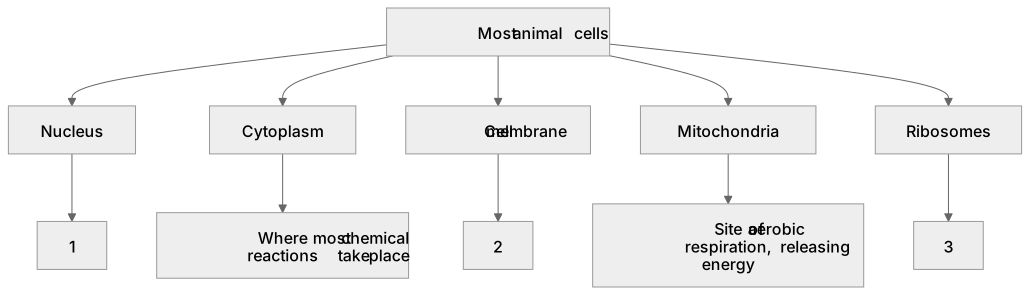
1Box 1
2Box 2
3Box 3
There is more to this lesson
The full lesson goes on to check your understanding and help you earn the marks. Create a free account to carry on, with your progress saved.
A week of Premium from your first lesson · Then the free plan continues · No card, no charge
Test your understanding of Animal and plant cells: Most animal cells have the following parts: • a nucleus • cytoplasm • a cell membrane • mitochondria • ribosomes.
Active recall beats re-reading. Take an instant quiz now to test what you’ve learned and lock it into long-term memory.
A week of Premium from your first lesson · Then the free plan continues · No card, no charge