AQA · GCSE · Biology
Course version: 8461 · Version from Sept 2018
This practical activity also provides opportunities to develop WS and MS.…
Full specification wording
Animal and plant cells: This practical activity also provides opportunities to develop WS and MS. Details of all skills are given in Key opportunities for skills development.
When comparing plant and animal cells under a microscope, the stain used is not a controlled variable because different stains are required to make specific subcellular structures visible.
Checked against the AQA 8461 specification (opens in a new tab) on .
- Point 8 of 8
- 3 key terms
Study notes
From the checked teaching notes for this specification point.
The idea
When comparing plant and animal cells under a microscope, the stain used is not a controlled variable because different stains are required to make specific subcellular structures visible. For example, iodine is used for onion epidermal cells, while methylene blue is used for human cheek cells. This practical develops working scientifically (WS) and mathematical skills (MS). WS includes planning a valid method, preparing slides safely, and recording results accurately. MS includes using standard units, calculating total magnification by multiplying eyepiece and objective lens powers, converting between millimetres and micrometres, and estimating cell size. You demonstrate these skills when you write a method, present observations in a table, and evaluate limitations such as air bubbles.
What earns the marks
- Identifies that stain type is not a controlled variable, as plant and animal cells require different stains (e.g., iodine and methylene blue).
- Plans a logical sequence for preparing and viewing a slide, including safe use of equipment and focusing the microscope.
- Records observations in an appropriate format, such as a biological drawing with clear, continuous lines, labels, and a magnification scale.
- Calculates total magnification using the eyepiece and objective lens powers and converts between millimetres and micrometres correctly.
Common mistakes and how to put them right
Treating stain as a controlled variable when comparing cell types.
Put it right: Recognise different stains are needed for plant and animal cells.
Adding the eyepiece and objective lens powers to find magnification.
Put it right: Multiply the eyepiece power by the objective power.
Ignoring units when recording measurements.
Put it right: State units such as mm or µm consistently and convert correctly.
Exam tips
- Remember that iodine is used for plant cells and methylene blue for animal cells. The stain is a methodological difference, not the independent variable (which is the cell type).
- Show all steps in magnification and unit-conversion calculations so method marks can be awarded even if the final value is wrong.
Try the lesson
The start of the Animal and plant cells: This practical activity also provides opportunities to develop WS and MS. Details of all skills are given in Key opportunities for skills development. lesson, made from checked teaching notes for this specification point.
Have a go first
A student measures the length of a plant cell as 0.08 mm. How should this value be written in standard form?
Listen
When comparing plant and animal cells under a microscope, the stain used is not a controlled variable because different stains are required to make specific subcellular structures visible. For example, iodine is used for onion epidermal cells, while methylene blue is used for human cheek cells. This practical develops working scientifically (WS) and mathematical skills (MS). WS includes planning a valid method, preparing slides safely, and recording results accurately. MS includes using standard units, calculating total magnification by multiplying eyepiece and objective lens powers, converting between millimetres and micrometres, and estimating cell size. You demonstrate these skills when you write a method, present observations in a table, and evaluate limitations such as air bubbles. A strong answer earns marks for these points. Identifies that stain type is not a controlled variable, as plant and animal cells require different stains (e.g., iodine and methylene blue). Plans a logical sequence for preparing and viewing a slide, including safe use of equipment and focusing the microscope. Records observations in an appropriate format, such as a biological drawing with clear, continuous lines, labels, and a magnification scale. Calculates total magnification using the eyepiece and objective lens powers and converts between millimetres and micrometres correctly. A common slip: Treating stain as a controlled variable when comparing cell types. Instead, recognise different stains are needed for plant and animal cells. Exam tip: Remember that iodine is used for plant cells and methylene blue for animal cells. The stain is a methodological difference, not the independent variable (which is the cell type).
See it
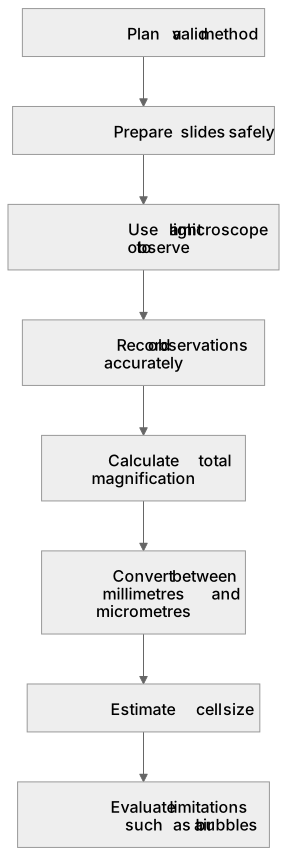
Put it in order
Put these steps in the order they happen.
- 1. Calculate total magnification
- 2. Evaluate limitations such as air bubbles
- 3. Convert between millimetres and micrometres
- 4. Plan a valid method
- 5. Prepare slides safely
- 6. Estimate cell size
- 7. Use a light microscope to observe
- 8. Record observations accurately
Key words
Say what each word means before you turn the card.
total magnification
Try answering aloud or in your head before turning the card.
unit conversion
Try answering aloud or in your head before turning the card.
evaluation
Try answering aloud or in your head before turning the card.
See every definition
- total magnification
- Calculated by multiplying the eyepiece and objective lens powers.
- unit conversion
- Converting between millimetres and micrometres correctly, stating units such as mm or µm consistently.
- evaluation
- Assessing limitations of the practical, such as air bubbles.
Label the diagram
Some boxes have lost their names. Pick the right name for each number.
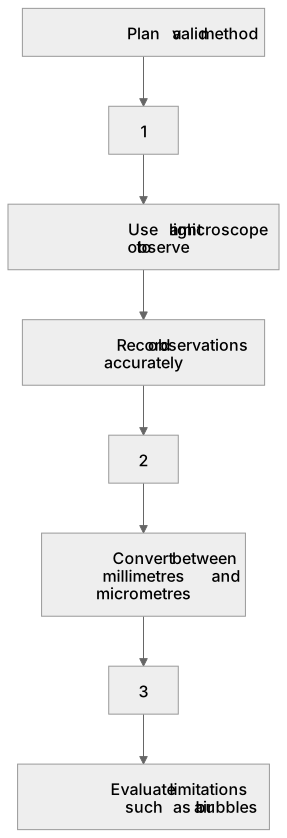
1Box 1
2Box 2
3Box 3
There is more to this lesson
The full lesson goes on to check your understanding and help you earn the marks. Create a free account to carry on, with your progress saved.
A week of Premium from your first lesson · Then the free plan continues · No card, no charge
Test your understanding of Animal and plant cells: This practical activity also provides opportunities to develop WS and MS. Details of all skills are given in Key opportunities for skills development.
Active recall beats re-reading. Take an instant quiz now to test what you’ve learned and lock it into long-term memory.
A week of Premium from your first lesson · Then the free plan continues · No card, no charge