AQA · GCSE · Biology
Course version: 8461 · Version from Sept 2018
However, the emergence of strains resistant to antibiotics is of great…
Full specification wording
Antibiotics and painkillers: However, the emergence of strains resistant to antibiotics is of great concern.
Antibiotic resistance arises when random mutations in bacterial DNA give some bacteria an advantage against an antibiotic.
Checked against the AQA 8461 specification (opens in a new tab) on .
- Point 5 of 8
- 4 key terms
Study notes
From the checked teaching notes for this specification point.
The idea
Antibiotic resistance arises when random mutations in bacterial DNA give some bacteria an advantage against an antibiotic. These bacteria survive, reproduce rapidly by binary fission, and pass the resistance allele to their offspring, so the resistant strain becomes more common. Resistance can also spread between bacteria by horizontal gene transfer. This is of great concern because infections caused by resistant strains, such as MRSA, may not respond to commonly used antibiotics, leading to longer illness, higher risk of death and fewer effective treatments. Overuse and inappropriate prescribing of antibiotics increase the chance of resistance evolving. Doctors reduce the problem by prescribing antibiotics only when needed, and patients should complete the course so all bacteria are killed.
What earns the marks
- Random mutation in bacterial DNA can produce a gene that gives resistance to an antibiotic.
- In the presence of the antibiotic, resistant bacteria survive and reproduce, so the resistant strain becomes more common.
- Bacteria reproduce rapidly by binary fission, so a resistant population can build up quickly.
- Resistance genes can be passed to other bacteria, spreading resistance between strains or species.
- Resistant infections such as MRSA may not respond to commonly used antibiotics, increasing the risk of serious illness or death.
- Overuse and inappropriate use of antibiotics increase the rate at which resistance emerges.
Common mistakes and how to put them right
Saying bacteria become resistant because they need to survive.
Put it right by stating that resistance arises from random mutation, and the antibiotic selects the resistant bacteria.
Thinking resistance develops in the patient's body cells.
Put it right by explaining that resistance is a feature of the bacterial population.
Believing a stronger antibiotic can always be used.
Put it right by noting that some strains are resistant to many antibiotics, so treatment options can run out.
Exam tips
- Use the words mutation, selection and reproduction to describe the evolution of a resistant strain.
- Refer to a named resistant bacterium such as MRSA to make the concern concrete.
- Explain the concern in terms of treatment failure and risk of death, not just that resistance exists.
Try the lesson
The start of the Antibiotics and painkillers: However, the emergence of strains resistant to antibiotics is of great concern. lesson, made from checked teaching notes for this specification point.
Have a go first
What is meant by a strain of bacteria that is resistant to an antibiotic?
Listen
Antibiotic resistance arises when random mutations in bacterial DNA give some bacteria an advantage against an antibiotic. These bacteria survive, reproduce rapidly by binary fission, and pass the resistance allele to their offspring, so the resistant strain becomes more common. Resistance can also spread between bacteria by horizontal gene transfer. This is of great concern because infections caused by resistant strains, such as MRSA, may not respond to commonly used antibiotics, leading to longer illness, higher risk of death and fewer effective treatments. Overuse and inappropriate prescribing of antibiotics increase the chance of resistance evolving. Doctors reduce the problem by prescribing antibiotics only when needed, and patients should complete the course so all bacteria are killed. A strong answer earns marks for these points. Random mutation in bacterial DNA can produce a gene that gives resistance to an antibiotic. In the presence of the antibiotic, resistant bacteria survive and reproduce, so the resistant strain becomes more common. Bacteria reproduce rapidly by binary fission, so a resistant population can build up quickly. Resistance genes can be passed to other bacteria, spreading resistance between strains or species. A common slip: Saying bacteria become resistant because they need to survive. Instead, stating that resistance arises from random mutation, and the antibiotic selects the resistant bacteria. Exam tip: Use the words mutation, selection and reproduction to describe the evolution of a resistant strain.
See it
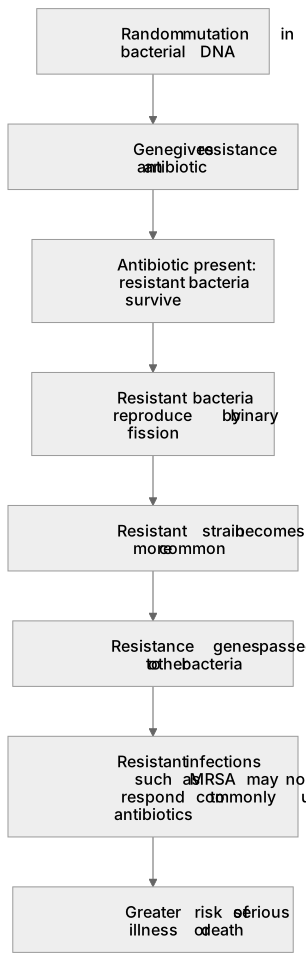
Put it in order
Put these steps in the order they happen.
- 1. Resistant strain becomes more common
- 2. Greater risk of serious illness or death
- 3. Resistance genes passed to other bacteria
- 4. Random mutation in bacterial DNA
- 5. Gene gives resistance to an antibiotic
- 6. Resistant infections such as MRSA may not respond to commonly used antibiotics
- 7. Antibiotic present: resistant bacteria survive
- 8. Resistant bacteria reproduce by binary fission
Key words
Say what each word means before you turn the card.
Antibiotic resistance
Try answering aloud or in your head before turning the card.
Binary fission
Try answering aloud or in your head before turning the card.
Horizontal gene transfer
Try answering aloud or in your head before turning the card.
MRSA
Try answering aloud or in your head before turning the card.
See every definition
- Antibiotic resistance
- Arises when random mutations in bacterial DNA give some bacteria an advantage against an antibiotic, so the resistant strain becomes more common.
- Binary fission
- The process by which bacteria reproduce rapidly, so a resistant population can build up quickly.
- Horizontal gene transfer
- The way resistance can spread between bacteria, passing resistance genes to other strains or species.
- MRSA
- A resistant strain whose infections may not respond to commonly used antibiotics, increasing the risk of serious illness or death.
Label the diagram
Some boxes have lost their names. Pick the right name for each number.
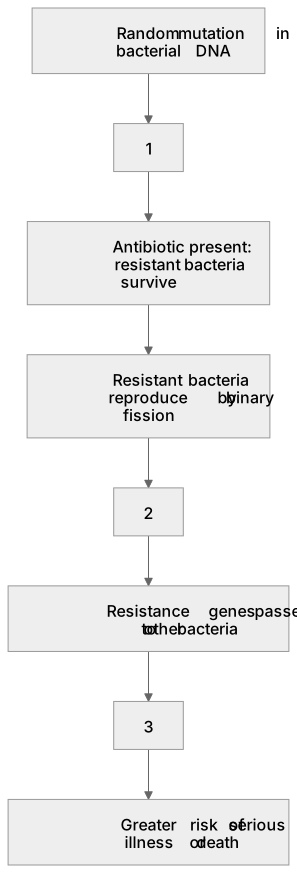
1Box 1
2Box 2
3Box 3
There is more to this lesson
The full lesson goes on to check your understanding and help you earn the marks. Create a free account to carry on, with your progress saved.
A week of Premium from your first lesson · Then the free plan continues · No card, no charge
Test your understanding of Antibiotics and painkillers: However, the emergence of strains resistant to antibiotics is of great concern.
Active recall beats re-reading. Take an instant quiz now to test what you’ve learned and lock it into long-term memory.
A week of Premium from your first lesson · Then the free plan continues · No card, no charge