AQA · GCSE · Biology
Course version: 8461 · Version from Sept 2018
Bacterial diseases: Gonorrhoea is spread by sexual contact.
Gonorrhoea is a communicable disease caused by the bacterium Neisseria gonorrhoeae.
Checked against the AQA 8461 specification (opens in a new tab) on .
- Point 6 of 7
Study notes
From the checked teaching notes for this specification point.
The idea
Gonorrhoea is a communicable disease caused by the bacterium Neisseria gonorrhoeae. It is transmitted when mucous membranes or body fluids from an infected person contact those of an uninfected person during sexual activity, including vaginal, anal and oral sex. The bacterium cannot survive long outside the body, so direct sexual contact is the main route. It does not spread by casual contact such as sharing cups or touching surfaces. Many infected people, especially women, show no symptoms, so they can pass it on unknowingly. Symptoms, when present, include a thick yellow or green discharge from the penis or vagina and a burning sensation when urinating. A concrete example is an uninfected person having unprotected sex with an infected partner; the bacteria transfer to the uninfected person's urethra or cervix and multiply there.
What earns the marks
- Gonorrhoea is caused by a bacterium, not a virus or fungus.
- Transmission occurs through sexual contact, including vaginal, anal and oral sex.
- The pathogen is passed from an infected person to an uninfected person during sexual activity.
- Asymptomatic carriers can transmit the infection without knowing they are infected.
Common mistakes and how to put them right
Thinking gonorrhoea is caused by a virus.
Put it right: It is caused by the bacterium Neisseria gonorrhoeae.
Believing it can be caught from toilet seats or shared towels.
Put it right: It is spread by sexual contact, not by casual contact.
Assuming a person must have symptoms to pass it on; the correction is that asymptomatic people can still transmit the infection.
Exam tips
- State the pathogen type clearly: gonorrhoea is bacterial, so antibiotics can treat it.
- Use the phrase 'sexual contact' rather than vague terms like 'contact' when describing transmission.
- Link the mode of transmission to control measures: because it spreads sexually, barrier contraception reduces risk.
Try the lesson
The start of the Bacterial diseases: Gonorrhoea is spread by sexual contact. lesson, made from checked teaching notes for this specification point.
Have a go first
Which statement describes how the bacterium that causes gonorrhoea passes from one person to another?
Listen
Gonorrhoea is a communicable disease caused by the bacterium Neisseria gonorrhoeae. It is transmitted when mucous membranes or body fluids from an infected person contact those of an uninfected person during sexual activity, including vaginal, anal and oral sex. The bacterium cannot survive long outside the body, so direct sexual contact is the main route. It does not spread by casual contact such as sharing cups or touching surfaces. Many infected people, especially women, show no symptoms, so they can pass it on unknowingly. Symptoms, when present, include a thick yellow or green discharge from the penis or vagina and a burning sensation when urinating. A concrete example is an uninfected person having unprotected sex with an infected partner; the bacteria transfer to the uninfected person's urethra or cervix and multiply there. A strong answer earns marks for these points. Gonorrhoea is caused by a bacterium, not a virus or fungus. Transmission occurs through sexual contact, including vaginal, anal and oral sex. The pathogen is passed from an infected person to an uninfected person during sexual activity. Asymptomatic carriers can transmit the infection without knowing they are infected. A common slip: Thinking gonorrhoea is caused by a virus. Instead, it is caused by the bacterium Neisseria gonorrhoeae. Exam tip: State the pathogen type clearly: gonorrhoea is bacterial, so antibiotics can treat it.
See it
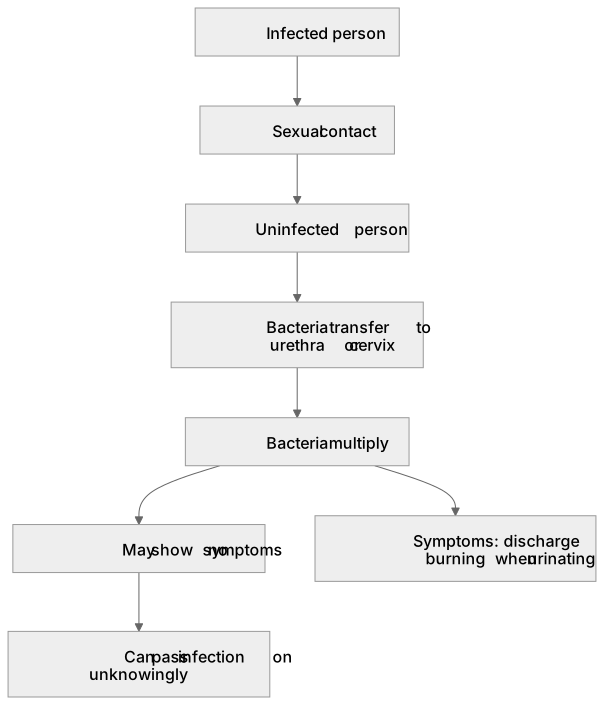
Label the diagram
Some boxes have lost their names. Pick the right name for each number.

1Box 1
2Box 2
3Box 3
There is more to this lesson
The full lesson goes on to check your understanding and help you earn the marks. Create a free account to carry on, with your progress saved.
A week of Premium from your first lesson · Then the free plan continues · No card, no charge
Test your understanding of Bacterial diseases: Gonorrhoea is spread by sexual contact.
Active recall beats re-reading. Take an instant quiz now to test what you’ve learned and lock it into long-term memory.
A week of Premium from your first lesson · Then the free plan continues · No card, no charge