AQA · GCSE · Biology
Course version: 8461 · Version from Sept 2018
Students should be able to recognise different types of blood cells in a…
Full specification wording
Blood: Students should be able to recognise different types of blood cells in a photograph or diagram, and explain how they are adapted to their functions.
In a photograph or diagram, red blood cells appear as numerous biconcave discs, often stained pink, with no nucleus visible.
Checked against the AQA 8461 specification (opens in a new tab) on .
- Point 3 of 3
- 4 key terms
Study notes
From the checked teaching notes for this specification point.
The idea
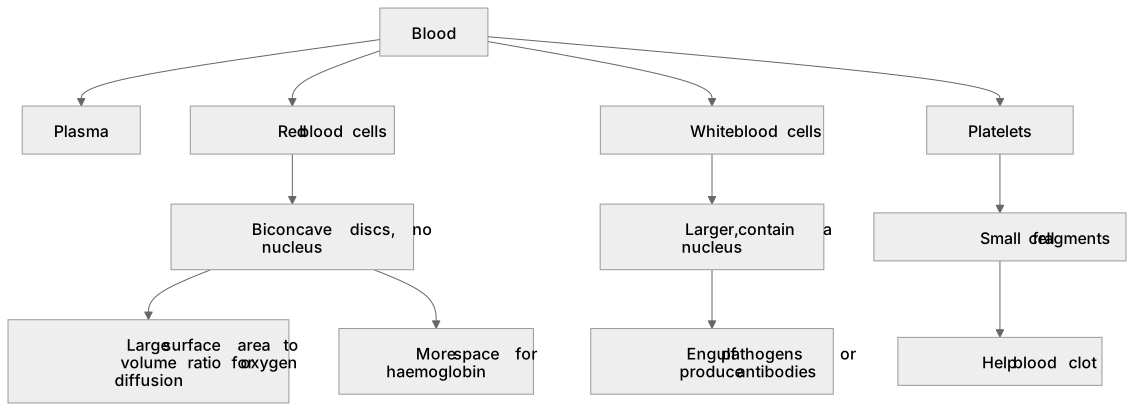
In a photograph or diagram, red blood cells appear as numerous biconcave discs, often stained pink, with no nucleus visible. Their biconcave shape gives a large surface area to volume ratio for oxygen diffusion, and the absence of a nucleus leaves more space for haemoglobin. White blood cells are fewer, larger and have a nucleus, often with a lobed or granular appearance; this supports their role in engulfing pathogens or producing antibodies. Platelets appear as small fragments, much smaller than red cells, and help clotting. Plasma is the liquid background in which the cells are suspended. To recognise cells, compare size, shape, nucleus presence and relative number. To explain adaptations, link each visible feature to its function, such as biconcavity to rapid oxygen uptake and release.
What earns the marks
- Red blood cells are biconcave discs without a nucleus, giving a large surface area to volume ratio and more room for haemoglobin.
- White blood cells are larger than red cells and contain a nucleus, which supports defence functions such as engulfing pathogens or producing antibodies.
- Platelets are small cell fragments that help blood clot, reducing blood loss and infection risk.
- Plasma is the liquid part of blood that transports dissolved substances and cells.
- Recognition should use size, shape, nucleus presence and relative number of each cell type.
Common mistakes and how to put them right
Identifying any large cell with a nucleus as a red blood cell.
Put it right by remembering that mature red blood cells lack a nucleus.
Thinking platelets are full cells.
Put it right by describing them as cell fragments involved in clotting.
Ignoring the biconcave shape when explaining oxygen transport.
Put it right by linking the shape to a large surface area for diffusion.
Exam tips
- Compare cells using size, shape, nucleus and number before naming them.
- For adaptation questions, state the feature and then explain the advantage it gives, for example biconcave shape gives a large surface area for oxygen diffusion.
- Use the diagram labels or scale bar to support your identification rather than guessing from colour alone.
Try the lesson
The start of the Blood: Students should be able to recognise different types of blood cells in a photograph or diagram, and explain how they are adapted to their functions. lesson, made from checked teaching notes for this specification point.
Have a go first
When viewing a photograph of a blood smear, how can a red blood cell be recognised and how does this feature adapt it to its function?
Listen
In a photograph or diagram, red blood cells appear as numerous biconcave discs, often stained pink, with no nucleus visible. Their biconcave shape gives a large surface area to volume ratio for oxygen diffusion, and the absence of a nucleus leaves more space for haemoglobin. White blood cells are fewer, larger and have a nucleus, often with a lobed or granular appearance; this supports their role in engulfing pathogens or producing antibodies. Platelets appear as small fragments, much smaller than red cells, and help clotting. Plasma is the liquid background in which the cells are suspended. To recognise cells, compare size, shape, nucleus presence and relative number. To explain adaptations, link each visible feature to its function, such as biconcavity to rapid oxygen uptake and release. A strong answer earns marks for these points. Red blood cells are biconcave discs without a nucleus, giving a large surface area to volume ratio and more room for haemoglobin. White blood cells are larger than red cells and contain a nucleus, which supports defence functions such as engulfing pathogens or producing antibodies. Platelets are small cell fragments that help blood clot, reducing blood loss and infection risk. Plasma is the liquid part of blood that transports dissolved substances and cells. A common slip: Identifying any large cell with a nucleus as a red blood cell. Instead, remembering that mature red blood cells lack a nucleus. Exam tip: Compare cells using size, shape, nucleus and number before naming them.
See it
Key words
Say what each word means before you turn the card.
Surface area to volume ratio
Try answering aloud or in your head before turning the card.
Oxygen transport
Try answering aloud or in your head before turning the card.
Defence and clotting
Try answering aloud or in your head before turning the card.
Plasma
Try answering aloud or in your head before turning the card.
See every definition
- Surface area to volume ratio
- The biconcave shape of red blood cells gives a large surface area to volume ratio for oxygen diffusion.
- Oxygen transport
- Red blood cells are adapted for oxygen transport because their biconcave shape gives a large surface area for diffusion and the absence of a nucleus leaves more space for haemoglobin.
- Defence and clotting
- White blood cells contain a nucleus, which supports defence functions such as engulfing pathogens or producing antibodies, while platelets are small cell fragments that help blood clot.
- Plasma
- The liquid background in which the cells are suspended, transporting dissolved substances and cells.
Label the diagram
Some boxes have lost their names. Pick the right name for each number.
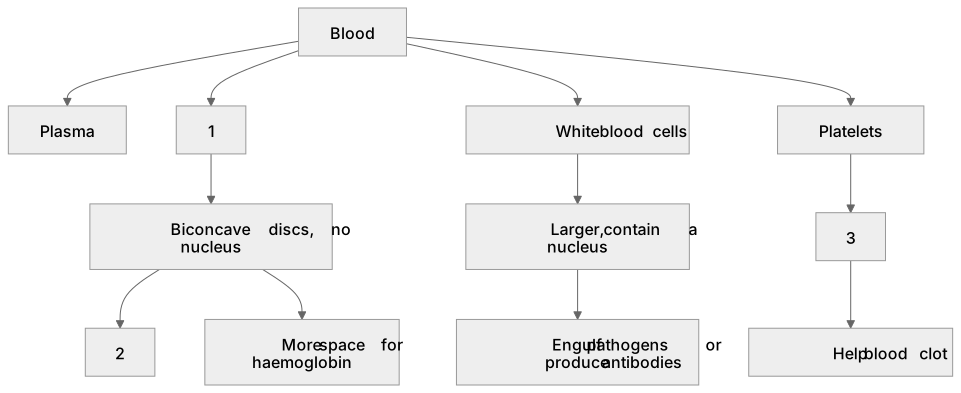
1Box 1
2Box 2
3Box 3
There is more to this lesson
The full lesson goes on to check your understanding and help you earn the marks. Create a free account to carry on, with your progress saved.
A week of Premium from your first lesson · Then the free plan continues · No card, no charge
Test your understanding of Blood: Students should be able to recognise different types of blood cells in a photograph or diagram, and explain how they are adapted to their functions.
Active recall beats re-reading. Take an instant quiz now to test what you’ve learned and lock it into long-term memory.
A week of Premium from your first lesson · Then the free plan continues · No card, no charge