AQA · GCSE · Biology
Course version: 8461 · Version from Sept 2018
Plants produce hormones to coordinate and control growth and responses to…
Full specification wording
Control and coordination: Plants produce hormones to coordinate and control growth and responses to light (phototropism) and gravity (gravitropism or geotropism).
Plants coordinate growth and respond to stimuli like light and gravity using hormones.
Checked against the AQA 8461 specification (opens in a new tab) on .
- Point 1 of 7
- 4 key terms
Study notes
From the checked teaching notes for this specification point.
The idea
Plants coordinate growth and respond to stimuli like light and gravity using hormones. Auxin is a key hormone that controls these directional growth responses, known as tropisms. Unequal distribution of auxin causes unequal growth rates. In shoots, auxin accumulates on the shaded or lower side, stimulating cell elongation. This causes the shoot to bend towards light (positive phototropism) or grow upwards (negative gravitropism). Conversely, in roots, auxin accumulates on the lower side but inhibits cell elongation. This causes the root to bend downwards (positive gravitropism), anchoring the plant and securing water and minerals.
What earns the marks
- Auxin stimulates cell elongation in shoots but inhibits cell elongation in roots.
- A tropism is a directional growth response to a stimulus such as light or gravity.
- In shoots, auxin accumulates on the shaded side, promoting elongation towards light.
- In roots, auxin accumulates on the lower side, inhibiting elongation to grow downwards.
Common mistakes and how to put them right
Saying auxin always promotes elongation.
Put it right: It inhibits elongation in roots.
Confusing positive and negative tropisms.
Put it right: Positive means growth towards the stimulus.
Stating roots grow towards light.
Put it right: Roots are positively gravitropic and grow downwards.
Exam tips
- Explicitly distinguish auxin's effect in shoots (promotes elongation) versus roots (inhibits elongation).
- Define phototropism and gravitropism clearly before explaining the hormonal mechanism.
Try the lesson
The start of the Control and coordination: Plants produce hormones to coordinate and control growth and responses to light (phototropism) and gravity (gravitropism or geotropism). lesson, made from checked teaching notes for this specification point.
Have a go first
Which statement best describes why plants produce hormones?
Listen
Plants coordinate growth and respond to stimuli like light and gravity using hormones. Auxin is a key hormone that controls these directional growth responses, known as tropisms. Unequal distribution of auxin causes unequal growth rates. In shoots, auxin accumulates on the shaded or lower side, stimulating cell elongation. This causes the shoot to bend towards light (positive phototropism) or grow upwards (negative gravitropism). Conversely, in roots, auxin accumulates on the lower side but inhibits cell elongation. This causes the root to bend downwards (positive gravitropism), anchoring the plant and securing water and minerals. A strong answer earns marks for these points. Auxin stimulates cell elongation in shoots but inhibits cell elongation in roots. A tropism is a directional growth response to a stimulus such as light or gravity. In shoots, auxin accumulates on the shaded side, promoting elongation towards light. In roots, auxin accumulates on the lower side, inhibiting elongation to grow downwards. A common slip: Saying auxin always promotes elongation. Instead, it inhibits elongation in roots. Exam tip: Explicitly distinguish auxin's effect in shoots (promotes elongation) versus roots (inhibits elongation).
See it
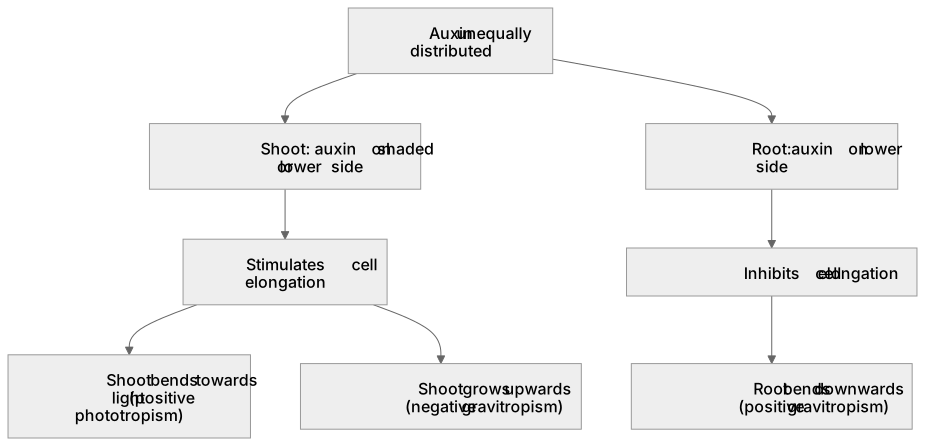
Key words
Say what each word means before you turn the card.
Tropisms
Try answering aloud or in your head before turning the card.
Auxin mechanisms
Try answering aloud or in your head before turning the card.
Phototropism
Try answering aloud or in your head before turning the card.
Gravitropism
Try answering aloud or in your head before turning the card.
See every definition
- Tropisms
- Directional growth responses to a stimulus such as light or gravity.
- Auxin mechanisms
- Unequal distribution of auxin causes unequal growth rates, stimulating cell elongation in shoots but inhibiting it in roots.
- Phototropism
- A directional growth response to light, in which auxin accumulates on the shaded side of shoots and promotes elongation towards light.
- Gravitropism
- A directional growth response to gravity, in which auxin accumulates on the lower side, promoting upward growth in shoots and downward growth in roots.
Label the diagram
Some boxes have lost their names. Pick the right name for each number.
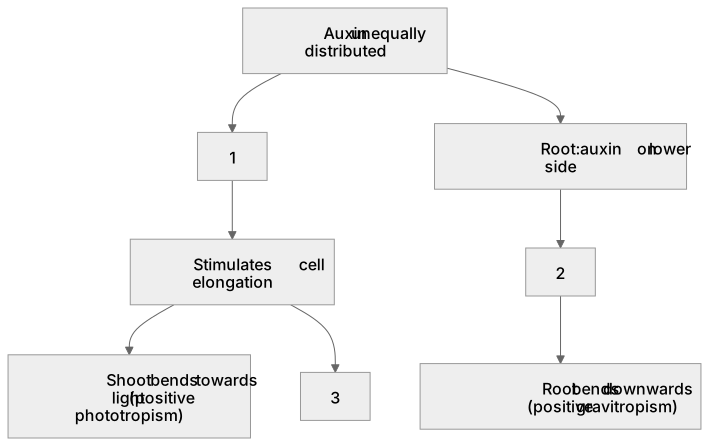
1Box 1
2Box 2
3Box 3
There is more to this lesson
The full lesson goes on to check your understanding and help you earn the marks. Create a free account to carry on, with your progress saved.
A week of Premium from your first lesson · Then the free plan continues · No card, no charge
Test your understanding of Control and coordination: Plants produce hormones to coordinate and control growth and responses to light (phototropism) and gravity (gravitropism or geotropism).
Active recall beats re-reading. Take an instant quiz now to test what you’ve learned and lock it into long-term memory.
A week of Premium from your first lesson · Then the free plan continues · No card, no charge